|
Key Insights
|
Details
|
|
Forecast Period
|
2027-2031
|
|
Market Size (2025)
|
USD 134.56 Million
|
|
CAGR (2026-2031)
|
6.21%
|
|
Fastest Growing Segment
|
Transmission General Repair
|
|
Largest Market
|
Southern Vietnam
|
|
Market Size (2031)
|
USD 193.16 Million
|
Market Overview
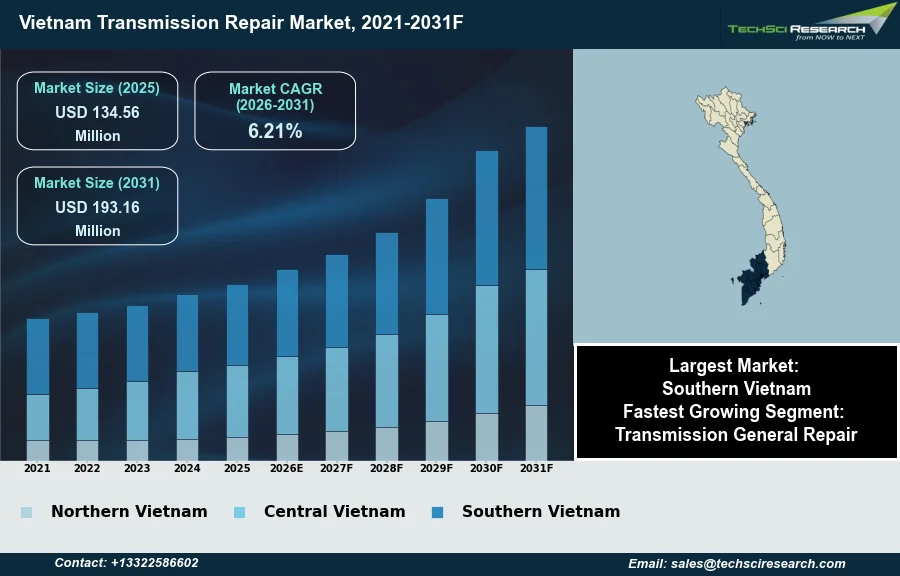
The Vietnam Transmission Repair Market will grow from USD 134.56 Million in 2025 to USD 193.16 Million by 2031 at a 6.21% CAGR. Transmission repair encompasses the diagnosis, servicing, and restoration of a vehicle's transmission system, including both manual and automatic powertrains, to ensure optimal functionality and extend operational life. Key drivers supporting market growth include the expanding vehicle parc in Vietnam and the increasing average age of vehicles in operation, which inherently escalate the demand for component maintenance and replacement. Furthermore, sustained economic growth and rising disposable incomes empower vehicle owners to invest in necessary repairs. According to the Vietnam Automobile Manufacturers' Association (VAMA), in 2025, its members sold 375,736 vehicles, marking a 10.5% increase from the prior year, contributing to the growing population of vehicles requiring maintenance.
A significant challenge that could impede market expansion is the ongoing shortage of adequately skilled technicians proficient in servicing increasingly complex and technologically advanced transmission systems. This necessitates substantial and continuous investment in specialized training programs and diagnostic equipment to ensure service quality and meet evolving industry demands.
Key Market Drivers
Aging Fleet Drives Transmission Repair Demand
The aging vehicle fleet represents a primary growth impetus for the Vietnam Transmission Repair Market, as older vehicles inherently require more frequent maintenance and component replacements, particularly for complex systems like transmissions. As vehicles accumulate mileage and years in operation, wear and tear on components increase, leading to a higher incidence of failures and the necessity for professional repair services to ensure continued functionality and safety. This trend is significant given the substantial number of vehicles already in circulation. For instance, according to Automotive Logistics, in its October 2025 coverage, Toyota was supporting 20 million vehicles in Vietnam with aftermarket services, indicating a large installed base that will progressively demand more extensive repairs as it ages.
Automatic Transmissions and Hybrid Powertrains Expand Repair Needs
The growing prevalence of automatic transmissions also significantly influences the transmission repair sector. These systems, including continuously variable transmissions and dual-clutch transmissions, are often more intricate than manual counterparts, requiring specialized diagnostic tools and technician expertise for effective servicing and repair. The shift towards more technologically advanced powertrains, such as hybrids, contributes to this complexity. According to VietNamNet, in its February 2026 report, hybrid models recorded sales of 14,171 units, reflecting a 44 percent year-on-year increase, signaling a rising adoption of vehicles with these complex transmission types. Overall, the broader automotive market in Vietnam continues its expansion, with over 600,000 cars sold nationwide in 2025, according to VietNamNet in February 2026, further augmenting the long-term demand for transmission repair services.
Download Free Sample Report
Key Market Challenges
Technician Shortage Constrains Transmission Repair Capacity
The Vietnam Transmission Repair Market faces a significant impediment due to the ongoing shortage of adequately skilled technicians. This deficiency directly hampers the industry's capacity to diagnose, service, and restore increasingly complex and technologically advanced transmission systems. As the overall vehicle population in Vietnam expands, the demand for specialized transmission repair services escalates. However, the limited availability of professionals proficient in these intricate systems means that a substantial portion of this growing demand remains unfulfilled, potentially leading to prolonged service times and compromised repair quality across the market.
Rising Vehicle Sales Elevate Maintenance Demand Amid Technician Shortage
This constraint directly impacts the operational efficiency and growth potential of automotive repair facilities across the nation. According to a compilation of figures from the Vietnam Automobile Manufacturers' Association (VAMA), Hyundai Thanh Cong Vietnam (HTCV), and local automaker VinFast, total automobile sales in 2025 reached approximately 540,000 units, marking a substantial increase from the prior year. This rapid expansion of the vehicle parc creates a corresponding surge in the need for maintenance and repair, including specialized transmission work. Consequently, the existing scarcity of qualified technicians impedes the market's ability to effectively serve this expanding demand, thereby restricting overall market growth and service quality.
Key Market Trends
Commercial Fleets and Ride-Hailing Drive Transmission Repair Demand
Growing demand from commercial fleets and ride-hailing services represents a significant trend impacting the Vietnam Transmission Repair Market. The expansion of these operational segments directly escalates the mileage accumulation and wear on vehicle transmissions, necessitating more frequent and robust repair services. Unlike general consumer vehicles, commercial and ride-hailing vehicles often operate under more strenuous conditions and for longer hours, accelerating the need for transmission maintenance and overhaul. According to the Vietnam News Agency, June 2026, citing the Vietnam Automobile Manufacturers' Association, commercial vehicle sales rose 32 percent to 50,270 units in the first five months of 2026. This sustained growth in commercial vehicle adoption underpins a consistent and increasing demand base for specialized transmission repair work, driven by operational requirements and fleet maintenance schedules.
Local Sourcing Expands Transmission Component Availability
The local sourcing and manufacturing of transmission components is another influential trend shaping the market. This shift towards domestic production aims to reduce reliance on imported parts, potentially leading to improved availability, reduced lead times, and more competitive pricing for repair facilities. The development of a robust local supply chain can foster greater market stability and enable quicker access to necessary components for complex transmission systems. According to The Star, September 2025, in its article 'Auto parts sector moves into fast lane', Vietnam had 858 enterprises and manufacturing facilities certified to the International Automotive Task Force (IATF) standards as of May 20, 2025, representing a 22-fold increase from 18 months prior. This surge in certified manufacturing capabilities indicates a maturing domestic ecosystem capable of supporting advanced automotive component production, which includes essential transmission parts.
Segmental Insights
Growth of Transmission General Repair Driven by Vehicle-Fleet Expansion and Aging Vehicles
The Vietnam Transmission Repair Market is experiencing substantial expansion, with Transmission General Repair emerging as a pivotal segment. This robust growth is primarily propelled by the nation's increasing vehicle ownership and an expanding middle class, leading to a larger operational vehicle fleet. Concurrently, the aging demographic of vehicles on the roads necessitates more frequent transmission maintenance due to natural wear and tear. The rising prevalence of technically complex automatic transmissions, replacing simpler manual systems in modern vehicles, further drives demand for specialized general repair services, emphasizing the segment's significant market activity.
Regional Insights
Southern Vietnam Leads Transmission Repair Demand Through Economic Growth and Vehicle Use
Southern Vietnam leads the Vietnam Transmission Repair Market due to its robust economic development and significant industrialization, particularly in key provinces surrounding Ho Chi Minh City. This region's strong industrial and logistics sectors contribute to high utilization rates for commercial and passenger vehicles, directly accelerating wear on mechanical systems such as transmissions. The elevated concentration of vehicles and intense operational demands in this economic hub naturally drive a greater need for specialized transmission repair services. Furthermore, the Vietnamese government's consistent focus on automotive industry growth, overseen by bodies like the Ministry of Transport, further underpins the demand for a comprehensive vehicle aftermarket, solidifying Southern Vietnam's market dominance.
Recent Developments
-
In August 2025, the rapid adoption of electric vehicles (EVs) in Vietnam highlighted a significant disparity in the country's repair infrastructure. Most existing repair workshops remained oriented towards internal combustion engine vehicles, with only a limited number in major cities beginning to offer EV-related services. Original Equipment Manufacturer (OEM) service networks, particularly VinFast, dominated the EV aftersales landscape, underscoring a critical need for independent garages in the Vietnam Transmission Repair Market to adapt and invest in new technologies and training for electric drivetrain systems.
-
In September 2024, Tasco Joint Stock Company and Geely Auto Group formed a joint venture to establish an automobile manufacturing and assembly plant in Vietnam. This facility is slated to produce vehicles incorporating modern automatic transmissions, which is anticipated to directly influence the local demand for specialized transmission servicing expertise. The joint venture aims to not only cater to the domestic market but also to export, signifying a growing confidence in Vietnam's automotive sector and its potential for advanced mechanical system maintenance and repair capabilities.
-
In September 2024, Hangzhou EED TRANSMISSION Co., Ltd. showcased several newly developed high-performance transmission equipment pieces at the Vietnam International Industry Machinery Fair (VIIF). These innovative products were highlighted for their enhanced efficiency and precision in industrial manufacturing applications. The introduction of such advanced transmission equipment into the Vietnamese market indicates an evolving demand for sophisticated industrial gearbox solutions and will necessitate a corresponding advancement in specialized repair services and technical expertise to maintain these complex systems within the Vietnam Transmission Repair Market.
-
In May 2024, Xiasha announced plans for a new automotive gears manufacturing facility in Vietnam, intended to bolster the regional supply chain for vehicle components. This strategic move aims to diminish reliance on imported parts and enhance the stability of component availability for transmission repairs and manufacturing within the Vietnamese automotive sector. The establishment of this plant is expected to significantly support the growing domestic automotive industry by localizing critical gear system production, thereby influencing the future landscape for transmission maintenance and overhaul services.
Key Market Players
- ZF Friedrichshafen AG
- Allison Transmission
- BorgWarner Inc.
- Continental AG
- Schaeffler Technologies
- AAMCO Transmissions
- Cottman Transmission and Total Auto Care
- Lee Myles Autocare & Transmission
- Firestone Complete Auto Care
- Mister Transmission
|
By Vehicle
|
By Repair
|
By Component
|
By Region
|
- Passenger Cars
- Light Commercial Vehicles and Heavy Commercial Vehicles
|
- Transmission General Repair (TGRM) and Transmission Overhaul (TOM)
|
- Gasket & Seal
- Transmission Filter
- O-Ring
- Fluid
- Flywheel
- Pressure Plate
- Oil Pump and Others
|
- Northern
- Central
- Southern
|
Report Scope:
In this report, the Vietnam Transmission Repair Market has been segmented into the following categories, in addition to the industry trends which have also been detailed below:
-
Vietnam Transmission Repair Market, By Vehicle:
-
Passenger Cars
-
Light Commercial Vehicles and Heavy Commercial Vehicles
-
Vietnam Transmission Repair Market, By Repair:
-
Transmission General Repair (TGRM) and Transmission Overhaul (TOM)
-
Vietnam Transmission Repair Market, By Component:
-
Gasket & Seal
-
Transmission Filter
-
O-Ring
-
Fluid
-
Flywheel
-
Pressure Plate
-
Oil Pump and Others
-
Vietnam Transmission Repair Market, By Region:
-
Northern
-
Central
-
Southern
Competitive Landscape
Company Profiles: Detailed analysis of the major companies present in the Vietnam Transmission Repair Market.
Available Customizations:
Vietnam Transmission Repair Market report with the given market data, TechSci Research offers customizations according to a company's specific needs. The following customization options are available for the report:
Company Information
- Detailed analysis and profiling of additional market players (up to five).
Vietnam Transmission Repair Market is an upcoming report to be released soon. If you wish an early delivery of this report or want to confirm the date of release, please contact us at sales@techsciresearch.com