|
Forecast Period
|
2026-2030
|
|
Market Size (2024)
|
USD 4.24 Billion
|
|
CAGR (2025-2030)
|
7.8%
|
|
Fastest Growing
Segment
|
Replacement
|
|
Largest Market
|
Dubai
|
|
Market Size (2030)
|
USD 6.67 Billion
|
Market Overview
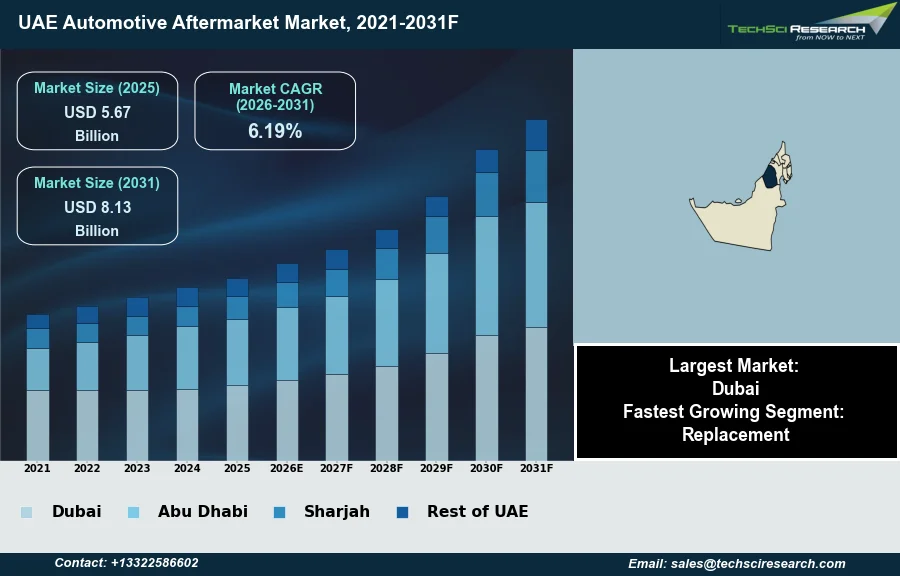
UAE automotive aftermarket market was
valued at USD 4.24 Billion in 2024 and is expected to reach USD 6.67 Billion by
2030 with a CAGR of 7.8% during the forecast period. The UAE
automotive aftermarket is witnessing robust growth, driven by a confluence of
economic development, rising vehicle parc, increasing average vehicle age, and
a growing preference for vehicle customization and maintenance services. As one
of the most car-centric nations in the GCC, the UAE benefits from a high per
capita vehicle ownership, particularly in urban centers like Dubai and Abu
Dhabi, where consumers prioritize both performance and aesthetics in their
vehicles. The market is further fueled by the country’s extreme climatic
conditions, which accelerate wear and tear on vehicle components such as tires,
batteries, and filters, thereby boosting demand for frequent replacements and
servicing. Government initiatives supporting smart mobility, road safety, and
sustainability are also contributing to increased vehicle inspections and
maintenance compliance, thereby stimulating the aftermarket. Moreover, the
UAE's strategic positioning as a trade hub encourages parallel imports and
re-exports of aftermarket parts, enabling wide availability and competitive
pricing. The rising adoption of electric and hybrid vehicles is prompting a
gradual shift in aftermarket services, with growing investments in EV-specific
spare parts and diagnostic tools. Digitization trends, including the
proliferation of e-commerce platforms, mobile-based service bookings, and
AI-powered vehicle health monitoring systems, are transforming how aftermarket
services are delivered, offering convenience and transparency to consumers. Additionally,
the increasing presence of global players, local distributors, and third-party
service providers has intensified competition, prompting greater focus on
service quality, customer retention, and loyalty programs. The growing
inclination among fleet operators, ride-hailing services, and logistics
companies to outsource vehicle maintenance is further expanding opportunities
in the B2B segment. As vehicle warranties expire and ownership cycles lengthen,
consumers are increasingly turning to independent aftermarket services rather
than authorized dealers, reflecting a shift toward cost-efficiency and
flexibility. While supply chain disruptions and counterfeit parts remain
challenges, regulatory efforts to standardize quality and ensure compliance with
international standards are gradually improving consumer trust. Overall, the
UAE automotive aftermarket is evolving into a tech-enabled, service-oriented
ecosystem, poised for sustained growth as it adapts to the changing dynamics of
mobility, technology, and consumer expectations.
Key Market Drivers
Expanding Vehicle Parc and Rising Average Vehicle Age
One of the most significant drivers of the UAE
automotive aftermarket is the consistent increase in the vehicle parc,
particularly passenger cars and commercial vehicles, across the Emirates. As of
recent years, the UAE has maintained one of the highest motorization rates in
the GCC region, with high disposable incomes, easy financing options, and a
strong car culture fuelling steady vehicle purchases. In 2024, the UAE registered a
total of 801,857 vehicles, Of the 801,857 registrations in 2024, 698,699 were
light vehicles (passenger cars, light vans, and motorcycles). However, beyond
the influx of new vehicles, a more critical trend impacting the aftermarket is
the rising average age of vehicles. While the UAE was traditionally
characterized by a younger fleet due to rapid vehicle turnover, this trend is
gradually shifting. Economic rationalization among consumers and a growing
awareness of vehicle maintenance have led to extended ownership periods. Older
vehicles inherently require more frequent repairs, servicing, and parts
replacement—especially components like tires, spark plugs, batteries, brake
pads, and filters. This trend is further amplified by the region’s extreme
weather conditions, where intense heat and dust accelerate the deterioration of
vehicle parts. As the overall fleet ages and expands, the demand for
maintenance services and replacement parts is increasing proportionately,
directly benefiting aftermarket suppliers, independent garages, and parts
distributors. Furthermore, a growing secondhand vehicle market in the UAE,
buoyed by the affordability and digital transparency offered by online
marketplaces, is also supporting this trend. Used cars typically require higher
maintenance than new ones, creating a sustained need for reliable aftermarket
services. As such, both the expansion and aging of the vehicle population are
fundamental demand generators for the UAE automotive aftermarket.
Harsh Climatic Conditions and Environmental Factors
The UAE's challenging environmental conditions
significantly impact vehicle durability and maintenance needs, serving as a
strong catalyst for aftermarket growth. The region experiences extreme
temperatures that can exceed 50°C during the summer, along with frequent dust
storms and high levels of UV radiation. These factors put immense strain on
critical vehicle components, such as air conditioning systems, tires,
batteries, and engine filters. For instance, automotive batteries have a
notably shorter lifespan in such heat-intensive environments, requiring replacement
more frequently than in temperate regions. Similarly, air filters get clogged
faster due to high dust levels, while tire degradation accelerates due to both
heat and harsh road conditions. These factors contribute to a recurring demand
for replacement parts, fueling consistent aftermarket activity. The constant
need for preventive maintenance in this climate compels both individual vehicle
owners and fleet operators to seek frequent servicing, providing steady revenue
streams for workshops, service centers, and auto parts retailers. Moreover,
rising environmental awareness and regulatory frameworks around emissions and
roadworthiness are encouraging more periodic inspections and repairs, ensuring
that vehicles remain compliant with safety and environmental standards. These
dynamics make maintenance and repair non-negotiable necessities rather than
optional services, reinforcing a stable and resilient demand pattern. The
climatic factor in the UAE thus not only influences the frequency of repairs but
also shapes consumer behavior, where reliability and readiness of service
options are highly valued.
Technological Advancements and Digital Transformation
of Aftermarket Services
Another pivotal driver reshaping the UAE automotive
aftermarket is the rapid adoption of technology across the value chain, driven
by both consumer expectations and industry innovation. The growing digitization
of the automotive service industry in the UAE has transformed how aftermarket
services are accessed, delivered, and managed. Consumers are increasingly
inclined toward convenience-based solutions, such as mobile applications for
vehicle diagnostics, digital service booking platforms, and doorstep maintenance
services. The integration of IoT, AI, and telematics in vehicles is enabling
real-time vehicle health monitoring, predictive maintenance alerts, and remote
diagnostics—giving rise to data-driven aftermarket solutions. This digital
shift not only improves service efficiency and transparency but also builds
customer trust and long-term engagement. E-commerce is playing an equally
crucial role, with both global and regional platforms offering a wide array of
genuine spare parts, accessories, and tools online, often at competitive
prices. The ease of comparing prices, checking reviews, and verifying product
authenticity has enhanced consumer confidence in purchasing auto parts
digitally. Simultaneously, workshops and garages are adopting digital inventory
management systems, CRM software, and advanced diagnostic equipment to
streamline operations and enhance customer experience. This digital
transformation is also encouraging the growth of independent aftermarket
players who can now compete with OEM service centers by leveraging technology
to deliver fast, affordable, and high-quality services. Additionally, the
increasing penetration of electric and hybrid vehicles is fostering demand for
specialized services and components, prompting innovation in diagnostic tools,
battery management systems, and technician training programs. By the end of 2023, electric
vehicles (EVs) made up approximately 3 % of all vehicles registered across the
UAE, based on data released by the Ministry of Energy and Infrastructure in
July 2024. As the UAE positions itself as a smart mobility leader in the region,
the digital evolution of the automotive aftermarket will remain a crucial
growth enabler.

Download Free Sample Report
Key Market Challenges
Prevalence of Counterfeit and Substandard Auto Parts
One of the most pressing challenges facing the UAE
automotive aftermarket is the widespread availability of counterfeit and
substandard spare parts, which undermines both safety and market integrity.
Despite regulatory efforts and awareness campaigns by government authorities
such as the Emirates Authority for Standardization and Metrology (ESMA) and
Dubai Municipality, counterfeit auto parts continue to infiltrate the market
due to their significantly lower price point and wide availability in informal
retail channels. These counterfeit components—ranging from brake pads and spark
plugs to filters and batteries—are often poorly manufactured and fail to meet
essential safety and performance standards. As a result, they not only pose
serious risks to vehicle reliability and occupant safety but also damage the
reputation of legitimate aftermarket service providers and parts suppliers. The
financial incentives for dealers to stock such products, combined with the
difficulty consumers face in distinguishing between genuine and fake parts,
perpetuate this challenge. Moreover, the growing popularity of e-commerce
platforms, while boosting convenience, has also made it easier for
counterfeiters to reach unsuspecting buyers, especially in the absence of
robust authentication mechanisms. This issue also negatively impacts OEMs and
high-quality independent suppliers who struggle to compete on price and
maintain consumer trust. While law enforcement actions and customs checks have
increased, the persistence of grey markets and unauthorized re-exports
continues to hinder market transparency and safety assurance. Therefore, the
prevalence of counterfeit products remains a structural barrier to the UAE
aftermarket’s sustainable growth and consumer confidence.
Limited Availability of Skilled Technicians and
Specialized Workforce
Another significant challenge confronting the UAE
automotive aftermarket is the shortage of skilled technicians and trained
professionals, particularly those capable of working on advanced and electric
vehicle (EV) systems. As vehicle technologies evolve rapidly—driven by
digitalization, automation, and electrification—the need for a highly trained
workforce that can perform diagnostics, repairs, and software-based updates has
become critical. However, the current talent pool in the UAE automotive service
sector is largely composed of technicians trained in conventional mechanical
systems, many of whom lack adequate certification or upskilling opportunities
to deal with the latest vehicle models. This skills gap is particularly
pronounced in areas such as hybrid powertrain repair, battery diagnostics,
sensor calibration, and EV-specific maintenance, all of which are essential for
serving the next generation of vehicles. Moreover, the reliance on expatriate
labor in the aftermarket service sector, while cost-effective, poses retention
and consistency challenges, especially in the face of labor regulation changes
and rising wage expectations. Language barriers, high attrition rates, and
limited local vocational training infrastructure further aggravate the issue.
While a few automotive training institutes and OEM-backed programs exist in the
UAE, their scale remains insufficient to meet industry-wide demand. The
shortage of skilled personnel not only affects service quality and turnaround
times but also limits the ability of aftermarket players to expand operations
or adopt new technologies. As vehicles become increasingly complex, the lack of
a competent and future-ready workforce may emerge as a critical bottleneck in
the sector’s growth trajectory.
Dependency on Imports and Supply Chain Vulnerabilities
The UAE automotive aftermarket is heavily reliant on
imports for its parts and components, making it vulnerable to global supply
chain disruptions, fluctuating freight costs, and geopolitical tensions. Nearly
all replacement parts—whether OEM or independent aftermarket products—are
sourced from international markets such as China, Japan, the U.S., Germany, and
South Korea. This dependency exposes the market to long lead times, price
volatility, and inventory management challenges, especially during periods of
global crisis such as the COVID-19 pandemic or the recent Red Sea shipping
disruptions. Moreover, the absence of a significant local manufacturing base
for automotive components limits the flexibility of the supply chain, making it
difficult for service providers and retailers to quickly respond to demand
surges or product shortages. Even though the UAE benefits from efficient
logistics infrastructure and free trade zones, it still faces risks associated
with currency fluctuations, import duties (in certain cross-border contexts),
and regulatory changes in supplier countries. Additionally, maintaining a
diversified and reliable supplier network becomes costly for small and
medium-sized aftermarket businesses, who often lack the bargaining power of
larger distributors. Any disruption in parts availability can delay repairs,
increase service costs, and reduce customer satisfaction—thereby weakening the
competitiveness of aftermarket players. This import dependency also poses
strategic risks as the UAE seeks to localize parts of its automotive ecosystem
and align with broader economic diversification goals under initiatives like
"Make it in the Emirates." Unless more investment is made in regional
sourcing partnerships or localized assembly, the aftermarket’s overreliance on
imports will remain a major structural vulnerability.
Key Market Trends
Shift Toward Service Aggregators and Mobile Garage
Platforms
One of the most prominent trends redefining the UAE
automotive aftermarket landscape is the growing prominence of digital service
aggregators and mobile garage platforms. With consumers increasingly seeking
convenience, transparency, and faster turnaround times, these digital-first
platforms are transforming how vehicle owners access aftermarket services.
Startups and established tech-enabled players are offering apps and websites
that allow users to compare prices, schedule appointments, access doorstep car
servicing, track service progress, and even avail of emergency roadside
assistance. This shift is fueled by a digitally-savvy consumer base and a wider
trend toward platform-based economies across the UAE’s services sector. The
rise of such aggregators has disrupted the traditional garage model by
improving price visibility, enabling service standardization, and building
consumer trust through verified reviews and digital payments. Moreover, these
platforms are partnering with networks of certified garages, allowing even
smaller workshops to broaden their reach without significant marketing or
technological investment. From quick oil changes and battery replacements to
diagnostics and cosmetic repairs, mobile service vans equipped with essential
tools are increasingly catering to busy urban customers who prefer not to visit
physical workshops. The trend is particularly relevant in metropolitan areas
like Dubai and Abu Dhabi, where time-efficiency is a high priority and parking
or traffic congestion can be an obstacle to traditional servicing. This
emerging model is helping reduce service delays, lower costs, and offer
flexible value-added services, thereby enhancing customer satisfaction and
creating a more connected, on-demand aftermarket ecosystem.
Increasing
Customization and Vehicle Personalization Culture
Another evolving trend within the UAE aftermarket is
the growing appetite for vehicle customization and personalization—driven
largely by a culture of automotive expression, social media influence, and
lifestyle enhancement. The UAE’s affluent and diverse population, particularly
among younger consumers and car enthusiasts, places significant value on
personalizing vehicles to reflect individual style, status, or performance
preferences. This has given rise to a thriving market for aftermarket accessories
and modifications ranging from alloy wheels, performance exhaust systems, and
LED lighting to infotainment upgrades, luxury interiors, and custom body kits.
The high visibility of car culture through social media platforms like
Instagram, TikTok, and YouTube further amplifies this trend, as influencers and
automotive communities showcase unique car builds, tuning projects, and brand
collaborations. This trend is not limited to luxury and sports cars—SUVs,
pickup trucks, and even budget sedans are increasingly being customized to
enhance both aesthetics and functionality. In parallel, tuning garages and
accessory retailers are investing in specialized inventory and tools to cater
to this demand, with some even offering subscription-based services for seasonal
upgrades or temporary visual transformations (e.g., color wraps). Regulatory
frameworks around vehicle modifications are also becoming more defined and
supportive, allowing certified players to operate transparently while ensuring
safety compliance. As the UAE continues to host large-scale auto shows,
motorsport events, and car club gatherings, the personalization trend is
expected to grow further, expanding the aftermarket opportunity beyond repairs
and maintenance into lifestyle-driven product categories.
Rise of Sustainability and Eco-Conscious Aftermarket
Solutions
Sustainability is gaining traction in the UAE’s
automotive aftermarket, aligning with the country's broader environmental goals
such as the UAE Net Zero by 2050 Strategic Initiative and the focus on clean
energy transition. Consumers, businesses, and regulators are becoming
increasingly conscious of the environmental impact of vehicle maintenance
practices and aftermarket components. As a result, there's a visible shift
toward eco-friendly products and services such as recycled or remanufactured
auto parts, biodegradable lubricants, energy-efficient air filters, and
sustainable tire disposal methods. International and regional suppliers are
introducing greener product lines that meet stricter emission and safety
standards, helping garages and service centers reduce their environmental
footprint. Fleet operators and logistics companies are also exploring
low-impact maintenance solutions to meet corporate ESG (Environmental, Social,
Governance) targets. Moreover, the emergence of electric vehicles (EVs) and hybrid
cars is prompting the aftermarket industry to adapt to new sustainability
demands—such as battery recycling, safe e-waste disposal, and EV-specific
component refurbishment. The UAE government’s supportive stance on EV adoption,
including charging infrastructure development and incentives for EV owners, is
indirectly fostering the development of a more environmentally responsible
aftermarket ecosystem. Workshops are beginning to adopt green practices such as
waterless car washes, energy-efficient lighting, and waste segregation. As
sustainability becomes a differentiator and a compliance necessity, aftermarket
players are finding competitive advantage by aligning their offerings with
eco-conscious values and helping customers make greener choices in vehicle
maintenance.
Segmental Insights
Vehicle
Type Insights
In UAE, Passenger cars represent a
dominant segment in the UAE’s automotive aftermarket, primarily due to the
country’s high vehicle ownership rates, affluent population, and urban-centric
mobility patterns. Sedans, hatchbacks, SUVs, and luxury cars together contribute
a significant share to aftermarket demand, especially for components such as
tires, brake pads, batteries, and air filters. With personal vehicle usage
remaining high in cities like Dubai, Abu Dhabi, and Sharjah, the need for
regular maintenance, cosmetic upgrades, and mechanical repairs is consistent
and widespread. Additionally, the popularity of premium brands such as Lexus,
Mercedes-Benz, and BMW fuels demand for high-quality OEM and branded
aftermarket parts. The technological sophistication of modern passenger cars
also drives specialized services like diagnostics, electronic repairs,
infotainment upgrades, and sensor calibrations, creating lucrative sub-niches
for workshops and service providers.
Component
Insights
In UAE, Tires remain one of the most
frequently replaced components in the UAE aftermarket, driven by extreme
climatic conditions, high-speed driving habits, and the country’s dependence on
private transportation. Frequent temperature fluctuations and long driving
distances contribute to faster tread wear and more frequent tire changes. The
demand spans across premium tire brands, budget alternatives, and
performance-specific variants. With the rise of electric vehicles and SUVs, new
tire specifications are entering the market, prompting retailers and workshops
to diversify their inventory. Additionally, tire service providers offer
balancing, alignment, nitrogen filling, and mobile tire replacement services to
meet urban customer needs. The segment is also supported by growing online tire
marketplaces offering digital fitment and delivery models. Air
filters experience strong aftermarket turnover due to the UAE’s dusty and
desert-prone environment, which increases the need for frequent replacements.
Whether for passenger or commercial vehicles, clogged air filters can affect
fuel efficiency and engine performance, making them a routine part of vehicle
servicing. Demand is spread across OEM-supplied filters and independent
aftermarket brands offering high-durability or washable filters. Garages often
recommend filter replacement during oil changes or major service milestones,
making them a volume driver for workshops and auto retailers alike.

Download Free Sample Report
Regional Insights
In UAE, Dubai is the leading regional
market in the UAE’s automotive aftermarket due to its dense population, high
vehicle ownership rates, and status as the commercial and logistics hub of the
country. As a global city with a well-developed road infrastructure and a
thriving tourism industry, Dubai has a large concentration of passenger
vehicles, including luxury and high-performance cars that demand premium
aftermarket services and components. The city is home to a vast network of
authorized service centers, independent garages, tire retailers, and spare
parts dealers. Dubai also plays a central role in automotive part re-export,
with its free zones such as Jebel Ali Port acting as a key entry point for
imported components. The emirate’s mature e-commerce ecosystem has further
boosted online sales of tires, batteries, and filters. Moreover, government
efforts to encourage electric vehicle (EV) adoption are gradually shaping the
aftermarket landscape, with increased demand for EV-compatible components and
services. Overall, Dubai remains the most influential and revenue-generating
region in the UAE aftermarket industry.
Recent Developments
- In 2024, At
Automechanika Dubai 2024, AISIN unveiled its new eco-friendly tire brand
AITERRA, showcasing a diverse lineup of aftermarket components—including wiper
blades, lubricants, batteries, tire accessories, and e-mobility tools—to
broaden its service offerings across the UAE region.
- In 2025, Ford
inaugurated a 41,792 m² high-tech Parts Distribution Centre in Dubai South,
developed with DB Schenker. The facility can store over 100,000 parts,
incorporates robotics and solar panels, and will serve the UAE, Saudi Arabia,
and select African markets—enhancing service efficiency and sustainability.
- In 2025, Chinese
automaker Chery launched its 12,000 m² largest Middle East spare parts
warehouse near Jebel Ali Port and Al Maktoum Airport. Housing over 20,000
components with advanced logistics tech, it aims to improve spare-parts
delivery across the GCC, West Asia, and North Africa.
Key Market Players
- Robert Bosch GmbH
- Bridgestone Corporation
- Denso Sales Middle East & North
Africa FZE.
- AISIN Middle East
- JTEKT Corporation
- Hitachi Automotive Systems
- Continental AG
- Yokohama Rubber Company
- The Goodyear Tire & Rubber Company
- ZF Friedrichshafen AG
|
By Vehicle Type
|
By Component
|
By Demand Category
|
By Region
|
- Passenger Cars
- Commercial Vehicles
|
- Tires
- Spark Plugs
- Air Filter
- Fuel Filter
- Brake Pad
- Brake Shoe
- Brake Calliper
- Batteries
- Others
|
|
- Dubai
- Abu Dhabi
- Sharjah
- Rest of UAE
|
Report Scope:
In this report, the UAE Automotive Aftermarket
market has been segmented into the following categories, in addition to the
industry trends which have also been detailed below:
- UAE Automotive Aftermarket Market,
By Vehicle Type:
o Passenger Cars
o Commercial Vehicles
- UAE Automotive Aftermarket Market,
By Component:
o Tires
o Spark Plugs
o Air Filter
o Fuel Filter
o Brake Pad
o Brake Shoe
o Brake Calliper
o Batteries
o Others
- UAE Automotive Aftermarket Market,
By Demand Category:
o OEM
o Replacement
- UAE Automotive Aftermarket Market,
By Region:
o Dubai
o Abu Dhabi
o Sharjah
o Rest of UAE
Competitive Landscape
Company Profiles: Detailed analysis of the major companies presents
in the UAE Automotive Aftermarket market.
Available Customizations:
UAE Automotive Aftermarket market report with the
given market data, TechSci Research offers customizations according to a
company's specific needs. The following customization options are available for
the report:
Company Information
- Detailed analysis and
profiling of additional market players (up to five).
UAE Automotive Aftermarket Market is an upcoming
report to be released soon. If you wish an early delivery of this report or
want to confirm the date of release, please contact us at [email protected]