|
Key Insights
|
Details
|
|
Forecast Period
|
2027-2031
|
|
Market Size (2025)
|
USD 1.23 Billion
|
|
CAGR (2026-2031)
|
6.45%
|
|
Fastest Growing Segment
|
Living-room Furniture
|
|
Largest Market
|
Southern Vietnam
|
|
Market Size (2031)
|
USD 1.79 Billion
|
Market Overview
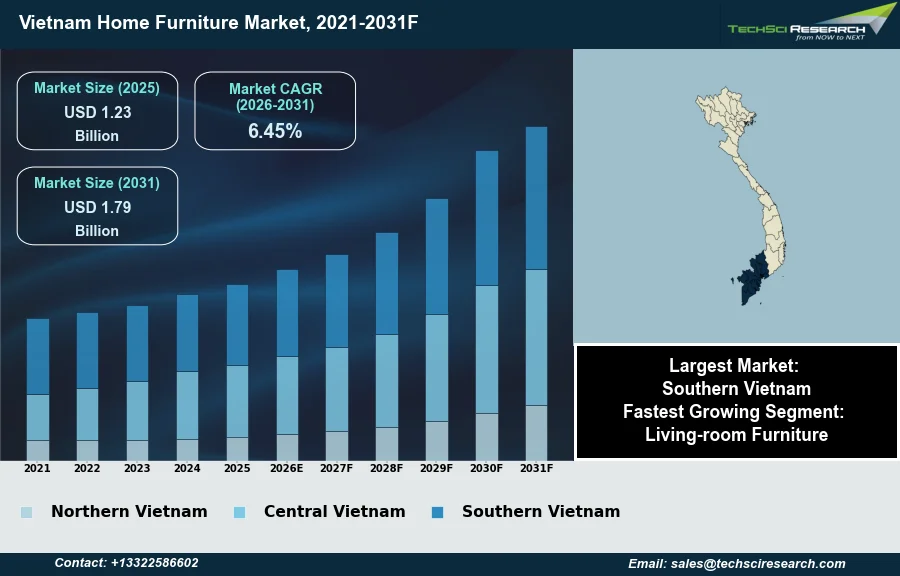
The Vietnam Home Furniture Market will grow from USD 1.23 Billion in 2025 to USD 1.79 Billion by 2031 at a 6.45% CAGR. Home furniture comprises movable objects crafted for interior spaces, serving both utilitarian and aesthetic functions through items such as chairs, tables, beds, and storage units. The Vietnam Home Furniture Market's expansion is primarily supported by robust urbanization rates, which continuously generate demand for residential furnishings, alongside increasing disposable incomes that empower consumers to invest in home enhancements. A growing middle class further propels this demand, augmented by a dynamic domestic construction sector requiring new fit-outs. According to the Vietnam Timber and Forest Products Association (VIFOREST) and Vietnam Customs, in 2025, the nation's wood and wood product exports attained approximately US$17.2 billion, signifying an increase of nearly 6 percent compared to 2024, underscoring the industry's substantial output and global integration.
However, a notable challenge impeding market growth is the industry's significant dependence on imported raw materials. This reliance exposes manufacturers to considerable risks, including global supply chain instabilities and fluctuations in international commodity prices, which directly affect production costs and operational schedules for both domestic and export-focused enterprises.
Key Market Drivers
Rising incomes and expanding middle class boost furniture demand
Rising disposable incomes and an expanding middle class significantly bolster the Vietnam Home Furniture Market by increasing household purchasing power and consumer willingness to invest in higher-quality furnishings. As more Vietnamese households transition into the middle-income bracket, their preferences shift towards modern, aesthetically pleasing, and functional furniture, driving demand for diverse product offerings. This upward trend in income directly fuels consumer spending on home improvement and new furniture purchases. According to the National Statistics Office (NSO), the average per capita income in 2025 was estimated at 5.9 million VND (approximately US$225) per person per month, marking a 9.3 percent increase compared to 2024.
Urbanization and housing development sustain furniture demand, with wood-product exports rising
Concurrently, rapid urbanization and extensive housing development are critical engines of market expansion, continuously generating demand for new residential furnishings. The ongoing migration from rural to urban centers necessitates the construction of new homes and apartments, all requiring fit-outs and furniture. This dynamic is further enhanced by government initiatives to address housing needs. According to the Ministry of Construction, Vietnam completed 103,133 social housing units in 2025, surpassing its annual target by 3 percent. Such developments create a consistent baseline demand for furniture across various price segments. The broader Vietnam wood and wood product industry, closely linked to furniture manufacturing, also demonstrates sustained growth; according to the Ministry of Agriculture and Environment, in the first five months of 2026, the export value of wood and wood products was estimated at US$7.12 billion, a 4.4% increase compared to the same period in 2025.
Download Free Sample Report
Key Market Challenges
Imported Material Dependence Drives Cost and Schedule Instability
The Vietnam Home Furniture Market faces a considerable challenge due to its substantial reliance on imported raw materials. This dependence exposes manufacturers to inherent vulnerabilities within global supply chains and makes them susceptible to fluctuations in international commodity prices. These external factors directly impact the stability of production costs and operational schedules for both domestic manufacturers and export-oriented enterprises.
Wood Import Dependence Elevates Costs and Pricing Pressure
According to the Vietnam Timber and Forest Products Association (VIFOREST), in 2024, raw wood materials accounted for approximately $2.4 billion, representing 85.2% of Vietnam's total wood and wood product imports. This high proportion of imported inputs directly drives up manufacturing expenses when global timber prices surge or shipping costs increase. Such cost escalations diminish profit margins and can lead to higher end-product prices, potentially reducing consumer demand and competitiveness in both domestic and international markets. Furthermore, any disruptions to the availability or timely delivery of these essential raw materials can halt production, causing delays in order fulfillment and ultimately impeding the market's overall growth trajectory.
Key Market Trends
E-commerce-Driven Transformation of Vietnam's Furniture Distribution
Accelerated e-commerce penetration is reshaping the distribution landscape of the Vietnam Home Furniture Market by offering consumers increased accessibility and choice. The rapid growth of online platforms allows local manufacturers to directly reach a broader customer base, both domestically and internationally, bypassing traditional retail channels. This shift necessitates investment in digital marketing, robust logistics networks, and enhanced online customer experiences to convert browsing into sales. According to VietNamNet, April 2026, furniture exports via e-commerce are forecast to expand by 20% annually, underscoring the increasing importance of digital channels for market growth.
Sustainability Demand, Certifications, and Material Innovation in Furniture
A growing consumer demand for sustainable furniture represents another significant trend, driven by increasing environmental awareness among buyers. This influences product development, material sourcing, and manufacturing processes as consumers seek eco-friendly options. Manufacturers are responding by adopting certifications and investing in sustainable material supply chains to meet both domestic and international buyer expectations. For instance, according to Orissa International, March 2025, Hoa Phat, a leading Vietnamese furniture company, is investing significantly in FSC-certified wood material zones, partnering with forest-growing households to produce 15,000 tonnes of certified wood annually. This trend encourages innovation in using recycled and renewable materials, impacting the entire value chain.
Segmental Insights
Surge in Vietnam's Living-Room Furniture Driven by Urbanization and Rising Incomes
A key segmental insight in the Vietnam Home Furniture Market reveals living-room furniture as a rapidly expanding category. This segment's robust growth is primarily driven by the nation's swift urbanization and the consistent increase in disposable incomes among the burgeoning middle class. Consumers are increasingly prioritizing interior aesthetics and comfort, leading to elevated demand for contemporary, stylish, and multi-functional sofas, coffee tables, and entertainment units. The evolving preference for modern, space-efficient designs, particularly in urban residential settings, further fuels this accelerated expansion as individuals seek to create appealing and practical living spaces.
Regional Insights
Manufacturing Hubs, Strategic Location, and Logistics Gateways Drive Southern Vietnam's Market Leadership
Southern Vietnam leads the Vietnam Home Furniture Market due to its established and robust manufacturing infrastructure, with provinces like Binh Duong and Dong Nai serving as key production hubs. This region's strategic proximity to Ho Chi Minh City, a major economic center, significantly drives both residential and commercial furniture demand. Critical export gateways, including Cat Lai and Cai Mep–Thi Vai ports, provide strong logistics for efficient raw material imports and streamlined global distribution of finished goods. Furthermore, a skilled labor force, combined with rapid urbanization and a growing middle class, fuels substantial domestic consumption and attracts consistent foreign investment, solidifying Southern Vietnam's market dominance.
Recent Developments
-
In May 2025, the Vietnam Furniture Association launched "Trend 26+", the inaugural trend publication for the nation's furniture industry. This biennial magazine was developed to forecast and shape architectural interior trends for the period 2026-2030, offering valuable insights into sustainability, personalization, and technological integration in design. The publication resulted from a long-term strategic collaboration among several key players in Vietnam's interior materials and accessories industry, serving as a critical reference for companies aiming to align product development and business strategies with future market directions in home furnishings.
-
In March 2025, Kuka Home, a prominent upholstery manufacturer, expanded its operations in Vietnam by launching a new 624,000-square-foot facility in Binh Duong province. This strategic expansion aimed to meet increasing demand from its retail partners and enhance efficiency in its production processes. The new plant represented a significant investment in the Vietnam home furniture market, contributing to increased manufacturing capacity for motion upholstery products. This initiative demonstrated the company's commitment to scaling its production base within the region, thereby reinforcing Vietnam's role as a key hub for global furniture manufacturing.
-
In March 2025, EuroStyle, a leading entity in luxury interior design, celebrated the grand opening of the first mono-brand Lema showroom in Hanoi. This significant event introduced high-end Italian furniture to the discerning Vietnamese market, marking a milestone in the luxury home furniture segment. The showroom offered an extensive range of Lema's sophisticated Italian designs, catering to consumers seeking elegance and innovative home furnishing solutions. This collaboration underscored EuroStyle's dedication to curating an unparalleled selection of luxury brands and elevating the standard of refined living within Vietnam.
-
In May 2024, Theodore Alexander, a luxury furniture manufacturer, introduced a new Vietnamese-made upholstery line. This collection was launched at the High Point Market, signaling the company's strategy to offer stylish, value-priced seating options. The new line leveraged the capabilities of the company's existing wood furniture manufacturing facilities located in the Ho Chi Minh City region, demonstrating a strategic move to diversify its product portfolio within the Vietnamese market. The initiative provided retailers and designers with compelling, high-quality upholstery choices, directly supporting the growth of Vietnam's home furniture production for international markets.
Key Market Players
- AA Corporation
- Duc Thanh Wood Processing JSC
- Truong Thanh Furniture Corporation
- An Cuong Wood Working JSC
- Minh Duong Furniture
- Scansia Pacific
- Ashley Furniture Industries Vietnam
- Kian Furniture Vietnam
- Nha Xinh Furniture
- BoConcept Vietnam
|
By Furniture Type
|
By Sales Channel
|
By Region
|
- Kitchen Furniture
- Living-room Furniture
- Dining-room Furniture
- Bedroom Furniture
- Other Furniture
|
- Supermarkets/Hypermarkets
- Specialty Stores
- Online
- Others
|
- Northern
- Central
- Southern
|
Report Scope:
In this report, the Vietnam Home Furniture Market has been segmented into the following categories, in addition to the industry trends which have also been detailed below:
-
Vietnam Home Furniture Market, By Furniture Type:
-
Kitchen Furniture
-
Living-room Furniture
-
Dining-room Furniture
-
Bedroom Furniture
-
Other Furniture
-
Vietnam Home Furniture Market, By Sales Channel:
-
Supermarkets/Hypermarkets
-
Specialty Stores
-
Online
-
Others
-
Vietnam Home Furniture Market, By Region:
-
Northern
-
Central
-
Southern
Competitive Landscape
Company Profiles: Detailed analysis of the major companies present in the Vietnam Home Furniture Market.
Available Customizations:
Vietnam Home Furniture Market report with the given market data, TechSci Research offers customizations according to a company's specific needs. The following customization options are available for the report:
Company Information
- Detailed analysis and profiling of additional market players (up to five).
Vietnam Home Furniture Market is an upcoming report to be released soon. If you wish an early delivery of this report or want to confirm the date of release, please contact us at sales@techsciresearch.com