|
Key Insights
|
Details
|
|
Forecast Period
|
2027-2031
|
|
Market Size (2025)
|
USD 441.82 Million
|
|
CAGR (2026-2031)
|
6.46%
|
|
Fastest Growing Segment
|
100% Fruit Juice
|
|
Largest Market
|
Southern Vietnam
|
|
Market Size (2031)
|
USD 643.23 Million
|
Market Overview
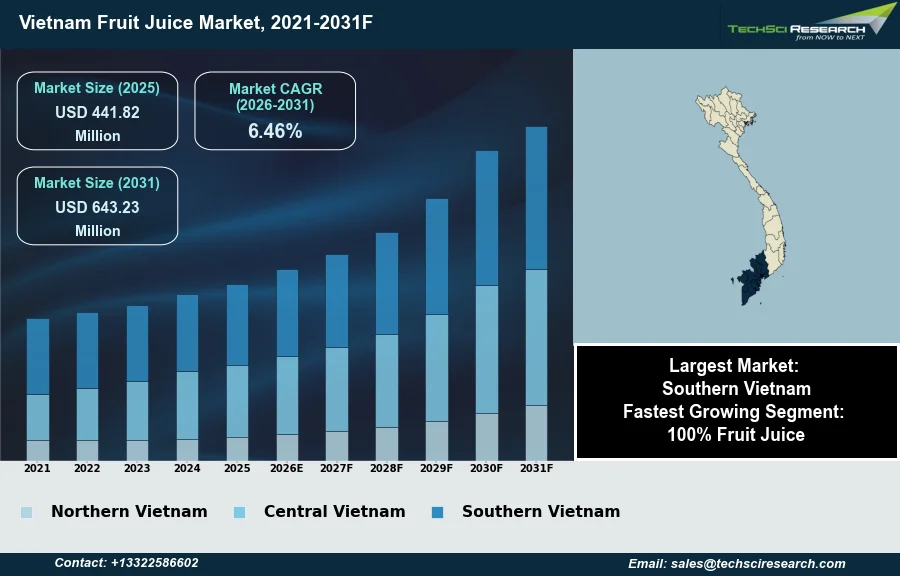
The Vietnam Fruit Juice Market will grow from USD 441.82 Million in 2025 to USD 643.23 Million by 2031 at a 6.46% CAGR. The Vietnam fruit juice market encompasses a range of beverages produced from various fruits, such as apple, orange, and pineapple, through methods like crushing, pressing, or blending, valued for their refreshing taste and nutritional content, particularly vitamins. Market growth is primarily driven by increasing health awareness among Vietnamese consumers, who are actively seeking natural and nutritious alternatives to sugary drinks. Concurrently, rising disposable incomes and an expanding middle class contribute to heightened consumer spending on higher-quality and premium beverage options. Furthermore, rapid urbanization and evolving, fast-paced lifestyles foster demand for convenient, ready-to-drink fruit juice formats. According to the Viet Nam Fruit and Vegetable Association (Vinafruit), in the first five months of 2026, fruit and vegetable exports, which include processed fruit products, reached US$2.67 billion, marking a 16% increase compared to the same period in 2025.
Despite these robust growth drivers, a significant challenge impeding market expansion is the intense competition from both imported fruit juices and the strong consumer preference for freshly squeezed options. Imported products often benefit from advanced technology and established brand recognition, while fresh juices are frequently perceived as superior in terms of health and naturalness by consumers. Addressing this competitive landscape requires continuous innovation in product quality, processing technologies, and effective brand differentiation strategies.
Key Market Drivers
Health-Driven Demand and Regulatory Support for Natural Juices
Rising health consciousness among Vietnamese consumers is a pivotal factor driving the fruit juice market. As awareness of nutrition grows, there is an observable shift away from carbonated and sugary drinks towards natural, healthier beverage alternatives. This heightened consumer focus on well-being directly fuels demand for fruit juices, which are perceived as wholesome and vitamin-rich. The government's stance further underlines this trend, as according to Vietnam Briefing, in February 2026, Vietnam's new excise tax on soft drinks, set to begin at 8 percent in 2027, explicitly exempts natural juices, highlighting a clear distinction based on health profiles and a governmental response to evolving consumer preferences. This regulatory support strengthens the market position of natural fruit juice products.
Expanded Retail and E-Commerce Infrastructure Driving Accessibility and Growth
Simultaneously, the expanding retail and e-commerce infrastructure significantly boosts the accessibility and availability of fruit juice products. The proliferation of modern trade channels, including supermarkets and convenience stores, alongside the rapid growth of online shopping platforms, allows manufacturers to reach a broader consumer base across urban and increasingly rural areas. This enhanced distribution network caters to the growing preference for convenient ready-to-drink options. According to the Vietnam E-commerce Association (VECOM), in its E-commerce Index (EBI) 2025, Vietnam's retail e-commerce value is expected to exceed 40 billion USD, facilitating widespread product delivery. This widespread market penetration, supported by efficient logistics, underpins overall market expansion. Furthermore, the broader agricultural sector demonstrates strong performance, with total exports of Vietnamese fruits and vegetables reaching USD 8.56 billion in 2025, according to the Ministry of Agriculture and Environment.
Download Free Sample Report
Key Market Challenges
Imported Competition and Surging Imports Pressure the Domestic Packaged Juice Market
The Vietnam fruit juice market faces significant challenges stemming from intense competition posed by both imported fruit juices and a strong consumer preference for freshly squeezed options. Imported products, often leveraging advanced processing technologies and established global brand recognition, directly compete with domestic offerings. This competitive pressure is evident in the substantial increase in foreign produce entering the market. According to the Vietnam Fruit and Vegetable Association (Vinafruit), total fruit and vegetable imports in 2025 surpassed US$3 billion, representing an approximate 24% increase compared to 2024. This influx, which includes fruits commonly used for juicing or consumed as fresh alternatives, directly constrains the market share and revenue potential for local packaged fruit juice manufacturers.
Fresh Juice Preference Dampens Growth of Packaged Juices
Concurrently, a pronounced consumer preference for freshly squeezed juices poses another direct impediment to packaged fruit juice market growth. Vietnamese consumers frequently perceive these freshly prepared beverages as inherently superior in terms of naturalness and health benefits. This perception shifts demand away from commercially processed and packaged fruit juices, thereby limiting their sales volume and hindering overall market expansion, despite the inherent convenience offered by ready-to-drink formats. The increasing availability and competitive pricing of imported fresh fruits, supported by tariff adjustments, further enable this preference for fresh options.
Key Market Trends
Premiumization Driving Elevated Juice Experiences
The Vietnam fruit juice market is significantly influenced by the premiumization of juice offerings, as discerning consumers increasingly seek elevated beverage experiences. This trend manifests in a demand for higher-quality ingredients, distinctive flavor profiles, and aesthetically appealing packaging, which manufacturers are addressing through innovation in product development and branding. Many consumers are now willing to invest more in juices that offer perceived superior taste, naturalness, or a unique consumption occasion. According to Vietnam Investment Review, April 2026, in its "Vietnamese to spend $29 billion on F&B in 2026" report, 57.58 percent of consumers now prefer drinks priced above $1.35, indicating a growing demand for enhanced beverage experiences.
Growth of Hybrid and Functional Beverage Blends
Another pivotal trend shaping the market is the development of hybrid and functional beverage blends. This involves integrating fruit juices with other components such as dairy, botanicals, or fortifying ingredients to deliver specific health benefits or novel taste sensations. These innovative blends cater to consumers looking for more than just refreshment, desiring drinks that support digestion, immunity, or provide an energy boost. This expansion into functional segments diversifies the market beyond traditional fruit juice categories. For instance, in its Q3 2024 financial report, G.C Food, a producer utilizing ingredients like aloe vera and coconut jelly, announced consolidated revenues of nearly $7.2 million, marking a 31 percent year-on-year increase, reflecting growth in related segments.
Segmental Insights
Health-driven Growth of the 100% Fruit Juice Segment in Vietnam
The 100% Fruit Juice segment is currently the fastest-growing within the Vietnam Fruit Juice Market, driven primarily by a significant shift towards heightened consumer health consciousness. Vietnamese consumers are increasingly prioritizing natural and nutritious beverage options, moving away from sugary soft drinks and artificial alternatives. This preference stems from a growing awareness of health and wellness, leading demand for products free from artificial additives and perceived as rich in essential vitamins and antioxidants. Furthermore, rapid urbanization and increasing disposable incomes enable consumers to opt for premium, authentic fruit juices that align with their evolving healthy lifestyles. The Vietnamese Ministry of Health's reports on increasing public interest in healthier dietary choices underscore this market trend.
Regional Insights
Geographic, Climatic, and Economic Drivers of Southern Vietnam's Fruit Juice Leadership
Southern Vietnam consistently leads the Vietnam Fruit Juice Market, primarily driven by its advantageous geographical and economic conditions. The region benefits significantly from a tropical climate, particularly in the Mekong Delta, which ensures an abundant and continuous supply of diverse fruits such as mangoes, pineapples, and passion fruits for raw material sourcing. This natural advantage supports cost-efficient production for manufacturers. Furthermore, Southern Vietnam, anchored by Ho Chi Minh City, exhibits a more advanced retail infrastructure, a higher population density, and greater consumer purchasing power, stemming from rapid urbanization and a growing middle-class base. These factors collectively facilitate extensive product distribution and bolster demand for convenient, ready-to-drink fruit juice offerings.
Recent Developments
-
In September 2025, SEP Cooperative, an enterprise from the Republic of Korea, announced its plan to survey and invest in a large-scale tropical fruit juice processing plant in Cần Thơ, Vietnam. This strategic investment, undertaken in partnership with the Vietnam-Asia Net Zero Alliance (VANZA), aimed to establish a facility with a daily capacity of 300,000–500,000 liters, primarily for export to markets such as the Republic of Korea, the EU, the US, and Japan. The project, requiring an estimated investment of $120–180 million in its initial phase, signified a significant foreign collaboration within the Vietnam fruit juice market.
-
In August 2025, Nature Foods Company (NFC) introduced ICHILL, an innovative beverage line featuring real fruit toppings in freeze-dried cubes, marking a significant advancement in the Vietnam fruit juice market. As a pioneer in applying freeze-dried technology in Vietnam, NFC developed this product to preserve the natural color, flavor, and nutrients of the fruit without the need for preservatives. The freeze-drying process converts ice directly into vapor, ensuring an extended shelf life while delivering a fresh taste upon preparation, catering to consumer demand for convenient and healthy options.
-
In May 2025, Nam Viet Foods & Beverage JSC (VINUT) unveiled several new 100% tropical juice SKUs with fruit pulp at THAIFEX Anuga Asia 2025, expanding its presence in the Vietnam fruit juice market. The new product range included exotic flavors such as lychee, mango, and dragon fruit, catering to evolving consumer tastes for authentic and natural fruit beverages. These introductions were part of the company's broader strategy to showcase beverage innovations and target global markets, demonstrating continued product development in the sector.
-
In December 2024, Vinamilk, a prominent Vietnamese company, launched a new line of fruit juices infused with collagen, targeting the health and beauty segment of the Vietnam fruit juice market. These functional beverages were made available in various flavors, including Pomegranate & Apple, Kiwi & Apple, and Orange & Peach. Each serving contained 500mg of hydrolyzed collagen, formulated to support skin health, hair strength, and nail fortification. The new offerings were also notably free from added sugar, aligning with growing consumer preferences for healthier drink options within Vietnam.
Key Market Players
- Vinamilk (Vfresh)
- Suntory PepsiCo Vietnam Beverage
- Coca-Cola Vietnam
- TH Group (TH true JUICE)
- Nafoods Group JSC (Juice Smile)
- Tan Hiep Phat Beverage Group
- RITA Food & Drink Co., Ltd.
- Lavifood JSC
- Tan Do Beverage
- Nam Viet Foods & Beverage (Vinut)
|
By Product Type
|
By Sales Channel
|
By Region
|
- 100% Fruit Juice
- Juice Drinks
- Concentrates
- Powdered Juice
- Others
|
- Supermarkets/Hypermarkets
- Convenience Stores
- Specialty Stores
- Online
- Others
|
- Northern
- Central
- Southern
|
Report Scope:
In this report, the Vietnam Fruit Juice Market has been segmented into the following categories, in addition to the industry trends which have also been detailed below:
-
Vietnam Fruit Juice Market, By Product Type:
-
100% Fruit Juice
-
Juice Drinks
-
Concentrates
-
Powdered Juice
-
Others
-
Vietnam Fruit Juice Market, By Sales Channel:
-
Supermarkets/Hypermarkets
-
Convenience Stores
-
Specialty Stores
-
Online
-
Others
-
Vietnam Fruit Juice Market, By Region:
-
Northern
-
Central
-
Southern
Competitive Landscape
Company Profiles: Detailed analysis of the major companies present in the Vietnam Fruit Juice Market.
Available Customizations:
Vietnam Fruit Juice Market report with the given market data, TechSci Research offers customizations according to a company's specific needs. The following customization options are available for the report:
Company Information
- Detailed analysis and profiling of additional market players (up to five).
Vietnam Fruit Juice Market is an upcoming report to be released soon. If you wish an early delivery of this report or want to confirm the date of release, please contact us at sales@techsciresearch.com