|
Key Insights
|
Details
|
|
Forecast Period
|
2027-2031
|
|
Market Size (2025)
|
USD 567.89 Million
|
|
CAGR (2026-2031)
|
29.11%
|
|
Fastest Growing Segment
|
Battery Electric Vehicle (BEV)
|
|
Largest Market
|
Southern Vietnam
|
|
Market Size (2031)
|
USD 2630.41 Million
|
Market Overview
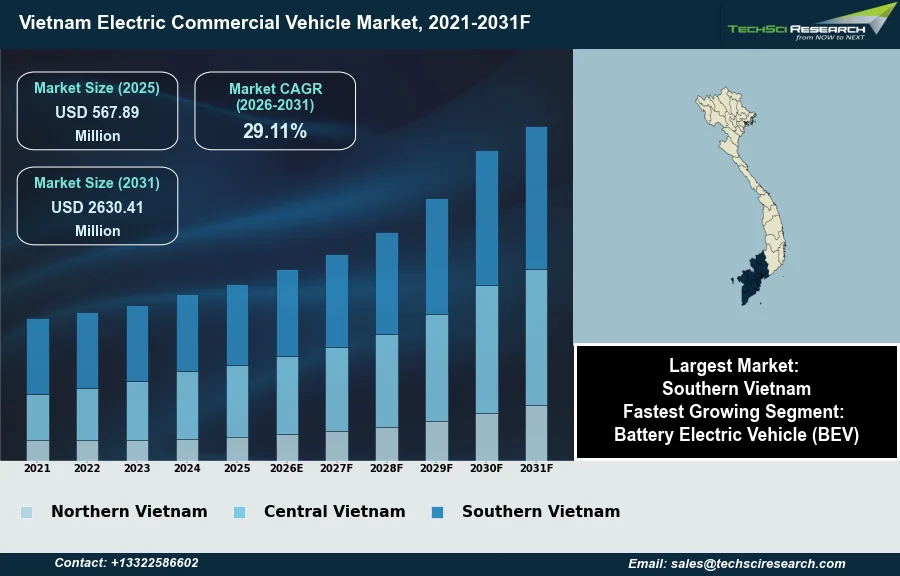
The Vietnam Electric Commercial Vehicle Market will grow from USD 567.89 Million in 2025 to USD 2630.41 Million by 2031 at a 29.11% CAGR. The Vietnam Electric Commercial Vehicle market encompasses battery electric vehicles, plug-in hybrid electric vehicles, and fuel cell electric vehicles designed for commercial applications such as logistics, public transport, and last-mile delivery. Key market growth drivers include robust governmental initiatives, particularly emission reduction targets and policies promoting green mobility, along with significant infrastructure development and urbanization projects. The increasing demand for efficient transportation solutions from the expanding e-commerce sector further propels adoption.
Furthermore, the inherent lower operating and maintenance costs of electric commercial vehicles present a compelling economic advantage for fleet operators. According to the Department of Transport and Traffic Safety under the Ministry of Construction, as of the end of May 2026, Vietnam had 3,396 electric trucks and 1,571 electric buses in operation. However, a significant impediment to market expansion remains the underdeveloped charging infrastructure, which poses challenges for widespread operational deployment.
Key Market Drivers
Policy Support and Incentives for EV Adoption
Government Policy and Regulatory Support for EV Adoption is a primary driver in the Vietnam Electric Commercial Vehicle Market, establishing a conducive environment for widespread adoption through various incentives and mandates. The Vietnamese government has demonstrated a clear commitment to fostering green mobility. For instance, according to Vietnam News Agency, in June 2026, the government issued Decree No. 202/2026/ND-CP, extending the 0% first-time registration fee for battery electric vehicles through the end of 2030. This sustained policy support provides long-term certainty for businesses and investors, directly reducing the initial acquisition costs for fleet operators and thereby accelerating the transition to electric commercial vehicles. Such regulatory frameworks also often include emission reduction targets, further compelling industries to shift towards cleaner transportation solutions.
Automaker Investment Driving EV Model Expansion
Automaker Investment and Introduction of EV Models significantly contributes to the market's expansion by increasing the availability and diversity of electric commercial vehicles, which caters to specific operational demands. Enhanced investment from vehicle manufacturers facilitates the development and launch of new electric models, including trucks, vans, and buses. For example, according to VietNamNet, in February 2026, THACO Auto announced its intention to introduce Thaco-branded minibuses in June 2026, aiming to strengthen its presence in the commercial vehicle segment. This proactive approach by domestic players expands consumer choices with improved performance and specialized features, making electric options more appealing and viable for businesses. Furthermore, the broader electric vehicle market in Vietnam is experiencing considerable growth; according to Stock Titan, in the first five months of 2026, VinFast reported preliminary domestic deliveries of 97,961 electric vehicles in Vietnam, indicating strong sales momentum. This reflects a growing preference for sustainable transport across various segments, which directly benefits the commercial sector.
Download Free Sample Report
Key Market Challenges
Underdeveloped charging infrastructure constrains EV fleet growth
The underdeveloped charging infrastructure significantly impedes the growth of the Vietnam Electric Commercial Vehicle market. The scarcity and uneven distribution of charging stations create operational challenges for fleet operators, leading to concerns regarding vehicle downtime and efficient route planning. This directly affects the feasibility of transitioning to electric fleets for logistics, public transport, and last-mile delivery services, as reliable access to charging facilities is paramount for sustained daily commercial operations.
High vehicle-to-charger ratio in Ho Chi Minh City hampers adoption and economic benefits
According to Vietnam News, as of May 2026, the ratio of electric vehicles to charging pillars in Ho Chi Minh City stood at approximately 18 vehicles per charger, which is notably higher than the recommended benchmark of one charging pillar for every 10 electric vehicles. This substantial disparity highlights the current inadequacy of the charging network to support widespread electric commercial vehicle adoption. Such an imbalance results in extended charging times and limited operational flexibility, thereby diminishing the inherent economic advantages otherwise offered by electric commercial vehicles and directly hindering market expansion.
Key Market Trends
Public Bus Electrification in Ho Chi Minh City
Widespread electrification of public bus systems represents a significant shift, driven by urban environmental concerns and the desire to modernize public transit. Cities are actively transitioning their fleets to electric to mitigate air and noise pollution, thereby enhancing urban liveability and passenger experience. This movement offers both environmental benefits and operational efficiencies, including smoother rides and potentially reduced long-term fuel costs for operators. According to the Public Transport Management Center under the municipal Department of Construction, as of June 2026, 1,649 electric or clean energy buses were in operation in Ho Chi Minh City, constituting 67.8 percent of the city's total bus fleet, reflecting a substantial commitment to green urban mobility. This large-scale adoption is actively transforming urban transport networks.
Electric Fleets for Last-Mile Delivery in Vietnam
The increasing adoption of electric vehicles for last-mile logistics is another pivotal trend, propelled by the escalating demand for rapid and sustainable urban delivery services. Businesses are increasingly recognizing the economic and operational advantages of electric vans and smaller trucks, which offer reduced operating costs through lower energy consumption and diminished maintenance requirements, especially for frequent stop-and-go operations characteristic of urban delivery. This trend is vital for supporting the burgeoning e-commerce sector, which requires efficient and environmentally friendly delivery solutions. According to electrive.com, in June 2026, Vietnamese company Huy Long signed an agreement to purchase 2,000 electric vehicles from VinFast, including commercial models like the EC Van, for deployment across major cities and central provinces. Such investments underscore the growing strategic importance of electric fleets in fulfilling consumer delivery expectations while advancing urban sustainability goals.
Segmental Insights
Policy Support and Cost Advantages Drive BEV Growth in Vietnam
In the Vietnam Electric Commercial Vehicle Market, Battery Electric Vehicles (BEVs) represent the fastest-growing segment. This rapid expansion is primarily driven by significant governmental support, including preferential special consumption tax rates and extended registration fee exemptions, which substantially reduce ownership costs for businesses. Furthermore, Vietnam's strategic national commitment to achieving net-zero emissions by 2050 is a strong catalyst, promoting a decisive shift towards environmentally friendly transportation solutions across various sectors. Fleet operators are increasingly adopting BEVs due to lower operational expenses, attributed to more affordable electricity compared to conventional fuels and reduced maintenance requirements. This confluence of policy incentives and economic advantages underscores the segment's robust growth.
Regional Insights
Southern Vietnam: Market Leader in Electric Commercial Vehicles
Southern Vietnam consistently leads the Vietnam Electric Commercial Vehicle Market due to its robust economic significance and high urban density, notably around Ho Chi Minh City. This region benefits from proactive urban development policies and clear roadmaps from local authorities, such as the Ho Chi Minh City Public Transport Management Centre under the Department of Construction, which prioritize green transportation through initiatives like electric bus conversions and low-emission zone planning. The substantial concentration of commercial activity and corporate headquarters in this area drives strong demand for fleet electrification in logistics and public transit. Furthermore, extensive investments in advanced charging infrastructure significantly reduce range anxiety, thereby accelerating the adoption of electric commercial vehicles.
Recent Developments
-
In December 2025, Lien Ninh commenced the operation of its initial units from a 111-electric-bus fleet in Hanoi. This represented a substantial deployment of electric buses, marking one of the largest integrations of electric commercial vehicles into the country's public transportation system. The initiative actively supported Hanoi's commitment to urban environmental improvements and demonstrated a tangible progression towards sustainable public transport solutions. This large-scale adoption highlighted the growing operational viability and increasing integration of electric commercial vehicles in Vietnam’s major cities.
-
In May 2025, VinFast introduced the EC Van electric cargo van, specifically targeting urban delivery operations within Vietnam. This new product launch significantly expanded the portfolio of electric commercial vehicles available to domestic fleet operators, offering a sustainable solution for logistics. The EC Van’s introduction underscored VinFast's strategic commitment to electrifying the country's commercial transportation sector, addressing the increasing demand for efficient and environmentally responsible last-mile delivery services in urban environments across Vietnam. This move is crucial for advancing green mobility in the Vietnamese commercial sector.
-
In January 2025, VinFast launched a new electric bus model designed to accommodate up to 60 passengers. Following its introduction, these electric buses were delivered to three key transport operators in Hanoi: Transerco, Newway, and Bao Yen. This handover facilitated their integration into Hanoi's public transportation network, significantly enhancing the city's green mobility infrastructure. This development was a strategic component of Hanoi's broader objective to achieve a fully electrified bus fleet by 2035, underscoring VinFast's role in advancing sustainable urban transit in Vietnam.
-
In October 2024, BYD substantially increased its presence within Vietnam’s electric vehicle market by introducing several new EV models. This strategic move aimed to directly compete with established local manufacturers, including VinFast, and was designed to cater to both passenger and commercial vehicle segments. BYD’s market entry brought advanced technology and manufacturing expertise to Vietnam, contributing to a more diversified and competitive electric vehicle landscape. This expansion is expected to foster broader electric vehicle adoption across various applications, significantly impacting the electric commercial vehicle market.
Key Market Players
- VinFast
- THACO Auto
- SAMCO (Saigon Transportation Mechanical Corporation)
- VinBus
- Selex Motors
- PEGA (HKbike)
- Dat Bike
- BYD Auto
- Yutong Bus
- Hyundai Motor Company
- Toyota Motor Corporation
- TC Motor (Hyundai Thanh Cong Vietnam)
|
By Vehicle
|
By Propulsion
|
By Battery
|
By End Use
|
By Region
|
- Light Commercial Vehicle (LCV)
- Heavy Commercial Vehicle (HCV)
- Buses
|
- Battery Electric Vehicle (BEV)
- Plug in Hybrid Vehicle (PHEV)
|
- <50kwh
- 50-150 kwh
- >150kwh
|
- Logistics
- Last mile Delivery
|
- Northern
- Central
- Southern
|
Report Scope:
In this report, the Vietnam Electric Commercial Vehicle Market has been segmented into the following categories, in addition to the industry trends which have also been detailed below:
-
Vietnam Electric Commercial Vehicle Market, By Vehicle:
-
Light Commercial Vehicle (LCV)
-
Heavy Commercial Vehicle (HCV)
-
Buses
-
Vietnam Electric Commercial Vehicle Market, By Propulsion:
-
Battery Electric Vehicle (BEV)
-
Plug in Hybrid Vehicle (PHEV)
-
Vietnam Electric Commercial Vehicle Market, By Battery:
-
<50kwh
-
50-150 kwh
-
>150kwh
-
Vietnam Electric Commercial Vehicle Market, By End Use:
-
Logistics
-
Last mile Delivery
-
Vietnam Electric Commercial Vehicle Market, By Region:
-
Northern
-
Central
-
Southern
Competitive Landscape
Company Profiles: Detailed analysis of the major companies present in the Vietnam Electric Commercial Vehicle Market.
Available Customizations:
Vietnam Electric Commercial Vehicle Market report with the given market data, TechSci Research offers customizations according to a company's specific needs. The following customization options are available for the report:
Company Information
- Detailed analysis and profiling of additional market players (up to five).
Vietnam Electric Commercial Vehicle Market is an upcoming report to be released soon. If you wish an early delivery of this report or want to confirm the date of release, please contact us at sales@techsciresearch.com