|
Key Insights
|
Details
|
|
Forecast Period
|
2027-2031
|
|
Market Size (2025)
|
USD 67.89 Million
|
|
CAGR (2026-2031)
|
25.31%
|
|
Fastest Growing Segment
|
DC
|
|
Largest Market
|
Dubai
|
|
Market Size (2031)
|
USD 262.86 Million
|
Market Overview
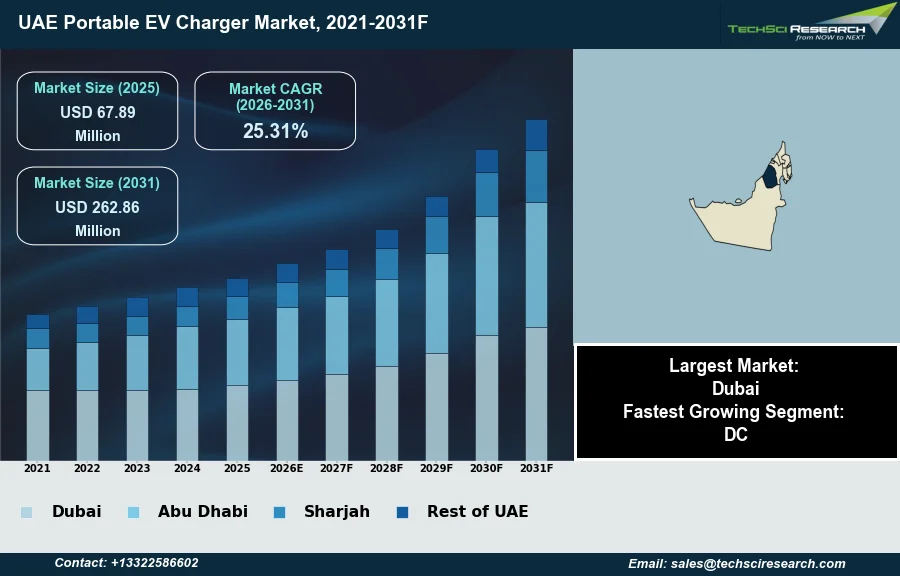
The UAE Portable EV Charger Market will grow from USD 67.89 Million in 2025 to USD 262.86 Million by 2031 at a 25.31% CAGR. The UAE Portable EV Charger Market comprises compact, mobile devices engineered to recharge electric vehicles without reliance on fixed charging stations, typically connecting to standard electrical outlets or designated power sockets. Market growth is fundamentally driven by the escalating adoption of electric vehicles, the inherent demand for enhanced charging flexibility and emergency backup capabilities, and the strategic imperative to supplement existing fixed charging infrastructure, particularly in less urbanized or underserved residential zones. Concurrently, governmental mandates and supportive policies promoting sustainable mobility actively bolster this increasing demand for convenient charging solutions.
According to the Dubai Water and Electricity Authority (DEWA), the number of electric vehicles in Dubai is projected to reach 12,852 by 2025, signaling a progressively expanding consumer base amenable to complementary charging options. Nevertheless, a primary impediment to significant market expansion is the inherently slower charging rates characteristic of portable units, which necessitate extended durations for achieving substantial battery recharges compared to permanent installations.
Key Market Drivers
Government Support as a Catalyst for Portable EV Chargers
Robust government support and incentives for EV adoption represent a fundamental catalyst for the UAE Portable EV Charger Market. The strategic vision of the UAE leadership actively promotes sustainable transportation, thereby creating a fertile environment for electric vehicle growth and, consequently, the demand for varied charging solutions. These governmental initiatives often include subsidies, preferential parking, and the development of public charging infrastructure, which, while beneficial, also highlight the need for flexible personal charging options to complement the expanding network. According to the Ministry of Energy and Infrastructure, in a press release dated November 2025, the UAE government allocated AED 300 million for EV infrastructure development and incentives in 2025, underscoring the substantial commitment to electrification. This strong backing encourages both consumers and businesses to transition to EVs, indirectly increasing the addressable market for portable chargers.
Range Anxiety and Growing EV Adoption Drive Portable Chargers
The imperative of overcoming range anxiety for inter-Emirate travel significantly drives the demand for portable EV chargers. As electric vehicle penetration rises across the UAE, longer journeys between major cities and less urbanized areas present a challenge for drivers concerned about charger availability. Portable units offer a critical assurance, providing emergency power or convenient top-ups when fixed stations are scarce or occupied, thereby alleviating this concern. According to a report by the Emirates Authority for Standardization and Metrology (ESMA) in January 2026, electric vehicle registrations increased by 65% across the UAE in 2025 compared to the previous year, highlighting the growing base of potential long-distance EV users. Furthermore, according to the Roads and Transport Authority (RTA) Dubai, in March 2026, the number of registered electric vehicles in Dubai reached 18,000, signifying a progressively expanding consumer base that benefits from enhanced charging flexibility for both daily use and extended trips.
Download Free Sample Report
Key Market Challenges
Slower charging rates limit growth and practical utility of portable EV chargers.
The inherently slower charging rates characteristic of portable units represent a substantial challenging factor for the growth of the UAE Portable EV Charger Market. These devices often necessitate extended durations for achieving significant battery recharges, a notable disadvantage when compared to the quicker capabilities of fixed, high-power charging installations. This limitation directly impacts user convenience and the practical utility of portable chargers as a primary or even frequent supplementary charging solution, particularly for electric vehicle owners seeking efficient and rapid energy replenishment.
Demand for faster charging constrains routine adoption of portable chargers.
The clear preference among consumers for faster charging solutions underscores a fundamental mismatch with the slower operational profile of portable chargers. According to the Roland Berger EV Charging Index 2025, published in October 2025, 43% of respondents across the GCC region expressed a desire for faster public charging options, specifically highlighting ultra-fast DC chargers. This demand for speed indicates that the extended charging times offered by portable units diminish their overall value proposition for routine use, thereby constraining their broader adoption despite the inherent demand for enhanced charging flexibility and emergency backup capabilities.
Key Market Trends
High-Power Portable DC Chargers and UAE Manufacturing Push
One significant trend shaping the UAE Portable EV Charger Market is the emergence of high-power portable DC charging solutions. This trend directly addresses the critical challenge of slow charging rates by introducing devices capable of faster energy replenishment, enhancing their utility beyond emergency use. Such solutions aim to bridge the performance gap between fixed infrastructure and mobile options. According to The EV Report, June 18, 2025, in the 'UAE to Manufacture EV Charging Stations' article, a joint venture was signed to manufacture EV charging equipment in the UAE, with the first 'Made in UAE' high-power DC charging stations anticipated by the end of 2025. This local manufacturing push underscores a growing market demand and technological shift towards more potent charging capabilities.
Expansion of On-Demand Mobile Charging Services
Another impactful trend transforming the market is the expansion of on-demand mobile charging services. This service-oriented innovation leverages portable EV chargers to offer unparalleled convenience by bringing charging directly to the customer's location, circumventing the need to find or wait at fixed stations. These services are particularly beneficial for addressing range anxiety in diverse settings and supporting fleet operations. According to Expand North Star, October 24, 2024, in the 'CAFU Announces its New EV Charging Solution, Enhancing On-Demand Car Services in the UAE and Region' article, CAFU launched a new electric vehicle charging solution, including mobile premium on-demand and trailer-based options, and partnered with Audi as its official UAE charging partner starting 2025. This partnership illustrates a clear move towards integrating portable charging into flexible, customer-centric service models.
Segmental Insights
DC Segment Drives Growth in UAE Portable EV Chargers
The DC segment is emerging as the fastest-growing component within the UAE Portable EV Charger Market. This acceleration is primarily driven by the escalating demand for rapid charging solutions that minimize electric vehicle downtime, crucial for addressing range anxiety and supporting inter-emirate travel across the UAE. Portable DC chargers offer the indispensable advantage of fast charging capabilities in diverse locations, complementing the expanding fixed charging infrastructure championed by initiatives such as the UAE Net Zero 2050 strategy. Their ability to provide quick power replenishment ensures convenience for EV owners, fleets, and commercial entities requiring flexible and efficient charging options where traditional installations may be impractical.
Regional Insights
Proactive Government Policy and Infrastructure Propel Dubai's Portable EV Chargers Market
Dubai leads the UAE Portable EV Charger Market primarily due to its proactive governmental strategies and comprehensive infrastructure development. The Dubai Electricity and Water Authority (DEWA) has pioneered the establishment of a robust electric vehicle ecosystem, including the region's first public charging infrastructure network. This includes a comprehensive regulatory and licensing framework for EV charging infrastructure, which encourages both direct development by DEWA and involvement from independent charge point operators, thereby fostering accelerated EV adoption. Furthermore, Dubai's commitment to sustainable mobility initiatives, such as the Dubai Clean Energy Strategy 2050 and the Dubai Green Mobility Strategy 2030, has created a supportive environment that drives demand for accessible charging solutions, including portable options to complement the fixed network. This integrated approach, combining policy, regulation, and infrastructure investment, establishes Dubai as a dominant force in the portable EV charger market within the UAE.
Recent Developments
-
In December 2025, Savvy Charging Technologies, a UAE-based company, announced a strategic collaboration with e-Boost, a division of Pioneer Power Solutions. This partnership was formed to introduce the region's first fully mobile, on-demand, and off-grid electric vehicle charging platform throughout the UAE and the wider GCC. The new platform was designed to offer rapid and grid-independent EV charging solutions, supporting fleet operators, logistics companies, and other entities by addressing infrastructure limitations and accelerating electric vehicle adoption.
-
In April 2025, Charger, a Dubai-based electric mobility firm, continued to expand its innovative on-demand mobile charging services across the UAE. The company emphasized its 24/7 service model, delivering mobile charging directly to electric vehicle users at their chosen locations. Its fleet of service vehicles was equipped with DC fast-charging technology, capable of providing up to 250 kW, ensuring rapid power delivery. This ongoing operational enhancement reinforced the availability and technological advancement of portable charging solutions in the market.
-
In October 2024, Charger, a Dubai-based electric mobility startup, debuted its innovative on-demand EV fast-charging station and an accompanying mobile application at WETEX 2024. This launch marked the introduction of a service utilizing a fleet of specialized trucks to deliver rapid electric vehicle charging directly to users in Dubai. The initiative aimed to enhance charging accessibility and convenience for electric vehicle owners, with the company announcing intentions to extend its operations across the broader UAE market. This development represented a significant new product offering within the portable EV charger sector.
-
In 2024, PlusX Electric introduced its portable charging pod system, designed to provide on-demand electric vehicle charging in Dubai. The company offered flexible charging solutions that did not rely on permanent infrastructure, utilizing compact, mobile units equipped with Level 2 chargers and integrated batteries. This innovative approach allowed electric vehicle owners to request charging services directly to their location via an application, providing a convenient power solution for various vehicle types within the city.
Key Market Players
- ChargePoint Middle East
- EVBox UAE
- ABB UAE
- Siemens UAE
- Schneider Electric UAE
- Blink Charging UAE
- Alfen UAE
- Delta Electronics UAE
- Pod Point UAE
- Wallbox UAE
|
By Type
|
By Vehicle Type
|
By Region
|
|
|
- Passenger Cars
- Commercial Vehicles
|
- Dubai
- Abu Dhabi
- Sharjah
- Rest of UAE
|
Report Scope:
In this report, the UAE Portable EV Charger Market has been segmented into the following categories, in addition to the industry trends which have also been detailed below:
-
UAE Portable EV Charger Market, By Type:
-
UAE Portable EV Charger Market, By Vehicle Type:
-
Passenger Cars
-
Commercial Vehicles
-
UAE Portable EV Charger Market, By Region:
-
Dubai
-
Abu Dhabi
-
Sharjah
-
Rest of UAE
Competitive Landscape
Company Profiles: Detailed analysis of the major companies present in the UAE Portable EV Charger Market.
Available Customizations:
UAE Portable EV Charger Market report with the given market data, TechSci Research offers customizations according to a company's specific needs. The following customization options are available for the report:
Company Information
- Detailed analysis and profiling of additional market players (up to five).
UAE Portable EV Charger Market is an upcoming report to be released soon. If you wish an early delivery of this report or want to confirm the date of release, please contact us at sales@techsciresearch.com