|
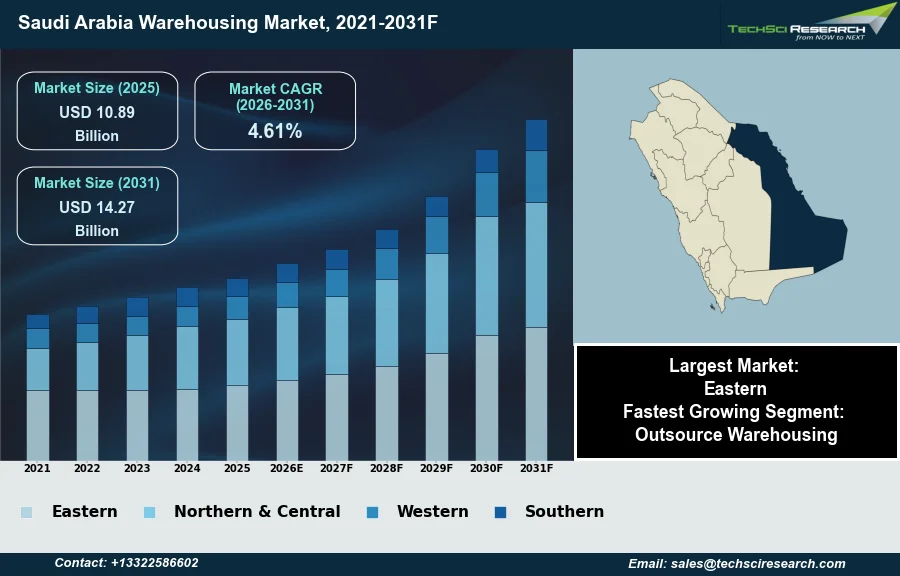
Forecast Period
|
2026-2030
|
|
Market Size (2024)
|
USD 10.25 Billion
|
|
CAGR (2025-2030)
|
4.61%
|
|
Fastest Growing Segment
|
Outsource Warehousing
|
|
Largest Market
|
Northern & Central
|
|
Market Size (2030)
|
USD 13.44 Billion
|
Market
Overview:
Saudi Arabia Warehousing
Market was valued at USD 10.25 Billion in 2024 and is expected to reach USD 13.44
Billion by 2030 with a CAGR of 4.61% during the forecast period. The Saudi Arabia warehousing sector has experienced a notable surge due
to the country’s ongoing diversification efforts, particularly in line with
Vision 2030. A key growth driver is the accelerated demand for efficient and
automated supply chains, largely spurred by the booming e-commerce industry.
The logistics sector is evolving with technologies like AI, IoT, and robotics,
enhancing warehousing capabilities. Automation not only increases efficiency
but also helps meet the increasing need for timely deliveries, an expectation
that continues to rise in the retail and manufacturing industries. As
businesses push for faster and more reliable logistics solutions, the demand
for high-quality warehousing facilities with advanced systems is likely to
expand significantly in the coming years.
Another contributing factor is
the robust investment in infrastructure development by both the government and
private players. Saudi Arabia has made substantial progress in developing
modern, state-of-the-art warehousing facilities that support a wide range of
industries, from food and pharmaceuticals to consumer goods and automotive. The
government’s focus on expanding the logistics and transport sectors, including
the development of key ports, highways, and industrial zones, positions the
warehousing market for continued growth. This development aligns with the
national strategy to strengthen non-oil sectors, offering ample opportunities
for businesses and investors to capitalize on the sector’s expansion.
Despite the positive outlook,
the warehousing sector in Saudi Arabia faces its own set of challenges. Rising
operational costs, especially in energy and labor, continue to pressure
businesses. Moreover, companies are grappling with the need for skilled labor
to manage increasingly complex, technology-driven systems. Another challenge is
the limited availability of land in prime locations, which can significantly
increase property costs, thereby affecting the profitability of warehousing
operations. Meeting these challenges will require a strategic approach to
workforce development and a more efficient use of available resources. With the
right adjustments, these obstacles can be overcome, allowing the warehousing
market to thrive.
Market
Drivers
E-Commerce Growth
The rapid expansion of the
e-commerce sector is one of the primary drivers of the warehousing market. As
online shopping becomes increasingly prevalent, retailers and logistics
companies face the pressure of meeting consumer demand for faster deliveries.
This has led to the rise of distribution centers and fulfillment warehouses
strategically placed to ensure quick, cost-effective delivery. E-commerce
growth encourages investments in technologies that streamline order picking,
packaging, and shipment, further propelling the demand for more advanced
warehousing solutions. The continuous shift toward online shopping means that
businesses must invest in efficient fulfillment strategies, creating a growing
need for new warehousing space and facilities. As consumer preferences change,
warehouses are adapting to more dynamic and flexible operations that can handle
diverse product types and seasonal fluctuations. The overall boom in global
trade, particularly online commerce, further solidifies this as a key growth driver.
For instance, Saudi Arabia’s e-commerce sector is undergoing rapid
expansion, driven by government reforms and digital infrastructure improvements
initiated by the Saudi E-Commerce Council. With over 34.5 million expected
users by 2025, 42,900 online stores, and USD 428 million in venture capital
funding secured in 2023, the sector is now the second most venture-funded in
the country. E-commerce is expected to contribute 12% to the nation’s GDP by
2025, reaching USD 69 billion in revenues. Growth is supported by 14,000
fulfillment centers, 191 delivery service providers, and a growing base of
verified e-commerce businesses and freelancers. As the Kingdom pushes toward
80% cashless payments by 2030, local SMEs are benefiting from broader market
access, lower operating costs, and safer payment platforms, unlocking new
domestic and international opportunities.
Technological Advancements in
Automation
Automation technologies are
transforming warehousing operations. Automated systems, including robotics, AI,
and IoT devices, significantly increase operational efficiency by reducing
human error, optimizing storage, and speeding up inventory management processes.
This technology enables warehouses to operate 24/7 with minimal human
intervention. Automated solutions are becoming increasingly affordable, driving
small and medium-sized enterprises to integrate these systems into their supply
chain operations, further increasing the demand for warehouses with automation
capabilities. The scalability of automation makes it easier for businesses to
expand their warehouse operations without a corresponding increase in labor
costs. Furthermore, automated warehouses contribute to enhanced safety by
reducing the risk of workplace injuries. As technology continues to evolve,
more sophisticated and smarter solutions are likely to emerge, driving
innovation in warehouse operations.
Supply Chain Optimization
As companies continuously look
to streamline their supply chains, they place increasing importance on
optimized warehousing solutions. Businesses are increasingly seeking efficient
and reliable warehousing services that can help lower operational costs while
improving the speed of inventory turnover and delivery. Warehousing systems
that allow for the effective tracking and management of stock play a crucial
role in the broader goal of supply chain optimization. Demand for these systems
is expected to rise as companies strive for just-in-time inventory management
and minimal storage costs. Efficient supply chains can directly reduce the time
goods spend in storage, further improving product availability and reducing the
risk of stockouts. The integration of advanced software for warehouse
management systems (WMS) ensures real-time visibility into stock levels and
shipments, further optimizing warehouse performance. As supply chain strategies
become more integrated, warehousing will remain at the center of these efforts
to reduce costs and improve service.
Demand for Cold Storage
Solutions
The global shift towards
healthier eating habits, along with the rising demand for pharmaceuticals, has
significantly increased the need for specialized cold storage warehouses.
Temperature-sensitive products require precise environmental controls to
maintain quality, safety, and freshness. Warehouses designed to meet these
needs must invest in high-quality refrigeration and monitoring systems, which
will continue to drive market growth in sectors such as food and beverages,
pharmaceuticals, and healthcare. The demand for cold storage is expected to
increase as consumer preferences shift toward fresh and organic products. As
the global pharmaceutical market expands, the need for temperature-controlled
storage solutions for vaccines and biologics is becoming even more critical.
Innovations in cold storage technology, such as energy-efficient refrigeration
systems, will help businesses meet both regulatory requirements and
cost-efficiency goals.
Government Investments in
Infrastructure
Government initiatives to
develop and expand infrastructure within the logistics sector are accelerating
the growth of warehousing services. Investments in modern transportation
networks, including highways, ports, and rail systems, contribute to improving
supply chain efficiency and increasing the demand for strategically located
warehouses. These investments make warehousing operations more efficient by
facilitating better connectivity between manufacturers, suppliers, and
consumers. With better infrastructure, warehousing companies are positioned to
provide more reliable and faster services, enabling them to cater to a larger
number of customers. Governments are also focusing on creating economic zones
and industrial parks where businesses can benefit from tax breaks and other
incentives. As infrastructure continues to evolve, warehousing services will
benefit from these improvements, offering new opportunities for growth and
expansion. For instance, Saudi Arabia is investing USD 2.67 billion to
develop 18 new logistics zones under Vision 2030, alongside a USD 1.33 billion
expansion of its Northern Train network. The country added 30 new shipping
lines and improved its maritime connectivity index by 231.7 points. Re-exports
hit USD 16.27 billion, up 23% from last year, with USD 1.87 billion in exports
from Maaden alone. At the Riyadh logistics conference, 86 agreements were
signed with 65 firms. The Kingdom is also advancing green and smart logistics
through electric vehicles, AI, IoT, and blockchain integration.

Download Free Sample Report
Key
Market Challenges
Rising Operational Costs
Operating warehouses involves
significant overheads, from electricity to maintenance. As energy costs rise
globally, the expenses for running warehouses are becoming a heavier burden on
businesses. Maintaining large spaces, managing temperatures in climate-controlled
facilities, and keeping up with the latest technology all require substantial
financial outlay. This leads to thinner profit margins, especially for smaller
players who struggle to absorb these rising costs while staying competitive in
the market. Moreover, high land prices, combined with increasing wages,
contribute to the rising costs associated with warehousing. Many businesses
also face fluctuating transportation costs, which further strain profitability.
These rising operational expenses highlight the need for warehouse operators to
invest in energy-efficient technologies and innovative operational strategies
to stay profitable.
Labor Shortages and Skills Gap
While automation helps alleviate
some labor demands, the increasing complexity of modern warehousing operations
requires a highly skilled workforce. There is a shortage of professionals with
the right technical skills to handle sophisticated warehouse management
systems, robotics, and automated solutions. This skills gap can delay
operations and lead to higher labor costs as businesses compete to attract and
retain qualified workers. Additionally, labor shortages in specific regions can
also create significant operational challenges. Many warehouse workers must
also be trained to manage new technologies and systems, which requires
additional investment in workforce development. The difficulty in finding the
right personnel with the expertise to operate and maintain cutting-edge systems
can significantly impact warehouse efficiency and productivity.
Space Constraints and Land Costs
In urban areas, space for
building new warehouses is limited, and available land is often expensive. The
rising demand for warehousing in prime locations, such as near transportation
hubs or dense consumer markets, increases the competition for land, driving up
prices. In some cases, this leads businesses to either settle for less optimal
locations or invest heavily in building vertically, which further inflates
costs. Space constraints also limit the expansion of existing warehouses,
making it difficult to meet growing demand without significant investment. As
warehouses grow larger and more complex, finding available land to build them
in high-demand areas becomes a bigger hurdle. The limited availability of land
also leads to more competition between logistics providers, pushing businesses
to find creative solutions like shared warehousing or multi-story facilities to
maximize space.
Regulatory and Compliance Issues
Warehousing operations must
adhere to a variety of regulatory requirements, including safety standards,
environmental guidelines, and import/export laws. Navigating complex
regulations can be challenging, particularly when these requirements differ by
region or product type. Non-compliance can result in fines, legal
complications, and damage to brand reputation. As regulations become stricter,
companies must invest more in compliance strategies, adding to operational
complexities and costs. Moreover, new regulations concerning sustainability and
carbon emissions are increasing the pressure on warehousing companies to adopt
greener practices. Keeping up with evolving compliance standards requires
constant vigilance, making it essential for businesses to maintain thorough
knowledge of the legal landscape in their respective industries.
Technology Integration Costs
The integration of new
technologies into warehousing operations can be prohibitively expensive. While
automation, AI, and IoT offer significant long-term benefits, the upfront
investment required for these technologies can be daunting, especially for smaller
companies. The complexity of integrating legacy systems with new technologies
can lead to unexpected costs and operational downtime, causing disruption in
supply chain continuity. Furthermore, maintaining and upgrading these systems
requires continual investment, further complicating the financial planning of
warehouse operators. As technology evolves rapidly, businesses must also
contend with the need for regular updates and system upgrades, which can
increase maintenance costs over time. Small-to-medium businesses may struggle
to keep up with technological advancements, leaving them vulnerable to
competitors who can better afford to make such investments.
Key
Market Trends
Sustainability in Warehousing
Sustainability has become a
growing trend in the warehousing sector as both consumers and businesses become
more conscious of their environmental footprint. Companies are increasingly
adopting eco-friendly practices, such as reducing energy consumption, implementing
waste reduction programs, and investing in sustainable materials for warehouse
construction. Green building certifications, such as LEED, are gaining
traction, with businesses striving to meet sustainability goals while
maintaining operational efficiency. This trend is expected to accelerate as
both consumers and regulatory bodies demand greater environmental
responsibility. Warehouses are being designed with energy-efficient lighting
systems, renewable energy sources, and eco-friendly packaging solutions. This
shift toward sustainability can not only reduce environmental impact but also
result in long-term cost savings by reducing energy consumption and waste.
Smart Warehousing and IoT
The rise of IoT technology has
led to the development of smart warehouses that use connected devices to
enhance operational performance. These warehouses incorporate sensors, RFID
tracking, and real-time data analytics to monitor inventory levels, track shipments,
and optimize storage. Smart warehousing offers improved inventory accuracy,
increased operational efficiency, and enhanced decision-making, enabling
companies to provide better service to their customers. The trend toward
smarter, more interconnected warehouses is expected to continue as IoT devices
become more affordable and accessible. IoT also allows for predictive
maintenance, reducing downtime and operational disruptions. With real-time data
at their disposal, warehouse managers can make more informed decisions, leading
to better resource allocation and cost optimization.
Omnichannel Distribution
As consumer expectations evolve,
businesses are adapting by adopting omnichannel distribution strategies. This
trend integrates multiple sales channels such as online platforms, physical
stores, and direct-to-consumer options into a seamless warehousing and
logistics operation. Warehouses are increasingly being designed to support a
wide range of fulfillment strategies, such as click-and-collect services and
real-time inventory updates. The demand for omnichannel solutions is expected
to grow as retailers look to provide customers with greater flexibility and
convenience in how they shop and receive goods. Omnichannel distribution allows
for efficient stock management across multiple sales channels, ensuring that
inventory is available and accessible no matter how the customer chooses to
shop. With the rise of digital platforms, businesses are rethinking their
warehousing strategies to meet new consumer demands for seamless experiences.
Last-Mile Delivery Focus
The emphasis on improving
last-mile delivery services is becoming more pronounced, driven by the
increasing need for speed and convenience in e-commerce. Warehouses are being
adapted to accommodate smaller, more frequent shipments that cater to the
rising demand for quick, same-day, or next-day delivery. This trend is pushing
businesses to rethink their warehousing strategies, with a focus on urban
micro-fulfillment centers and optimized delivery networks. The expansion of
last-mile solutions will continue to be a key trend in the warehousing
industry, with innovations aimed at reducing delivery times and costs.
Businesses are adopting advanced algorithms for route optimization and
leveraging local distribution hubs to speed up deliveries. Micro-fulfillment
centers are also emerging to address the growing demand for rapid delivery,
often located closer to urban centers.
Advanced Data Analytics and AI
The adoption of advanced data
analytics and artificial intelligence (AI) is revolutionizing warehouse
management. AI-powered systems enable predictive analytics, helping businesses
forecast demand, optimize inventory, and improve overall supply chain performance.
The integration of AI also enhances decision-making processes, allowing
companies to adapt quickly to changing market conditions. As AI continues to
evolve, its capabilities in inventory management, demand forecasting, and
operational efficiency will be crucial in driving the next wave of innovation
in warehousing. AI systems can process vast amounts of data to make real-time
adjustments to supply chain operations, ensuring optimal stock levels and
minimizing the risk of disruptions. Machine learning algorithms also help
improve warehouse layout design, optimizing space utilization and operational
workflows.
Segmental
Insights
Ownership Insights
In 2024, private warehouses was dominated in the Saudi Arabia warehousing market, driven by the increasing demand
for customized storage solutions, rising e-commerce activities, and the need
for efficient inventory management by large retailers, manufacturers, and
logistics providers. These warehouses are typically owned and operated by
private companies, enabling full control over storage, design, inventory
processes, and technology implementation. This level of control provides
operational flexibility, speed, and efficiency—key advantages for businesses
that require tailored services to match their supply chain needs. Private
warehouses often incorporate advanced warehouse management systems (WMS),
automated handling technologies, and cold storage facilities to manage diverse
product categories, making them more appealing to fast-moving industries such
as retail, pharmaceuticals, and food & beverage.
The expansion of large-scale
distribution networks and the growth of omnichannel retail strategies have
further strengthened the position of private warehouses. Businesses are
increasingly seeking storage spaces that align with just-in-time delivery models,
real-time inventory visibility, and order accuracy. Private warehouses meet
these expectations by offering integrated systems and value-added services such
as packaging, labeling, and cross-docking. They also allow companies to scale
operations with seasonal fluctuations without being restricted by shared usage
or limited infrastructure, which is often a constraint in public or bonded
facilities. The long-term cost efficiency and performance consistency
associated with owning or leasing dedicated storage facilities is another
factor driving their popularity among large players in the market.
Public warehouses, bonded
warehouses, and consolidated warehouses continue to serve specific needs,
particularly for small and medium-sized enterprises or import-export
operations. However, their market share remains secondary compared to private
warehouses, especially in industries requiring tailored logistics solutions and
controlled environments. Public warehouses tend to offer limited customization
and are generally shared by multiple users, making them less favorable for
businesses with sensitive or high-value goods. Bonded warehouses are mostly
utilized for deferred customs duties and international storage, and
consolidated warehouses serve multi-client logistics operations. While they
play important roles in the overall logistics landscape, their growth has not
matched the momentum seen in private warehousing.

Download Free Sample Report
Regional
Insights
In 2024, the Northern &
Central region dominated the Saudi Arabia warehousing market due to its
strategic geographic location, dense population centers, and strong logistics
infrastructure. This region includes Riyadh, the capital and one of the country’s
largest urban and commercial hubs, which has become a focal point for
warehousing and distribution activities. Riyadh's central location allows for
efficient connectivity to all other regions, making it an ideal base for
national logistics operations. The region’s well-developed road networks and
proximity to major highways enhance access to retail outlets, manufacturing
zones, and end consumers, reducing transportation time and improving delivery
efficiency.
Government-driven economic
diversification efforts have led to significant investments in infrastructure
and industrial zones across the Northern & Central region. The presence of
major logistics corridors and dry ports has supported the expansion of both
traditional and technologically advanced warehousing facilities. These dry
ports serve as inland customs clearance points, facilitating the movement of
goods from ports to inland destinations with greater ease. The demand for
warehousing in this region is further amplified by the growth of sectors such
as retail, FMCG, healthcare, and manufacturing, all of which require efficient
storage and timely distribution solutions. E-commerce companies have also
scaled up their warehousing footprints here to meet rising online consumer
demand and shorter delivery timelines.
The availability of skilled
labor, advanced logistics services, and access to digital infrastructure also
contributes to the region’s warehousing leadership. Warehouses in the Northern
& Central region are increasingly integrating automation, robotics, and
warehouse management systems to boost inventory accuracy and reduce operational
delays. Businesses seeking streamlined operations are selecting this region due
to its ability to offer a balance of cost-efficiency, service quality, and
scalability. Real estate developers are also focusing on building smart
warehouses that meet modern industry standards, which continues to attract both
local and international players looking for operational bases in Saudi Arabia.
Recent
Developments
- In 2025, Arcapita, a
Bahrain-based asset manager, is intensifying its investments in Saudi Arabia's
logistics sector, focusing on high-growth assets such as urban distribution
centers, cold storage, and temperature-controlled warehousing facilities.
Driven by strong market fundamentals, increasing tenant demand, and strategic
partnerships, the firm aims to capitalize on the Kingdom's burgeoning
e-commerce market, projected to reach USD 44 billion by 2030. With occupancy
rates nearing 97% in key hubs like Riyadh and Jeddah, Arcapita is leveraging
joint ventures and fund-based investment models to develop ESG-compliant
logistics assets, aligning with Saudi Arabia's Vision 2030 to become a global
logistics hub.
- In 2024, SAL Saudi Logistics
Services Co., the Kingdom’s leading cargo handling company, is set to raise up
to $678 million through an initial public offering (IPO), offering 24 million
shares representing a 30% stake. Priced between 98 and 106 riyals per share, the
IPO values the company at up to $2.26 billion. With an estimated 95% market
share, SAL plays a pivotal role in Saudi Arabia's logistics sector, aligning
with Vision 2030 to diversify the economy and reduce oil dependence. The IPO is
part of broader efforts to privatize state-owned enterprises, improve
transparency, and boost capital inflows, reinforcing Saudi Arabia's position as
a global logistics hub.
- In 2024, CEVA Logistics and
Almajdouie Logistics have finalized a joint venture agreement to enhance
integrated logistics solutions in Saudi Arabia. Announced in July 2024 and
approved by Saudi authorities, the venture combines CEVA's global network with
Almajdouie's extensive local infrastructure. Headquartered in Dammam, the joint
entity operates with a fleet exceeding 2,000 assets and employs around 2,000
people, aiming to serve sectors such as energy, automotive, e-commerce, and
retail. This collaboration aligns with Saudi Arabia's Vision 2030, supporting
the nation's economic transformation and positioning both companies among the
top logistics providers in the Kingdom.
Key
Market Players
- Kuehne+Nagel
- CEVA Logistics
- YBA KANOO,
- Tamer Logistics
- Almajdouie Logistics
- DB Schenker
- Wared Logistics
- Aramex
- SMSA Express Transportation Company Ltd.
- DHL
|
By Type
|
By Ownership
|
By Size
|
By Region
|
- Insource Warehousing
- Outsource Warehousing
|
- Public Warehouses
- Private Warehouses
- Bonded Warehouses
- Consolidated Warehouse
|
|
- Northern & Central
- Western
- Southern
- Eastern
|
Report
Scope:
In this
report, the Saudi Arabia Warehousing Market has
been segmented into the following categories, in addition to the industry
trends which have also been detailed below:
- Saudi Arabia Warehousing Market, By Type:
o
Insource
Warehousing
o
Outsource
Warehousing
- Saudi Arabia Warehousing Market, By Ownership:
o
Public
Warehouses
o
Private
Warehouses
o
Bonded
Warehouses
o
Consolidated
Warehouse
- Saudi Arabia Warehousing Market, By Size:
o
Small
o
Medium
o
Large
- Saudi Arabia Warehousing Market, By Region:
o
Northern
& Central
o
Western
o
Southern
o
Eastern
Competitive
Landscape
Company
Profiles: Detailed
analysis of the major companies presents in the Saudi Arabia Warehousing Market.
Available
Customizations:
Saudi
Arabia Warehousing Market report with the given market data, TechSci Research offers customizations according to the company’s specific needs.
The following customization options are available for the report:
Company
Information
- Detailed analysis
and profiling of additional market players (up to five).
Saudi
Arabia Warehousing Market is an upcoming report to be released soon. If you
wish an early delivery of this report or want to confirm the date of release,
please contact us at [email protected]