Main Content start here
Main Layout
Report Description

Report Description

Forecast Period

2026-2030

Market Size (2024)

USD 6.83 Billion

CAGR (2025-2030)

9.8%

Fastest Growing Segment

Small Car

Largest Market

Northern & Central

Market Size (2030)

USD 11.98 Billion


Market Overview

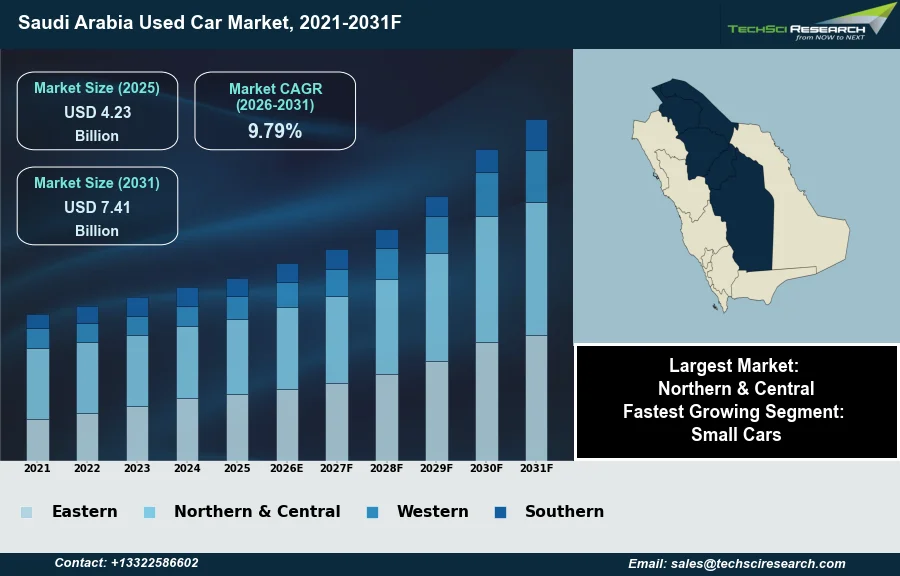
Saudi Arabia used car market was valued at USD 6.83 Billion in 2024 and is expected to reach USD 11.98 Billion by 2030 with a CAGR of 9.8% during the forecast period. The Saudi Arabia used car market is witnessing robust growth driven by a confluence of economic, regulatory, and technological factors. Rising awareness around cost efficiency and value retention has made used vehicles an increasingly attractive option for both urban and rural consumers. The government's Vision 2030 initiative, which aims to diversify the economy and increase disposable income, has boosted middle-class spending, further fueling demand for affordable transportation solutions such as pre-owned vehicles. Additionally, the high initial depreciation rate of new cars in the Kingdom—often up to 30% in the first year—encourages price-sensitive buyers to opt for used alternatives. Another critical driver is the growing digitalization of automotive transactions, with platforms like Syarah, CarSwitch, and SaudiSale offering transparent, hassle-free online car buying and selling experiences. The expansion of fintech solutions and online vehicle inspection services has also improved trust in used car transactions, particularly among first-time and individual buyers. With more expats settling in Saudi Arabia due to recent labor market liberalization, the demand for budget-friendly used cars has surged. Moreover, the removal of the ban on women driving in 2018 has added a new segment of buyers, amplifying the need for affordable mobility. The increasing cost of new vehicles, impacted by global supply chain issues and VAT implementation, has further pivoted consumer preference toward used models. Environmental considerations are subtly shaping trends too, with some urban consumers favoring well-maintained fuel-efficient used cars over purchasing newer, less sustainable models. Market activity is also bolstered by a rise in certified pre-owned programs offered by established dealerships, providing warranties and financing options that elevate buyer confidence. Despite a traditionally fragmented and informal market, government efforts to standardize vehicle inspections, enforce documentation, and promote formal dealerships are gradually organizing the sector. Furthermore, rising social media usage and influencer-driven marketing are playing a role in educating younger buyers about the advantages of the used car market. As a result, the used car landscape in Saudi Arabia is becoming increasingly structured, technology-enabled, and buyer-friendly, signaling a shift toward maturity in what was once an underregulated segment. With favorable demographics, increasing urbanization, and digital integration, the market is poised for continued expansion in the coming years.

Key Market Drivers

Economic Diversification and Shifting Consumer Preferences Due to Vision 2030

One of the most significant drivers of the Saudi Arabia used car market is the broader economic transformation ushered in by the Kingdom’s Vision 2030 initiative. As part of this national plan, the government is actively working to reduce dependency on oil revenues by expanding sectors such as tourism, logistics, and services, which has led to rising employment opportunities, especially among young Saudis and expatriates. This socioeconomic shift is creating a more cost-conscious middle class that prioritizes value-for-money purchases. Used cars, with their lower upfront cost and slower depreciation curve, offer an appealing alternative to new vehicles—particularly as ownership becomes more about utility and less about status. The affordability of pre-owned vehicles allows a larger portion of the population to participate in the automotive economy without incurring heavy debt or financial burden. Furthermore, Vision 2030 also aims to increase female workforce participation and reduce reliance on public sector jobs, which has led to a growing segment of first-time buyers—including women—seeking practical mobility solutions. With new car prices escalating due to VAT introduction (5% in 2018, increased to 15% in 2020), higher insurance costs, and customs duties, many middle-income individuals are turning to the used car market to meet their needs for personal transportation. This macroeconomic transformation is fundamentally reshaping automotive consumption behavior and lending long-term momentum to the pre-owned vehicle segment in the Kingdom.

Digitalization and Emergence of Online Used Car Platforms

The rapid adoption of digital technology and e-commerce platforms has revolutionized the used car buying experience in Saudi Arabia, serving as a major growth driver for the market. Traditionally dominated by informal roadside dealers or classified ads, the used car industry has become more organized and accessible with the emergence of tech-enabled platforms such as Syarah, CarSwitch, YallaMotor, and Haraj. These digital players offer services such as online listings, vehicle history reports, financing options, and doorstep delivery, reducing buyer anxiety around quality and transaction transparency. Additionally, some platforms now provide certified pre-owned programs, where vehicles undergo a comprehensive inspection process and are sold with limited warranties—significantly improving consumer trust. With internet penetration exceeding 98% in the Kingdom and smartphone usage widespread among the youth, more consumers are opting to search, compare, and purchase vehicles online. Furthermore, the availability of AI-powered price comparison tools and digital vehicle evaluation services ensures that customers receive fair market prices, encouraging even reluctant buyers to consider second-hand options. Online platforms also enable used car dealerships to expand their customer base geographically, reaching buyers across cities and remote regions without the need for a physical showroom. This evolution has made the market more dynamic, competitive, and transparent, and is especially appealing to tech-savvy millennials and Gen Z consumers who expect frictionless, digitally native purchase experiences. As a result, digital transformation is not just complementing the physical used car market—it is leading its next phase of growth.

High Depreciation of New Cars and Growing Awareness of Value Retention

Another critical factor driving the used car market in Saudi Arabia is the steep depreciation rate of new vehicles, which has made consumers increasingly aware of the long-term value proposition of buying used. A brand-new car in Saudi Arabia can lose 20% to 30% of its value within the first year, and up to 50% over the first three years. This depreciation is particularly severe in a market where imported vehicles dominate, and frequent model upgrades can reduce resale values sharply. As a result, many financially savvy buyers are now choosing second-hand vehicles that have already undergone the largest depreciation hit, thus preserving more value over time. This awareness is further strengthened by the proliferation of content around total cost of ownership (TCO), including factors like insurance, registration, maintenance, and fuel costs. Used cars, especially those that are two to four years old, are often available in good condition with modern features at significantly lower prices than new models. Additionally, the growing availability of vehicle history databases, digital maintenance records, and third-party inspection services has reduced concerns around reliability, making used cars more attractive to a wider segment of consumers. Fleet operators and car rental companies also frequently offload well-maintained vehicles after short lease periods, feeding high-quality inventory into the used car market. The perception shift from “risky purchase” to “smart investment” is causing more individuals, institutions, and even first-time buyers to consider second-hand vehicles as a practical and economically sound option, thereby fueling sustained demand.


Download Free Sample Report

Key Market Challenges

Fragmented Market and Lack of Regulatory Oversight

One of the most persistent challenges facing the Saudi Arabia used car market is its highly fragmented and informal structure, particularly in the low- to mid-priced vehicle segments. A significant portion of used car sales still occur through unorganized dealers, private sellers, and roadside showrooms, many of which operate with minimal regulatory compliance or consumer protection mechanisms. This fragmented landscape undermines buyer confidence, as there is often limited transparency around vehicle history, pricing consistency, accident records, and odometer tampering. Unlike organized platforms or certified pre-owned programs, informal transactions frequently lack warranty coverage, standardized inspection procedures, or financing options, leaving buyers vulnerable to post-sale issues. Furthermore, disputes over quality, documentation, and hidden defects are difficult to resolve due to the absence of formal grievance redressal mechanisms or industry-wide dispute settlement frameworks. While government initiatives are underway to digitalize vehicle records and improve documentation via platforms such as the Saudi Traffic Department's “Absher” system, the transition remains incomplete and uneven across regions. The lack of centralized databases, poor enforcement of consumer rights, and loopholes in trade regulation create a trust deficit, particularly among first-time buyers, expatriates, and women. Without robust policy enforcement and a streamlined ecosystem of dealers, inspectors, and financial institutions, the used car market risks losing potential customers to more formal mobility options like car subscriptions or leasing.

Limited Financing Options and High Interest Rates for Used Cars

Access to affordable vehicle financing remains a major bottleneck in the Saudi Arabia used car market, particularly for individuals from low- and middle-income groups who form the largest consumer base. While banks and Islamic finance institutions readily offer loans for new vehicles with favorable interest rates and longer tenures, financing for used cars is still seen as riskier due to depreciation concerns, resale uncertainty, and inconsistent vehicle conditions. As a result, most lenders either avoid financing second-hand cars or impose higher interest rates, shorter tenures, and stricter eligibility criteria. For instance, used car loans in the Kingdom may come with annual percentage rates (APRs) that are 2–4% higher than new car loans, significantly increasing the cost of ownership over time. Additionally, many financial institutions only provide loans for vehicles that are less than five years old, narrowing choices for budget-conscious buyers. The lack of tailored loan products, especially for unbanked or gig economy workers, further limits the reach of organized used car sales. While some online platforms and fintech startups have begun offering innovative credit solutions, such as digital EMI calculators and buy-now-pay-later (BNPL) options, their market penetration remains low. Without wide-scale collaboration between banks, NBFCs, and digital marketplaces, the used car ecosystem remains financially inaccessible to a large portion of the population, thereby capping its potential growth.

Inadequate After-Sales Support and Quality Assurance

Another critical challenge in the Saudi used car market is the lack of consistent after-sales support and quality assurance, particularly outside the certified pre-owned (CPO) segment. While new car buyers in the Kingdom enjoy extensive warranty coverage, free servicing packages, and manufacturer-backed support, used car buyers—especially those purchasing from private sellers or non-certified dealerships—often receive no formal after-sales care. This gap leads to higher long-term maintenance costs and discourages many buyers from engaging in the used car market. Even in cases where dealers offer limited warranties, coverage is usually restricted to a few months or limited components, with no transparency on service standards. In a market where the average car age is rising and road conditions can vary drastically between urban and rural regions, the importance of mechanical reliability and post-sale service becomes even more critical. The lack of standardized inspection protocols before sale also means many used cars are sold with hidden engine issues, frame damage, or faulty electronics, which only surface after several months of use. Additionally, spare part availability for older or imported models can be a concern, increasing repair times and costs. This leads to a perception that used cars are unreliable and financially risky, especially among new drivers, women, and expatriates unfamiliar with local repair ecosystems. Without structured after-sales networks, service partnerships, and nationwide quality monitoring frameworks, the used car market remains vulnerable to reputation damage and customer churn.

Key Market Trends

Rise of Certified Pre-Owned (CPO) Programs by OEMs and Dealerships

One of the most transformative trends in the Saudi Arabian used car market is the increasing prominence of Certified Pre-Owned (CPO) programs, introduced by both original equipment manufacturers (OEMs) and large organized dealerships. These programs aim to bridge the trust gap that has traditionally plagued the second-hand vehicle segment by offering thoroughly inspected, refurbished, and warranty-backed vehicles. Major automotive brands such as Toyota, Nissan, Ford, and Hyundai, along with prominent dealership groups like Abdul Latif Jameel and Aljomaih Automotive, now provide structured CPO schemes with multi-point inspections, free servicing for limited durations, and extended warranties—similar to those offered on new vehicles. This trend is helping to formalize the used car ecosystem, encouraging customers who were once hesitant to consider used cars due to concerns over reliability and post-sale risks. Moreover, CPO vehicles are often bundled with attractive financing options and buyback guarantees, making them a compelling alternative for value-conscious consumers who seek peace of mind. As customers become more quality-sensitive and digitally informed, the preference is shifting from informal sellers to branded, certified, and guaranteed vehicles that offer better resale value, easier financing, and consistent service support. This trend is expected to gain further momentum as competition intensifies and customer service becomes a key differentiator in the used vehicle segment.

Increasing Popularity of Online-Only and Omni-Channel Sales Models

Saudi Arabia’s used car market is undergoing rapid digital transformation, with online-only and omni-channel sales platforms emerging as key influencers in reshaping customer buying behavior. Companies like Syarah, CarSwitch, Motory, and OpenSooq are redefining the car buying experience by offering features such as digital vehicle listings, 360-degree virtual tours, real-time price comparisons, home test drives, and doorstep delivery. These platforms are leveraging artificial intelligence, data analytics, and mobile apps to provide personalized recommendations, predict price drops, and ensure buyers receive fair market deals. Notably, some platforms even offer 7-day return policies and integrated vehicle financing, which mirror the experience of shopping for consumer goods online. Meanwhile, traditional dealers are also adopting omni-channel strategies, allowing customers to begin their car purchase journey online and complete the transaction offline or vice versa. This hybrid model provides greater flexibility and convenience to the buyer while enhancing inventory exposure for sellers. Furthermore, the online channel is increasingly being used to sell luxury and imported used cars, which benefit from wider market access and trust-based digital experiences. As internet penetration nears universal levels and the Saudi government continues to push for e-commerce adoption, the online and omni-channel models are expected to become the default standard for used car transactions in the Kingdom.

Growing Focus on Women Buyers and First-Time Drivers Post 2018

The removal of the ban on women driving in Saudi Arabia in 2018 has had a profound impact on the automotive landscape, particularly the used car market. This policy shift introduced millions of potential new drivers, many of whom are more inclined to opt for affordable, easy-to-maintain, and smaller used cars rather than expensive new models. The growing financial independence of Saudi women, combined with changing social norms and a surge in employment opportunities, has created a new demographic that is actively seeking mobility solutions. Automakers, used car dealers, and digital platforms are all adapting to this shift by offering tailored services such as female-only customer support teams, women-focused marketing campaigns, and vehicles that emphasize safety, ease of handling, and fuel economy. Additionally, women are increasingly participating in online car buying, appreciating the convenience, transparency, and lower-pressure environment compared to visiting traditional showrooms. As a result, the market is seeing an uptrend in demand for compact sedans, hatchbacks, and fuel-efficient SUVs, especially from brands known for reliability, such as Toyota, Honda, and Hyundai. This growing inclusivity not only expands the addressable market for used cars but also enhances customer diversity and strengthens long-term industry sustainability. Dealerships that successfully capture and cater to the needs of this emerging customer base are likely to gain a significant competitive edge in the years ahead.

Segmental Insights

End Use Insights

In Saudi Arabia, Individual consumers form the largest end-user segment in the Saudi used car market. This includes locals, expatriates, working professionals, and students who prefer used cars for their cost-effectiveness, reliability, and ease of ownership. The removal of the driving ban for women has significantly expanded the pool of individual buyers, adding millions of new drivers to the market. Used vehicles—especially those under SAR 50,000—are widely accessible to individuals who seek low upfront costs, flexible payment options, and affordable insurance premiums. This segment is also highly active in the digital space, using platforms like Syarah, Motory, and CarSwitch to compare, purchase, and finance vehicles online. Individual buyers primarily seek petrol-powered, small to mid-size vehicles with low mileage and strong service records. The rise in disposable income, increasing urbanization, and growing digital literacy are reinforcing this segment’s dominance, making it the most vibrant and rapidly evolving category in the market.

Vehicle Type Insights

In Saudi Arabia, Mid-size cars constitute a core segment of the used vehicle landscape, bridging the gap between affordability and premium features. These vehicles are favored by working professionals, small families, and ride-hailing service providers. They offer more cabin space, enhanced comfort, and better performance than small cars, while still being cost-effective in the second-hand market. Popular models include Toyota Camry, Honda Accord, Hyundai Sonata, and Nissan Altima. The mid-size car segment benefits from high original vehicle sales, ensuring a steady flow of inventory into the used market. Additionally, many of these cars come from lease returns, trade-ins, or certified pre-owned programs, which improves the quality and documentation of available vehicles. Mid-size cars are especially attractive to individuals looking for a balanced mix of status, comfort, and cost-effectiveness, making this segment highly resilient to economic fluctuations. With rising consumer awareness and improving financing options, mid-size cars are increasingly seen as reliable alternatives to new vehicles.


Download Free Sample Report

Regional Insights

In Saudi Arabia, the Northern & Central region, anchored by Riyadh, is the leading region in the Saudi Arabian used car market. Riyadh, being the capital and the most populous city, drives the majority of the demand due to its concentration of government institutions, corporate offices, and a large working-class population. The Central region benefits from a diverse demographic profile, including a high percentage of expatriates and middle-income families, all of whom actively participate in the used vehicle ecosystem. Small and mid-size petrol cars dominate transactions in this region, with high turnover on digital platforms and physical dealerships alike. Riyadh’s highly developed infrastructure, abundance of vehicle inspection centers, and access to financing options make it a hub for organized used car transactions, including certified pre-owned (CPO) programs. The presence of major rental and fleet management companies further increases the availability of well-maintained used vehicles. This region also sees strong repeat buying behavior due to short vehicle ownership cycles. As a result, the Northern & Central region maintains its position as the largest and most structured used car market in the Kingdom.

Recent Developments

  • In 2024, Leading online used-car platform Syarah raised $60 million in a Series C round, backed by investors including Artal Capital, Tawuniya, Elm, Impact46, and Derayah Ventures. This boost strengthens its capabilities in vehicle refurbishing, inspection, and expanded market reach.
  • Lumi Rental Company, part of Seera Group, inaugurated its second used-car outlet in Jeddah in June 2023, signaling the brand’s deepening footprint in Saudi’s secondary market and diversified consumer access.
  • In 2025, Chinese EV luxury brand ROX Motor officially entered the Saudi market by unveiling its ROX 01 electric SUV at the LEAP 2025 conference and opening its first Riyadh showroom, marking the start of its Gulf expansion strategy.
  • In 2025, Tesla announced plans to begin local sales in April 2025, debuting models across showrooms and pop-up stores. Arab News confirmed the launch date of April 10, further strengthening Saudi’s EV ecosystem.

Key Market Players

  • Abdul Latif Jameel Motors
  • AlFuttaim Automotive
  • AlTayer Motors
  • AlNabooda Automobiles
  • Arabian Auto Agency
  • Aljomaih Automotive
  • Syarah Ltd
  • CarSwitch
  • SaudiSale
  • YallaMotor.

By Vehicle Type

By Fuel Type

By End Use

By Region

  • Small Cars
  • Mid-Size Cars
  • Luxury Cars
  • Petrol
  • Diesel
  • CNG
  • Institutional
  • Individual
  • Northern & Central
  • Southern
  • Eastern
  • Western


Report Scope:

In this report, the Saudi Arabia Used Car market has been segmented into the following categories, in addition to the industry trends which have also been detailed below:

  • Saudi Arabia Used Car Market, By Vehicle Type:

o   Small Cars

o   Mid-Size Cars

o   Luxury Cars

  • Saudi Arabia Used Car Market, By Fuel Type:

o   Petrol

o   Diesel

o   CNG

  • Saudi Arabia Used Car Market, By End Use:

o   Institutional

o   Individual

  • Saudi Arabia Used Car Market, By Region:

o   Northern & Central

o   Southern

o   Eastern

o   Western

Competitive Landscape

Company Profiles: Detailed analysis of the major companies presents in the Saudi Arabia Used Car market.

Available Customizations:

Saudi Arabia Used Car market report with the given market data, TechSci Research offers customizations according to a company's specific needs. The following customization options are available for the report:

Company Information

  • Detailed analysis and profiling of additional market players (up to five).

Saudi Arabia Used Car Market is an upcoming report to be released soon. If you wish an early delivery of this report or want to confirm the date of release, please contact us at [email protected]  

Table of content

Table of content

1. Introduction

1.1. Product Overview

1.2. Key Highlights of the Report

1.3. Market Coverage

1.4. Market Segments Covered

1.5. Research Tenure Considered

2. Research Methodology

2.1. Methodology Landscape

2.2. Objective of the Study

2.3. Baseline Methodology

2.4. Formulation of the Scope

2.5. Assumptions and Limitations

2.6. Source of Research

2.7. Approach for the Market Study

2.8. Methodology Followed for Calculation of Market Size & Market Shares

2.9. Forecasting Methodology

3. Executive Summary

3.1. Overview of the Market

3.2. Overview of Key Market Segmentations

3.3. Overview of Key Market Players

3.4. Overview of Key Regions

3.5. Overview of Market Drivers, Challenges, and Trends

4. Saudi Arabia Used Car Market Outlook

4.1. Market Size & Forecast

4.1.1. By Value

4.2. Market Share & Forecast

4.2.1. By Vehicle Type Market Share Analysis (Small Cars, Mid-Size Cars, Luxury Cars)

4.2.2. By Fuel Type Market Share Analysis (Petrol, Diesel, CNG)

4.2.3. By End Use Market Share Analysis (Institutional, Individual)

4.2.4. By Regional Market Share Analysis

4.2.5. By Top 5 Companies Market Share Analysis, Others (2024)

4.3. Saudi Arabia Used Car Market Mapping & Opportunity Assessment

4.3.1. By Vehicle Type Market Mapping & Opportunity Assessment

4.3.2. By Fuel Type Market Mapping & Opportunity Assessment

4.3.3. By End Use Market Mapping & Opportunity Assessment

4.3.4. By Regional Market Mapping & Opportunity Assessment

5. Saudi Arabia Small Cars Market Outlook

5.1. Market Size & Forecast 

5.1.1. By Value

5.2. Market Share & Forecast

5.2.1. By Fuel Type Market Share Analysis

5.2.2. By End Use Market Share Analysis

6. Saudi Arabia Mid-Size Cars Market Outlook

6.1. Market Size & Forecast 

6.1.1. By Value

6.2. Market Share & Forecast

6.2.1. By Fuel Type Market Share Analysis

6.2.2. By End Use Market Share Analysis

7. Saudi Arabia Luxury Cars Market Outlook

7.1. Market Size & Forecast 

7.1.1. By Value

7.2. Market Share & Forecast

7.2.1. By Fuel Type Market Share Analysis

7.2.2. By End Use Market Share Analysis

8. Market Dynamics

8.1. Drivers

8.2. Challenges

9. Market Trends & Developments

9.1. Merger & Acquisition (If Any)

9.2. Vehicle Type Launches (If Any)

9.3. Recent Developments

10. Disruptions: Conflicts, Pandemics and Trade Barriers

11. Porters Five Forces Analysis

11.1. Competition in the Industry

11.2. Potential of New Entrants

11.3. Power of Suppliers

11.4. Power of Customers

11.5. Threat of Substitute Product

12. Policy & Regulatory Landscape

13. Saudi Arabia Economic Profile

14. Competitive Landscape

14.1. Company Profiles

14.1.1. Abdul Latif Jameel Motors.

14.1.1.1. Business Overview

14.1.1.2. Company Snapshot

14.1.1.3. Product & Services

14.1.1.4. Financials (As Per Availability)

14.1.1.5. Key Market Focus & Geographical Presence

14.1.1.6. Recent Developments

14.1.1.7. Key Management Personnel

14.1.2. AlFuttaim Automotive

14.1.3. AlTayer Motors

14.1.4. AlNabooda Automobiles

14.1.5. Arabian Auto Agency

14.1.6. Aljomaih Automotive

14.1.7. Syarah Ltd

14.1.8. CarSwitch

14.1.9. SaudiSale

14.1.10. YallaMotor.

15. Strategic Recommendations

15.1. Key Focus Areas

15.1.1. Target Vehicle Type

15.1.2. Target End Use

15.1.3. Target Region

16. About Us & Disclaimer

Figures and Tables

Frequently asked questions

Frequently asked questions

The market size of the Saudi Arabia Used Car Market is estimated to be USD 6.83 Billion in 2024.

Major trends in the Saudi Arabia Used Car market include Sustainability Awareness and Preference for Fuel-Efficient Used Vehicles, Growing Focus on Women Buyers and First-Time Drivers Post 2018 Increasing Popularity of Online-Only and Omni-Channel Sales Models Rise of Certified Pre-Owned (CPO) Programs by OEMs and Dealerships. These trends reflect evolving consumer preferences and industry responses to create distinct and appealing offerings.

Major challenges for the Saudi Arabia Used Car market encompass Inadequate After-Sales Support and Quality Assurance, Limited Financing Options and High Interest Rates for Used Cars, Fragmented Market and Lack of Regulatory Oversight. Understanding these challenges is critical for stakeholders to strategize effectively and ensure long-term growth in this competitive market.

The major driver for the Saudi Arabia Used Car market includes High Depreciation of New Cars and Growing Awareness of Value Retention, Digitalization and Emergence of Online Used Car Platforms, Economic Diversification and Shifting Consumer Preferences Due to Vision 2030. These factors collectively contribute to the market's dynamic growth and appeal to diverse end consumers.

Related Reports

We use cookies to deliver the best possible experience on our website. To learn more, visit our Privacy Policy. By continuing to use this site or by closing this box, you consent to our use of cookies. More info.