|
Key Insights
|
Details
|
|
Forecast Period
|
2027-2031
|
|
Market Size (2025)
|
USD 1.24 Billion
|
|
CAGR (2026-2031)
|
8.38%
|
|
Fastest Growing Segment
|
Shoes
|
|
Largest Market
|
Northern & Central
|
|
Market Size (2031)
|
USD 2.01 Billion
|
Market Overview
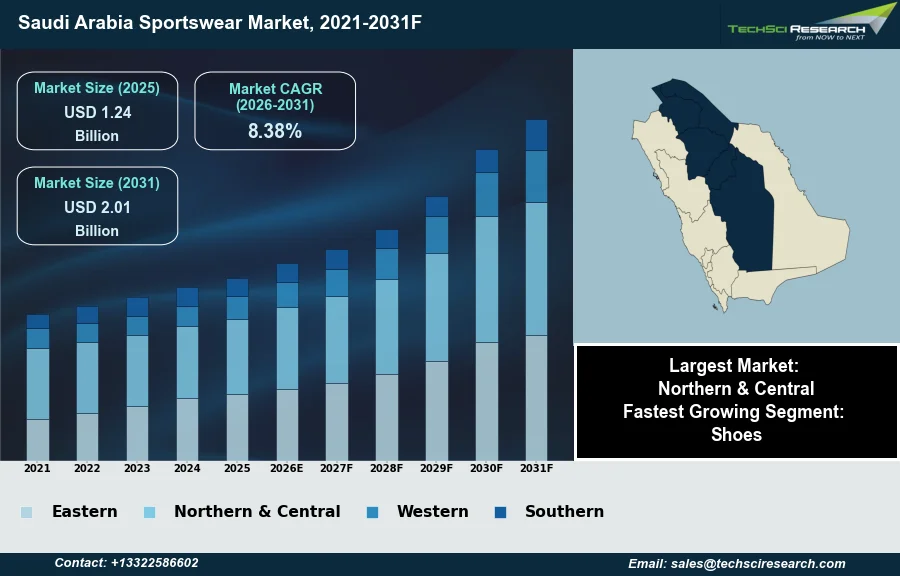
The Sportswear Market in Saudi Arabia will grow from USD 1.24 Billion in 2025 to USD 2.01 Billion by 2031 at a 8.38% CAGR. Sportswear defines a category of apparel and accessories designed for physical activities, providing specialized comfort, flexibility, and performance-enhancing features. The Saudi Arabia sportswear market's expansion is significantly propelled by substantial government initiatives, particularly Vision 2030, which actively fosters health and fitness through strategic investments in sports infrastructure and events to improve overall quality of life. Simultaneously, a rising health and fitness consciousness among the Saudi populace, notably younger demographics, drives increased participation in various sports and wellness activities. According to the Saudi Sports for All Federation's 2024 Annual Report, 58.5% of adults were engaged in physical activity for at least 150 minutes, indicating a robust underlying demand for athletic wear and equipment.
However, a principal challenge impeding market growth involves navigating inherent cultural sensitivities and gender-specific preferences, particularly concerning the demand for modest sportswear options for female consumers. International brands frequently encounter difficulties in adapting global designs to conform with local traditional norms, which impacts product acceptance and market penetration.
Key Market Drivers
Vision 2030 Initiatives Driving Sportswear Growth
Government initiatives and Vision 2030 sports development are significantly propelling the Saudi Arabia sportswear market. The Kingdom's strategic focus on enhancing quality of life and diversifying its economy through sports has led to substantial investment in infrastructure and programs. For example, according to SceneNow, in November 2025, the Ministry of Sport announced a SAR 1.7 billion investment in three sports initiatives for the 2024-2025 season, specifically aimed at boosting club development and enhancing the nation's overall sports sector profile. This commitment extends to developing sports facilities, organizing major events, and fostering a robust domestic sports industry, which directly stimulates demand for athletic apparel.
Rising Health Consciousness Driving Sportswear Demand
Concurrently, growing health and fitness awareness among the Saudi populace is a crucial driver. There is an observable shift towards more active lifestyles, with increasing participation in various physical activities and wellness programs. This trend is evident in the expanding fitness club sector; according to GymNation's UAE & KSA Health & Fitness Report 2026, released in January 2026, 51% of their members in Saudi Arabia and the UAE had no gym membership in the 12 months prior to joining, indicating a surge in new entrants to organized fitness activities. This rising health consciousness fuels consistent demand for specialized sportswear that offers comfort, durability, and performance. Overall, the broader Saudi sports market reflects this dynamism, with the Vice Minister of Sport, Bader Alkadi, noting in December 2025, at the Saudi Budget Forum 2026, that the market is currently valued at SAR 32 billion.
Download Free Sample Report
Key Market Challenges
Cultural sensitivities and modestwear demand constrain market growth
A principal challenge impeding the growth of the Saudi Arabia sportswear market involves navigating inherent cultural sensitivities and gender-specific preferences. This is particularly evident in the demand for modest sportswear options for female consumers. International brands frequently encounter difficulties in adapting their global designs to conform with local traditional norms, which directly impacts product acceptance and subsequently limits market penetration.
Rising female participation not matched by modest sportswear supply
This challenge hampers market expansion by creating a significant gap between rising female engagement in sports and the availability of suitable athletic wear. According to the Saudi Sports for All Federation, in 2026, female participation in the Riyadh Marathon rose to 25.8 percent, compared to 18.7 percent in the inaugural 2022 edition. Despite this demonstrable increase in active female participants, the market struggles to provide adequate modest sportswear. This misalignment means that a substantial segment of the consumer base remains underserved, directly curtailing potential sales volume and inhibiting the overall expansion of the sportswear market.
Key Market Trends
Athleisure Expansion in Saudi Sportswear
Athleisure adoption beyond traditional activewear represents a significant trend in the Saudi Arabia sportswear market, as consumers increasingly integrate athletic apparel into their daily fashion choices. This shift is driven by a desire for comfort and versatility, extending sportswear's utility beyond purely fitness-related activities to casual and social settings. Brands are responding by offering designs that blend performance features with contemporary aesthetics, appealing to a broader consumer base seeking functional yet stylish clothing for various aspects of their lives. This growing lifestyle segment contributed to the sportswear and activewear market reaching SAR 7.5 billion in 2025.
Online Retail Expansion and D2C Growth
The expansion of e-commerce and digital retail channels is profoundly reshaping how sportswear is accessed and purchased across Saudi Arabia. The widespread digital penetration and a tech-savvy population are propelling consumers towards online platforms for their sportswear needs, offering convenience, wider product selections, and competitive pricing. This digital transformation enables both international and local brands to reach consumers nationwide, bypassing traditional retail limitations and fostering direct-to-consumer relationships. Reflecting this robust growth, e-commerce sales via mada cards in Saudi Arabia exceeded SAR 30.7 billion in October 2025, marking a 68% year-on-year increase compared to October 2024, according to the Saudi Central Bank statistical bulletin.
Segmental Insights
Growth Fueled by Health Consciousness and Active Lifestyles
The Shoes segment is rapidly expanding within the Saudi Arabia Sportswear Market, primarily driven by a significant increase in health consciousness and active lifestyles among the population. Government initiatives, such as the Ministry of Sports' "Quality of Life Program" under Vision 2030, actively promote widespread sports participation and invest in fitness infrastructure, directly boosting demand for athletic footwear. Concurrently, technological advancements in footwear design, offering enhanced comfort and performance through innovative materials, are appealing to consumers. The growing influence of athleisure trends, integrating sports shoes into everyday fashion, further solidifies this segment's robust growth.
Regional Insights
Northern & Central Region: Market Leader Driven by Affluence, Demographics, and Vision 2030 Initiatives
The Northern & Central region emerges as the leading segment within the Saudi Arabia sportswear market, primarily driven by its significant economic and demographic influence. This dominance stems from the concentration of a substantial and affluent consumer base, particularly within Riyadh, which serves as the capital and a major economic hub. The region benefits from higher disposable incomes and a pronounced inclination towards active lifestyles, further stimulated by the presence of a robust retail infrastructure accommodating both international and local sportswear brands. Additionally, strategic government initiatives under Saudi Vision 2030, such as the Quality of Life Program and infrastructure projects like the Sports Boulevard, actively promote health and sports participation, thereby fueling consistent demand for sportswear in this central area.
Recent Developments
-
In October 2025, Saudia, the national flag carrier of Saudi Arabia, unveiled its new premium lifestyle brand, "SV by Saudia," at Riyadh Fashion Week. The collection, which featured 40 runway pieces, was developed in collaboration with a Saudi designer and blended aviation-inspired details with modern global trends. It included ready-to-wear apparel, travel essentials, and accessories that emphasized sophistication and movement. This new product launch by Saudia signifies its foray into the broader fashion and lifestyle segment, which often overlaps with and influences the sportswear and athleisure market in Saudi Arabia.
-
In October 2024, adidas, in collaboration with the Saudi fashion label Kaf by Kaf, presented its inaugural regional runway show in Saudi Arabia. This event unveiled the Spring-Summer 2025 Sportswear Collection, which notably fuses traditional Saudi garments with contemporary athletic styles. The collection, designed by the creative force behind Kaf by Kaf, emphasizes versatility through unisex pieces, drawing inspiration from iconic local attire like abayas and headscarves, and was set to be available for purchase globally in February 2025. This initiative represents a direct collaboration enhancing the Saudi Arabia sportswear market by integrating local cultural aesthetics with global athletic wear.
-
In September 2024, the Saudi Olympic & Paralympic Committee (SOPC) announced a new official partnership agreement with ASICS. Under this multi-year collaboration, ASICS was appointed as the Official Kit Partner for Team Saudi, providing official sportswear for major international sporting events from 2025 to 2028. These events include the Islamic Solidarity Games, Asian Games, and the Olympic and Paralympic Games. The kits will be designed to meet global competition standards while showcasing Saudi culture and national sporting progress, marking a significant development for sportswear in the Kingdom.
-
In February 2024, adidas disclosed substantial expansion plans within the Saudi Arabia sportswear market, including a strategic partnership with the Saudi Pro League. As part of this collaboration, adidas became the official match ball supplier for the league starting from February 2024. Concurrently, the company announced its intention to establish 100 new retail stores across the Kingdom by 2025. This dual approach of forming a significant league partnership and expanding retail presence directly impacts the availability and branding of sportswear products in Saudi Arabia.
Key Market Players
- Nike KSA
- Adidas KSA
- Puma KSA
- Under Armour KSA
- Alshaya Sport
- Jarir Sportswear
- Extra Sport
- Lulu Sport
- HyperPanda Sport
- Amazon.sa Sportswear
|
By Product Type
|
By End User
|
By Sales Channel
|
By Region
|
|
|
|
- Online
- Specialty Stores
- Supermarkets/Hypermarkets
- Others
|
- Eastern
- Northern & Central
- Western
- Southern
|
Report Scope:
In this report, the Saudi Arabia Sportswear Market has been segmented into the following categories, in addition to the industry trends which have also been detailed below:
-
Saudi Arabia Sportswear Market, By Product Type:
-
Saudi Arabia Sportswear Market, By End User:
-
Saudi Arabia Sportswear Market, By Sales Channel:
-
Online
-
Specialty Stores
-
Supermarkets/Hypermarkets
-
Others
-
Saudi Arabia Sportswear Market, By Region:
-
Eastern
-
Northern & Central
-
Western
-
Southern
Competitive Landscape
Company Profiles: Detailed analysis of the major companies present in the Saudi Arabia Sportswear Market.
Available Customizations:
Saudi Arabia Sportswear Market report with the given market data, TechSci Research offers customizations according to a company's specific needs. The following customization options are available for the report:
Company Information
- Detailed analysis and profiling of additional market players (up to five).
Saudi Arabia Sportswear Market is an upcoming report to be released soon. If you wish an early delivery of this report or want to confirm the date of release, please contact us at sales@techsciresearch.com