|
Key Insights
|
Details
|
|
Forecast Period
|
2027-2031
|
|
Market Size (2025)
|
USD 312.45 Million
|
|
CAGR (2026-2031)
|
6.51%
|
|
Fastest Growing Segment
|
Premium Products
|
|
Largest Market
|
Northern & Central
|
|
Market Size (2031)
|
USD 456.17 Million
|
Market Overview
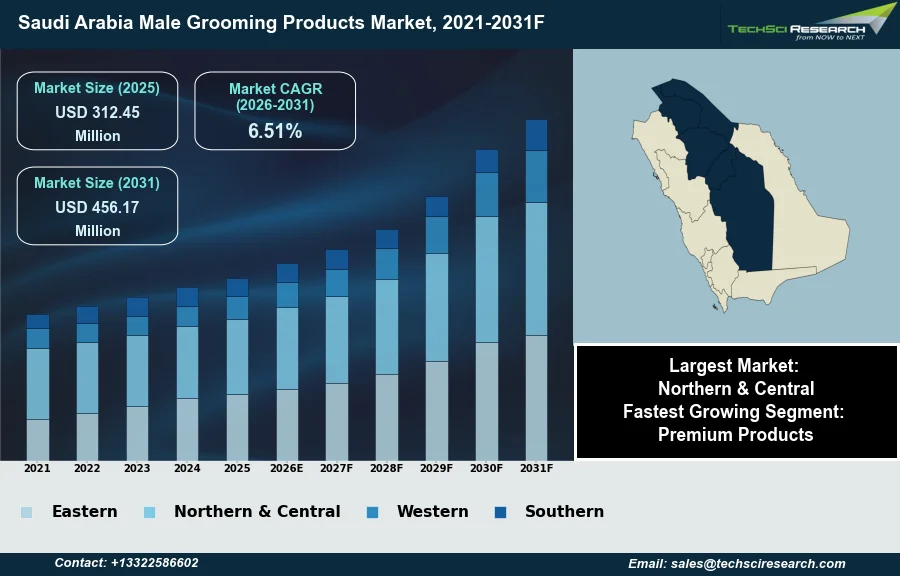
The Male Grooming Products Market in Saudi Arabia will grow from USD 312.45 Million in 2025 to USD 456.17 Million by 2031 at a 6.51% CAGR. Male grooming products comprise a diverse range of personal care items utilized by men to maintain and enhance their physical appearance, hygiene, and overall wellness. The Saudi Arabia Male Grooming Products Market is experiencing substantial growth, primarily driven by heightened personal grooming awareness among younger demographics, increasing disposable incomes, and evolving cultural perceptions. The pervasive influence of digital platforms and e-commerce also significantly contributes to this expansion. According to the Saudi General Authority for Statistics, in 2025, the annual average prices for the 'personal care, social protection and miscellaneous goods and services' division increased by 5.1%.
However, a notable impediment to market expansion remains cultural conservatism. Traditional social perceptions in certain segments of society can limit the adoption and open purchase of grooming products beyond basic hygiene, thereby affecting market penetration for specific product categories and potentially slowing growth in more traditional regions.
Key Market Drivers
E-commerce Expansion Drives Grooming Market Growth
The rapid expansion of e-commerce platforms is a significant driver within the Saudi Arabia male grooming products market, transforming how consumers access and purchase a diverse array of items. These platforms offer convenience, broader product selections, and a degree of privacy for purchases that might be influenced by cultural preferences. According to the Saudi Press Agency, citing the Saudi Central Bank in July 2025, e-commerce sales in the Kingdom via "Mada" cards during the first quarter of 2025 exceeded SAR 69.3 billion, representing an annual growth of 56%. This robust digital infrastructure enables brands to reach a wider audience, including those in more remote areas, facilitating increased market penetration and sales volumes for grooming essentials.
Rising Grooming Awareness Drives Market Growth
Concurrently, increasing awareness of personal grooming and hygiene is profoundly influencing market growth. Influenced by global trends, social media, and a growing emphasis on well-being, Saudi males are adopting more sophisticated grooming routines. This heightened awareness extends beyond basic hygiene to encompass skincare, haircare, and fragrance products. According to Global Business Outlook, in January 2026, spending on personal care products in Saudi Arabia rose by 31.7% in the week of January 3, 2026, as reported by the Saudi Central Bank, indicating strong consumer engagement. This trend is further supported by the Kingdom's extensive digital connectivity, with the General Authority for Statistics reporting in January 2026 that 99% of individuals aged 15 to 74 in Saudi Arabia use the internet.
Download Free Sample Report
Key Market Challenges
Cultural conservatism impedes market growth despite expanding manufacturing capacity.
Cultural conservatism represents a notable impediment to the growth of the Saudi Arabia Male Grooming Products Market. Traditional social perceptions in certain segments of society restrict the adoption and open purchase of grooming products beyond basic hygiene. This directly hampers market expansion by limiting penetration for specific product categories and potentially slowing growth in more traditional regions. While the industrial capacity for personal care products is developing, as indicated by the Saudi Food and Drug Authority reporting an 18% increase in licensed factories and warehouses within the cosmetics sector in 2025 compared to 2024, consumer adoption lags behind for non-essential items.
Conservative attitudes limit uptake of premium grooming and market diversification.
This conservative cultural outlook discourages men from purchasing or openly utilizing products perceived as being for aesthetic purposes rather than strictly for cleanliness. For example, specialized skincare routines, advanced hair styling products, or diverse fragrance collections for daily wear often encounter resistance. This market dynamic leads to strong performance in basic hygiene product sales while more specialized or premium male grooming categories struggle to realize their full market potential, thereby limiting overall market diversification and higher value growth.
Key Market Trends
Shift Toward Natural and Organic Formulations in Saudi Male Grooming
The Saudi Arabia Male Grooming Products Market is significantly shaped by a discernible shift towards natural and organic formulations. Consumers are increasingly scrutinizing product ingredients, driven by growing health consciousness and a desire to avoid synthetic chemicals. This preference extends to male grooming, where demand for products featuring plant-based ingredients, essential oils, and formulations free from parabens, sulfates, and artificial fragrances is rising. This trend encourages both local and international brands to innovate and expand their natural and organic offerings specifically tailored for the Saudi market. According to Arab News in February 2026, a major regional beauty retailer reported a 12% increase in consumer spending on natural ingredient-based personal care items across its Saudi Arabian stores, reflecting this evolving preference.
Halal Certification and Cultural Alignment in Grooming
Concurrently, a growing preference for Halal-certified and culturally resonant products is a major trend influencing the male grooming sector. As religious observance and cultural identity remain central to Saudi society, consumers actively seek products that adhere to Islamic principles, ensuring they are free from forbidden (haram) ingredients and are ethically produced. This encompasses not only ingredient purity but also the entire manufacturing and supply chain. Brands that successfully integrate Halal certification and local cultural elements, such as traditional fragrances or ingredients, gain significant consumer trust and market share. The Saudi Standards, Metrology and Quality Organization (SASO) noted in January 2026 that applications for Halal certification in the cosmetics and personal care sector in the Kingdom grew by 18% over the preceding year.
Segmental Insights
Drivers of premium segment growth
The Premium Products segment represents the fastest-growing category within the Saudi Arabia Male Grooming Products Market, propelled by several distinct factors. A key driver is the increase in disposable incomes, empowering male consumers to invest in superior personal care items. Concurrently, there is a heightened awareness and interest in personal grooming among Saudi men, influenced by global beauty trends and social media platforms showcasing advanced routines. This shift reflects a preference for high-quality ingredients and targeted solutions addressing specific concerns, alongside an appreciation for the aspirational value and self-confidence associated with premium offerings.
Regional Insights
Northern & Central Region's Market Leadership: Demographics, Affluence, and Digital Engagement
The Northern & Central region significantly leads the Saudi Arabia Male Grooming Products Market, primarily driven by its substantial population density and advanced urbanization. This region, encompassing major commercial and administrative centers such as Riyadh, features a considerable concentration of consumers with higher disposable incomes, fostering increased expenditure on premium grooming solutions. A large, youthful, and digitally engaged population, exposed to evolving global trends, further fuels demand for a diverse range of personal care products. This demographic shift, coupled with heightened awareness of personal hygiene and appearance, underpins the region's prominent market position.
Recent Developments
-
In February 2025, German brand owner Stada significantly expanded its Oilatum skincare range in Saudi Arabia with the launch of nine new products. This expansion introduced diverse offerings, including rich moisturizing creams and gentle body washes, directly addressing the prevalent skin concerns such as eczema and chronic dryness in the region. The initiative aimed to provide targeted solutions within the Saudi Arabia personal grooming market, acknowledging the impact of the country's extreme climate on skin health. These products, suitable for all genders, contribute to the growing options for male consumers seeking specialized skincare.
-
In January 2025, YA-MAN, a Japanese beauty device manufacturer, entered the Saudi Arabian market, marking its initial foray into the Middle East. The company made its "YA-MAN TOKYO JAPAN" brand and other beauty products available through an e-commerce platform and at aesthetic clinics in Riyadh. This strategic market entry aimed to introduce innovative beauty solutions to Saudi consumers. Although encompassing a broad range of beauty offerings, the launch of advanced skincare and aesthetic devices contributes to the evolving male grooming landscape in Saudi Arabia, where men are increasingly adopting comprehensive personal care routines.
-
In September 2024, FSN E-Commerce Ventures Ltd., the parent company of the Indian online fashion and beauty retailer Nykaa, established a new subsidiary in Saudi Arabia. This new entity was formed to facilitate the online and offline retail sale of beauty products within the Kingdom. Nykaa's entry into the Saudi market, with its diverse portfolio that typically includes male grooming products, is set to enhance product availability and competition in the Saudi Arabia Male Grooming Products Market, catering to the growing consumer interest in accessible personal care items.
-
In July 2024, Henkel, a global consumer goods company, inaugurated a new state-of-the-art beauty care manufacturing plant in Riyadh, Saudi Arabia. This facility was established to produce various products under the well-known Pert brand, including shampoos and conditioners. The launch of this manufacturing plant signifies a significant investment by Henkel to meet the increasing demand for high-quality personal care products in the Middle East, directly impacting the availability and innovation within the Saudi Arabia male grooming products market through its hair care offerings.
Key Market Players
- Procter & Gamble Grooming KSA
- Unilever Grooming KSA
- L'Oréal Men Expert KSA
- Gillette KSA
- Alshaya Grooming
- Jarir Grooming
- Extra Grooming
- HyperPanda Grooming
- Amazon.sa Grooming
- Hikma Grooming
|
By Type
|
By Price Range
|
By Sales Channel
|
By Region
|
- Male Toiletries
- Electrical Products
- After Shave Lotions
- Others
|
- Mass Products
- Premium Products
|
- Supermarkets/Hypermarkets
- Pharmacy Stores
- Online
- Others
|
- Eastern
- Northern & Central
- Western
- Southern
|
Report Scope:
In this report, the Saudi Arabia Male Grooming Products Market has been segmented into the following categories, in addition to the industry trends which have also been detailed below:
-
Saudi Arabia Male Grooming Products Market, By Type:
-
Male Toiletries
-
Electrical Products
-
After Shave Lotions
-
Others
-
Saudi Arabia Male Grooming Products Market, By Price Range:
-
Mass Products
-
Premium Products
-
Saudi Arabia Male Grooming Products Market, By Sales Channel:
-
Supermarkets/Hypermarkets
-
Pharmacy Stores
-
Online
-
Others
-
Saudi Arabia Male Grooming Products Market, By Region:
-
Eastern
-
Northern & Central
-
Western
-
Southern
Competitive Landscape
Company Profiles: Detailed analysis of the major companies present in the Saudi Arabia Male Grooming Products Market.
Available Customizations:
Saudi Arabia Male Grooming Products Market report with the given market data, TechSci Research offers customizations according to a company's specific needs. The following customization options are available for the report:
Company Information
- Detailed analysis and profiling of additional market players (up to five).
Saudi Arabia Male Grooming Products Market is an upcoming report to be released soon. If you wish an early delivery of this report or want to confirm the date of release, please contact us at sales@techsciresearch.com