|
Key Insights
|
Details
|
|
Forecast Period
|
2027-2031
|
|
Market Size (2025)
|
USD 1.23 Billion
|
|
CAGR (2026-2031)
|
5.75%
|
|
Fastest Growing Segment
|
Mobile Crane
|
|
Largest Market
|
Eastern
|
|
Market Size (2031)
|
USD 1.72 Billion
|
Market Overview
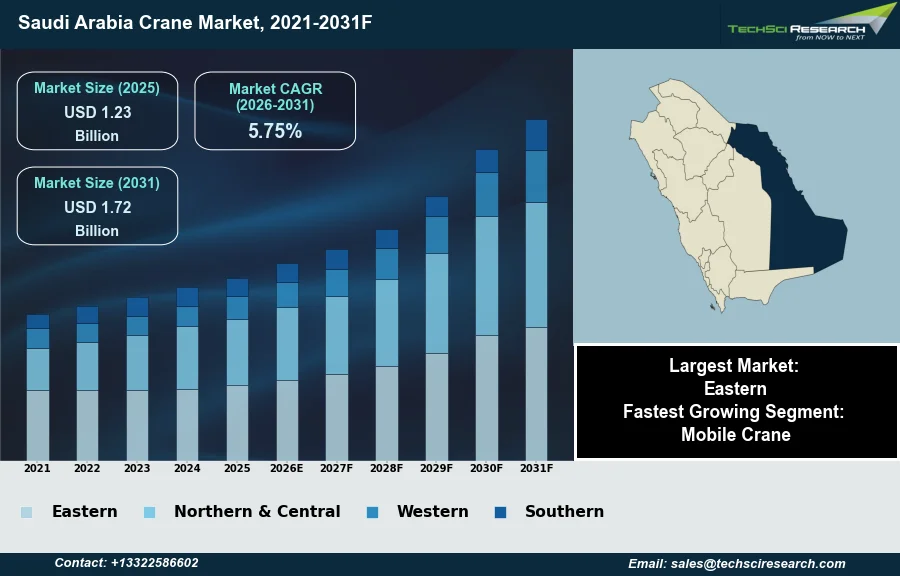
The Saudi Arabia Crane Market will grow from USD 1.23 Billion in 2025 to USD 1.72 Billion by 2031 at a 5.75% CAGR. A crane is a mechanical device engineered to lift, lower, and horizontally transport heavy materials, utilizing cables, pulleys, and a hoisting mechanism across various industrial and construction applications. The Saudi Arabia crane market's expansion is fundamentally propelled by the Kingdom's Vision 2030 initiatives, which include extensive giga-projects such as NEOM and the Red Sea Project. These strategic plans drive significant government investment in infrastructure development, residential construction, and economic diversification beyond oil, stimulating substantial demand for heavy lifting equipment.
This robust growth environment is supported by a dynamic construction sector. According to the Saudi General Authority for Statistics, in October 2025, the Construction Cost Index for the non-residential sector saw a 0.9% increase, primarily due to a 1.3% rise in equipment and machinery rental costs, largely driven by a 1.6% increase in the rental of equipment and machinery with operators. Despite these drivers, a significant impediment to market expansion remains the persistent challenge of labor and skills shortages within the construction industry, particularly for specialized equipment operators.
Key Market Drivers
Vision 2030 Giga-Projects and PIF Funding Drive Crane Demand
Saudi Vision 2030 and its ambitious giga-project development initiatives are instrumental in driving the Saudi Arabia crane market. These undertakings, exemplified by ventures such as NEOM, involve constructing vast new urban centers and strategic infrastructure, requiring extensive deployment of heavy lifting equipment. According to the Saudi Press Agency, in April 2026, the Public Investment Fund (PIF) announced it had invested more than $199 billion in new projects across Saudi Arabia from 2021 to 2025, underscoring the significant capital injection propelling these large-scale constructions. The sheer magnitude and complexity of these developments ensure a sustained, high demand for diverse crane types, essential for foundational work and superstructure erection.
Infrastructure Expansion and Industrial Growth Sustain Crane Demand
Further contributing to market expansion is the expansive infrastructure and urban development occurring throughout the Kingdom. Beyond the giga-projects, substantial investment is directed towards enhancing existing urban centers, building new residential and commercial facilities, and modernizing transportation networks, generating consistent demand for crane services. For instance, according to Middle East Briefing, in March 2026, Saudi Arabia is expected to construct 15 stadiums for the upcoming FIFA World Cup, with 11 of these yet to be built, indicating significant future construction needs for heavy lifting equipment. Overall, the Ministry of Industry and Mineral Resources reported that in 2025, 1,660 new industrial licenses were issued with investments exceeding SAR76 billion, reflecting robust growth in sectors heavily reliant on cranes.
Download Free Sample Report
Key Market Challenges
Skilled-Operator Shortage Hinders Crane Market Growth
The primary impediment to the expansion of the Saudi Arabia crane market is the persistent shortage of skilled labor, particularly specialized equipment operators. The extensive scope of Vision 2030 giga-projects, while driving demand for heavy lifting equipment, simultaneously exacerbates this critical workforce deficit. A lack of proficient crane operators directly translates into inefficient equipment utilization, impacting project timelines and increasing operational overheads for construction firms.
Labor Shortfall Slows Construction Pace and Crane Demand
This labor challenge severely hampers the ability of the construction sector to execute projects at the required pace. According to the National Labor and Social Development Ministry, in 2024, the Saudi construction industry required over 90,000 additional skilled workers to effectively meet project demands. Such a substantial shortfall for specialized roles, including those necessary for complex crane operations, leads to delays in key infrastructure and development initiatives. Consequently, the understaffing of projects slows down the deployment and subsequent demand for new cranes, thereby constraining market growth despite significant investment in infrastructure.
Key Market Trends
Rising demand for specialized tower cranes in Saudi megaprojects
The rising demand for specialized tower cranes is a significant trend, driven by the sheer scale and vertical complexity of ongoing urban and mega-projects across Saudi Arabia. These developments necessitate equipment capable of reaching extreme heights and managing heavy loads over extended durations for efficient vertical transportation. The intensive construction schedules and architectural ambitions inherent in these projects underscore the reliance on high-performance tower cranes. According to Construction Briefing, October 2025, one Diriyah construction project reportedly utilized 83 tower cranes, a record number for a single regional undertaking. This deployment illustrates the concentrated need for specialized lifting solutions to facilitate rapid high-rise construction.
Digitalization and automation in crane operations
Increased digitalization and automation in crane operations represent another pivotal trend, enhancing efficiency, safety, and operational control within the Saudi Arabian construction sector. The integration of advanced technologies, such as remote-controlled systems and predictive maintenance, is becoming crucial for managing complex logistics and optimizing equipment utilization. These advancements address operational challenges and contribute to streamlined workflows across vast project sites. According to NEOM, June 2025, the Port of NEOM received Saudi Arabia's first fully automated, remote-controlled cranes, aiming to establish one of the world's most advanced trade hubs. This adoption reflects a broader industry movement towards intelligent crane solutions supporting ambitious development timelines.
Segmental Insights
Expansion of Mobile Cranes Driven by Vision 2030 Infrastructure Initiatives
The Mobile Crane segment is rapidly expanding within the Saudi Arabia Crane Market, primarily driven by the Kingdom's ambitious Vision 2030 initiatives. This comprehensive national transformation strategy, encompassing massive infrastructure, urban development, and industrial projects like NEOM and the Riyadh Metro, necessitates versatile and adaptable lifting solutions. Mobile cranes are highly valued for their mobility, quick setup, and capacity to perform diverse heavy lifting tasks across various construction phases, making them indispensable for widespread project sites. Additionally, ongoing growth in the oil, gas, and petrochemical sectors further contributes to the sustained demand for these efficient and flexible crane types throughout the Kingdom.
Regional Insights
Eastern Region Dominance Fueled by Oil, Gas Sector and Industrial Growth
The Eastern region stands as a leading area within the Saudi Arabia Crane Market. This dominance stems from the significant concentration of the Kingdom's oil and gas industry, including the headquarters of Saudi Aramco and major operational fields, necessitating extensive heavy-duty and specialized lifting equipment. Substantial investments in industrial development, particularly in cities like Jubail and Ras Al-Khair, further fuel this demand through ongoing refinery expansions, petrochemical projects, and large-scale industrial maintenance operations. Additionally, the region's vast oil reserves and significant offshore fields drive continuous infrastructure upgrades and energy sector activities, ensuring a sustained requirement for advanced crane technologies.
Recent Developments
-
In June 2025, the Port of NEOM marked a significant technological advancement with the arrival of its first fully automated, remote-controlled Ship-To-Shore (STS) and Electric Rubber-Tyred Gantry (eRTG) cranes. This deployment was the initial instance of such sophisticated equipment in Saudi Arabia, representing a pivotal step towards establishing the port as a major Red Sea trade hub by 2026. These next-generation cranes were designed to facilitate high-efficiency operations and were part of a broader strategy for Terminal 1 to incorporate horizontal transport automation. The initiative aimed to significantly boost the port's logistics capacity and support regional industrial expansion.
-
In January 2025, Raimondi Cranes announced its scheduled participation in the Big 5 Construct Saudi event, set to take place in February 2025. During this significant industry exhibition, the company planned to debut a new crane model. This marked the Italian manufacturer's first appearance at Saudi Arabia’s largest construction gathering, signaling a focused effort on the Kingdom's dynamic market. The forthcoming crane model was expected to showcase enhanced lifting capacities, alongside other advanced crane technologies, including innovative control systems. Raimondi's engagement aimed to strengthen its presence and support Saudi Arabia’s ambitious infrastructure development goals aligned with Vision 2030.
-
In November 2024, Wolffkran Holding, a global leader in tower crane manufacturing, and Saudi Arabia's Zamil Group Investment Company formalized a strategic partnership. This agreement granted Zamil a 50 percent stake in Wolffkran's local rental and service business, Wolffkran for Equipment, aiming to significantly expand operations in the Kingdom and the broader Middle East. A key component of this collaboration was the establishment of the first tower crane manufacturing facility in Saudi Arabia. This pioneering development was intended to meet the surging demand for tower cranes across the region and align with Saudi Arabia's industrial growth objectives under Vision 2030.
-
In February 2024, Al Marwan Machinery, a prominent provider of heavy equipment, entered into an exclusive agreement to supply Kobelco cranes throughout the Saudi Arabian market. This significant dealership formalized Al Marwan's role as the primary distributor for Kobelco in the Kingdom, building upon a long-standing relationship that began in the UAE in 2005. The partnership was designed to cater to the escalating demand for high-quality crawler cranes within Saudi Arabia's construction and infrastructure sectors. This initiative strategically positioned Al Marwan to contribute to the nation’s extensive development projects, including those under Vision 2030, by ensuring access to essential lifting solutions.
Key Market Players
- Liebherr KSA
- Terex KSA
- Manitowoc KSA
- Grove KSA
- Al Futtaim Crane
- Al Naboodah Crane
- United Motors Crane
- Al Jaber Crane
- Bin Laden Crane
- Local Crane Suppliers KSA
|
By Crane Type
|
By End User Type
|
By Application Type
|
By Region
|
- Mobile Crane
- Fixed Crane
- Marine and Offshore Crane
|
- Construction
- Industrial Applications
- Energy & Power
- Marine and Offshore
- Mining and Excavation
|
- Construction and Infrastructure
- Mining
- Oil and Gas
- and Others
|
- Eastern
- Northern & Central
- Western
- Southern
|
Report Scope:
In this report, the Saudi Arabia Crane Market has been segmented into the following categories, in addition to the industry trends which have also been detailed below:
-
Saudi Arabia Crane Market, By Crane Type:
-
Mobile Crane
-
Fixed Crane
-
Marine and Offshore Crane
-
Saudi Arabia Crane Market, By End User Type:
-
Construction
-
Industrial Applications
-
Energy & Power
-
Marine and Offshore
-
Mining and Excavation
-
Saudi Arabia Crane Market, By Application Type:
-
Construction and Infrastructure
-
Mining
-
Oil and Gas
-
and Others
-
Saudi Arabia Crane Market, By Region:
-
Eastern
-
Northern & Central
-
Western
-
Southern
Competitive Landscape
Company Profiles: Detailed analysis of the major companies present in the Saudi Arabia Crane Market.
Available Customizations:
Saudi Arabia Crane Market report with the given market data, TechSci Research offers customizations according to a company's specific needs. The following customization options are available for the report:
Company Information
- Detailed analysis and profiling of additional market players (up to five).
Saudi Arabia Crane Market is an upcoming report to be released soon. If you wish an early delivery of this report or want to confirm the date of release, please contact us at sales@techsciresearch.com