|
Key Insights
|
Details
|
|
Forecast Period
|
2027-2031
|
|
Market Size (2025)
|
USD 1.51 Billion
|
|
CAGR (2026-2031)
|
4.11%
|
|
Fastest Growing Segment
|
Radial
|
|
Largest Market
|
Eastern
|
|
Market Size (2031)
|
USD 1.92 Billion
|
Market Overview
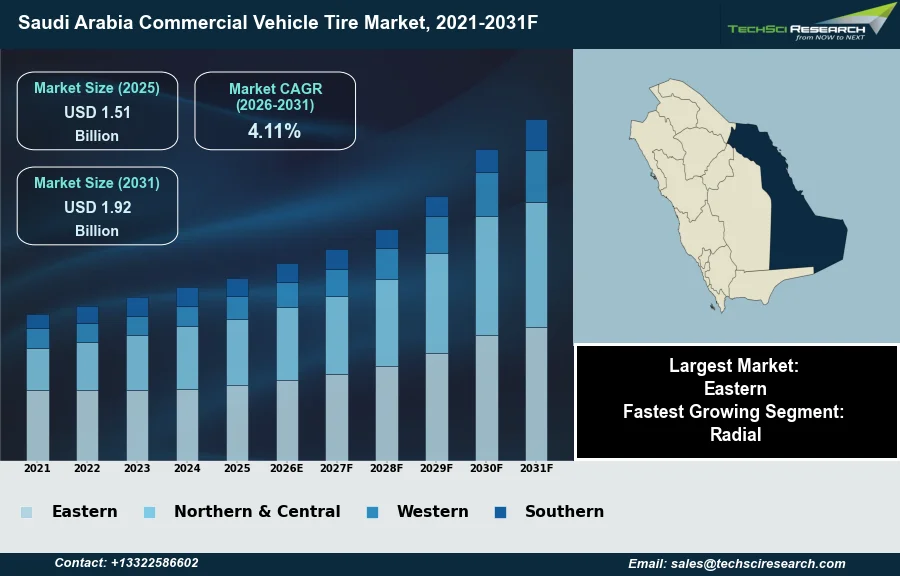
The Saudi Arabia Commercial Vehicle Tire Market will grow from USD 1.51 Billion in 2025 to USD 1.92 Billion by 2031 at a 4.11% CAGR. Commercial vehicle tires are specialized pneumatic components engineered for heavy-duty applications in trucks, buses, and other commercial vehicles, designed for superior durability, load-bearing capacity, and operational efficiency. The market's expansion is fundamentally driven by substantial government investments in large-scale infrastructure projects under Vision 2030, including new cities and extensive transportation networks. Concurrently, the robust growth in logistics and e-commerce sectors necessitates continuous fleet expansion, further stimulating demand for new tires. Additionally, stringent vehicle inspection regulations in the Kingdom mandate regular tire replacements, contributing significantly to market volume.
According to the International Organization of Motor Vehicle Manufacturers (OICA), in 2024, commercial vehicle sales in Saudi Arabia totaled 99,507 units. A significant challenge impeding market growth is the considerable reliance on imported tires and raw materials, which exposes the market to global supply chain vulnerabilities and international material cost fluctuations, thereby impacting product availability and pricing stability.
Key Market Drivers
Vision 2030 infrastructure expansion drives tire demand.
The continued execution of Saudi Arabia's Vision 2030 infrastructure and mega-projects development acts as a primary catalyst for the commercial vehicle tire market. Extensive government investments in new cities, industrial zones, and transportation networks directly drive demand for heavy-duty trucks, construction vehicles, and related equipment. These projects necessitate a continuous supply of durable and high-performance tires to operate effectively under demanding conditions. According to Minister of Economy and Planning Faisal Al-Ibrahim, in February 2025, Saudi Arabia's infrastructure sector is expected to attract approximately $1 trillion in investments by 2030, underscoring the scale of ongoing and future construction activities that will sustain commercial vehicle fleet expansion. This massive undertaking ensures a consistent need for tire replacements and new tire procurements across the Kingdom.
Expansion of logistics and domestic truck production boosts tire demand.
A second significant factor is the expanding transportation and logistics sector, which encompasses the rapid growth of e-commerce and last-mile delivery services. As Saudi Arabia diversifies its economy, the movement of goods across its vast terrain and into urban centers has intensified, increasing the operational demands on commercial vehicle fleets. This sector's expansion mandates reliable vehicles equipped with tires capable of enduring frequent use and varied road conditions. According to Al Majalla, in April 2026, rail freight volumes in Saudi Arabia rose from 28 million tons in 2024 to more than 30 million tons in 2025, reflecting the increasing overall movement of goods. Furthermore, the heavy truck assembly market in Saudi Arabia produces approximately 5,000 units locally per year, as reported by WifiTalents in February 2026, indicating a steady local demand for commercial vehicles that consequently drives the tire aftermarket.
Download Free Sample Report
Key Market Challenges
Import Dependence and Global Supply-Chain Vulnerability
The Saudi Arabia Commercial Vehicle Tire Market is significantly hampered by its substantial reliance on imported tires and raw materials. This dependency creates considerable exposure to global supply chain vulnerabilities. Any disruption in international shipping, trade policies, or manufacturing in source countries can directly lead to delays and shortages in tire availability, impacting the operational continuity of commercial fleets across the Kingdom.
Cost Volatility from Imported Materials and Vehicle Imports
Moreover, the market's reliance on imported raw materials, such as various types of rubber and chemicals, subjects it to international material cost fluctuations. Such volatility directly affects the manufacturing costs for imported tires, subsequently influencing their pricing stability within Saudi Arabia. According to the Saudi Zakat, Tax and Customs Authority, vehicle imports to Saudi Arabia totaled approximately 959,403 units in 2025. This considerable volume of vehicle imports highlights the broader automotive sector's dependence on international supply, which in turn drives a large proportion of the demand for imported tires. This inherent external reliance limits the market's ability to maintain consistent supply and stable pricing, thus impeding its overall growth trajectory.
Key Market Trends
Sustainability-Driven Retreading and Recycling Adoption
A significant trend reshaping the Saudi Arabia commercial vehicle tire market is the increasing adoption of tire retreading and recycling solutions. This movement is fundamentally driven by a heightened focus on sustainability and operational cost efficiencies across commercial fleets. Retreading extends the lifespan of tire casings, offering a more economical alternative to purchasing new units, which directly benefits fleet operators facing rising expenses. Concurrently, the emphasis on recycling addresses environmental concerns by reducing waste. According to Gradeall International, in March 2026, Saudi Arabia handles 15 million tires annually through recycling efforts, indicating a substantial commitment to circular economy practices within the tire industry.
Shift Toward Premium, High-Performance Tires and Radial Construction
Another pivotal trend influencing the market is the shifting preference towards premium and high-performance commercial vehicle tires. Fleet operators are increasingly prioritizing tires that offer superior durability, enhanced safety features, and improved fuel efficiency, particularly given Saudi Arabia's challenging climate and extensive road networks. These preferences align with the demand for products capable of enduring harsh conditions and supporting efficient long-haul operations. This trend is underscored by the widespread adoption of advanced tire construction. According to a news article from May 2026, radial construction now accounts for 92% of market volume in Saudi Arabia, driven by its superior heat dissipation and extended tread life characteristics.
Segmental Insights
Radial Tires Drive Rapid Growth in the Saudi Commercial Vehicle Market, Fueled by Performance, Vision 2030 Infrastructure Upgrades, and SASO Regulations
The Radial segment is demonstrating the most rapid growth within the Saudi Arabia Commercial Vehicle Tire Market, reflecting a significant industry evolution. This accelerated adoption is primarily fueled by the inherent performance advantages of radial tires, which include superior heat dissipation, extended tread life, and enhanced fuel efficiency, all crucial for commercial operations navigating the Kingdom's demanding climate and extensive road networks. The ongoing infrastructure development projects under Saudi Vision 2030, coupled with the modernization efforts of commercial fleets, further necessitate tires that contribute to operational cost savings and reliability. Moreover, regulatory mandates from the Saudi Standards, Metrology and Quality Organization (SASO), which outline specific requirements for tire performance such as rolling resistance and wet grip, effectively encourage the widespread transition to advanced radial tire technologies across the commercial vehicle sector.
Regional Insights
Eastern Province: Core Driver of Saudi Commercial Vehicle Tire Market
The Eastern Province is a pivotal leader in the Saudi Arabia Commercial Vehicle Tire Market, primarily driven by its substantial concentration of industrial and energy-related activities. The region serves as the core of the nation's oil and gas sector, hosting major operations of entities such as Saudi Aramco and significant oil fields, which necessitate extensive commercial vehicle fleets for operational logistics. Furthermore, the presence of major industrial cities like Jubail Industrial City and several industrial estates overseen by the Saudi Authority for Industrial Cities and Technology Zones (MODON) fuels demand for commercial vehicles in manufacturing and construction. Its role as a vital logistics hub, supported by key ports like King Abdulaziz Port in Dammam, also generates considerable requirement for commercial vehicle tires for efficient cargo movement and distribution.
Recent Developments
-
In August 2025, Saudi Green Sea Company launched a significant tire production project in Saudi Arabia, involving a collaboration with an unnamed Chinese firm and petrochemical giant Sabic, which committed to supplying raw materials. The Sandstone facility, to be constructed in Yanbu, was designed with a target annual production capacity of 5 million tires by 2028. This output was projected to include 2.5 million units of truck and military vehicle tires, directly addressing the demand for commercial vehicle tires and reducing reliance on imports in the Saudi Arabian market.
-
In February 2025, The Goodyear Tire & Rubber Company introduced an advanced Tire Pressure Monitoring System (TPMS) in Saudi Arabia, specifically designed for logistics and mass transit fleets. This new product integrated digital technology with the company's tire expertise to provide real-time, proactive tire monitoring and maintenance capabilities. The system aimed to optimize tire performance and reduce operational disruptions within the challenging environmental conditions prevalent in the region. This launch highlighted a strategic focus on leveraging technology to enhance fleet efficiency and safety across the Saudi Arabian commercial vehicle tire sector.
-
In February 2025, Bridgestone Corporation partnered with various Saudi Arabian logistics companies to implement smart tire monitoring systems across commercial fleets. This initiative involved utilizing Internet of Things (IoT) sensors and predictive analytics to enhance tire performance and proactively mitigate unexpected failures within the expanding transportation sector. The collaboration aimed to improve fleet operational efficiency and safety for commercial vehicles operating throughout Saudi Arabia by providing advanced insights into tire health.
-
In November 2024, Saudi Arabia's Black Arrow Tire Co. (Blatco) formed a partnership with Thailand's Golden Star Rubber Co. to establish a new tire manufacturing facility in Yanbu. This collaboration aimed to create the Middle East's largest tire production plant, backed by an estimated $470 million investment. The facility was slated to commence with an initial capacity of 4 million passenger vehicle tires annually, with future plans for expansion to 6 million units per year, which would include the production of truck and bus tires. This joint venture is expected to strengthen local manufacturing capabilities within the Saudi Arabia commercial vehicle tire market.
Key Market Players
- Bridgestone KSA
- Michelin KSA
- Goodyear KSA
- Pirelli KSA
- Continental KSA
- Yokohama KSA
- Hankook KSA
- Apollo Tyres KSA
- MRF KSA
- Dunlop KSA
|
By Vehicle Type
|
By Tire Construction Type
|
By Price Segment
|
By Region
|
|
|
|
- Budget
- Ultra Budget
- Premium
|
- Eastern
- Northern & Central
- Western
- Southern
|
Report Scope:
In this report, the Saudi Arabia Commercial Vehicle Tire Market has been segmented into the following categories, in addition to the industry trends which have also been detailed below:
-
Saudi Arabia Commercial Vehicle Tire Market, By Vehicle Type:
-
Saudi Arabia Commercial Vehicle Tire Market, By Tire Construction Type:
-
Saudi Arabia Commercial Vehicle Tire Market, By Price Segment:
-
Budget
-
Ultra Budget
-
Premium
-
Saudi Arabia Commercial Vehicle Tire Market, By Region:
-
Eastern
-
Northern & Central
-
Western
-
Southern
Competitive Landscape
Company Profiles: Detailed analysis of the major companies present in the Saudi Arabia Commercial Vehicle Tire Market.
Available Customizations:
Saudi Arabia Commercial Vehicle Tire Market report with the given market data, TechSci Research offers customizations according to a company's specific needs. The following customization options are available for the report:
Company Information
- Detailed analysis and profiling of additional market players (up to five).
Saudi Arabia Commercial Vehicle Tire Market is an upcoming report to be released soon. If you wish an early delivery of this report or want to confirm the date of release, please contact us at sales@techsciresearch.com