|
Forecast
Period
|
2026-2030
|
|
Market
Size (2024)
|
USD
1.02 billion
|
|
CAGR
(2025-2030)
|
7.8%
|
|
Fastest
Growing Segment
|
Electric
|
|
Largest
Market
|
Doha
|
|
Market
Size (2030)
|
USD
1.12 billion
|
Market
Overview
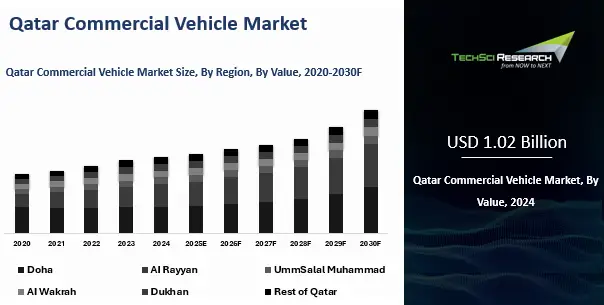
Qatar Commercial Vehicle
Market was valued at USD 1.02 billion in 2024 and is expected to reach USD 1.12
billion by 2030 with a CAGR of 7.8% during the forecast period. The Qatar
Commercial Vehicle Market is witnessing significant growth due to the country's
focus on economic diversification and infrastructure development. In
preparation for major global events and ongoing projects, there is an
increasing demand for commercial vehicles across various sectors. This includes
construction, logistics, and retail, where commercial vehicles play a crucial
role in transporting goods and materials. Heavy commercial vehicles, in
particular, are in high demand to support large-scale construction projects.
Technological innovation is
another key driver, with electric and hybrid commercial vehicles gaining
traction in the market. These vehicles are becoming more attractive due to
their fuel efficiency and lower environmental impact. The Qatar government’s support
for green technologies, including tax incentives for electric vehicles, has
further stimulated the market. With growing awareness of sustainability,
businesses are increasingly transitioning to electric and hybrid commercial
fleets, contributing to cleaner air and reduced emissions. Despite the
favorable market conditions, challenges such as high import costs, limited
local manufacturing, and regulatory hurdles exist. The heavy reliance on
imports leads to higher costs for commercial vehicles, which can be a barrier
for some businesses. Additionally, although there is increasing demand for
eco-friendly vehicles, the cost of these models and the infrastructure to
support them remain challenges. However, advancements in autonomous vehicles
and telematics offer opportunities for improved fleet management, which could
enhance efficiency and reduce operating costs.
Market
Drivers
Economic Diversification
Qatar's ongoing efforts to
diversify its economy beyond oil and gas have resulted in significant
investments in infrastructure and construction. This has directly impacted the
demand for commercial vehicles, particularly in sectors such as logistics and construction.
The need to transport materials, equipment, and personnel for ongoing and
upcoming projects in various sectors drives the commercial vehicle
market. The commercial vehicle industry in Qatar is undergoing significant
technological transformation, including the adoption of electric, hybrid, and
autonomous vehicles. These advancements are driving market growth by offering
enhanced fuel efficiency, lower maintenance costs, and environmental benefits.
Technological improvements, such as advanced telematics and connectivity
features, are also helping fleet operators improve efficiency and reduce
downtime.
Infrastructure Development
Qatar’s ambitious infrastructure
projects, including the construction of roads, bridges, and airports, are
driving the demand for heavy commercial vehicles. These vehicles are essential
for transporting materials, machinery, and equipment to construction sites. The
ongoing development of transportation networks further fuels the demand for a
diverse range of commercial vehicles, from trucks to buses. The Qatari
government offers various incentives for adopting green vehicles, including
electric and hybrid commercial vehicles. Regulations that promote
sustainability and energy efficiency are also pushing the market toward cleaner
alternatives. These government initiatives are encouraging businesses to switch
to more fuel-efficient and eco-friendly fleets, helping to drive growth in the
commercial vehicle market.
Population Growth and
Urbanization
Qatar’s increasing population
and rapid urbanization are creating a greater demand for goods and services,
resulting in an increased need for commercial transportation. The expansion of
cities and the development of new residential and commercial areas drive demand
for light and medium commercial vehicles for last-mile delivery, logistics, and
urban transport.
Download Free Sample Report
Key Market Challenges
High Import Costs
Qatar’s commercial vehicle
market faces challenges related to high import costs. Vehicles must be imported
from international manufacturers, which adds to their overall cost due to
shipping fees, tariffs, and other logistical expenses. This affects the affordability
of vehicles for businesses and may create barriers to market entry for smaller
companies. Qatar lacks a large-scale local vehicle manufacturing industry,
meaning the country relies heavily on imports to meet demand. This reliance on
external sources can lead to supply chain disruptions, delays, and price
volatility. Additionally, without local production, Qatar misses out on
potential benefits such as job creation and reduced dependency on foreign
suppliers.
Regulatory Compliance
The commercial vehicle market in
Qatar must comply with stringent emission standards and safety regulations.
Meeting these regulatory requirements can increase the costs associated with
vehicle production, importation, and operation. Companies may face difficulties
in adhering to these regulations, which can hinder the growth of the
market. Qatar’s fuel prices, while relatively low compared to global
standards, are still subject to fluctuations in the international market.
Volatility in fuel prices can affect operating costs for businesses, especially
those relying heavily on fuel for transportation. This creates uncertainty for
fleet operators, particularly for long-term planning and cost forecasting.
Environmental Concerns
While Qatar has made progress in
adopting green technologies, the adoption of electric commercial vehicles
remains slow due to the high initial cost and limited charging infrastructure.
This can deter fleet operators from transitioning to more environmentally
friendly options. The need for better infrastructure and more affordable
solutions remains a challenge for widespread adoption.
Key Market Trends
Electrification of Commercial
Fleets
The trend of electrifying
commercial vehicle fleets is gaining momentum in Qatar. Driven by both
regulatory pressure and environmental concerns, fleet operators are
increasingly turning to electric and hybrid vehicles. The government’s
incentives for green vehicles further encourage businesses to adopt more
sustainable transportation solutions, making this trend crucial for the future
of the market.
Integration of Telematics and
Connectivity
The use of telematics and
connected vehicle technologies is becoming more prevalent in Qatar's commercial
vehicle market. These technologies allow fleet managers to monitor vehicle
performance in real-time, optimize routes, and improve fuel efficiency. By
collecting data on vehicle usage, maintenance needs, and driver behavior,
businesses can reduce operational costs and improve safety. Autonomous
commercial vehicles, particularly in the logistics and transportation sectors,
are becoming a key trend in Qatar. The development of self-driving trucks and
delivery vehicles is expected to reduce labor costs, improve efficiency, and
enhance safety on the roads. While still in early stages, autonomous vehicles
are anticipated to revolutionize the commercial vehicle market in the future.
Fleet Management Solutions
Fleet management technologies
are transforming how commercial vehicles are operated in Qatar. These solutions
enable fleet operators to track vehicle performance, manage maintenance
schedules, and ensure compliance with regulations. With the growing demand for
efficient and cost-effective operations, fleet management solutions are
becoming an essential part of commercial vehicle operations. Commercial
vehicle safety is a growing trend in Qatar. The increasing adoption of advanced
safety features such as collision detection, lane-keeping assist, and automatic
braking systems is improving safety standards in the commercial vehicle market.
These technologies help reduce accidents, enhance driver safety, and prevent
costly damage to vehicles and cargo.
Segmental Insights
Vehicle Type Insights
The Qatar Commercial Vehicle
Market is divided into four main segments: light commercial vehicles (LCVs),
medium commercial vehicles (MCVs), heavy commercial vehicles (HCVs), and buses.
Light commercial vehicles are commonly used for smaller cargo transportation
and urban logistics, where flexibility and maneuverability are important.
Medium commercial vehicles serve businesses that require more capacity for
transporting goods over longer distances. Heavy commercial vehicles, including
trucks and tractors, are essential for large-scale industrial operations, such
as construction and mining, where substantial payloads need to be transported.
Buses play a vital role in passenger transportation, both for public transit
and tourism. As Qatar’s economy continues to grow, there is an increased demand
for each of these vehicle types, particularly in construction and logistics.
Heavy vehicles are particularly sought after in sectors requiring the
transportation of large loads, while buses are essential for urban transportation,
especially with an increasing population. Medium and light vehicles are also
crucial in urban areas for goods transportation, last-mile delivery services,
and daily logistics.

Download Free Sample Report
Regional
Insights
In 2024, the dominant region in
the Qatar Commercial Vehicle Market is Doha. As the capital and the country’s
primary economic center, Doha leads in demand for commercial vehicles. The city
is experiencing rapid infrastructure development, with numerous construction
projects underway, which increases the need for heavy-duty vehicles.
Additionally, Doha’s role as a hub for business, trade, and tourism fuels
demand for light and medium commercial vehicles, particularly for logistics and
transportation services. This makes Doha the focal point for the majority of
commercial vehicle activity in Qatar. The expansion of roads, ports, and
public transportation networks further drives the need for commercial vehicles.
Businesses in Doha require a range of vehicles to meet logistical demands, from
large trucks for construction projects to smaller vehicles for urban
deliveries. This growth in infrastructure, combined with Doha's economic
importance, ensures its position as the dominant region for commercial vehicles
in Qatar in 2024.
Recent
Developments
- In 2023, Isuzu Motors Limited introduced
a new range of compressed natural gas (CNG)-powered commercial trucks in
Qatar through its regional distributor. This move aligns with Qatar’s
vision for reducing vehicular emissions and promoting cleaner transportation.
The launch was specifically targeted at fleet operators in the logistics
and delivery sectors, offering them a more cost-effective and
eco-friendlier alternative to diesel-powered vehicles. The CNG trucks were
well received by operators looking to comply with stricter environmental
regulations and benefit from lower fuel costs.
- In 2024, Tata Motors Limited unveiled a
series of medium-duty trucks designed specifically for the Gulf
Cooperation Council (GCC) region, including Qatar. These vehicles feature
reinforced chassis, upgraded cooling systems, and sand-resistant
components tailored for harsh desert conditions. With Qatar’s heavy
investment in infrastructure projects and expanding logistics networks,
these customizations provide operators with enhanced performance and
reliability under demanding local conditions.
- Also in 2024, Ford Motor Company
partnered with a Qatari logistics firm to launch a pilot program involving
a fleet of electric delivery vans in Doha. This collaboration marks a
significant step towards the electrification of commercial fleets in the
country. The pilot aims to test the operational feasibility of electric
vehicles (EVs) in high-temperature environments and evaluate the required
charging infrastructure. The program supports Qatar’s sustainability
initiatives under its National Vision 2030, focusing on reducing the
carbon footprint of its transport sector.
Key
Market Players
- Toyota Motor Corporation
- Isuzu Motors Limited
- Ford Motor Company
- Mercedes-Benz Group AG
- Tata Motors Limited
- MAN Truck & Bus SE
- Scania AB
- Hyundai Motor Company
- Hino Motors, Ltd.
- Ashok Leyland Limited
|
By Vehicle
Type
|
By
Propulsion Type
|
By
Region
|
|
·
Light
Commercial Vehicle
·
Medium
Commercial Vehicle
·
Heavy
Commercial Vehicle
·
Bus
|
·
ICE
·
Electric
|
·
Doha
·
AI Rayyan
·
UmmSalal
Muhammad
·
AI Wakrah
·
Dukhan
·
Rest of
Qatar
|
Report
Scope:
In this
report, the Qatar Commercial Vehicle Market has been segmented into the
following categories, in addition to the industry trends which have also been
detailed below:
· Qatar Commercial Vehicle
Market, By Vehicle Type:
o Light
Commercial Vehicle
o Medium
Commercial Vehicle
o Heavy
Commercial Vehicle
o Bus
· Qatar Commercial Vehicle
Market, By Propulsion Type:
o ICE
o Electric
· Qatar Commercial Vehicle
Market, By Region:
o Doha
o AI Rayyan
o UmmSalal Muhammad
o AI Wakrah
o Dukhan
o Rest of Qatar
Competitive
Landscape
Company
Profiles: Detailed
analysis of the major companies presents in the Qatar Commercial Vehicle
Market.
Available
Customizations:
Qatar
Commercial Vehicle Market report with the given market data,
TechSci Research offers customizations according to the company’s specific
needs. The following customization options are available for the report:
Company
Information
- Detailed analysis and profiling of additional
market players (up to five).
Qatar
Commercial Vehicle Market is an upcoming report to be released soon. If you
wish an early delivery of this report or want to confirm the date of release,
please contact us at sales@techsciresearch.com