Market Overview
India
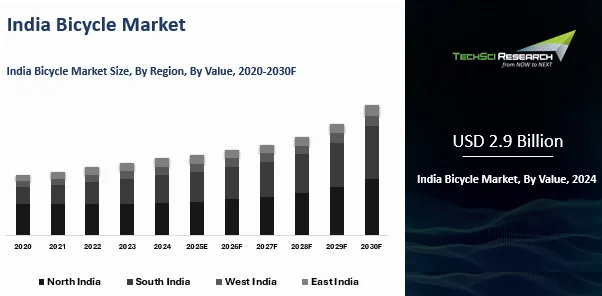
Bicycle market was valued at USD 2.9 Billion in 2024 and is projected to reach
approximately USD 4.1 Billion by 2030, expanding at a CAGR of 5.9% during the
forecast period. The market is evolving with rising health awareness and
demand for sustainable mobility, as bicycles gain popularity for both
recreation and daily commuting. Government initiatives promoting cycling and
non-motorized transport are supporting growth, while a wide product range from
basic cycles to mountain and specialty bikes expands consumer choice.
Increasing incomes, lifestyle shifts, and urban congestion are further driving
adoption. AICMA reported sales of over 10.6 million units in FY 2023–24,
reflecting steady demand.
Technological
advancements such as lightweight materials, aerodynamic designs, and smart
features are enhancing product appeal. E-bicycles are attracting wider
demographics, while customization trends and adventure tourism are boosting
premium segments. However, limited cycling infrastructure, safety concerns,
high costs, and competition from motorized two-wheelers remain key challenges.
Market Drivers
Rising
Fitness and Health Awareness
Rising fitness and health awareness is becoming a powerful demand driver in India’s bicycle industry, as more consumers are turning to cycling as a practical way to manage weight, improve cardiovascular health, reduce stress, and stay physically active without depending on gym-based routines alone. Growing concern around lifestyle conditions such as obesity, diabetes, and hypertension is making bicycles more relevant across age groups, while public health messaging, wellness communities, and social media fitness culture are helping position cycling as both attainable and aspirational.
Group rides organized by residential communities, cycling clubs, schools, and corporate or wellness networks are further strengthening participation by making cycling social, visible, and habit-forming rather than an occasional activity. This shift is especially important in urban India, where consumers are increasingly trying to combine mobility and exercise through early-morning rides, post-work cycling sessions, and fitness-led commuting choices that fit into compressed daily schedules. For Instance, Business India reported that Hero Cycles sold over 400,000 premium cycles in a year at an average price of 12,000 rupees per unit, showing that health-conscious riders are increasingly willing to spend on higher-value bicycles built for fitness, endurance, and lifestyle use.
Expansion
of Cycling Events and Communities
Cycling events and community rides are becoming strong adoption triggers in India’s bicycle market because they turn cycling from an individual exercise into a visible, social, and experience-driven lifestyle activity that encourages both first-time riders and regular enthusiasts to invest in better bicycles and accessories. Organized marathons, endurance races, charity rides, and weekend community events create repeated touchpoints for participation, while schools, colleges, workplaces, and local clubs help build habits through group rides, workshops, and skill-sharing that make cycling more approachable for newcomers.
These communities also reduce entry barriers by offering route guidance, maintenance tips, peer motivation, and validation through both offline networks and digital groups, which is especially important in a market where confidence and social reinforcement often shape lifestyle adoption. As participation widens, cycling increasingly gains relevance not only as a fitness tool but also as a recreational and aspirational culture linked to wellness, travel, and urban identity, which supports demand across road bikes, mountain bikes, and commuter-oriented models. For Instance, HCL Cyclothon states that its events across Delhi, Chennai, and Hyderabad have drawn more than 10,000 cyclists from 25 states, highlighting how large-format community platforms are helping normalize cycling at scale and stimulate bicycle interest across India.
Government
Initiatives for Sustainable Transportation
The government’s growing emphasis on sustainable transportation is becoming a meaningful catalyst for India’s bicycle industry, as urban policy is increasingly linking cycling with cleaner mobility, lower congestion, safer short-distance travel, and healthier city design through programs aligned with the Smart Cities Mission. Municipal bodies and urban planners are giving more attention to non-motorized transport corridors, dedicated cycling lanes, neighborhood street redesign, public awareness drives, and bike-sharing systems, which together make bicycle commuting more practical for students, office-goers, and first- and last-mile users. This policy direction matters because infrastructure visibility reduces the psychological barrier to cycling, while institutional backing from schools, workplaces, and local governments helps shift bicycles from being seen only as recreational products to becoming credible everyday mobility tools.
As cities experiment with rental schemes, open-street events, and integrated planning in residential and commercial districts, bicycles are gaining stronger relevance in urban transport conversations, especially where affordability and environmental performance are both policy priorities. For Instance, the Ministry of Housing and Urban Affairs stated that 107 cities registered for the India Cycles4Change challenge, 41 cities launched cycling initiatives, and participating cities began work on about 400 kilometers of arterial roads and more than 3,500 kilometers of neighborhood streets, highlighting the scale of public-sector support now strengthening bicycle adoption in India.
Rising
Environmental Awareness
Rising environmental awareness is steadily strengthening bicycle demand in India, as more consumers are connecting daily mobility choices with concerns around air pollution, fuel dependence, greenhouse gas emissions, and the broader need for sustainable urban living. Bicycles are gaining relevance because they offer a zero-emission, low-resource alternative to motorized transport, making them attractive not only for cost-conscious commuters but also for citizens who want their everyday travel habits to reflect cleaner and more responsible consumption.
This shift is being reinforced by environmental campaigns, sustainability discussions in schools and public forums, and the growing visibility of urban air quality concerns, all of which are helping position cycling as a practical way to reduce one’s personal carbon footprint while also improving public health outcomes. As eco-consciousness becomes more aspirational across younger and urban demographics, bicycles are increasingly seen not just as mobility products but as visible symbols of green living, especially for short-distance commuting where environmental benefits are easiest to understand and adopt. For Instance, SmartBike states that it operates over 7,000 bicycles and more than 700 stations across India, highlighting how shared cycling infrastructure is expanding access to environmentally friendly mobility at scale.
Growth
in Adventure Tourism
Adventure tourism is becoming an important growth lever for India’s specialized bicycle segment, as the country’s diverse terrain spanning Ladakh, Himachal Pradesh, the Western Ghats, desert routes, and coastal trails is creating strong demand for bicycles designed for mountain biking, trail riding, and endurance touring. This shift is being driven by younger consumers and working professionals who increasingly view cycling not only as recreation but also as an immersive travel experience that combines fitness, exploration, and social storytelling. Organized cycling expeditions and destination-based tours are further strengthening this trend, because they require durable, high-performance bicycles suited to rugged surfaces, steep climbs, and long-distance usage rather than basic commuter models.
Social media visibility around adventure rides, cycling festivals, and endurance events is also expanding the appeal of mountain bikes by turning specialized cycling into an aspirational lifestyle linked with travel, resilience, and outdoor achievement. As a result, demand is gradually shifting toward feature-rich bicycles with stronger frames, better suspension, and terrain-specific capabilities, helping manufacturers and retailers widen their premium product mix within the broader bicycle category. For Instance, Decathlon states that it operates more than 100 stores across 19 states in India, reflecting the expanding retail reach through which adventure-oriented bicycles such as mountain bikes are becoming more accessible to Indian consumers.
Download Free Sample Report
Key Market Challenges
Lack
of Cycling Infrastructure
Lack of dedicated cycling infrastructure remains one of the most serious barriers to wider bicycle adoption in India, because most riders still have to share congested roads with motorized traffic, which sharply reduces perceived safety and discourages regular use. This problem affects the market across demographic groups, but it is especially restrictive for women, children, older riders, and first-time commuters, who are more sensitive to traffic risk, poor road behavior, and the absence of protected spaces for everyday cycling. Even where cycle tracks exist, their practical value is often weakened by poor maintenance, encroachment, fragmented routing, weak lighting, and limited connectivity with transit hubs or commercial centers, making bicycles less viable for consistent commuting.
The challenge is not confined to cities, because rural areas also face inadequate road quality, limited signage, and weak end-point facilities such as secure parking, all of which reduce confidence in bicycles as a dependable mobility choice. For Instance, a parliamentary reply stated that under the Smart Cities Mission, 712.59 kilometers of cycle track had been developed across 61 cities as of September 30, 2024, which also underlines how limited formal cycling infrastructure still is relative to India’s broader mobility needs.
High
Cost of Premium Bicycles
The high upfront cost of performance-oriented bicycles remains a meaningful constraint in India, particularly for middle- and lower-income consumers who may aspire to upgrade from basic models but find specialized bicycles too expensive relative to their discretionary budgets. While entry-level bicycles remain comparatively affordable, fitness, mountain, and long-distance models are priced much higher because they incorporate better frame materials, advanced gearing systems, disc brakes, suspension technologies, and other performance features that raise retail costs. Import dependence for certain components, along with taxes and logistics costs, further widens the gap between standard bicycles and premium offerings, reinforcing the perception that quality cycling equipment is a lifestyle luxury rather than an accessible mobility or wellness investment.
Limited financing options also slow adoption, because bicycles are not yet supported by the same deep EMI culture that helps consumers buy smartphones, appliances, or motor vehicles, leaving many price-sensitive buyers to choose cheaper models that may not deliver satisfactory durability or riding experience. For Instance, Decathlon’s India mountain bike range currently spans from 6,499 rupees to 89,999 rupees, with performance models such as the Rockrider ST120 priced at 24,499 rupees, clearly illustrating how the premium end of the category can remain out of reach for a large section of Indian consumers.
Market Trends
Growth
of E-Bicycles
Electric
bicycles, or e-bikes, are emerging as a dynamic trend within the India Bicycle
Market. These battery-powered bicycles offer assisted pedaling, making longer
commutes and challenging terrains more accessible to a broader audience,
including the elderly and those less inclined toward intense physical exertion.
The demand for e-bikes is being driven by rising fuel costs, growing
eco-consciousness, and the desire for affordable and flexible commuting
solutions. Government incentives promoting electric mobility, though currently
focused more on electric cars and scooters, are beginning to trickle down to
include e-bicycles. Urban consumers are embracing e-bikes for short-distance
office commutes, while businesses are exploring e-bicycles for last-mile deliveries.
Technological advancements in battery technology, motor efficiency, and
lightweight frame design are making modern e-bikes more reliable and
aesthetically appealing. Shared e-bicycle fleets are also becoming a visible
feature in smart city mobility initiatives, making e-bikes accessible without
ownership costs. Awareness of the health benefits of moderate cycling exercise,
even with electric assistance, is further broadening the appeal. As consumer
expectations evolve toward convenience combined with environmental
responsibility, the growth of e-bicycles is poised to redefine the future
trajectory of the Indian bicycle market.
Rising
Popularity of Bicycle Commuting
Growing
concerns over traffic congestion, rising fuel prices, and environmental
degradation are pushing urban consumers to seek alternative modes of
transportation, with bicycle commuting gaining traction. Many city dwellers are
beginning to prefer cycling for short to medium-distance commutes, especially
as dedicated cycling tracks and bicycle-sharing programs start emerging in
select cities. Cycling offers a cost-effective, healthy, and often faster
alternative to being stuck in traffic during peak hours. Companies are also
promoting green commuting by offering incentives to employees who use bicycles
for daily travel.
Younger demographics, particularly millennials and Gen Z, are
adopting cycling not just for practical transportation but also as a lifestyle
choice aligned with sustainability and fitness values. Social media trends
showcasing urban cycling culture and communities are reinforcing this shift.
While large-scale adoption still faces hurdles such as infrastructure gaps and
safety concerns, the visible change in commuter habits in key metropolitan
centers signals a long-term trend favoring bicycle commuting as a mainstream
mobility option.
Integration
of Smart Features in Bicycles
Smart
bicycles equipped with integrated GPS navigation, fitness tracking, theft
protection systems, and performance analytics are gaining popularity among
tech-savvy consumers. Features such as Bluetooth-enabled speedometers,
anti-theft alarms, smart locks, and app-based ride tracking are becoming
desirable additions, enhancing the user experience and offering better
convenience and security. Fitness enthusiasts are particularly drawn to smart
bicycles that offer real-time performance data, enabling them to monitor and
optimize their cycling routines.
Smart features also appeal to urban commuters
who value route optimization, safety alerts, and digital maintenance updates.
As technology becomes more accessible and affordable, manufacturers are
increasingly embedding these smart solutions across different bicycle segments,
from hybrid bikes to cargo models. This trend aligns with broader digital
lifestyle adoption in India, where smartphone penetration and mobile app usage
are soaring. Although initially premium-priced, the gradual mainstreaming of
smart bicycle technologies will likely open up mass-market opportunities and
redefine how consumers interact with and perceive bicycles.
Segmental Insights
Type
Insights
The
India Bicycle Market is segmented by type into mountain bikes, road bikes,
cargo bikes, and others. Mountain bikes are designed to handle rugged terrains
with features like wide tires, strong frames, and suspension systems, making
them popular among adventure enthusiasts and fitness-conscious individuals.
They offer a versatile riding experience suitable for off-road trails, parks,
and unpaved rural roads.
Road
bikes, engineered for speed on paved roads, attract users focused on
long-distance cycling, fitness, and competitive sports. Their lightweight
frames, narrow tires, and aerodynamic designs support efficient and high-speed
rides, making them favorites among cycling clubs and marathon participants.
Cargo
bikes, designed to carry heavy loads, are emerging as practical solutions for
small businesses, delivery services, and families. With strong frames and
specially designed compartments or trailers, cargo bikes enable efficient urban
logistics and are gaining visibility in last-mile delivery networks.
The
others category includes specialty bicycles such as folding bikes, BMX bikes,
and children's bicycles. Folding bikes are gaining attention among urban
commuters seeking portability and space-saving convenience, particularly in
cities with limited parking options. BMX bikes appeal to enthusiasts engaged in
stunts and extreme sports, while children's bicycles represent a steady market
driven by parental demand for affordable, safe, and colorful options for young
riders.

Download Free Sample Report
Region Insights
In 2024, North India stood out as the leading region in the India bicycle market, supported by strong adoption across urban centers such as Delhi, Chandigarh, and Lucknow, where bicycles are increasingly used for commuting, fitness, and recreational riding. This regional strength is reinforced by a combination of citizen-led cycling culture, rising environmental and health awareness, and government-backed mobility measures that are making bicycles more visible in everyday urban life. Cities in the region are benefiting from improving cycling infrastructure, smart city initiatives, and growing interest in non-motorized transport, while relatively flat terrain in several major urban clusters makes cycling more practical for daily travel and leisure use.
North India also gains from a broad demand base that spans students, office commuters, fitness enthusiasts, and rural users who continue to rely on bicycles for access to schools, markets, and workplaces, giving the region both volume depth and category diversity. For Instance, Hero Cycles operates manufacturing units in Ludhiana, Ghaziabad, and Bihta and sells through a network of over 3000 dealers across India, highlighting the strong production and distribution backbone that helps sustain North India’s influence in the bicycle industry.
Recent Developments
- In January 2025, Hero Motors Company used Bharat Mobility Expo 2025 to showcase new mobility solutions and highlight its ongoing partnerships aimed at making India a global hub for cycle and e-cycle production. In January 2025, the company said it was investing in research and development, smart manufacturing, and global partnerships to expand advanced bicycle and e-cycle production, making the announcement notable as an innovation-and-collaboration signal for India’s organised bicycle industry.
- In January 2025, India Cycle Show 2025 featured a wave of bicycle launches from domestic brands, including Hero’s Hero Sonic and Hero Sprint Enzo for off-road riding, Avon Cycles’ TYKE brand for children, and an E-Cargo Bike designed for delivery applications. In January 2025, Kross Bikes also introduced its Esentia Series for children, women, and adults, while Helen Bikes unveiled a modern prototype, making the event a concentrated showcase of new product development across utility, lifestyle, and cargo cycling segments in India.
- In January 2026, British bicycle brand Muddyfox entered India through an exclusive distribution partnership with Ananta Ventures and simultaneously launched 18 bicycle models across mountain, road, and hybrid segments. In January 2026, the collaboration mattered because Ananta already operates a domestic dealer network through its Roam and Kylon brands, giving Muddyfox an immediate route into the Indian premium cycle market while also allowing future adaptation of products to local consumer preferences.
- In January 2026, Muddyfox said its initial India range would include models for women and children as well as cycling apparel and accessories, with more products planned based on demand patterns. In January 2026, this made the launch more than a simple market entry because it signaled a broader portfolio-building strategy in India’s bicycle ecosystem, where premium positioning, segment diversification, and accessory-led expansion are becoming increasingly important.
- In
February 2025, Hero Cycles announced the launch of a new premium range of
bicycles under its lifestyle segment aimed at urban commuters and fitness
enthusiasts. The range focuses on lightweight frames, smart tracking
features, and eco-friendly manufacturing processes. This move supports the
brand’s strategy to tap into the growing demand for high-end bicycles in
metro cities.
- In
January 2025, the Government of India launched a nationwide initiative to
build 5,000 kilometers of dedicated cycling tracks under the Smart Cities
Mission. The plan aims to promote bicycles as a mainstream mode of
sustainable transport and reduce urban congestion, benefiting the overall
bicycle market.
- In
March 2025, Firefox Bikes introduced a new line of electric-assist
bicycles designed for urban commuting and fitness enthusiasts. These
models integrate smart performance tracking, long-range battery systems,
and ergonomic designs, offering an enhanced cycling experience and
catering to the evolving mobility preferences in Indian cities.
Key Market Players
- Hero Cycles Limited
- TI
Cycles of India Limited (part of Tube Investments of India Limited)
- Avon
Cycles Limited
- Atlas
Cycles Limited
- Firefox
Bikes Private Limited
- Ninety
One Cycles Private Limited
- Schnell
Cycles Private Limited
- Decathlon
Sports India Private Limited
- Giant
Starkenn Bicycles Private Limited
- SRF
Limited
|
By Type
|
By Technology
|
By Sales Channel
|
By Region
|
- Mountain Bikes
- Road Bikes
- Cargo Bikes
- Others
|
|
|
|
Report Scope:
In this report,
the India Bicycle Market has been segmented into the following categories, in
addition to the industry trends which have also been detailed below:
- India Bicycle
Market, By Type:
o Mountain
Bikes
o Road
Bikes
o Cargo
Bikes
o Others
- India Bicycle
Market, By Technology:
o Electric
o Conventional
- India Bicycle
Market, By Sales Channel:
o Online
o Offline
- India Bicycle
Market, By Region:
o North
India
o West
India
o South
India
o East
India
Competitive
Landscape
Company
Profiles: Detailed analysis of the major companies
presents in the India Bicycle Market.
Available
Customizations:
India Bicycle
Market report with the given market data, TechSci Research offers
customizations according to the company’s specific needs. The following
customization options are available for the report: -
Company
Information
- Detailed analysis and profiling of additional
market players (up to five).
India Bicycle
Market is an upcoming report to be released soon. If you wish an early delivery
of this report or want to confirm the date of release, please contact us at sales@techsciresearch.com