|
Key Insights
|
Details
|
|
Forecast Period
|
2027-2031
|
|
Market Size (2025)
|
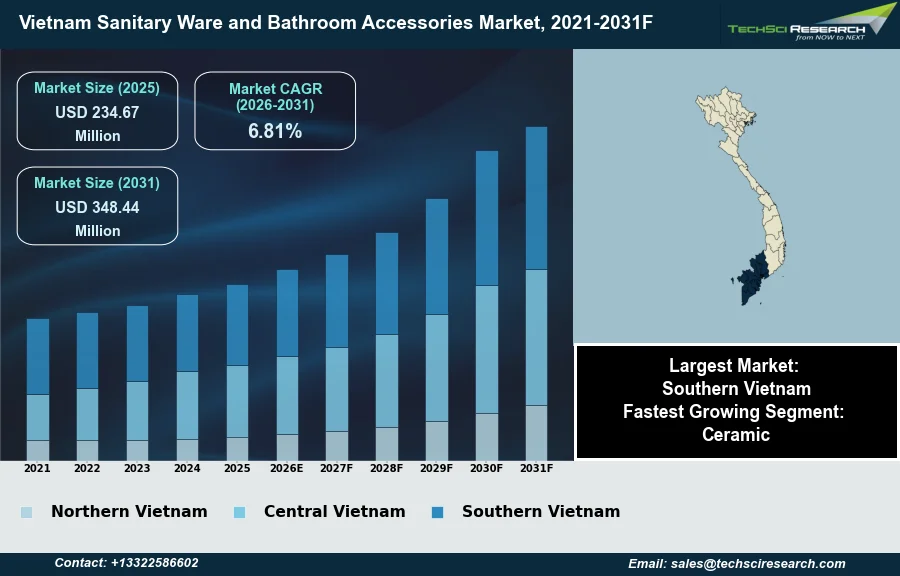
USD 234.67 Million
|
|
CAGR (2026-2031)
|
6.81%
|
|
Fastest Growing Segment
|
Ceramic
|
|
Largest Market
|
Southern Vietnam
|
|
Market Size (2031)
|
USD 348.44 Million
|
Market Overview
The Vietnam Sanitary Ware and Bathroom Accessories Market will grow from USD 234.67 Million in 2025 to USD 348.44 Million by 2031 at a 6.81% CAGR. Sanitary ware and bathroom accessories encompass a comprehensive range of products vital for modern living spaces, including toilets, washbasins, faucets, showers, and other fixtures designed to enhance functionality and aesthetics in bathrooms. The Vietnam market for these products is primarily driven by rapid urbanization and extensive infrastructure development, alongside rising disposable incomes and evolving consumer preferences for contemporary and higher-quality bathroom solutions. Substantial government investments in the construction sector further bolster demand, especially for new residential, commercial, and hospitality projects.
According to the Foreign Investment Agency under the Ministry of Finance, the total registered foreign direct investment in Vietnam reached VND 798.7 trillion (approximately USD 31.5 billion) in the first ten months of 2025, marking a year-on-year growth of 15.6%. This robust investment directly fuels the construction industry, subsequently stimulating demand for sanitary ware and bathroom accessories. However, the market faces a notable challenge from intense competition among both domestic and international manufacturers, requiring continuous innovation and strategic positioning to maintain market share.
Key Market Drivers
Urbanization and infrastructure drive demand
Accelerated urbanization and extensive infrastructure development are key catalysts for the Vietnam Sanitary Ware and Bathroom Accessories Market. The rapid expansion of urban centers drives continuous demand for new residential and commercial buildings, each requiring comprehensive bathroom solutions. Government-led infrastructure projects, including new roads and public utilities, stimulate further construction and enhance economic activity. According to VietNamNet, in its January 2026 article 'Infrastructure breakthrough – powerful driver of national growth', 564 infrastructure projects with total investment exceeding 5.14 quadrillion VND (195.5 billion USD) were inaugurated or started construction in 2025, directly bolstering the construction sector and demand for sanitary ware. This sustained investment fosters a favorable environment for manufacturers.
Rising incomes and growth expand premium demand
Rising disposable income and an expanding middle class further propel market demand by enabling consumers to invest in higher-quality sanitary ware and bathroom accessories. Improved living standards shift preferences towards modern designs, advanced functionalities, and premium brands, moving beyond basic utility to encompass comfort. This trend drives both renovations and purchases for new properties. According to the National Statistics Office, in its January 2026 report 'Per capita income rises 9.3% in 2025', the average per capita income in 2025 was estimated at 5.9 million VND (approximately US$225) per month, marking a significant increase from 2024. This enhanced purchasing power translates into increased spending on home improvement. Overall economic vitality supports these drivers; according to the General Statistics Office of Vietnam, in 2026, Vietnam's Gross Domestic Product (GDP) in the first quarter was estimated to increase by 7.83% year-on-year.
Download Free Sample Report
Key Market Challenges
Competitive Pressure Drives Investment and Impacts Profitability
Intense competition among both domestic and international manufacturers represents a significant impediment to the sustained growth of the Vietnam Sanitary Ware and Bathroom Accessories Market. This highly competitive environment directly results in considerable pressure on pricing strategies and profit margins for all market participants. Companies are compelled to channel substantial investments into product development, branding, and establishing robust distribution networks to differentiate themselves, often impacting overall profitability.
Rising Capacity and Market Entry Risks Amid Intensifying Competition
The presence of numerous entities vying for market share creates a challenging landscape where continuous innovation and strategic market positioning are imperative, yet financially demanding. According to the Vietnam Building Materials Association, the installed production capacity for ceramic sanitary ware in Vietnam expanded by 7.5% in 2025, indicating an increasing supply base within the market. This surge in manufacturing capabilities, coupled with aggressive market strategies, strains existing businesses and complicates market entry for new ventures, thereby hampering organic expansion and potentially leading to market saturation.
Key Market Trends
Space-saving fixtures driven by urban density and affordable housing.
Demand for space-saving and compact bathroom fixtures represents a significant trend in the Vietnam market, driven by rapid urbanization and the proliferation of smaller residential units, particularly within the affordable housing segment. As urban density increases, consumers and developers prioritize efficient use of limited bathroom space, leading to heightened demand for compact toilets, wall-hung basins, and integrated shower systems. These solutions optimize functionality without compromising modern aesthetics, a crucial factor for developers aiming to maximize livable area and appeal to a broader demographic. This trend is notably supported by housing development initiatives. For example, according to a March 2026 article from Vietnam News Agency (VNA), the government aims to complete one million social housing units by 2030, with approximately 100,275 apartments targeted for 2025, fueling demand for practical and compact designs.
Eco-friendly and sustainable bathroom fixtures on the rise.
Another prominent trend influencing the Vietnam sanitary ware and bathroom accessories market is the escalating demand for eco-friendly and sustainable fixtures. Growing environmental awareness among Vietnamese consumers and stringent green building regulations are compelling manufacturers to innovate with products that reduce water consumption and incorporate sustainable materials. This shift reflects a broader commitment to environmental responsibility within the construction sector, as developers increasingly seek certifications for their projects. For instance, according to the Vietnam News Agency (VNA), in a March 2026 article, Vietnam ranked eighth globally for LEED-certified floor area in 2025, recording approximately 2.6 million square meters of certified space across 100 projects, indicating a clear trajectory towards green construction and sustainable bathroom solutions.
Segmental Insights
Ceramics: Fastest-Growing Segment Fueled by Urbanization and Construction
The key segmental insight for the Vietnam Sanitary Ware and Bathroom Accessories Market highlights ceramic products as the fastest-growing segment. This rapid expansion is primarily driven by the nation's accelerating urbanization and the robust growth of its construction and real estate sectors. The ongoing development of residential and commercial projects, including significant social housing initiatives overseen by the Ministry of Construction, directly escalates demand for durable and aesthetically appealing ceramic fixtures. Additionally, rising disposable incomes among Vietnamese consumers foster a greater preference for modern and high-quality bathroom solutions, where ceramic's inherent resilience and design versatility provide a compelling value proposition. This convergence of factors ensures ceramic's sustained market leadership.
Regional Insights
Southern Vietnam's Market Leadership Driven by Urbanization and Rising Incomes
Southern Vietnam stands as the leading region in the Vietnam Sanitary Ware and Bathroom Accessories Market. This dominance is primarily driven by extensive construction activities and robust real estate development, particularly within major urban centers such as Ho Chi Minh City. The region is experiencing rapid urbanization, which fuels substantial demand for modern housing infrastructure and commercial spaces. Furthermore, a growing middle class with increasing disposable incomes consistently drives consumer preference towards higher-quality, aesthetically appealing, and functional bathroom solutions. This economic dynamism, coupled with ongoing government initiatives supporting urban development, collectively contributes to Southern Vietnam's prominent position in the market.
Recent Developments
-
In July 2025, Caesar Vietnam enhanced the bathroom experience by introducing a range of "no-touch" sanitary devices. These products integrated advanced sensor technology for automated operation, promoting improved hygiene and user convenience. Additionally, the innovations included Aqua Jet discharge technology, designed for effective cleaning and water conservation, and Magic Power technology for self-power generation in specific components, underscoring the company's commitment to modern, sustainable, and user-centric solutions in the Vietnamese market.
-
In April 2025, ARROW, a global provider of smart bathroom solutions, expanded its strategic presence in the Vietnamese market through a partnership with DASH Co., Ltd. This collaboration marked ARROW's official entry into the country, highlighted by the opening of its first flagship showroom. The initiative aimed to introduce world-class smart bathroom technologies to local consumers, addressing the increasing demand for modern, intelligent, and user-friendly home solutions across Vietnam.
-
In March 2025, TOTO Vietnam officially launched two new products for the local market: the MS857 one-piece toilet and the TBW01035V Spa Mist Shower. The MS857 was presented as an upgraded mid-range toilet, incorporating TOTO's signature technologies for cleanliness, powerful flushing, and durable ceramic. Concurrently, the Spa Mist Shower was introduced to elevate the bathing experience through advanced misting technology, aiming to provide a soothing and comprehensive body care solution for Vietnamese consumers.
-
In October 2024, TOTO Vietnam launched an upgraded version of its NEOREST NX smart toilet, continuing to convey a message of pure luxury in the Vietnamese sanitary ware market. The product featured an impressive design and integrated modern technology to deliver a healthy and relaxing experience, while also promoting sustainability. Key advancements included optimal cleaning technologies such as CEFIONTECT, PREMIST, RIMLESS design, TORNADO flush, and EWATER+, which collectively enhanced hygiene and minimized maintenance requirements for users.
Key Market Players
- Grohe
- Kohler
- Hansgrohe
- American Standard
- Jaquar
- Toto
- Villeroy & Boch
- Al Futtaim Group
- Damac Properties
- Emaar Properties
|
By Product Type
|
By Material
|
By Region
|
- Toilet/Water Closet
- Wash basin
- Cistern
- Faucets
- Showers
- Others
|
- Ceramic
- Pressed Metal
- Acrylic Plastic & Perspex
- Others
|
- Northern
- Central
- Southern
|
Report Scope:
In this report, the Vietnam Sanitary Ware and Bathroom Accessories Market has been segmented into the following categories, in addition to the industry trends which have also been detailed below:
-
Vietnam Sanitary Ware and Bathroom Accessories Market, By Product Type:
-
Toilet/Water Closet
-
Wash basin
-
Cistern
-
Faucets
-
Showers
-
Others
-
Vietnam Sanitary Ware and Bathroom Accessories Market, By Material:
-
Ceramic
-
Pressed Metal
-
Acrylic Plastic & Perspex
-
Others
-
Vietnam Sanitary Ware and Bathroom Accessories Market, By Region:
-
Northern
-
Central
-
Southern
Competitive Landscape
Company Profiles: Detailed analysis of the major companies present in the Vietnam Sanitary Ware and Bathroom Accessories Market.
Available Customizations:
Vietnam Sanitary Ware and Bathroom Accessories Market report with the given market data, TechSci Research offers customizations according to a company's specific needs. The following customization options are available for the report:
Company Information
- Detailed analysis and profiling of additional market players (up to five).
Vietnam Sanitary Ware and Bathroom Accessories Market is an upcoming report to be released soon. If you wish an early delivery of this report or want to confirm the date of release, please contact us at sales@techsciresearch.com