|
Key Insights
|
Details
|
|
Forecast Period
|
2027-2031
|
|
Market Size (2025)
|
USD 456.78 Million
|
|
CAGR (2026-2031)
|
6.41%
|
|
Fastest Growing Segment
|
Kitchen Cabinets
|
|
Largest Market
|
Southern Vietnam
|
|
Market Size (2031)
|
USD 663.13 Million
|
Market Overview
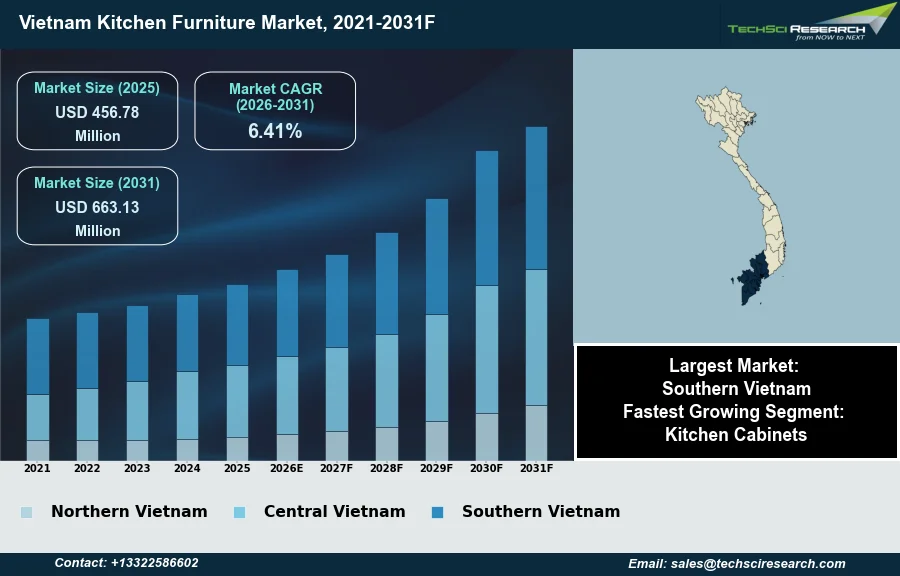
The Vietnam Kitchen Furniture Market will grow from USD 456.78 Million in 2025 to USD 663.13 Million by 2031 at a 6.41% CAGR. Kitchen furniture encompasses essential components such as cabinets, tables, and chairs, designed for functional and aesthetic integration within culinary spaces, serving both residential and commercial sectors. The market's expansion is fundamentally driven by sustained rapid urbanization and extensive real estate development across Vietnam. Furthermore, increasing disposable incomes among a burgeoning middle class contribute to a rising demand for modern and efficient kitchen solutions.
According to the Vietnam Timber and Forest Products Association (VIFOREST) and Vietnam Customs, in 2025, the country's wood and wood product exports reached US$17.2 billion, with wooden furniture constituting approximately 61 percent of this total. However, a significant impediment to market growth is the heightened regulatory scrutiny, including retaliatory tax measures and anti-dumping investigations in key export markets such as the United States, as highlighted by the Handicraft and Wood Industry Association of Ho Chi Minh City (HAWA).
Key Market Drivers
Urbanization and Real Estate Expansion Drive Kitchen Furniture Demand
Rapid urbanization and extensive real estate development are pivotal drivers for the Vietnam Kitchen Furniture Market, fueling demand for new installations and renovations. As cities expand and new residential and commercial projects emerge, there is a consistent requirement for functional and aesthetically pleasing kitchen solutions. For instance, according to B&Company in April 2026, more than 128,000 new housing units were launched in 2025, marking an 88 percent increase year on year and representing the highest level recorded between 2019 and 2025. This surge in housing supply directly translates into heightened demand for kitchen cabinets, countertops, and other essential furniture components to outfit these newly constructed spaces, thereby sustaining growth in the market.
Income Growth and Middle-Class Expansion Fuel Premium Kitchen Furniture Demand
Concurrently, rising disposable incomes and the expansion of Vietnam's middle class significantly influence consumer spending on home furnishings, including kitchen furniture. As economic prosperity increases, households prioritize modern, efficient, and higher-quality kitchen designs that align with evolving lifestyles. According to the Government News in January 2026, citing preliminary findings from the National Statistics Office (NSO), the average per capita income in 2025 was estimated at VND5.9 million ($225) per month, reflecting a 9.3 percent increase from 2024. This enhanced purchasing power enables consumers to invest in premium kitchen furniture, driving demand for innovative materials, smart features, and customized designs. Overall, the domestic wood and wood product industry continues to demonstrate robust activity, with exports of wood and wood products reaching US$7.1 billion during the January-May period of 2026, up 3.8 per cent compared with the same period last year.
Download Free Sample Report
Key Market Challenges
Regulatory Trade Barriers Raise Costs and Uncertainty
The Vietnamese kitchen furniture market faces a significant impediment from heightened regulatory scrutiny, including retaliatory tax measures and anti-dumping investigations. These actions, predominantly from key export markets like the United States, directly escalate the cost of operations for Vietnamese manufacturers. Such trade barriers increase legal and compliance expenditures, diminish profit margins, and consequently reduce the price competitiveness of Vietnamese kitchen furniture products. This environment fosters considerable uncertainty, complicating strategic planning and deterring potential investments in the sector.
Tariff Pressures Impede Export Growth
The impact of these trade defense measures directly hampers market expansion, particularly concerning vital export volumes. For example, according to Vietnam Customs and the Vietnam Timber and Forest Products Association (VIFOREST), Vietnam's wooden furniture exports to the United States reached approximately US$9.46 billion in 2025. Despite this, the market experienced reciprocal tariff pressure from the third quarter of 2025, with a 25 percent duty specifically imposed on kitchen cabinets and upholstered furniture from October. This directly affects a substantial portion of the market, forcing manufacturers to divert resources towards navigating these challenges instead of focusing on innovation or growth initiatives.
Key Market Trends
Modular and Customized Kitchens Drive Market Growth
The Vietnam Kitchen Furniture Market is significantly influenced by the growing demand for modular and customized kitchens. Consumers increasingly seek flexible designs tailored to their specific spatial and aesthetic preferences, moving from conventional, pre-fabricated options. This shift reflects a desire for personalized living spaces aligning with modern lifestyles and functional requirements. Manufacturers are expanding offerings to include versatile modular components and bespoke design services. For instance, in January 2026, Hettich, a German hardware manufacturer, established its first joint subsidiary in Vietnam with FGV, a local furniture fittings producer. This partnership aims to enhance local manufacturing of hardware systems, enabling greater customization for Vietnamese kitchen standards. This collaboration underscores the market's trajectory towards adaptable and individualized kitchen designs.
Smart Storage and Space Optimization in Urban Kitchens
Concurrently, a pronounced emphasis on smart storage and space optimization shapes the market. As rapid urbanization leads to more compact residential units, efficient utilization of kitchen space is a critical consumer priority. This trend drives the adoption of innovative storage solutions, multi-functional furniture, and ergonomic designs maximizing utility without compromising aesthetics. Solutions include pull-out pantries, integrated waste management, and concealed appliances to enhance convenience and declutter urban kitchens. The robust activity in urban housing development further fuels this demand; according to Xinhua in January 2026, citing the Ministry of Construction, over 138,000 apartment deals were completed nationwide in 2025, marking an increase of approximately 10 percent from 2024. This volume of transactions directly contributes to the heightened need for intelligent, space-saving kitchen furniture.
Segmental Insights
Kitchen Cabinets: Dominant Growth Driver Fueled by Urbanization, Incomes, and Policy Initiatives
The key segmental insight for the Vietnam Kitchen Furniture Market reveals kitchen cabinets as a dominant and rapidly expanding category. This robust growth is primarily driven by accelerated urbanization and substantial real estate development across Vietnam, particularly in major cities. The rise in disposable incomes among the expanding middle class, coupled with evolving consumer preferences for modern, functional, and customized kitchen designs, significantly drives demand for high-quality cabinetry. Government initiatives promoting housing and infrastructure further contribute to this market expansion, as developers integrate standardized and modular kitchen solutions into new residential projects, making kitchen cabinets a significant driver of overall market growth.
Regional Insights
Drivers of Southern Vietnam's Kitchen Furniture Market Leadership
Southern Vietnam is a key driver of the Vietnam Kitchen Furniture Market, holding a dominant position. This leadership stems from the region's strong economic development and extensive urbanization, particularly within the Ho Chi Minh City metropolitan area. Significant growth in the real estate sector, including numerous newly constructed residential buildings and apartments, directly fuels demand for kitchen furnishings in Southern Vietnam. The area also benefits from well-established industrial clusters, which support a robust manufacturing and distribution infrastructure. An expanding urban middle class with increasing purchasing power further contributes to heightened consumer spending on modern kitchen solutions, cementing Southern Vietnam's market dominance.
Recent Developments
-
In June 2025, Woodsland, a Vietnamese furniture manufacturer, achieved a significant milestone by receiving the Certificate of Conformity of the Factory Production Control for its plywood products from Istituto Giordano. This certification confirms compliance with European Union standards, allowing their plywood to bear the CE mark. This accomplishment enhances Woodsland's product quality assurance for materials used in kitchen cabinet production, facilitating further expansion into international markets and demonstrating an advancement in material standards.
-
In January 2025, Monogram Home Vietnam, a kitchen cabinet manufacturer, embarked on a significant collaboration with Sherwin-Williams, a leading global paint producer. This partnership aimed to elevate kitchen cabinet manufacturing through innovative coating technologies and superior finishes. The initiative focused on creating high-quality cabinetry solutions that incorporate global design trends and enhance both aesthetic appeal and product longevity within the Vietnamese kitchen furniture market.
-
In December 2024, Oppein, a prominent whole-house furnishing company, inaugurated its new B2B franchise showroom in Vietnam. This strategic expansion focused on serving commercial projects within the Vietnamese market, including offerings for kitchen, wardrobe, and bathroom displays. The launch also involved solidifying partnerships with local contractors, builders, and developers, aiming to influence regional market trends and expand the company's footprint in the Vietnamese home furnishing sector.
-
In October 2024, IXINA, a German kitchen cabinet brand with a notable presence in Vietnam, reinforced its commitment to personalized and sustainable modular kitchen solutions. The company emphasized its adherence to rigorous international certifications, including Golden M, CARB2, Blauer Engel, and F4Star, for its products. This strategy highlights IXINA’s continuous product development, focusing on minimizing harmful chemicals and utilizing environmentally responsible materials to meet evolving consumer demands in the Vietnamese market.
Key Market Players
- AA Corporation
- An Cuong Wood Working JSC
- Truong Thanh Furniture Corporation
- Duc Thanh Wood Processing JSC
- Minh Duong Furniture Corporation
- Scansia Pacific Co., Ltd.
- Nha Xinh Furniture
- Hoang Anh Gia Lai Furniture
- Kaiser 1 Furniture Industry
- Savimex Corporation
|
By Furniture Type
|
By Sales Channel
|
By Region
|
- Kitchen Cabinets
- Kitchen Chairs
- Kitchen Tables
- Others
|
- Supermarkets/Hypermarkets
- Specialty Stores
- Online
- Others
|
- Northern
- Central
- Southern
|
Report Scope:
In this report, the Vietnam Kitchen Furniture Market has been segmented into the following categories, in addition to the industry trends which have also been detailed below:
-
Vietnam Kitchen Furniture Market, By Furniture Type:
-
Kitchen Cabinets
-
Kitchen Chairs
-
Kitchen Tables
-
Others
-
Vietnam Kitchen Furniture Market, By Sales Channel:
-
Supermarkets/Hypermarkets
-
Specialty Stores
-
Online
-
Others
-
Vietnam Kitchen Furniture Market, By Region:
-
Northern
-
Central
-
Southern
Competitive Landscape
Company Profiles: Detailed analysis of the major companies present in the Vietnam Kitchen Furniture Market.
Available Customizations:
Vietnam Kitchen Furniture Market report with the given market data, TechSci Research offers customizations according to a company's specific needs. The following customization options are available for the report:
Company Information
- Detailed analysis and profiling of additional market players (up to five).
Vietnam Kitchen Furniture Market is an upcoming report to be released soon. If you wish an early delivery of this report or want to confirm the date of release, please contact us at sales@techsciresearch.com