|
Key Insights
|
Details
|
|
Forecast Period
|
2027-2031
|
|
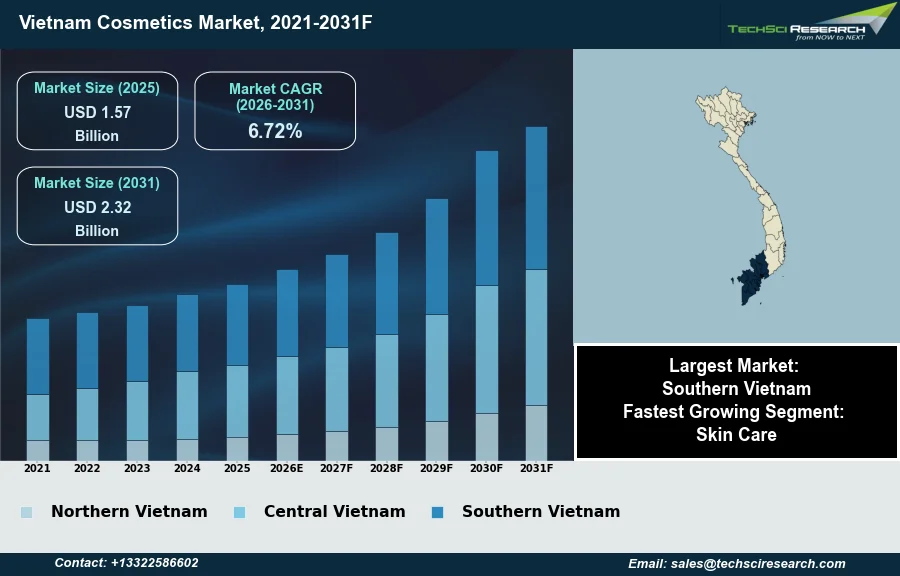
Market Size (2025)
|
USD 1.57 Billion
|
|
CAGR (2026-2031)
|
6.72%
|
|
Fastest Growing Segment
|
Skin Care
|
|
Largest Market
|
Southern Vietnam
|
|
Market Size (2031)
|
USD 2.32 Billion
|
Market Overview
The Cosmetics Market in Vietnam will grow from USD 1.57 Billion in 2025 to USD 2.32 Billion by 2031 at a 6.72% CAGR. Cosmetics are substances intended to be applied to the human body for cleansing, beautifying, promoting attractiveness, or altering appearance, encompassing products such as makeup, skincare, and hair care items. The Vietnam Cosmetics Market's growth is fundamentally supported by robust macroeconomic drivers including rising disposable incomes, accelerated urbanization, and a heightened consumer consciousness regarding personal grooming and beauty standards. Increased financial independence among women also significantly contributes to expanding consumer spending within this sector.
However, market expansion faces a notable impediment due to the pervasive challenge of counterfeit cosmetic products, which erodes consumer trust and brand integrity. According to the Observatory of Economic Complexity, in 2024, Vietnam imported $1.92 billion in perfumery and cosmetics, highlighting the market's reliance on external supply amidst these operational complexities.
Key Market Drivers
E-commerce as the Growth Engine for Vietnam Cosmetics
The rapid growth of e-commerce and digital platforms is a primary catalyst for the Vietnam Cosmetics Market. These platforms offer unparalleled accessibility and convenience, transforming consumer purchasing habits. Digital storefronts on major platforms have become crucial channels for product discovery and transaction. Vietnamese consumers spent nearly US$3 billion on beauty and personal care products on e-commerce platforms in 2025, marking a significant rise of approximately 30 percent from the preceding year. This substantial increase underscores the pivotal role of online retail in the market's expansion, driven by widespread smartphone adoption and evolving digital payment infrastructure. The transition towards online purchasing also allows for broader product assortments, including international brands, catering to diverse consumer preferences across urban and rural areas.
Social Media and Digital Connectivity Drive Cosmetic Demand
Concurrently, the influence of global beauty trends and social media profoundly shapes consumer demand and engagement within the sector. Social media platforms serve as powerful avenues for brand visibility, influencer marketing, and the dissemination of international beauty standards, notably from South Korea and other Asian markets. According to Elite Asia, in June 2026, there were 79.0 million active social media user identities in Vietnam in October 2025, equivalent to 77.6% of the population. This extensive digital penetration facilitates rapid trend adoption and peer recommendations, directly impacting purchasing decisions. According to Elite Asia, Vietnam recorded 85.6 million internet users in October 2025, representing an internet penetration rate of 84.2%. This high level of digital connectivity creates a fertile environment for cosmetic brands to engage directly with a vast and digitally-savvy consumer base, accelerating market responsiveness to emerging trends and product innovations.
Download Free Sample Report
Key Market Challenges
Counterfeit Cosmetics Undermine Trust and Market Growth
The pervasive challenge of counterfeit cosmetic products significantly impedes the growth of the Vietnam Cosmetics Market. These illicit goods directly erode consumer trust and undermine the integrity of authentic brands. When consumers encounter fake products, which often contain substandard or harmful ingredients, their confidence in the overall market diminishes, leading to reduced purchasing intent. This direct consequence negatively impacts sales for legitimate businesses and discourages new market entrants.
Regulatory Violations, Health Risks, and Market Uncertainty
According to the Ministry of Industry and Trade's Domestic Markets Department, market inspectors uncovered more than 23,000 violations across Vietnam in 2025, resulting in fines totaling 372 billion VND (approximately 14.3 million USD). These infractions frequently involved goods of unclear origin and counterfeit items, including cosmetics. The proliferation of such products not only diverts revenue from genuine brands but also poses serious health risks to consumers, further deterring engagement with the beauty sector. Consequently, brand reputation suffers, making it challenging for companies to build and maintain a loyal customer base amidst widespread uncertainty about product authenticity.
Key Market Trends
Rising Demand for Natural/Organic Cosmetics and Transparent Labeling
A significant trend transforming the Vietnam Cosmetics Market is the accelerating consumer demand for natural and organic cosmetic products, driven by heightened awareness of ingredient safety and environmental impact. Consumers are increasingly scrutinizing product labels and seeking formulations free from synthetic chemicals, aligning with a broader global movement towards 'clean beauty'. This preference for authenticity and quality is evident in purchasing behavior, with official brand stores on e-commerce platforms, known as Shop Malls, accounting for 64.4% of total revenue in Q4/2025, representing a 36% year-on-year increase. This substantial shift underscores a consumer inclination towards trusted retail channels that often house brands emphasizing ingredient transparency and sustainable practices, thereby fueling the growth of the natural and organic segment.
Growth of Male Grooming Driven by Shifting Masculinity and Self-Care
Concurrently, the Vietnam Cosmetics Market is experiencing a robust expansion in the male grooming segment. Traditional perceptions of masculinity are evolving, leading to a greater acceptance and adoption of dedicated skincare and personal care routines among Vietnamese men. This demographic is increasingly investing in products ranging from facial cleansers and moisturizers to specialized hair care items, driven by social media influence and rising disposable incomes. According to DPS Media, January 16, 2026, in the '2026 Cosmetics Industry Report: KOC Power & “Clean Beauty” Era,' the men's cosmetics market is projected to reach 500 million USD in 2026. This growth signifies a considerable untapped market potential and a notable shift in consumer behavior, as personal grooming becomes a more prominent aspect of male self-care in Vietnam.
Segmental Insights
Key drivers of Vietnam skincare market growth
The Skin Care segment is currently the fastest-growing in the Vietnam Cosmetics Market, driven by a pronounced increase in consumer awareness concerning skin health and overall personal grooming. This growth is significantly fueled by the pervasive influence of global beauty trends, particularly K-beauty, which encourages multi-step skincare routines. Furthermore, rising disposable incomes within Vietnam's expanding middle class enable greater investment in specialized products addressing concerns such as anti-aging, hydration, and sun protection. Urbanization also contributes to this demand, as consumers seek solutions for environmental factors. The Ministry of Industry and Trade recognizes these key drivers shaping the segment's robust expansion.
Regional Insights
Market Leadership in Southern Vietnam: Economic Strength, Urban Development, and Retail Access
Southern Vietnam stands as the leading region in the Vietnam Cosmetics Market, primarily driven by its robust economic landscape and advanced urban development. Ho Chi Minh City, as a major financial hub, contributes significantly through its high population density and substantial consumer purchasing power. The region benefits from superior modern retail infrastructure and extensive e-commerce penetration, facilitating broad access to a diverse range of cosmetic products. Furthermore, a concentration of young consumers and greater exposure to international beauty trends enhance brand awareness and demand for cosmetics in Southern Vietnam.
Recent Developments
-
In July 2025, Cloud Beauty announced its participation in the VIETBEAUTY and COSMOBEAUTÉ VIETNAM exhibitions, where it unveiled a range of sustainable innovations. The company showcased new ready-to-use formulas aimed at simplifying beauty routines while prioritizing eco-responsibility. Key highlights included physical sunscreen innovations tailored for tropical climates and gentle maternity care solutions, reflecting Cloud Beauty's focus on sustainable ingredients and low-impact production methods for the Vietnamese consumer.
-
In May 2025, Amway Vietnam introduced the Artistry Labs Illuminating System to the Vietnamese cosmetics market. This new product line was specifically designed to address hyperpigmentation, uneven skin tone, and visible signs of aging, targeting women over 40. The launch underscored Amway's commitment to anti-aging skincare solutions, contributing to product innovation and market expansion within Vietnam's beauty sector.
-
In April 2025, a collaboration between Sol by Melia Phu Quoc and Cocoon Vietnam resulted in the "Endless Summer" campaign. This initiative focused on promoting vegan skincare products, aligning with the growing consumer interest in sustainable beauty. The partnership highlighted eco-friendly and cruelty-free skincare options, emphasizing shared values between a hospitality provider and a local Vietnamese beauty brand within the domestic market.
-
In November 2024, YA-MAN LTD. inaugurated its first permanent overseas boutique in Ho Chi Minh City, Vietnam. This strategic opening marked a significant expansion for the Japanese beauty device company in the Vietnamese market. The boutique allowed Vietnamese customers to experience and purchase flagship "YA-MAN TOKYO JAPAN" products, which incorporate advanced beauty technologies, alongside "YA-MAN PROFESSIONAL" salon products.
Key Market Players
- L'Oréal Vietnam
- Unilever Vietnam
- Shiseido Vietnam
- Procter & Gamble Vietnam
- Estée Lauder Companies
- LG Household & Health Care
- Amorepacific Corporation
- Cocoon Vietnam
- Thorakao Cosmetics
- Lemonade Cosmetics Vietnam
|
By Type
|
By Gender
|
By Sales Channel
|
By Region
|
- Skin Care
- Hair Care
- Bath & Shower Products
- Makeup & Color Cosmetics
- Fragrances & Deodorants
- Others
|
|
- Supermarkets/Hypermarkets
- Pharmacy
- Departmental Stores
- Multi-Branded Stores
- Online
- Others
|
- Northern
- Central
- Southern
|
Report Scope:
In this report, the Vietnam Cosmetics Market has been segmented into the following categories, in addition to the industry trends which have also been detailed below:
-
Vietnam Cosmetics Market, By Type:
-
Skin Care
-
Hair Care
-
Bath & Shower Products
-
Makeup & Color Cosmetics
-
Fragrances & Deodorants
-
Others
-
Vietnam Cosmetics Market, By Gender:
-
Vietnam Cosmetics Market, By Sales Channel:
-
Supermarkets/Hypermarkets
-
Pharmacy
-
Departmental Stores
-
Multi-Branded Stores
-
Online
-
Others
-
Vietnam Cosmetics Market, By Region:
-
Northern
-
Central
-
Southern
Competitive Landscape
Company Profiles: Detailed analysis of the major companies present in the Vietnam Cosmetics Market.
Available Customizations:
Vietnam Cosmetics Market report with the given market data, TechSci Research offers customizations according to a company's specific needs. The following customization options are available for the report:
Company Information
- Detailed analysis and profiling of additional market players (up to five).
Vietnam Cosmetics Market is an upcoming report to be released soon. If you wish an early delivery of this report or want to confirm the date of release, please contact us at sales@techsciresearch.com