|
Key Insights
|
Details
|
|
Forecast Period
|
2027-2031
|
|
Market Size (2025)
|
USD 234.68 Million
|
|
CAGR (2026-2031)
|
5.61%
|
|
Fastest Growing Segment
|
Fish
|
|
Largest Market
|
Southern Vietnam
|
|
Market Size (2031)
|
USD 325.62 Million
|
Market Overview
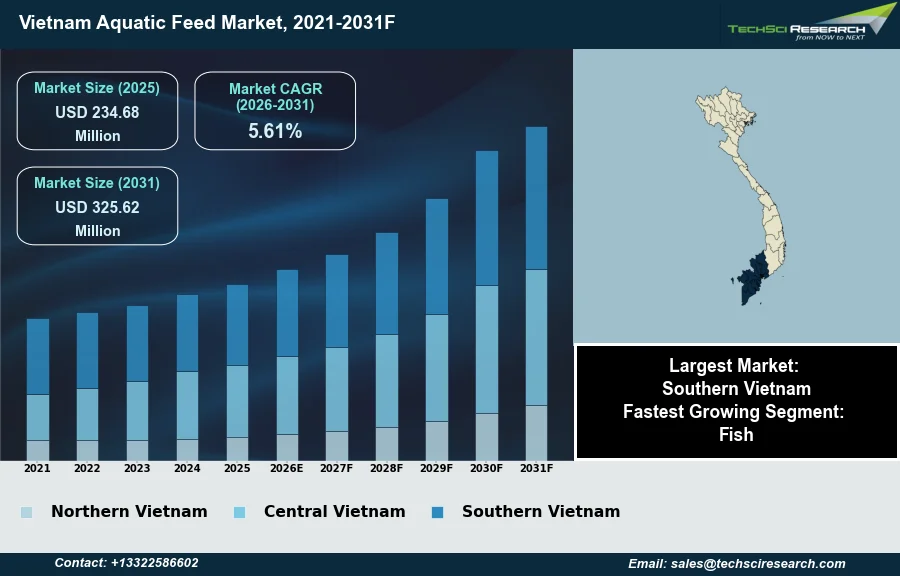
The Aquatic Feed Market in Vietnam will grow from USD 234.68 Million in 2025 to USD 325.62 Million by 2031 at a 5.61% CAGR. Aquatic feed comprises manufactured products or raw materials providing essential nutrients and beneficial components for the growth and health of farmed aquatic animals. The market's expansion in Vietnam is fundamentally driven by the substantial growth of the nation's aquaculture industry, a leading global exporter of key species such as shrimp and pangasius. Additionally, increasing domestic consumption and robust international demand for traceable seafood, coupled with sustained government support for sustainable aquaculture development, significantly bolster market progression.
This robust growth is underscored by specific sector performance; according to the Vietnam Association of Seafood Export and Production (VASEP), in the first half of 2025, pangasius exports alone reached $1 billion. Nevertheless, a significant challenge impeding continued market expansion is the considerable reliance on imported raw materials, including fishmeal, soybean meal, and corn, which exposes the industry to global supply chain disruptions and inherent price volatility.
Key Market Drivers
Aquaculture Expansion Drives Feed Demand
The rapid expansion of the aquaculture industry serves as a fundamental driver for the Vietnam Aquatic Feed Market. This growth is characterized by significant increases in cultivation areas and overall production volumes across various aquatic species. The burgeoning aquaculture sector necessitates a substantial volume of compound feeds to adequately support the nutritional requirements of farmed fish and shrimp, thereby directly boosting feed demand. According to the Directorate of Fisheries and Fisheries Surveillance, as reported by VASEP on January 23, 2026, Vietnam's aquaculture production reached 6.1 million tons in 2025, marking a 5.1% increase year-on-year. This expansion is further fueled by the increasing adoption of intensive farming practices, which are heavily reliant on high-quality formulated feeds to maximize yields.
Rising Global and Domestic Seafood Demand
Concurrently, the growing domestic and international seafood demand profoundly influences the aquatic feed market. Robust international demand, particularly from major importing regions, compels Vietnamese aquaculture producers to scale up operations and enhance output efficiency. This intensified production directly correlates with a heightened requirement for specialized aquatic feeds. According to the Vietnam Association of Seafood Exporters and Producers (VASEP), May 2026, the total seafood export value for the first four months of 2026 reached $3.7 billion, representing a nearly 15% increase compared to the same period in 2025. Domestically, rising consumer incomes and evolving dietary preferences also contribute to a sustained increase in seafood consumption. This robust and continuous demand environment drives innovation and investment within the aquatic feed manufacturing sector. Furthermore, according to the Secretary General of the Vietnam Association of Seafood Exporters and Producers, May 2026, Vietnam's seafood exports are projected to reach approximately US$12.3 billion in 2026.
Download Free Sample Report
Key Market Challenges
Import Dependency Elevates Costs and Global Volatility Exposure
A significant impediment to the sustained expansion of the Vietnam Aquatic Feed Market is its substantial reliance on imported raw materials, including crucial ingredients such as fishmeal, soybean meal, and corn. This dependency directly exposes the industry to pronounced global supply chain disruptions and inherent price volatility in international commodity markets. Such reliance translates into higher operational costs for domestic feed manufacturers. According to preliminary statistics from the Customs Department, Vietnam's imports of all types of soybeans in 2025 reached 2.61 million tonnes, valued at over $1.21 billion.
Cost Volatility Erodes Margins and Hinders Market Growth
These fluctuating input costs consequently erode the profit margins of aquatic feed producers, making it challenging to maintain stable pricing for aquaculture farmers. This directly hampers market growth as elevated feed expenses can constrain farmers' capacity for investment, expansion, and ultimately, the overall productivity of the aquaculture sector.
Key Market Trends
Diversification into Alternative Proteins and Insect-Based Feed
The Vietnam Aquatic Feed Market demonstrates a significant trend toward diversifying into alternative protein sources, reducing reliance on volatile traditional ingredients like fishmeal and soybean meal. This shift involves incorporating novel proteins such as insect meal and plant-based alternatives to enhance sustainability and supply chain stability. Major aquaculture players are actively adopting these new feed ingredients. For instance, according to Entobel, February 2024, in the "Entobel Signs Agreement with Vinh Hoan for the Supply of Insect Protein to Accelerate Vinh Hoan's Transition Towards More Sustainable Pangasius Production" news article, Vinh Hoan, a leading pangasius producer, committed to purchasing a minimum of 15,000 metric tons of insect protein from Entobel between 2025 and 2027.
Adoption of Sustainable Feed Formulations and International Collaborations
Another influential trend is the increasing adoption of sustainable feed formulations. This is driven by consumer demand for traceable and responsibly produced seafood, alongside stringent environmental regulations. Feed manufacturers are reformulating products with sustainable ingredients and processes to minimize aquaculture's environmental footprint. International collaborations further support this. According to SeafoodSource, January 2026, in the "US-Vietnam partnership targets tilapia development and soy-based aquafeed trade" news article, the United States is investing $15.2 million in a five-year project to expand soy-based aquaculture feed trade in Vietnam.
Segmental Insights
Fish Segment: Fastest-Growing Category Driven by Domestic and International Demand
The Fish segment is experiencing rapid growth within the Vietnam Aquatic Feed Market, emerging as the fastest-growing category. This accelerated expansion is primarily driven by escalating domestic consumption and robust international demand for fish as an essential protein source. The Vietnamese government, through the Ministry of Agriculture and Rural Development (MARD), strategically supports the aquaculture sector by implementing development programs and promoting sustainable farming practices for key species such as pangasius and tilapia. Furthermore, continuous advancements in breeding technologies and feed formulations enhance productivity and feed efficiency, solidifying the segment's strong market position.
Regional Insights
Southern Vietnam as the Aquaculture Hub Driving Feed Demand
Southern Vietnam leads the Vietnam Aquatic Feed Market due to its advantageous geographical position, primarily the Mekong Delta, which serves as the nation's aquaculture heartland. This region benefits from extensive river networks and a tropical climate, creating ideal conditions for intensive shrimp and pangasius farming, Vietnam's primary aquaculture exports. The concentration of these high-value species drives significant demand for commercial aquatic feed. Furthermore, the region possesses a well-developed aquaculture infrastructure, including numerous feed mills and processing facilities, supported by strategic initiatives from the Ministry of Agriculture and Rural Development and its Directorate of Fisheries, fostering a robust supply chain to meet strong domestic and international demand.
Recent Developments
-
In August 2025, Skretting Vietnam launched STELLA P, a new premium aquaculture feed specifically developed for pompano farmers operating in Vietnam's central region. This specialized feed solution was formulated to promote faster fish growth, enabling pompano to reach market size earlier and develop a naturally vibrant coloration. The product was designed to deliver both biological and economic advantages, aligning global nutritional innovations with local aquaculture demands to support enhanced productivity and profitability for Vietnamese pompano cultivators.
-
In August 2024, De Heus and ShrimpVet entered a cooperation agreement focused on advancing sustainable shrimp farming practices in Vietnam. The partnership encompassed joint efforts in research, testing, and the supply of aquafeeds. Key activities included experimental research into shrimp diseases and collaborative development in shrimp farming processes. This strategic alliance aimed to integrate advanced technologies and knowledge transfer to optimize productivity, reduce environmental impact, and establish De Heus as a reliable partner for Vietnamese farmers and businesses in the pursuit of a more sustainable shrimp aquaculture industry.
-
In March 2024, Skretting Vietnam introduced two new product lines designed to enhance shrimp farming in the country. At the VietShrimp Aquaculture International Fair, the company unveiled "Titan," a cost-effective solution intended to support shrimp production, and "Galea," a natural and effective product formulated to inhibit parasites. These introductions aimed to provide Vietnamese shrimp farmers with advanced nutritional and health management tools, contributing to improved efficiency and sustainability within the critical shrimp aquaculture segment of the Vietnam aquatic feed market.
-
In February 2024, Vinh Hoan Corporation and Entobel expanded their strategic partnership, focusing on sustainable aquaculture in Vietnam. This collaboration involved Feed One, a subsidiary of Vinh Hoan, agreeing to purchase a substantial volume of insect protein from Entobel's Vung Tau factory for pangasius feed. The agreement aimed to accelerate the adoption of insect-based ingredients, thereby fostering a more environmentally conscious food system and reducing the aquaculture sector's reliance on traditional protein sources. This initiative underscored a commitment to developing cost-effective and sustainable feed solutions without compromising quality within the Vietnamese aquatic feed market.
Key Market Players
- Cargill
- CP Group
- DSM
- Adisseo
- Nutreco
- Alltech
- Kemin
- Archer Daniels Midland
- Local Feed Mills
- Al Futtaim Feed
|
By Feed Type
|
By Form
|
By Region
|
- Fish
- Mollusks
- Shrimps
- Others
|
|
- Northern
- Central
- Southern
|
Report Scope:
In this report, the Vietnam Aquatic Feed Market has been segmented into the following categories, in addition to the industry trends which have also been detailed below:
-
Vietnam Aquatic Feed Market, By Feed Type:
-
Fish
-
Mollusks
-
Shrimps
-
Others
-
Vietnam Aquatic Feed Market, By Form:
-
Vietnam Aquatic Feed Market, By Region:
-
Northern
-
Central
-
Southern
Competitive Landscape
Company Profiles: Detailed analysis of the major companies present in the Vietnam Aquatic Feed Market.
Available Customizations:
Vietnam Aquatic Feed Market report with the given market data, TechSci Research offers customizations according to a company's specific needs. The following customization options are available for the report:
Company Information
- Detailed analysis and profiling of additional market players (up to five).
Vietnam Aquatic Feed Market is an upcoming report to be released soon. If you wish an early delivery of this report or want to confirm the date of release, please contact us at sales@techsciresearch.com