|
Key Insights
|
Details
|
|
Forecast Period
|
2027-2031
|
|
Market Size (2025)
|
USD 1.32 Billion
|
|
CAGR (2026-2031)
|
5.98%
|
|
Fastest Growing Segment
|
Online
|
|
Largest Market
|
South
|
|
Market Size (2031)
|
USD 1.87 Billion
|
Market Overview
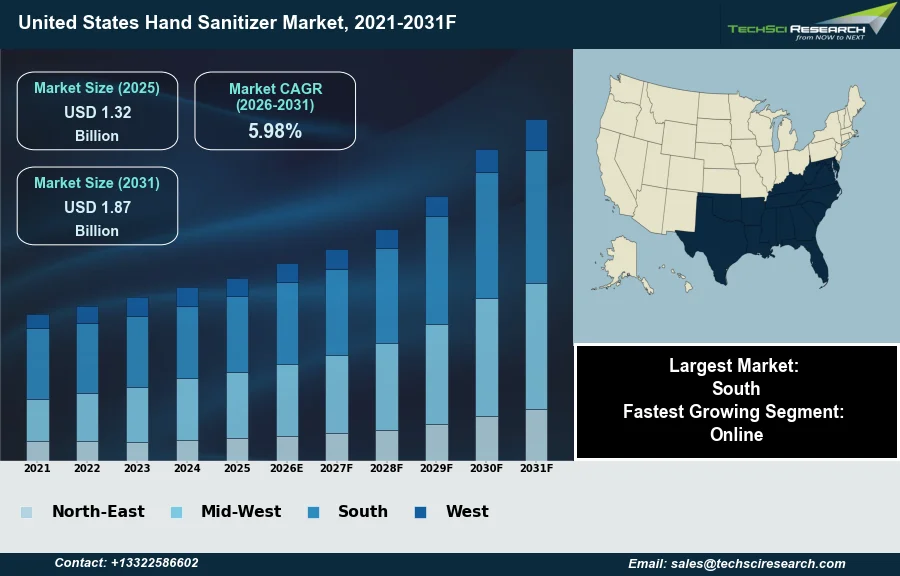
The United States Hand Sanitizer Market will grow from USD 1.32 Billion in 2025 to USD 1.87 Billion by 2031 at a 5.98% CAGR. Hand sanitizer is a liquid, gel, or foam formulation designed to reduce microbes on hands when traditional washing methods are unavailable. The United States Hand Sanitizer Market's expansion is fundamentally driven by elevated public health awareness, increased prioritization of personal hygiene, and the inherent convenience of accessible product formats. These core drivers foster consistent demand across both consumer and commercial sectors, distinct from transient market trends.
A significant challenge that could impede market growth is the potential for diminished perceived necessity as public health concerns fluctuate. However, foundational hygiene practices remain. According to the American Cleaning Institute, in 2025, 97% of Americans considered cleaning and hygiene important for public health, with 74% having adjusted their cleaning habits to enhance overall health.
Key Market Drivers
Heightened Hygiene Awareness Sustains Market Demand
Heightened Hygiene Consciousness and Public Health Awareness continues to significantly influence the United States Hand Sanitizer Market. This sustained awareness, often catalyzed by seasonal health concerns, translates into consistent consumer engagement with hygiene practices. For instance, according to the American Cleaning Institute, in October 2025, in the 'New ACI Survey Reveals Hygiene Gaps That Put Families at Risk During Cold & Flu Season' report, 72% of Americans indicated they change their cleaning habits during cold and flu season. This ongoing vigilance ensures hand sanitizers remain a vital component of daily routines, not merely a response to acute outbreaks, reinforcing demand across diverse consumer environments.
Healthcare and Commercial Sector Demand as a Key Driver
Concurrently, the Expanding Demand from Healthcare and Commercial Sectors serves as another fundamental market driver. These institutional settings require robust hygiene protocols, leading to consistent procurement and usage of hand sanitizers. For example, according to a June 24, 2026, article titled 'Updated WHO Guidelines Support Multi-Modal Approach to Hand Hygiene Compliance', hand hygiene compliance rates in most U.S. healthcare facilities are estimated to be between 30% and 50% on average. This persistent need for improved compliance drives continuous demand for advanced dispensing systems and bulk product formats. Beyond healthcare, commercial environments such as offices and retail spaces also integrate hand sanitizers into their operational standards. Supporting this broader market activity, according to Unilever's Q4 and Full Year 2025 results, released in February 2026, its Personal Care segment, encompassing various hygiene products, achieved 4.7% underlying sales growth for the full year 2025.
Download Free Sample Report
Key Market Challenges
Diminished Perceived Necessity as Public Health Concerns Fluctuate
The challenging factor impacting the United States Hand Sanitizer Market is the potential for diminished perceived necessity as public health concerns fluctuate. This directly impedes market growth by reducing the sustained urgency for hand hygiene products among consumers and commercial entities. When widespread public health alerts or pandemic conditions recede from public consciousness, the demand for frequent hand sanitizer usage tends to moderate significantly. Consumers may revert to pre-crisis hygiene behaviors, leading to a natural decline in purchase frequency and overall sales volumes.
ISSA Report: 7% YoY Decline in Cleaning & Hygiene Sales
This shift directly translates into reduced demand across various sectors. According to data reported by ISSA, the worldwide cleaning industry association, in its Q1 2025 Cleaning & Hygiene Report, total portfolio sales for the cleaning and hygiene industry were down 7% year-over-year, with nearly all product categories experiencing declines. This broad contraction signals a recalibration of the market, where buyers are purchasing less, reflecting a softening demand driven by changing customer expectations and a decreased perception of immediate health threats.
Key Market Trends
Premiumization and Skin-Health Benefits Driving Innovation in Hand Sanitizers
The United States Hand Sanitizer Market is significantly influenced by a growing trend towards premiumization and the integration of skincare benefits into product formulations. Consumers increasingly seek hand sanitizers that offer more than just germ-killing efficacy, prioritizing formulations that address skin dryness and irritation. This shift reflects a broader consumer demand for personal care products that provide dual benefits, combining hygiene with skin health. For example, according to a January 28, 2026, article in Hand Sanitizer Market Size, Share Growth Report 2035, manufacturers leveraging organic extracts and aloe vera have observed a 22% increase in repeat purchases, demonstrating the value placed on these enhanced attributes. This trend encourages innovation in ingredients, leading to products enriched with moisturizers, vitamins, and other skin-conditioning agents.
Diversification of Formats and Touchless Dispensing Trends
Concurrently, diversification in product formats and dispensing technologies is reshaping market offerings. Beyond traditional gels, the market is expanding to include sprays, foams, and wipes, catering to varied consumer preferences and application needs. Innovative dispensing technologies, particularly touchless systems, are also gaining traction, driven by convenience and a desire to minimize cross-contamination in both public and private settings. Reflecting the widespread familiarity and sustained interest in established formats, Google search interest for "hand sanitizer gel" consistently shows high engagement, peaking in September 2025 with a value of 69, according to data from PRNewswire in "Hand Sanitizer Trends 2025: Market Growth & Consumer Insights". This indicates a foundational preference for gel while other formats continue to carve out their market niches through technological advancements and user-specific designs.
Segmental Insights
Online Channel Driving Rapid Growth in the U.S. Hand Sanitizer Market
The Online segment is emerging as the fastest-growing distribution channel within the United States Hand Sanitizer Market, demonstrating significant expansion. This rapid growth is primarily attributable to enhanced consumer convenience, offering continuous accessibility and efficient home delivery services for a wide array of products. Online platforms also provide a substantially broader selection of brands, formulations, and sizes compared to traditional retail outlets, catering to diverse consumer preferences. Furthermore, the increasing consumer reliance on e-commerce for everyday essentials, alongside the prevalence of competitive pricing and promotional strategies in digital marketplaces, further propels this segment's robust market expansion.
Regional Insights
Key Growth Drivers in the Southern U.S. Hand Sanitizer Market
The Southern United States leads the nation's hand sanitizer market, primarily due to its significant population and high urban density, which naturally elevates demand for hygiene products. The region also benefits from an extensive healthcare infrastructure and robust commercial activity across its hospitality, retail, and office sectors, driving considerable institutional procurement. Ongoing hygiene protocols within these facilities, often reinforced by public health standards and recommendations from institutions like the Centers for Disease Control and Prevention (CDC), further sustain consistent demand. Furthermore, the warm climate in many Southern areas can contribute to increased germ awareness, making regular hand sanitization a priority for residents.
Recent Developments
-
In July 2025, GOJO Industries, a leading US-based manufacturer, unveiled its new PURELL Hand Sanitizer Spray, introducing an innovative format to the United States Hand Sanitizer Market. This product delivers the established germ-killing effectiveness of PURELL gel in a lightweight, refreshing spray designed for convenience. Available in various scents, including Lavender & Verbena, Tangerine & Pear, and Unscented, the sprays are formulated with essential oils and are free from harsh dyes, parabens, phthalates, and sulfates. This launch was aimed at meeting the demand for portable and effective hand hygiene solutions for consumers with active lifestyles, offering a sensory-enhanced sanitizing experience.
-
In May 2025, Church & Dwight Co., Inc. entered into a definitive agreement to acquire Touchland, a rapidly growing hand sanitizer brand, for up to $880 million. This strategic acquisition significantly impacted the United States Hand Sanitizer Market, as Touchland was recognized as the fastest-growing brand and the second-largest in the category. The deal, comprising cash and Church & Dwight stock, aimed to integrate Touchland's differentiated consumer proposition and loyal customer base, particularly among younger demographics, into Church & Dwight's portfolio. Touchland’s products were primarily marketed in the U.S., enhancing the acquiring company's presence.
-
In April 2025, Safetec of America, an infection control product manufacturer based in Buffalo, New York, announced the launch of its new 2 oz. Instant Hand Sanitizer Spray. This product was introduced to the United States Hand Sanitizer Market to offer an effortless, no-touch application that eliminates 99.9% of germs. The formula contains 66.5% ethyl alcohol, surpassing CDC recommendations, and is enriched with aloe vera to maintain skin moisture. Designed for versatility, this quick-drying spray leaves no sticky residue and is suitable for various settings, including workplaces, healthcare facilities, schools, and personal use, as well as being TSA-friendly for travelers.
-
In 2024, GOJO Industries introduced its ES10 Dispensing System, marking a notable advancement in sustainable hand hygiene solutions within the United States market. This new touch-free dispensing system was engineered to combine efficiency with environmental responsibility, representing GOJO's most sustainable offering to date. The design focused on reducing material waste and emissions through streamlined refill components, while maintaining durability and reliability essential for various environments. This innovation underscored the company’s commitment to setting new standards for both efficacy and sustainability in hand hygiene technology.
Key Market Players
- Reckitt Benckiser Group plc
- Henkel AG and Company
- Unilever
- Best Sanitizers, Inc.
- Procter and Gamble
- The Himalaya Drug Company
- GOJO Industries, Inc.
- Vi-Jon
- Chattem, Inc.
- Kutol
|
By Product Type
|
By Sales Channel
|
By Region
|
- Gel
- Foam
- Liquid
- Spray
- Wipes
|
- Supermarkets/Hypermarkets
- Convenience Stores
- Pharmacies/Drugstores
- Online
- Others
|
- Northeast
- Midwest
- South
- West
|
Report Scope:
In this report, the United States Hand Sanitizer Market has been segmented into the following categories, in addition to the industry trends which have also been detailed below:
-
United States Hand Sanitizer Market, By Product Type:
-
Gel
-
Foam
-
Liquid
-
Spray
-
Wipes
-
United States Hand Sanitizer Market, By Sales Channel:
-
Supermarkets/Hypermarkets
-
Convenience Stores
-
Pharmacies/Drugstores
-
Online
-
Others
-
United States Hand Sanitizer Market, By Region:
-
Northeast
-
Midwest
-
South
-
West
Competitive Landscape
Company Profiles: Detailed analysis of the major companies present in the United States Hand Sanitizer Market.
Available Customizations:
United States Hand Sanitizer Market report with the given market data, TechSci Research offers customizations according to a company's specific needs. The following customization options are available for the report:
Company Information
- Detailed analysis and profiling of additional market players (up to five).
United States Hand Sanitizer Market is an upcoming report to be released soon. If you wish an early delivery of this report or want to confirm the date of release, please contact us at sales@techsciresearch.com