|
Key Insights
|
Details
|
|
Forecast Period
|
2027-2031
|
|
Market Size (2025)
|
USD 3641.55 Million
|
|
CAGR (2026-2031)
|
6.81%
|
|
Fastest Growing Segment
|
Online
|
|
Largest Market
|
South
|
|
Market Size (2031)
|
USD 5407.02 Million
|
Market Overview
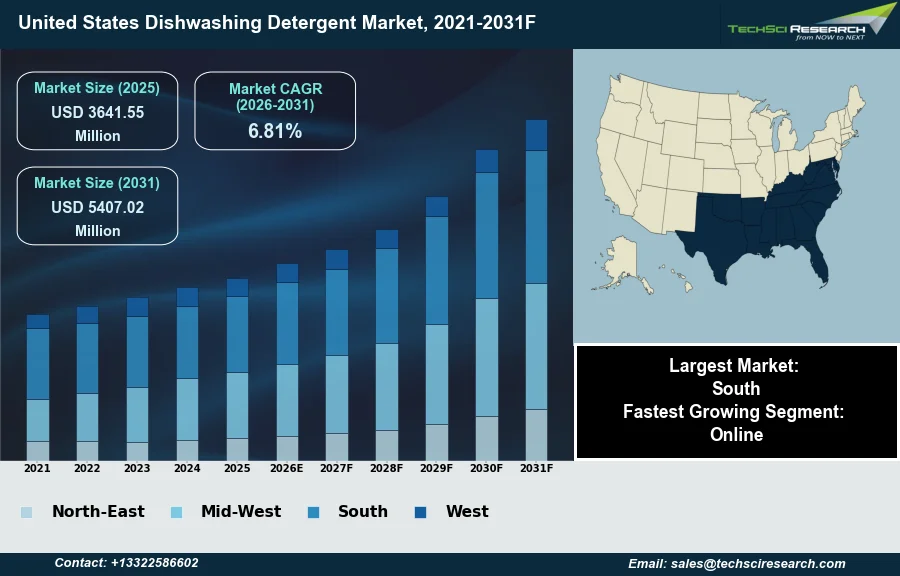
The United States Dishwashing Detergent Market will grow from USD 3641.55 Million in 2025 to USD 5407.02 Million by 2031 at a 6.81% CAGR. Dishwashing detergents are specialized chemical formulations employed for cleaning kitchenware, glassware, and cooking utensils, facilitating the removal of food residues, grease, and other contaminants through either manual or automatic washing processes. The United States market for these products is primarily driven by the expanding adoption of automatic dishwashers, fueled by evolving consumer lifestyles and a growing emphasis on convenience in domestic tasks. Furthermore, a heightened consumer awareness regarding hygiene and sanitation standards contributes substantially to sustained product demand. According to the Household and Commercial Products Association, companies within the broader cleaning, protecting, maintaining, and disinfecting products industry generate $227 billion annually.
A significant challenge impeding market expansion is intense price competition, particularly from private label brands that frequently offer comparable product efficacy at more competitive price points. This pervasive competitive environment necessitates continuous investment in product innovation and strategic promotional activities to preserve market share and ensure profitability.
Key Market Drivers
Dishwasher penetration drives demand for machine-specific detergents
The increasing penetration of automatic dishwashers stands as a primary catalyst for growth in the United States dishwashing detergent market. As modern lifestyles continue to emphasize convenience, automatic dishwashers are becoming an increasingly integral part of household routines, directly correlating with a heightened demand for specialized machine dishwashing detergents. This trend is evident in reports from leading industry players. For instance, according to Reckitt Benckiser's Q1 2026 earnings, reported in April 2026, the company observed double-digit sales value growth in its Finish Ultimate Plus auto-dish segment, contributing to a positive product mix. This demonstrates how advancements in appliance technology and consumer adoption of automatic washing methods directly fuel the need for effective and high-performance detergent formulations designed for these machines.
Hygiene awareness fuels demand for sanitizing dishwashing products
Concurrently, heightened consumer hygiene awareness profoundly influences purchasing decisions within the market. Driven by an increased understanding of the link between cleanliness and health, consumers are prioritizing products that offer superior sanitization capabilities, even for dishwashing. According to survey data released by the American Cleaning Institute (ACI) in March 2025, 74% of Americans have adjusted their cleaning habits to prioritize health. This focus extends to kitchen hygiene, creating sustained demand for dishwashing detergents that promise effective removal of food residues and germs. The broader U.S. cleaning product supply chain, which the American Cleaning Institute represents, had a value of $60 billion in March 2025, underscoring the substantial economic scale influenced by these consumer priorities.
Download Free Sample Report
Key Market Challenges
Private-label price competition constrains growth and margins.
Intense price competition represents a significant impediment to the growth of the United States dishwashing detergent market. This challenge stems particularly from the proliferation of private label brands that consistently offer products with comparable cleaning efficacy at more accessible price points. Such competitive dynamics force established brands to engage in aggressive pricing strategies, which can erode profit margins and limit investment in further market expansion initiatives.
Private-label strength constrains premium-brand growth.
The presence of these lower-priced alternatives directly pressures the market share and revenue potential of national brands. For instance, according to the Household and Commercial Products Association, in 2025, sales of private label household care products, including dishwashing detergents, represented a notable percentage of the overall market, indicating consumer willingness to opt for value-driven options. This trend underscores how price sensitivity among consumers, coupled with the strong performance of private labels, constrains revenue growth and market penetration for premium and established brands, thereby hampering the overall expansion of the United States dishwashing detergent market.
Private-label competition undermines margins and expansion.
Intense price competition represents a significant impediment to the growth of the United States dishwashing detergent market. This challenge stems particularly from the proliferation of private label brands that consistently offer products with comparable cleaning efficacy at more accessible price points. Such competitive dynamics force established brands to engage in aggressive pricing strategies, which can erode profit margins and limit investment in further market expansion initiatives.
Private-label sales outpace brands, constraining detergent growth.
The presence of these lower-priced alternatives directly pressures the market share and revenue potential of national brands. According to the Private Label Manufacturers Association, in 2025, private label retail sales in the United States reached a record $282.8 billion across all outlets, outpacing the growth of national brands. This trend, where store brands are increasingly chosen for their value and perceived quality, indicates that consumer behavior shifts away from higher-priced branded options. This directly constrains the potential for volume and revenue growth for branded dishwashing detergents, thereby hampering the overall expansion of the United States dishwashing detergent market.
Key Market Trends
Surge in Sustainable, Transparent Cleaning Products
The accelerated adoption of sustainable and eco-friendly products represents a pivotal trend reshaping the United States dishwashing detergent market. Consumers are increasingly prioritizing products formulated with natural ingredients, biodegradable components, and reduced environmental impact, driven by heightened environmental consciousness. This shift compels manufacturers to innovate their product lines, emphasizing transparency in sourcing and production to meet evolving consumer expectations. According to federal statistics from the US Environmental Protection Agency's Safer Choice Program, as reported on June 12, 2026, in the 'Household Cleaning Products Market Size, Forecasts Report 2026-2035', the number of certified sustainable cleaning products on the US market grew by more than 35% between 2022 and 2025. This trend is leading to a greater variety of green cleaning options and influencing brand positioning across the market.
E-commerce Expansion Reshaping Dishwashing Detergent Distribution
Concurrently, the expansion of e-commerce and direct-to-consumer sales channels is significantly influencing the distribution landscape of dishwashing detergents. The convenience and accessibility offered by online platforms are increasingly attracting consumers, shifting purchasing habits away from traditional brick-and-mortar stores. This trend enables both established brands and agile direct-to-consumer players to reach a broader audience, requiring adaptations in supply chain logistics, digital marketing strategies, and packaging suitable for shipping. According to Kroger's Q1 2026 earnings, reported on June 18, 2026, in 'Kroger digital sales become profitable 'ahead of schedule' in Q1', the retailer's digital sales grew 19% year over year. This transformation in retail dynamics creates new competitive avenues and demands greater investment in digital infrastructure.
Segmental Insights
Online Channel: Fastest-Growing Segment Driven by Convenience
The Online segment stands out as the fastest-growing channel within the United States Dishwashing Detergent Market, propelled by evolving consumer purchasing behaviors. This rapid expansion is primarily attributed to the unparalleled convenience that online platforms provide, enabling consumers to effortlessly research, compare, and procure a diverse array of products, including specialty and premium brands. Additionally, the widespread adoption of subscription-based delivery models offers consistent product replenishment and often includes cost benefits, further cementing the shift towards digital retail. This fundamental transition to online shopping for household essentials was also significantly accelerated by recent global events, fostering enduring digital purchasing habits.
Regional Insights
Southern United States market leadership driven by climate, development, and retail networks
The Southern United States stands as a prominent leader in the national dishwashing detergent market, contributing significantly to overall volume and revenue. This regional dominance is primarily driven by several distinct factors. The prevailing warmer climate across the South often leads to more frequent dishwashing routines among households, directly stimulating higher detergent consumption. Additionally, the region benefits from robust growth in urban development and housing expansion, which continually broadens the consumer base for home care products. The extensive presence and accessibility of major retail chains, including Publix, H-E-B, and Dollar General, throughout the South are also crucial in facilitating strong sales across various product price points.
Recent Developments
-
In July 2025, Buff City Soap expanded its product offerings in the United States with the launch of a new plant-based dish soap. This introduction was part of the company's broader strategy to bring plant-based cleaning solutions into various areas of the home. The dish soap was formulated to effectively tackle grease and residue, providing a clean without harsh chemicals such as sulfates, parabens, or dyes. Consumers had the option to customize the scent of these new kitchen essentials, creating a personalized cleaning experience available in-store and online.
-
In March 2025, Cascade, a brand under Procter & Gamble, rolled out its newly improved Platinum Plus dishwasher detergent in the United States. This product upgrade addressed primary consumer concerns regarding stubborn food residues, tough grease, and dish spots. The enhanced formula was specifically designed to eliminate up to 100% of food particles and deliver a virtually spotless finish without requiring pre-rinsing or rewashing. The company offered a money-back guarantee to encourage consumers to experience the new formulation, which became available at grocery and mass retailers across the country.
-
In February 2025, Procter & Gamble introduced Dawn PowerSuds Dish Soap, a new product designed for the United States dishwashing detergent market. This innovative liquid dish soap featured proprietary "Trap & Lock" technology, engineered to effectively capture and remove up to 99% of grease from dishes. The formulation also provided double the suds, which remained active longer, enhancing cleaning efficiency and reducing the need for repetitive scrubbing. The product's development was influenced by consumer research indicating that dishwashing remained a top disliked chore, aiming to simplify the task for consumers nationwide.
-
In October 2024, Dropps, a B Corp certified leader in home care innovation, launched its new UltraWash Plus Biobased Power Dishwasher Detergent Pods in the United States. This new product marked a significant advancement as the first multi-chamber dishwasher detergent pod to incorporate advanced cleaning technology with a USDA Certified Biobased formulation. The introduction of UltraWash Plus aimed to establish a new benchmark for sustainably sourced dishwashing solutions, offering exceptional performance. The product also saw an expansion in its retail presence, becoming available in stores like Meijer and Save Mart, following an earlier launch into Wegmans.
Key Market Players
- The Procter & Gamble Company
- Reckitt Benckiser Group plc
- Colgate-Palmolive Company
- Henkel AG & Co. KGaA
- Unilever PLC
- Miele & Cie. KG
- Cot'n Wash, Inc.
- Blueland, Inc.
- Ecolab Inc.
- S.C. Johnson & Son, Inc.
|
By Product
|
By Distribution Channel
|
By Region
|
- Machine Dishwashing Detergents
- Hand Dishwashing Detergents
- Others
|
|
- Northeast
- Midwest
- South
- West
|
Report Scope:
In this report, the United States Dishwashing Detergent Market has been segmented into the following categories, in addition to the industry trends which have also been detailed below:
-
United States Dishwashing Detergent Market, By Product:
-
Machine Dishwashing Detergents
-
Hand Dishwashing Detergents
-
Others
-
United States Dishwashing Detergent Market, By Distribution Channel:
-
United States Dishwashing Detergent Market, By Region:
-
Northeast
-
Midwest
-
South
-
West
Competitive Landscape
Company Profiles: Detailed analysis of the major companies present in the United States Dishwashing Detergent Market.
Available Customizations:
United States Dishwashing Detergent Market report with the given market data, TechSci Research offers customizations according to a company's specific needs. The following customization options are available for the report:
Company Information
- Detailed analysis and profiling of additional market players (up to five).
United States Dishwashing Detergent Market is an upcoming report to be released soon. If you wish an early delivery of this report or want to confirm the date of release, please contact us at sales@techsciresearch.com