|
Key Insights
|
Details
|
|
Forecast Period
|
2027-2031
|
|
Market Size (2025)
|
USD 423.71 Million
|
|
CAGR (2026-2031)
|
5.71%
|
|
Fastest Growing Segment
|
Online
|
|
Largest Market
|
South
|
|
Market Size (2031)
|
USD 591.24 Million
|
Market Overview
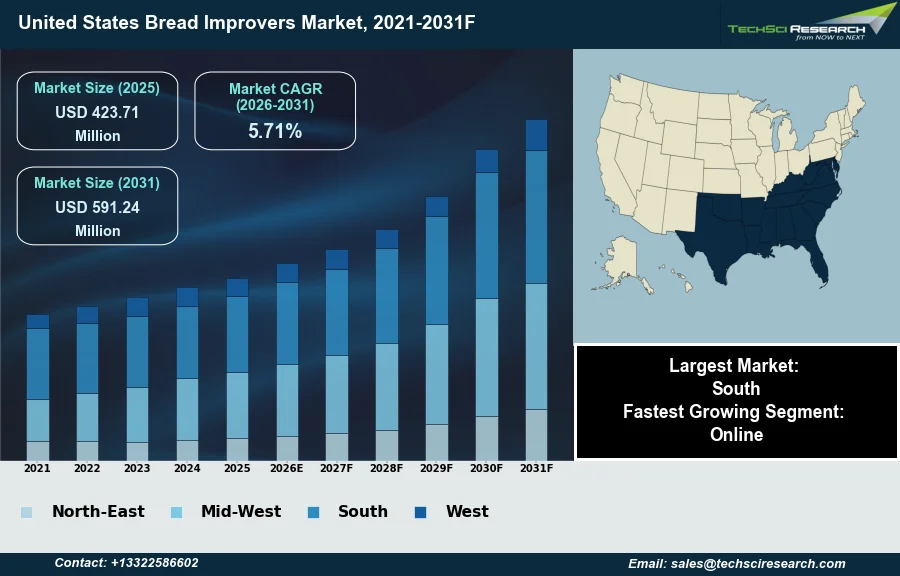
The United States Bread Improvers Market will grow from USD 423.71 Million in 2025 to USD 591.24 Million by 2031 at a 5.71% CAGR. Bread improvers, also known as dough conditioners, are specialized blends of functional ingredients like enzymes and emulsifiers, formulated to enhance dough characteristics, improve baked product texture, volume, consistency, and extend shelf life. Market expansion in the United States is driven by escalating demand for uniform quality and prolonged freshness in bakery goods, fueled by industrial baking modernization and evolving consumer preferences for artisanal and clean-label products. According to the American Bakers Association, in 2025, the US baking industry contributed approximately 2.1 percent to the nation's gross domestic product.
A significant challenge impeding market growth is increasing consumer demand for clean-label products, compelling manufacturers to develop natural alternatives without compromising performance. The industry also faces complexities from volatile raw material prices and stringent regulatory frameworks. Continuous technological advancements remain crucial for overcoming these hurdles.
Key Market Drivers
Rising Demand for Quality and Shelf Life
Increasing consumer demand for consistent quality and extended shelf life stands as a primary growth driver in the United States bread improvers market. Consumers increasingly seek bakery products that maintain desirable texture, volume, and freshness over time, necessitating the use of specialized dough conditioners. This heightened expectation extends beyond taste, with over 70% of U.S. consumers prioritizing texture, ingredient quality, and perceived wellness in their bakery product choices, according to Amra & Elma, September 2025, in "TOP 20 BAKERY MARKETING STATISTICS 2026 REVEAL SHOCKING GLOBAL SWEET SALES SURGE." Bread improvers address these demands by stabilizing dough, optimizing fermentation, and retarding staling, thereby meeting both industrial production requirements and consumer preferences for high-quality, long-lasting baked goods.
Industrial Expansion and Investment Driving Demand for Bread Improvers
The expansion of industrial and in-store baking operations further fuels the demand for bread improvers across the United States. Large-scale bakeries and supermarket in-store operations rely on these ingredients to achieve uniformity across vast production batches and to streamline processes for efficiency. For instance, a comprehensive study of 1,300 commercial bakers revealed that 44% anticipate increased capital investment in 2026 compared to the previous year, with primary goals including improving product quality consistency and process flexibility, as reported by Kingwood Food in "Industrial Bakery Investment Remains Steady" on January 26, 2026. This ongoing investment in baking infrastructure and automation directly translates to a greater need for functional ingredients like bread improvers. Overall, the baking industry in the United States generates over $42 billion in direct wages, according to the American Bakers Association, in June 2026.
Download Free Sample Report
Key Market Challenges
Clean-Label Demand Drives Innovation in Bread Improvers
The increasing consumer demand for clean-label products presents a significant challenge to the United States bread improvers market. Many traditional bread improvers contain ingredients that consumers perceive as artificial or overly processed, leading to a strong push for simpler, more recognizable labels. This forces manufacturers to invest substantially in research and development to create natural, high-performing alternatives that maintain dough characteristics and finished product quality.
Ultra-Processed Food Aversion Elevates Clean-Label Costs and R&D
According to insights from the American Bakers Association, in early 2025, 62% of U.S. consumers were actively avoiding ultra-processed foods. This preference directly impacts ingredient selection across the baking industry, including bread improvers. Formulating clean-label versions that match the efficacy of conventional offerings is complex, often involving extensive testing with natural enzyme systems, sunflower lecithin, or fermented wheat proteins. This process is time-consuming and can lead to higher production costs, ultimately impeding the pace of innovation and market adoption for new bread improver solutions that align with evolving consumer expectations.
Key Market Trends
Shift to Enzyme-Based and Natural Ingredients
The transition towards enzyme-based and natural ingredients represents a significant trend in the United States bread improvers market. This shift is primarily driven by consumer demand for cleaner labels and a reduced reliance on artificial additives. Manufacturers are actively reformulating products to align with these preferences, leading to the widespread adoption of enzyme systems and naturally derived components that maintain dough performance and product quality. A 2025 survey found that nearly 95% of American Bakers Association member company respondents already do not use azodicarbonamide (ADA) in their baked goods, with a full phase-out expected by the end of 2026. This trend underscores the industry's commitment to ingredient transparency and its proactive response to evolving consumer expectations for healthier and more recognizable food components.
Specialized Improvers for Artisanal Baking
Another impactful trend is the development of specialized improvers tailored for artisanal baking. The growing consumer appreciation for handcrafted, high-quality, and unique bread products has fueled the expansion of the artisanal bakery segment. This necessitates improver solutions that support traditional baking methods, enhance crust development, improve crumb structure, and provide the distinct flavor profiles characteristic of artisanal loaves. According to Snack Food & Wholesale Bakery, June 16, 2026, in "State of the Industry 2026: Bread shifts towards healthier alternatives", center store specialty bread sales reached $35.9 million, experiencing an 8.3% uptick for the 52 weeks ending April 19, 2026. This indicates a strong market performance for specialty products, which in turn drives the demand for innovative improvers designed to meet the specific technical challenges and quality requirements of artisanal formulations, offering bakers precise control over their unique creations.
Segmental Insights
Online Channel Drives Growth in the U.S. Bread Improvers Market Through Convenience and Accessibility
The Online segment is emerging as the fastest-growing distribution channel within the United States Bread Improvers Market. This rapid expansion is primarily driven by the unparalleled convenience and significantly broader product accessibility that online platforms offer to both professional bakeries and home bakers alike. E-commerce channels provide a comprehensive array of specialized and clean-label bread improver formulations, which are crucial for meeting evolving consumer preferences for diverse, high-quality, and consistent baked goods. The increasing digitalization of procurement processes also enables efficient sourcing, comparison of offerings, and direct access to manufacturers or distributors, thereby fostering substantial growth in this segment.
Regional Insights
Southern U.S. Leads Bread Improvers Market Fueled by Population and HoReCa Growth
The Southern United States stands as the leading region in the United States Bread Improvers Market, primarily driven by its substantial population and a deeply established culture of bread consumption. This robust demand is further amplified by a flourishing bakery and foodservice industry across the region. States such as Texas, Florida, and Georgia, in particular, exhibit a strong concentration of commercial bakeries, in-store bakeries, and quick-service restaurants that consistently utilize bread improvers to enhance dough performance and extend shelf life. Moreover, the South's diverse demographics contribute to a rising demand for artisan, ethnic, and specialty breads, further reinforcing the region's dominance. The rapid expansion of the HoReCa sector also creates sustained demand for high-quality, consistent baked products.
Recent Developments
-
In August 2025, Millbio, an Italian ingredient manufacturer, and Cain Foods, a Dallas, U.S.-based company, announced a global clean label partnership. This collaboration aims to leverage their combined expertise in providing advanced ingredient solutions, including natural mold inhibitors, sourdough, and enzyme-based improvers, particularly for bread and roll production. The alliance is set to enhance the availability of clean label baking solutions in the United States, catering to the growing demand for products with simpler ingredient declarations. This strategic collaboration is significant for the United States bread improvers market by fostering innovation in natural and enzyme-based functional ingredients.
-
In August 2024, King Arthur Baking Company highlighted its sustained collaboration with The Breadlab at Washington State University, focusing on innovative grain research and development. This partnership, which has spanned over a decade, aims to pioneer new grain varieties and flour solutions for bakers across the United States. One notable outcome was the development of Climate Blend Flour, an innovative blend of wheat varieties bred for climate resilience and farmed using regenerative practices. This research and collaboration influence the United States bread improvers market by providing alternative approaches to enhancing bread quality, nutrition, and freshness through advanced ingredient sourcing and development.
-
In May 2024, Bakels USA expanded its product portfolio with the launch of Fermdor® Active, a new concentrated powder bread improver. This innovation enables bakers to authentically reproduce the traditional taste and exceptional texture of sourdough in a wide array of artisan bakery products. By simply adding flour, salt, and water, Fermdor® Active provides a reliable foundation for producing high-quality bread with a full-bodied flavor profile. This product introduction strengthens Bakels USA’s offerings within the United States bread improvers market, providing advanced solutions that meet the increasing consumer preference for traditional and flavorful bread varieties.
-
In March 2024, Bakels USA introduced Lecisoft Master, an innovative low-dose bread improver designed to significantly enhance the softness and freshness of both bread and sweet dough over an extended period. This new product is formulated with modern and effective enzymes, which contribute to its capability in prolonging the fresh feeling and soft texture of baked goods. Notably, Lecisoft Master is positioned as a clean-label solution, being entirely free from E-numbers and containing no added sugar. This launch directly contributes to the United States bread improvers market by offering a solution that addresses consumer demand for improved product quality and simplified ingredient lists.
Key Market Players
- Lesaffre
- Nutrex N. V.
- E.I. Du Pont De Nemours and Company
- Oriental Yeast Co., Ltd.
- Group Soufflet
- Fazer Group
- Archer Daniels Midland Compan
- Ireks GmbH
- Pak Holding
- Bakels Worldwide
|
By Application
|
By End User
|
By Region
|
- Breads
- Rolls & Buns
- Flatbreads
- Others
|
- Bakeries
- HoReCa
- Food Processing Companies
- Others
|
- Northeast
- Midwest
- South
- West
|
Report Scope:
In this report, the United States Bread Improvers Market has been segmented into the following categories, in addition to the industry trends which have also been detailed below:
-
United States Bread Improvers Market, By Application:
-
Breads
-
Rolls & Buns
-
Flatbreads
-
Others
-
United States Bread Improvers Market, By End User:
-
Bakeries
-
HoReCa
-
Food Processing Companies
-
Others
-
United States Bread Improvers Market, By Region:
-
Northeast
-
Midwest
-
South
-
West
Competitive Landscape
Company Profiles: Detailed analysis of the major companies present in the United States Bread Improvers Market.
Available Customizations:
United States Bread Improvers Market report with the given market data, TechSci Research offers customizations according to a company's specific needs. The following customization options are available for the report:
Company Information
- Detailed analysis and profiling of additional market players (up to five).
United States Bread Improvers Market is an upcoming report to be released soon. If you wish an early delivery of this report or want to confirm the date of release, please contact us at sales@techsciresearch.com