|
Key Insights
|
Details
|
|
Forecast Period
|
2027-2031
|
|
Market Size (2025)
|
USD 67.88 Million
|
|
CAGR (2026-2031)
|
8.91%
|
|
Fastest Growing Segment
|
Mats
|
|
Largest Market
|
Northern & Central
|
|
Market Size (2031)
|
USD 113.28 Million
|
Market Overview
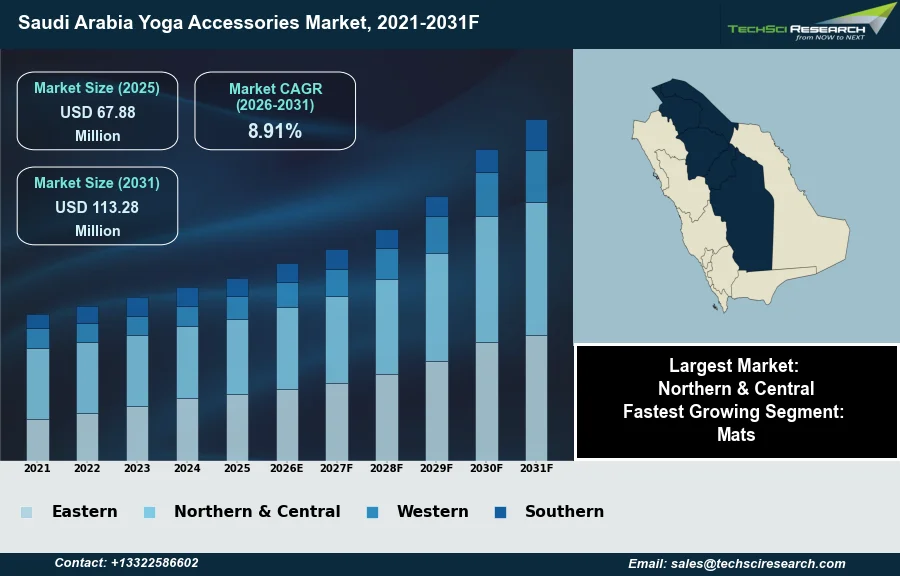
The Yoga Accessories Market in Saudi Arabia will grow from USD 67.88 Million in 2025 to USD 113.28 Million by 2031 at a 8.91% CAGR. Yoga accessories encompass specialized equipment such as mats, blocks, straps, and bolsters, designed to support practitioners in achieving proper alignment, enhancing flexibility, and ensuring stability during their practice. The Saudi Arabia Yoga Accessories Market's growth is primarily driven by escalating health consciousness among the populace and robust government initiatives under Vision 2030, which actively promote physical activity and holistic well-being across the Kingdom. Further impetus stems from the official recognition of yoga as a sport by the Saudi Ministry of Trade and Industry in 2017, alongside the expanding network of yoga studios and wellness centers catering to a growing participant base. According to the Saudi Yoga Committee, reported via the Saudi Press Agency, in 2024, the committee organized more than 13 community yoga events, indicating active engagement within the sector.
Despite significant market support, a notable challenge impeding expansion is the high operational costs associated with establishing and maintaining specialized fitness facilities in prime urban locations, coupled with increasing competitive pressure from diverse fitness offerings. This can impact the accessibility and pricing of yoga services and related accessories.
Key Market Drivers
Rising health and wellness awareness boosts demand for yoga accessories
The rising health and wellness consciousness among the Saudi populace is a primary driver for the Saudi Arabia Yoga Accessories Market. This societal shift is characterized by a growing understanding of the benefits of physical activity and holistic well-being, leading more individuals to adopt fitness regimens, including yoga. As awareness about preventative healthcare and maintaining an active lifestyle increases, the demand for supportive equipment such as yoga mats, blocks, and straps naturally expands. According to Saudi Vision 2030 - Saudi Arabia's Sports Evolution, December 2025, the percentage of adults engaging in physical activity for at least 150 minutes per week reached 59.1% in 2025, surpassing the target set for 2027. This notable increase in active participation directly correlates with a heightened need for accessories that facilitate safe and effective yoga practice, whether in studios or home environments.
Vision 2030 initiatives and government investment bolster market growth
Concurrently, robust government initiatives and Vision 2030 programs are significantly bolstering the market. The Kingdom's strategic emphasis on improving the quality of life and promoting a healthy society through various sports and wellness programs provides a structured framework for market growth. These initiatives not only encourage participation but also foster the development of related infrastructure and a supportive ecosystem for fitness activities like yoga. In April 2025, as reported by Arab News, Saudi Arabia's Assistant Minister of Investment Ibrahim Al-Mubarak stated that the market value of the Saudi sports sector had reached SR32 billion ($8.53 billion), reflecting substantial growth from less than SR5 billion at the launch of Vision 2030 in 2016. This demonstrates the significant economic impact of government-led development in the sports sector. The broader Saudi sports market, currently valued at $7.2 billion, is projected to experience an annual growth rate of 8.7% through 2026, according to the U.S. Commercial Service in March 2025, underscoring a favorable environment for ancillary markets like yoga accessories.
Download Free Sample Report
Key Market Challenges
Rising Facility Costs and Access Barriers
High operational costs associated with establishing and maintaining specialized fitness facilities in prime urban locations present a notable challenge for the Saudi Arabia Yoga Accessories Market. These elevated expenses directly translate to higher membership fees for yoga studios and wellness centers, which significantly impacts the affordability and accessibility of consistent yoga practice for a broader consumer base. This financial barrier limits the potential growth of regular practitioners who would typically invest in specialized yoga accessories such as mats, blocks, and straps.
Affordability Constraints Amid Growing Physical Activity
The challenge persists despite a growing national interest in physical activity. For example, according to the Saudi Sports for All Federation, the percentage of the physically active population in the Kingdom rose to approximately 60 percent in 2025. However, if a significant segment of this active population is deterred by the high cost of specialized yoga studio memberships, it directly curtails the demand for yoga accessories that are frequently recommended or sold within these structured environments. This economic hurdle also exacerbates competitive pressure, making it difficult for new yoga studios to enter the market and for existing ones to expand, thereby constraining the overall growth trajectory for related accessories.
Key Market Trends
Sustainability Driving Demand for Eco-Friendly Yoga Accessories
The adoption of sustainable and eco-friendly products significantly influences the Saudi Arabia Yoga Accessories Market. Consumers increasingly prioritize environmental responsibility and ethical sourcing, extending these values to fitness gear. This is driven by a rising awareness of environmental issues and a desire for products aligning with holistic well-being. Consequently, demand for accessories made from natural, recyclable, or sustainably harvested materials, like organic cotton straps or natural rubber mats, is growing. This encourages manufacturers to innovate with environmentally conscious designs and transparent production. According to GlobeNewswire, November 17, 2025, in the 'Saudi Arabia Sustainability Report 2025' announcement, nearly 47% of consumers in Saudi Arabia are willing to invest more in sustainable products.
Hybrid Model and Digital Integration Boost Personal Yoga Accessories
Hybrid fitness model integration is another prominent trend reshaping the Saudi Arabia Yoga Accessories Market. This model merges traditional in-studio practice with online, virtual, and home-based workouts, offering enhanced flexibility and accessibility. The growing reliance on digital platforms and home fitness necessitates more personal yoga accessories for non-studio environments, directly boosting sales of individual mats, blocks, and props. This trend is further supported by technological integration as users incorporate smart devices for guided sessions. According to PwC Middle East, September 2025, in their 'Voice of the Consumer 2025: Saudi Arabia findings' report, wearable technology and apps have led to a change in daily habits for 50% of consumers in Saudi Arabia.
Segmental Insights
Mats Demand Fueled by Rising Yoga Adoption, Government Initiatives, and Expanded Access
In the Saudi Arabia Yoga Accessories Market, the Mats segment stands out as the fastest-growing due to several interconnected factors. The official recognition of yoga as a sport by the Ministry of Sports and its increasing cultural acceptance have significantly broadened participation across the Kingdom. This growing mainstream adoption is further bolstered by governmental initiatives like Vision 2030 and Ministry of Health campaigns promoting holistic health and physical activity, encouraging more individuals to embrace yoga for well-being. Consequently, the proliferation of yoga studios and wellness centers, alongside a rise in home-based practice and convenient e-commerce platforms, drives the essential demand for foundational accessories such as quality yoga mats.
Regional Insights
Northern & Central Region Leads Market Through Urbanization and Vision 2030 Initiatives
The Northern & Central region dominates the Saudi Arabia Yoga Accessories Market, primarily driven by its significant urbanization and concentrated economic activity. Major cities like Riyadh, serving as the nation's capital and a hub for corporate headquarters, host a large population with higher disposable incomes and a pronounced inclination towards health and wellness activities. Government initiatives under Saudi Vision 2030, particularly the Quality of Life Programme, actively encourage physical activity and healthier lifestyles, further stimulating demand. This, combined with advanced infrastructure, including numerous fitness and yoga studios, creates a robust environment for the uptake of yoga accessories.
Recent Developments
-
In November 2025, Technogym, a global leader in fitness, wellness, and sport, inaugurated its new headquarters and a brand boutique in Riyadh. This strategic expansion represented a significant step in the company's commitment to strengthening its direct presence in the Saudi market. The new facility was established to offer the full Technogym solution, including its range of connected products and digital technologies. Among the products available through this expanded presence were exercise and yoga mats, directly impacting the availability of premium yoga accessories for consumers and fitness operators across Saudi Arabia.
-
In May 2025, Kayanee, a Saudi activewear brand, continued to expand its offerings which include sportswear designed for yoga and dance. The company focused on producing stylish and supportive athletic apparel from sustainable and ethically sourced materials. This strategic emphasis on mindful manufacturing aligns with the growing consumer preference in the Saudi Arabia yoga accessories market for products that support both personal wellness and environmental stewardship. The brand's commitment highlights an ongoing trend towards incorporating ethical production practices into fitness apparel and accessories.
-
In December 2024, Yogikor, a company operating in Saudi Arabia, introduced its range of eco-friendly yoga mats, positioning them as a sustainable investment for practitioners in the region. These premium yoga mats were crafted from natural rubber, providing non-slip and high-performance qualities suitable for various yoga and fitness activities. The company emphasized that these offerings were designed to meet the increasing demand for sustainable products within the Saudi Arabia yoga accessories market. Furthermore, Yogikor committed to donating a portion of its profits to environmental initiatives, reinforcing its dedication to ecological responsibility.
-
In an announcement made in 2025, Saudi Yoga, a brand founded in Riyadh by a local instructor, launched its "Rawdat Khuraim – Lavender Yoga Mat." This new product was characterized by a lavender color, a luxurious velvet-like surface, and a natural rubber base, designed to provide enhanced stability during yoga practice. The mat’s design also featured patterns inspired by Saudi heritage, aiming to resonate with the local identity while offering high-quality, eco-friendly yoga accessories to the Saudi market.
Key Market Players
- Lululemon KSA
- Alo Yoga KSA
- Manduka KSA
- Jade Yoga KSA
- Alshaya Yoga
- Jarir Yoga
- Extra Yoga
- Lulu Yoga
- HyperPanda Yoga
- Amazon.sa Yoga
|
By Type
|
By Application
|
By Sales Channel
|
By Region
|
- Mats
- Straps
- Clothing
- Others
|
- Yoga Centers
- Households
- Fitness Clubs
|
|
- Eastern
- Northern & Central
- Western
- Southern
|
Report Scope:
In this report, the Saudi Arabia Yoga Accessories Market has been segmented into the following categories, in addition to the industry trends which have also been detailed below:
-
Saudi Arabia Yoga Accessories Market, By Type:
-
Mats
-
Straps
-
Clothing
-
Others
-
Saudi Arabia Yoga Accessories Market, By Application:
-
Yoga Centers
-
Households
-
Fitness Clubs
-
Saudi Arabia Yoga Accessories Market, By Sales Channel:
-
Saudi Arabia Yoga Accessories Market, By Region:
-
Eastern
-
Northern & Central
-
Western
-
Southern
Competitive Landscape
Company Profiles: Detailed analysis of the major companies present in the Saudi Arabia Yoga Accessories Market.
Available Customizations:
Saudi Arabia Yoga Accessories Market report with the given market data, TechSci Research offers customizations according to a company's specific needs. The following customization options are available for the report:
Company Information
- Detailed analysis and profiling of additional market players (up to five).
Saudi Arabia Yoga Accessories Market is an upcoming report to be released soon. If you wish an early delivery of this report or want to confirm the date of release, please contact us at sales@techsciresearch.com