|
Key Insights
|
Details
|
|
Forecast Period
|
2027-2031
|
|
Market Size (2025)
|
USD 67.89 Million
|
|
CAGR (2026-2031)
|
14.51%
|
|
Fastest Growing Segment
|
Tofu
|
|
Largest Market
|
Northern & Central
|
|
Market Size (2031)
|
USD 153.06 Million
|
Market Overview
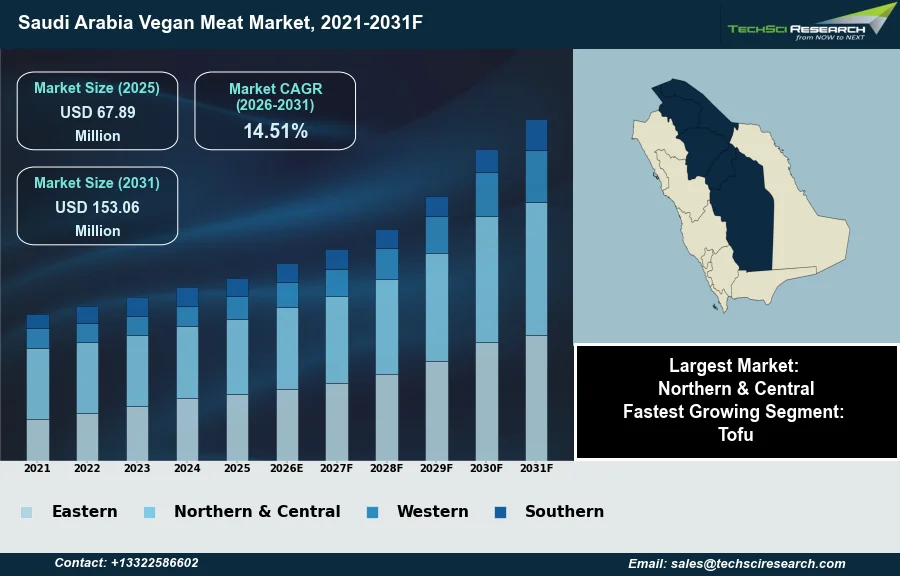
The Vegan Meat Market in Saudi Arabia will grow from USD 67.89 Million in 2025 to USD 153.06 Million by 2031 at a 14.51% CAGR. Vegan meat products are plant-based alternatives designed to replicate the taste, texture, and appearance of traditional animal meat, typically made from ingredients such as soy, pea, or wheat proteins. The market's growth in Saudi Arabia is substantially supported by increasing health consciousness among consumers, who are seeking nutritious alternatives to mitigate lifestyle-related health issues. For instance, according to the Health Determinants Statistics Publication for Saudi Arabia, as of November 2024, the obesity rate among individuals aged 15 and above stood at 23.1%, driving demand for healthier dietary options. Furthermore, government initiatives promoting food security and sustainable agriculture, alongside a young and urban population with higher disposable incomes open to new culinary experiences, also serve as significant market drivers.
Despite these drivers, a significant impediment to market expansion is the limited availability of vegan meat products beyond major urban centers. Smaller cities and rural areas often face inconsistent access to these alternatives due to underdeveloped distribution networks and a scarcity of retail outlets, thereby restricting broader consumer adoption and market penetration.
Key Market Drivers
Health Consciousness Driving Plant-Based Demand in Saudi Arabia
Rising health consciousness significantly propels the Saudi Arabia vegan meat market as consumers increasingly prioritize nutritious alternatives. This shift is driven by a heightened awareness of diet-related health issues and a desire for proactive wellness, leading to a re-evaluation of traditional dietary patterns. For instance, according to a cross-sectional study published in Frontiers in January 2026, over 35% of Saudi Generation Z respondents cited health motivations for consuming plant-based proteins. This demographic, increasingly influential, demonstrates a clear inclination towards healthier food choices, directly fostering demand for plant-based meat products that align with their wellness objectives.
Policy Support and Vision 2030 for Market Expansion
Complementing this, government support and alignment with Vision 2030 are instrumental in fostering the market's expansion. The Kingdom's strategic objectives prioritize food security, sustainable agriculture, and economic diversification, creating a conducive environment for plant-based food innovation and production. Illustrating this commitment, according to AgriFuture Magazine Middle East and Africa, in April 2026, the Ministry of Environment, Water and Agriculture announced investment opportunities including the establishment of an agricultural nursery in Taif Governorate, covering a total area of 6,698 square meters, aimed at cultivating vegetables and crops to enhance food security. Furthermore, the broader commitment to environmental sustainability underpins the market's growth, with Saudi Arabia successfully restoring one million hectares of degraded land in early 2026 as part of the Saudi Green Initiative, as reported by the Ministry of Environment, Water and Agriculture and Arab News.
Download Free Sample Report
Key Market Challenges
Limited Availability Beyond Urban Centers Impedes Expansion
A significant impediment to the expansion of the Saudi Arabia Vegan Meat Market is the limited availability of products beyond major urban centers. Smaller cities and rural areas frequently encounter inconsistent access to these plant-based alternatives due to underdeveloped distribution networks and a scarcity of dedicated retail outlets. This restriction directly curtails broader consumer adoption and market penetration, as a substantial portion of the population outside metropolitan hubs remains underserved.
Urban Retail Concentration Constrains Access and Market Size
This concentrated retail landscape hinders growth by limiting consumer exposure and purchasing opportunities. According to the USDA Foreign Agricultural Service, in 2024, the five largest retail chains in Saudi Arabia collectively represented over 80 percent of food retail revenues. This high level of market concentration, primarily within urban centers, underscores the challenge for specialized products like vegan meat to establish a comprehensive presence in less populated regions. Consequently, potential consumers in these areas are unable to regularly access vegan meat options, thereby diminishing overall market size and delaying the widespread acceptance of these products.
Key Market Trends
Localization of Production and Local Supply Chains
The Saudi Arabia vegan meat market is significantly shaped by the increasing emphasis on domestic manufacturing and supply chain development. This trend reduces reliance on imported products, enhancing food security and potentially lowering costs for consumers. Establishing local production facilities is crucial for developing a robust in-country ecosystem for plant-based alternatives. For instance, according to Green Queen, in February 2025, the Middle East’s first vegan meat production facility, Thryve, expanded its operations into Saudi Arabia, with its factory capable of helping it reach 30% of the GCC population. This localized production supports the national agenda for economic diversification and fosters greater accessibility of vegan meat products across various distribution channels.
Mainstreaming Flexitarianism Expands Market Potential
A parallel and equally impactful trend is the mainstreaming of flexitarianism, where a growing segment of the Saudi population actively seeks to reduce their meat intake without fully committing to a vegetarian or vegan diet. This dietary pattern broadens the consumer base for vegan meat products beyond strict vegans, driving demand for innovative and appealing alternatives. This shift is notable as it reflects a broader cultural acceptance and integration of plant-based options into regular diets. According to House of Saud, in April 2026, 26% of the Saudi population has expressed interest in reducing meat consumption. This demonstrates a substantial market opportunity for convenient and tasty vegan meat options that cater to these evolving dietary preferences, solidifying plant-based foods as a viable and desirable choice.
Segmental Insights
Tofu's Rapid Growth Fueled by Local Adaptability, Health and Environmental Awareness, and Regulatory Support
Tofu stands out as the fastest-growing segment within the Saudi Arabia Vegan Meat Market, driven by its established presence and exceptional adaptability to local cuisine. Its neutral flavor and versatile texture make it an ideal substitute in traditional Saudi dishes like kebabs and stews, facilitating widespread acceptance in both home cooking and restaurant settings. This rapid expansion is further propelled by increasing consumer health consciousness and a growing awareness of the environmental impacts associated with conventional meat consumption. Moreover, supportive governmental initiatives promoting plant-based diets and the stringent regulatory framework overseen by the Saudi Food and Drug Authority (SFDA), including critical Halal certification, bolster consumer trust and market access for plant-based alternatives like tofu.
Regional Insights
Northern & Central Region: Primary Market Driver
The Northern & Central region emerges as a primary contributor to the Saudi Arabia Vegan Meat Market, significantly driven by Riyadh, the capital city. This dominance stems from Riyadh's large and affluent urban population, which demonstrates increasing receptiveness to diverse and healthier food alternatives. Growing health consciousness, particularly regarding prevalent lifestyle-related health concerns, motivates consumers in this region to actively seek plant-based options. Furthermore, expanded retail and e-commerce infrastructure in Riyadh has enhanced the accessibility and availability of vegan meat products. Government initiatives, such as the Saudi Vision 2030 and the Saudi Green Initiative, further support market expansion by promoting sustainable food practices and encouraging innovation within the plant-based sector.
Recent Developments
-
In February 2025, the UAE-based IFFCO Group's plant-based meat brand, Thryve, expanded its presence into Saudi Arabia. This expansion made Thryve's diverse range of fava-bean-based meat alternatives, including burgers, mince, shawarma, koftas, and nuggets, available to Saudi consumers. The company stated that its production facility could reach 30% of the GCC population, highlighting the significant market access in Saudi Arabia. This move aimed to cater to the growing demand for sustainable and locally relevant plant-based meat products in the Kingdom.
-
In February 2025, Nabati Eatery was launched in Jeddah, Saudi Arabia, by Ola Kayal, offering a new vegan food experience. The restaurant focused on providing plant-based, gluten-free, and organic dishes, emphasizing creative culinary options. This establishment also prioritized sustainability by sourcing local ingredients and implementing eco-friendly practices. The introduction of Nabati Eatery directly contributed to the expansion of vegan food options in the Saudi market, enhancing consumer access to plant-based meals that serve as alternatives to traditional meat dishes.
-
In January 2025, Siniora Foods announced plans for a new food production facility in Saudi Arabia, committing an investment of 150 Million Saudi Riyals ($40 Million) to the project. This strategic initiative aimed to bolster the production of "Made in Saudi Arabia" goods, including items from its plant-based Badeel brand. Badeel is recognized as the first certified vegan, gluten-free, and soy-free meat alternative available in the Middle East. The facility's development underscored Siniora Foods' expansion efforts within the Saudi Arabian market, directly contributing to the local availability and manufacturing of vegan meat alternatives.
-
In December 2024, Almarai Company disclosed a substantial investment of USD 4.8 billion directed towards its domestic dairy production facilities throughout Saudi Arabia. A key aspect of this investment included intentions to integrate plant-based alternatives into its existing manufacturing infrastructure. This strategic move positioned Almarai Company to leverage its established distribution networks for entry into the alternative protein market, while maintaining supply chain control. The integration plans indicated a notable shift in the company's strategy to address the increasing demand for plant-based food options within the Saudi Arabia vegan meat market.
Key Market Players
- Beyond Meat KSA
- Impossible Foods KSA
- Alshaya Vegan
- Jarir Vegan Meat
- Extra Vegan
- Lulu Vegan
- HyperPanda Vegan
- Amazon.sa Vegan
- Local Vegan Brands KSA
- Greenheart Vegan
|
By Type
|
By Type of Sales
|
By Region
|
- Tofu
- Tempeh
- Textured Vegetable Protein
- Others
|
- Institutional Sales
- Retail Sales
|
- Eastern
- Northern & Central
- Western
- Southern
|
Report Scope:
In this report, the Saudi Arabia Vegan Meat Market has been segmented into the following categories, in addition to the industry trends which have also been detailed below:
-
Saudi Arabia Vegan Meat Market, By Type:
-
Tofu
-
Tempeh
-
Textured Vegetable Protein
-
Others
-
Saudi Arabia Vegan Meat Market, By Type of Sales:
-
Institutional Sales
-
Retail Sales
-
Saudi Arabia Vegan Meat Market, By Region:
-
Eastern
-
Northern & Central
-
Western
-
Southern
Competitive Landscape
Company Profiles: Detailed analysis of the major companies present in the Saudi Arabia Vegan Meat Market.
Available Customizations:
Saudi Arabia Vegan Meat Market report with the given market data, TechSci Research offers customizations according to a company's specific needs. The following customization options are available for the report:
Company Information
- Detailed analysis and profiling of additional market players (up to five).
Saudi Arabia Vegan Meat Market is an upcoming report to be released soon. If you wish an early delivery of this report or want to confirm the date of release, please contact us at sales@techsciresearch.com