|
Key Insights
|
Details
|
|
Forecast Period
|
2027-2031
|
|
Market Size (2025)
|
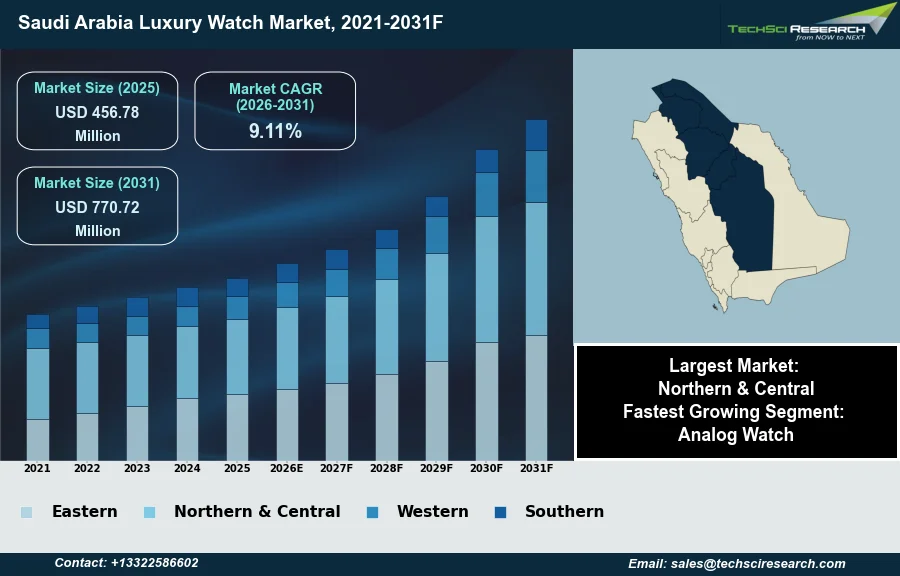
USD 456.78 Million
|
|
CAGR (2026-2031)
|
9.11%
|
|
Fastest Growing Segment
|
Analog Watch
|
|
Largest Market
|
Northern & Central
|
|
Market Size (2031)
|
USD 770.72 Million
|
Market Overview
The Luxury Watch Market in Saudi Arabia will grow from USD 456.78 Million in 2025 to USD 770.72 Million by 2031 at a 9.11% CAGR. Luxury watches are defined as precision wrist accessories crafted from premium materials, such as precious metals or high-grade steel, incorporating complex mechanical or advanced quartz movements, and positioned as high-value items for discerning consumers. The Saudi Arabia luxury watch market's growth is primarily driven by consistent increases in disposable incomes and accumulating wealth among the affluent population. Furthermore, the strong cultural significance placed on luxury goods as symbols of status and achievement significantly supports demand. The ongoing expansion of high-end retail infrastructure across major urban centers, stimulated by Vision 2030 initiatives, also contributes to market accessibility. According to the Federation of the Swiss Watch Industry, exports of Swiss watches to Saudi Arabia increased by 8.9% in 2025.
A significant impediment to the market's sustained expansion is its substantial dependence on imported timepieces. This reliance exposes the Saudi luxury watch sector to vulnerabilities within global supply chains, including potential disruptions from geopolitical tensions or evolving customs regulations.
Key Market Drivers
Rising Affluence Drives Luxury Watch Demand
The increasing affluent consumer base and growing disposable income are fundamental drivers of the Saudi Arabia Luxury Watch Market. As the wealth of high-net-worth individuals expands, their capacity and inclination to invest in premium timepieces, often perceived as status symbols and tangible assets, also rise. This demographic shift directly translates into heightened demand for exclusive and high-value luxury watches, fostering a robust market environment. According to Henley & Partners, cited by Boodle Hatfield in July 2025, Saudi Arabia is projected to attract 2,400 millionaires in 2025, an approximate eightfold increase from 2024. This significant inflow of wealth underscores a expanding pool of potential buyers who view luxury watches as essential components of their lifestyle and investment portfolios.
Vision 2030 and Tourism Drive Luxury Watch Growth
The Saudi Vision 2030 economic diversification initiatives further stimulate the luxury watch market by transforming the Kingdom into a global hub for business and tourism. These ambitious programs drive substantial investment in premium retail infrastructure and the burgeoning tourism sector, attracting both international visitors and high-spending residents. The development of integrated luxury retail destinations across major cities provides optimal platforms for international watch brands to showcase their collections, enhancing market accessibility and visibility. According to the World Travel and Tourism Council, in May 2026, Saudi Arabia's travel and tourism gross domestic product rose 7.4 percent in 2025 to about $178 billion. This growth in tourism and related spending directly benefits luxury retail. Overall, according to the National Transformation Program 2025 Annual Report, in 2025, Saudi Arabia's real GDP reached $1.31 trillion, demonstrating the strong economic foundation supporting the luxury sector's expansion.
Download Free Sample Report
Key Market Challenges
Import dependence undermines supply chain resilience.
A significant impediment to the sustained expansion of the Saudi Arabia luxury watch market is its substantial dependence on imported timepieces. This reliance exposes the sector to inherent vulnerabilities within global supply chains, including potential disruptions from geopolitical tensions, evolving customs regulations, or unforeseen logistical challenges. Such external factors directly compromise the consistent availability of high-value items, which are critical for discerning consumers in this market.
Supply disruptions impede growth and new-model availability.
These supply chain vulnerabilities directly hamper market growth by causing product shortages and delays in new model introductions. For instance, according to the Federation of the Swiss Watch Industry, Saudi Arabia experienced a 16.8% drop in exports in March 2026 compared to the previous year, extending a weakening trend that began in January. This decline illustrates how external disruptions can limit the flow of luxury watches into the kingdom, consequently restricting sales volumes and impeding the market's capacity to capitalize on strong local demand. The inability to consistently meet consumer preferences for new or exclusive timepieces due to import reliance therefore constrains the market's overall expansion.
Key Market Trends
Growing demand for exclusive, bespoke timepieces in Saudi Arabia
The Saudi Arabia luxury watch market is notably influenced by the increasing demand for exclusive and customized timepieces. Affluent consumers in the Kingdom are moving beyond standard luxury models, increasingly seeking unique designs, limited editions, and bespoke creations that reflect personal identity and connoisseurship. This trend underscores a desire for rarity and a deeper appreciation for artisanal craftsmanship within their collections, contributing to the market's evolving premium segment. For instance, Daniel Roth unveiled a Tourbillon Platinum timepiece at Dubai Watch Week 2025, limited to approximately 10 pieces for 2025 and priced at CHF 185,000, exemplifying the type of ultra-exclusive offerings attracting buyers in the broader Middle East region.
Regional impact of the expanding secondary luxury watch market
Another significant trend shaping the market is the burgeoning growth of the secondary market for luxury watches. This segment offers consumers access to discontinued models, investment opportunities, and a wider range of price points for pre-owned high-value timepieces. The increasing interest from collectors and investors in acquiring rare or in-demand pieces outside primary retail channels is driving this expansion. While specific Saudi Arabian data is highly constrained by reporting limitations from approved sources, global shifts reflect a normalization in the secondary market. According to Chrono24's 2025 Market Review, published in February 2026, Rolex volume on the secondary market normalized with a -3.3% change, indicating a healthier, more collector-driven environment globally, which influences regional market dynamics including Saudi Arabia.
Segmental Insights
Analog Watches Drive Market Growth Through Heritage and Wealth
The Saudi Arabia Luxury Watch Market is witnessing significant expansion, with analog watches emerging as the fastest-growing segment. This growth is primarily driven by the enduring appeal of their timeless design, mechanical sophistication, and rich heritage, which strongly resonate with affluent collectors and status-conscious consumers in the Kingdom. Luxury analog timepieces are perceived as vital symbols of success, personal achievement, and social standing within Saudi Arabian culture. Furthermore, the economic diversification initiatives under Saudi Vision 2030 have fostered substantial wealth accumulation among high-net-worth individuals, consequently boosting the demand for such prestigious items.
Regional Insights
Regional Leadership Driven by Wealth, Luxury Retail Hubs, and Vision 2030
The Northern & Central region demonstrably leads the Saudi Arabia Luxury Watch Market due to several interconnected factors. Riyadh, as the Kingdom's capital and primary economic center, hosts the highest concentration of high-net-worth individuals, providing a robust consumer base with substantial purchasing power for luxury timepieces. This area also benefits from a superior luxury retail infrastructure, featuring prestigious shopping destinations and flagship stores of prominent international brands. Furthermore, the region's role as a hub for major corporate headquarters and government ministries concentrates high-income professionals, fostering significant demand for luxury watches. Saudi Vision 2030 initiatives are additionally accelerating economic diversification and luxury retail development, reinforcing the region's market dominance.
Recent Developments
-
In October 2025, Ahmed Seddiqi, a leading luxury watches and jewelry retailer from the UAE, made a significant entry into the Saudi Arabian market by opening its first standalone boutique in Riyadh. Located on Tahliah Street, this new 4,400 square foot destination presented a curated selection of over 25 premier global watch and jewelry brands, including independent labels like Ressence, Bremont, and H. Moser & Cie. The expansion aimed to provide an elevated retail experience for discerning clientele, reinforcing Saudi Arabia's position as a key growth market for luxury timepieces and bespoke services.
-
In February 2025, Attar United, a prominent luxury retailer, inaugurated its second Hublot flagship boutique in Saudi Arabia, situated in Riyadh’s Solitaire Mall. This expansive 2,650 square foot showroom served to deepen Hublot's presence in the Kingdom, signaling its strategic focus on the region's burgeoning luxury market. The new boutique also featured the Middle East's first Experiential Room, offering an interactive showcase of Hublot's innovations in materials and watchmaking techniques. This expansion reflects the ongoing commitment by international luxury watch brands and their regional partners to invest in premium retail experiences in Saudi Arabia.
-
In August 2024, Laco, a German watchmaker, partnered with Saudi Arabian company 10Ten Labs to introduce an exclusive collection of pilot watches tailored for the Middle Eastern market. This collaboration resulted in a limited edition of 75 pieces, consisting of three distinct colorways—Smoked Salmon, Fuchsia, and Moss Aqua—within Laco's Aachen pilot watch line. Each 39mm watch, housing an automatic movement, was offered at USD 620. This initiative highlights a focused strategy to cater to regional preferences with unique, design-led products, reinforcing the discerning demand within the Saudi Arabia luxury watch market for exclusive editions.
-
In May 2024, the international luxury jewelry and watchmaking brand Mouawad expanded its e-commerce capabilities in the Kingdom of Saudi Arabia through a collaboration with FeatureMind, a provider of digital retail solutions. This strategic enhancement allowed Mouawad to strengthen its online presence within the region, offering an integrated and personalized digital shopping experience. The initiative utilized omnichannel expertise, including Salesforce Commerce Cloud and a tailored Order Management Solution, to improve customer interactions and facilitate online purchases. This development underscores the growing importance of digital platforms in the Saudi luxury watch and jewelry market.
Key Market Players
- Rolex KSA
- Omega KSA
- Tag Heuer KSA
- Cartier KSA
- Patek Philippe KSA
- Alshaya Watches
- Jarir Watches
- Extra Watches
- Lulu Watches
- Amazon.sa Watches
|
By Type
|
By End User
|
By Sales Channel
|
By Region
|
- Analog Watch
- Digital Watch
|
|
|
- Eastern
- Northern & Central
- Western
- Southern
|
Report Scope:
In this report, the Saudi Arabia Luxury Watch Market has been segmented into the following categories, in addition to the industry trends which have also been detailed below:
-
Saudi Arabia Luxury Watch Market, By Type:
-
Analog Watch
-
Digital Watch
-
Saudi Arabia Luxury Watch Market, By End User:
-
Saudi Arabia Luxury Watch Market, By Sales Channel:
-
Saudi Arabia Luxury Watch Market, By Region:
-
Eastern
-
Northern & Central
-
Western
-
Southern
Competitive Landscape
Company Profiles: Detailed analysis of the major companies present in the Saudi Arabia Luxury Watch Market.
Available Customizations:
Saudi Arabia Luxury Watch Market report with the given market data, TechSci Research offers customizations according to a company's specific needs. The following customization options are available for the report:
Company Information
- Detailed analysis and profiling of additional market players (up to five).
Saudi Arabia Luxury Watch Market is an upcoming report to be released soon. If you wish an early delivery of this report or want to confirm the date of release, please contact us at sales@techsciresearch.com