|
Key Insights
|
Details
|
|
Forecast Period
|
2027-2031
|
|
Market Size (2025)
|
USD 5.64 Billion
|
|
CAGR (2026-2031)
|
6.72%
|
|
Fastest Growing Segment
|
Northern & Central HVAC Systems
|
|
Largest Market
|
Northern & Central
|
|
Market Size (2031)
|
USD 8.33 Billion
|
Market Overview
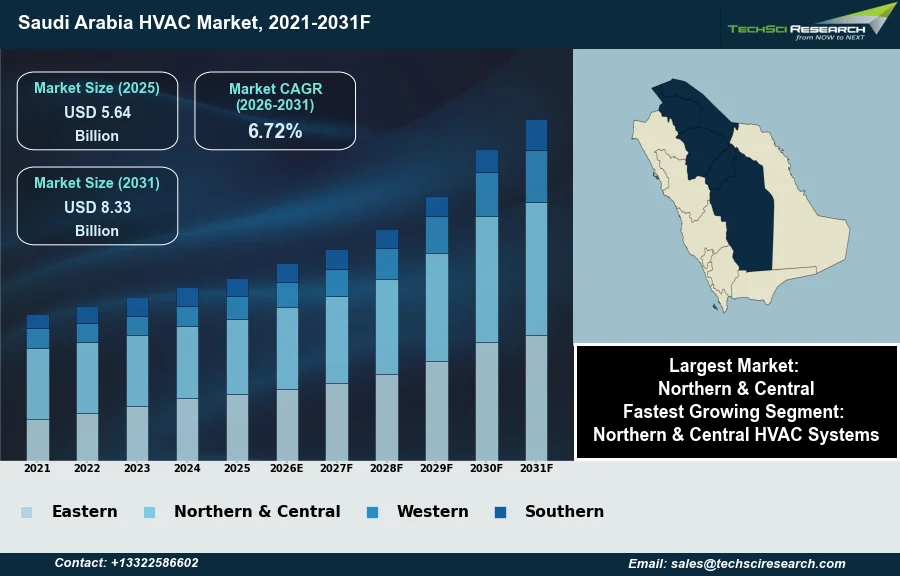
The HVAC Market in Saudi Arabia will grow from USD 5.64 Billion in 2025 to USD 8.33 Billion by 2031 at a 6.72% CAGR. Heating, Ventilation, and Air Conditioning (HVAC) systems comprise integrated technologies designed to regulate indoor temperature, humidity, and air quality across residential, commercial, and industrial environments. The Saudi Arabia HVAC market is primarily driven by the nation's extreme climatic conditions, which necessitate extensive cooling infrastructure, alongside ambitious government-led urbanization and large-scale construction projects under Vision 2030, including developments such as NEOM and The Red Sea Project.
Sustained population growth further fuels demand for new housing and commercial spaces, contributing significantly to market expansion. A considerable challenge, however, is the high energy consumption associated with HVAC systems, which accounts for a substantial portion of the residential sector's electricity use, coupled with rising electricity costs. According to the General Authority for Statistics, in Q3 2025, Saudi Arabia's real GDP increased by 4.8% year-on-year, indicating strong economic activity that supports construction and associated HVAC demand.
Key Market Drivers
Climate-driven HVAC demand and energy-efficiency focus
Saudi Arabia's HVAC market is significantly propelled by the nation's extreme climatic conditions, which necessitate robust cooling infrastructure across all sectors. The intense summer heat drives substantial demand for efficient air conditioning systems in residential, commercial, and industrial buildings. This pervasive need is underscored by the fact that cooling accounts for approximately 50% of total annual electricity consumption in Saudi Arabian buildings, escalating to around 70% at peak demand, representing the highest rate of air conditioning use globally. Such high reliance ensures a sustained and fundamental demand for HVAC solutions, with a continuous focus on improving energy efficiency to manage consumption and operational costs.
Vision 2030 projects and tourism activity drive HVAC demand
The ambitious Vision 2030 development projects represent another critical driver, transforming the urban and economic landscape and generating extensive demand for new HVAC installations. Mega-projects like NEOM, The Red Sea Project, and AMAALA involve vast new cities, resorts, and commercial hubs, all requiring advanced climate control systems. For instance, Red Sea Global, a developer of regenerative tourism destinations, announced in September 2025 that stc group would invest more than 1.2 billion SAR to expand digital infrastructure and services across its portfolio, indicative of the large-scale investment fueling these developments. Concurrently, the broader travel and tourism sector in Saudi Arabia demonstrated strong economic activity, contributing US$178 billion to the economy in 2025 after experiencing 7.4% growth, further solidifying the need for advanced HVAC systems in new hospitality and commercial spaces.
Download Free Sample Report
Key Market Challenges
Rising energy costs constrain HVAC market growth and technology adoption
The high energy consumption associated with HVAC systems, coupled with rising electricity costs, poses a significant challenge to the growth of the Saudi Arabia HVAC market. This factor directly impacts consumer and commercial purchasing decisions by increasing the total cost of ownership beyond the initial acquisition price. As operational expenses for cooling rise, potential buyers may defer investments in new or advanced HVAC technologies, or opt for less efficient, lower-cost alternatives to mitigate immediate financial strain. This reluctance hinders the adoption of more modern, energy-efficient systems that could otherwise drive market expansion.
High electricity consumption and tariffs limit HVAC upgrades and demand
The substantial electricity usage attributed to HVAC systems underscores this challenge. According to the General Authority for Statistics, in 2024, total electricity consumption in the residential sector across the Kingdom of Saudi Arabia reached 161,207 gigawatt-hours. This substantial consumption, combined with evolving electricity tariffs, places a continuous financial burden on end-users. Businesses, too, face increased operational expenditures, which can compress profit margins and discourage upgrades to more sophisticated, albeit initially more expensive, energy-saving HVAC solutions. This economic pressure thus constrains overall market demand and slows the penetration of advanced technologies.
Key Market Trends
Sustainability-driven adoption of high-efficiency HVAC and insulation standards
The increasing emphasis on energy-efficient and sustainable HVAC solutions represents a significant trend, driven by national sustainability agendas and rising environmental awareness beyond mere cost reduction. This trend is underscored by initiatives aimed at green building practices and reduced carbon footprints. For instance, according to TradeArabia, in June 2026, in its report 'Red Sea Global achieves major carbon reduction milestone', Red Sea Global, a major developer in the Kingdom, announced it avoided 117,879 tonnes of carbon dioxide equivalent (tCO₂e) in 2024 through its renewable energy and low-carbon operations. This demonstrates a tangible commitment to integrating sustainable practices, which directly influences the selection and deployment of HVAC systems that support such ambitious environmental objectives. The ongoing evolution of Saudi Building Codes further reinforces the adoption of high-efficiency HVAC equipment and improved insulation standards to mitigate energy waste.
Expansion of district cooling for mega-developments
The expansion of district cooling infrastructure is another pivotal trend, fundamentally reshaping how large-scale developments meet their cooling demands in Saudi Arabia. This approach offers enhanced efficiency and reliability for vast urban projects, aligning with the Kingdom's rapid urbanization under Vision 2030. Illustrating this expansion, according to Saudi Tabreed, in a news update on 'NEOM Oxagon', Saudi Tabreed successfully signed a Design, Build, and Operate (DBO) contract with NEOM Oxagon to construct a district cooling plant with a capacity of 25,000 refrigeration tons (TR) for the first phase of the Oxagon project. Such substantial investments in centralized cooling systems are critical for managing the intense heat across mega-developments like NEOM, optimizing energy consumption while ensuring consistent environmental control over extensive areas.
Segmental Insights
Northern and Central Regions: Rapid HVAC Growth Driven by Climate, Urbanization, and Vision 2030 Initiatives
The Northern and Central regions of Saudi Arabia represent the fastest-growing segment in the country's HVAC market, primarily due to a convergence of distinct factors. The extreme climatic conditions prevalent in these areas necessitate robust and efficient cooling solutions for both human comfort and industrial processes. Concurrently, rapid urbanization and significant government-led development initiatives, central to Saudi Vision 2030, are concentrated within these regions. Key projects, including various giga-projects and expansions within the capital, Riyadh, drive substantial demand for large-scale, energy-efficient HVAC systems across commercial, residential, and industrial sectors. Regulatory oversight from bodies like the Ministry of Municipal, Rural Affairs, and Housing, which enforces the Saudi Building Code, ensures the integration of advanced HVAC infrastructure in these new constructions.
Regional Insights
Northern and Central Region Drives Demand for Saudi HVAC Market
The Northern and Central region consistently leads the Saudi Arabia HVAC Market due to a confluence of distinct factors. The prevailing extreme climatic conditions in these areas necessitate comprehensive cooling solutions across residential, commercial, and industrial applications. Rapid urbanization and significant population growth, particularly centered around the capital city of Riyadh, drive substantial new construction projects. Additionally, government initiatives under Vision 2030, which include the development of megaprojects and smart cities, are heavily concentrated within this region, generating considerable demand for advanced HVAC systems. This robust economic activity and focused infrastructure investment, alongside regulatory mandates from bodies like the Saudi Standards, Metrology, and Quality Organization promoting energy efficiency, solidify the region's market dominance.
Recent Developments
-
In July 2025, LG Electronics commenced a collaborative research initiative aimed at developing advanced HVAC technologies tailored for extreme climates. This breakthrough research project involves a partnership with King Saud University, Shaker Group, and Pusan National University. The focus of the initiative is on creating highly efficient cooling systems specifically designed for harsh desert environments and regions experiencing both high heat and humidity within Saudi Arabia. The project will involve collecting real-world operational data from installations across the Kingdom to enhance the performance, durability, and energy efficiency of commercial and residential air conditioning units.
-
In July 2025, Naba Alsaha Hospital, a prominent healthcare provider in Saudi Arabia, announced a strategic collaboration with Strataphy, a clean cooling innovator. This partnership involves deploying advanced, subsurface-powered cooling systems, utilizing Strataphy's PrimeLoop geothermal hybrid architecture, for Naba Alsaha's new hospital complex currently under construction in Riyadh. This innovative approach offers a sustainable cooling solution, differing from traditional HVAC systems by providing consistent performance, significantly reducing grid impact, and lowering carbon emissions, with a notable Coefficient of Performance over 5.
-
In February 2024, Alat, a Public Investment Fund company, and Carrier Global Corporation announced a significant partnership to establish an advanced manufacturing and research and development (R&D) facility in Saudi Arabia. This initiative aims to produce innovative heating, ventilation, and air conditioning (HVAC) solutions specifically designed for the Kingdom's visionary giga-projects, such as NEOM, and to serve broader regional and global markets. The new facility is expected to create over 5,000 local jobs and focus on developing breakthrough technologies, including high ambient temperature and low-Global Warming Potential (GWP) refrigerant HVAC systems, thereby contributing to sustainable climate solutions.
-
In February 2024, Midea RAC introduced its new IcyBlast Split AC at the Big 5 Construct Saudi exhibition in Riyadh, a significant product launch for the Saudi Arabia HVAC market. This innovative air conditioning unit was specifically engineered to address the challenging climate conditions of the Middle East. Key features include a 180° Spinning Wind function, Inverter Quattro technology for maintaining consistent cooling even in extreme heat, and a Bézier Curve Air Outlet designed for quiet and efficient operation. This launch underscored the company's commitment to delivering advanced cooling solutions adapted for local requirements.
Key Market Players
- Daikin Industries
- Carrier Global
- Trane Technologies
- Johnson Controls
- LG Electronics
- Samsung Electronics
- Mitsubishi Electric
- Gree Electric
- Lennox International
- Zamil Air Conditioners
|
By Type
|
By End User
|
By Region
|
- Direct Expansion Systems
- Central HVAC Systems
|
- Residential
- Commercial
- Institutional
|
- Eastern
- Northern & Central
- Western
- Southern
|
Report Scope:
In this report, the Saudi Arabia HVAC Market has been segmented into the following categories, in addition to the industry trends which have also been detailed below:
-
Saudi Arabia HVAC Market, By Type:
-
Direct Expansion Systems
-
Central HVAC Systems
-
Saudi Arabia HVAC Market, By End User:
-
Residential
-
Commercial
-
Institutional
-
Saudi Arabia HVAC Market, By Region:
-
Eastern
-
Northern & Central
-
Western
-
Southern
Competitive Landscape
Company Profiles: Detailed analysis of the major companies present in the Saudi Arabia HVAC Market.
Available Customizations:
Saudi Arabia HVAC Market report with the given market data, TechSci Research offers customizations according to a company's specific needs. The following customization options are available for the report:
Company Information
- Detailed analysis and profiling of additional market players (up to five).
Saudi Arabia HVAC Market is an upcoming report to be released soon. If you wish an early delivery of this report or want to confirm the date of release, please contact us at sales@techsciresearch.com