|
Key Insights
|
Details
|
|
Forecast Period
|
2027-2031
|
|
Market Size (2025)
|
USD 387.01 Million
|
|
CAGR (2026-2031)
|
6.24%
|
|
Fastest Growing Segment
|
Software & Systems
|
|
Largest Market
|
Northern & Central
|
|
Market Size (2031)
|
USD 556.48 Million
|
Market Overview
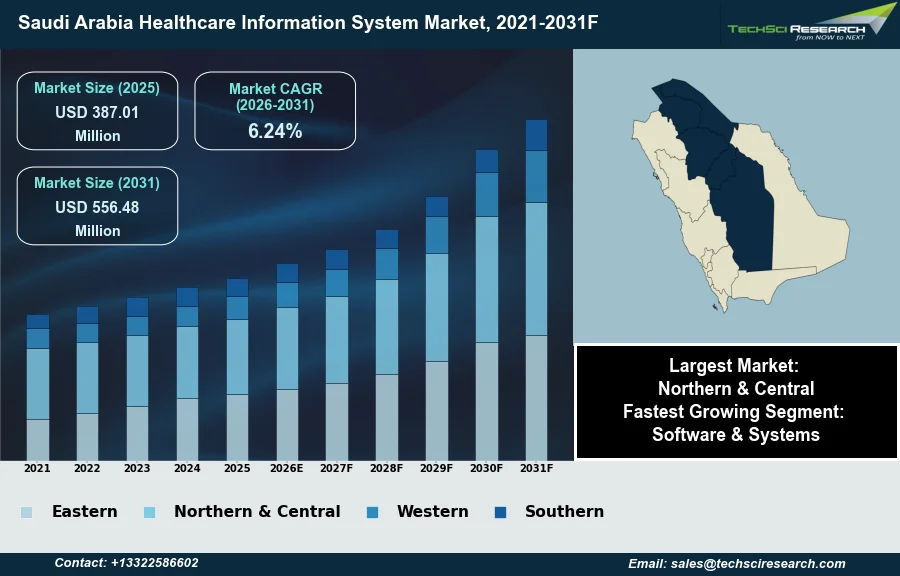
The Saudi Arabia Healthcare Information System Market will grow from USD 387.01 Million in 2025 to USD 556.48 Million by 2031 at a 6.24% CAGR. A Healthcare Information System (HIS) is a comprehensive framework that collects, stores, manages, and transmits health data, enabling informed decision-making, improved patient outcomes, and enhanced operational efficiency within healthcare settings. The Saudi Arabia Healthcare Information System market's growth is predominantly driven by the nation's Vision 2030 initiatives, which actively promote digital transformation and substantial investments in modernizing healthcare infrastructure. Concurrently, the increasing prevalence of chronic diseases and a growing demand for streamlined patient management solutions further accelerate market expansion. According to reports from the 2025 Global Health Exhibition, the event saw over SAR133 billion in investments and agreements focused on hospital infrastructure, venture capital, and life sciences.
A significant challenge impeding this market's expansion is the substantial financial outlay required for system implementation and ongoing maintenance, particularly for smaller healthcare facilities. Moreover, concerns regarding data security, privacy compliance, and interoperability issues continue to present operational barriers for stakeholders.
Key Market Drivers
Strategic National Vision and Governmental Push for Digital Health
The Strategic National Vision and Government Directives for Digital Health are profoundly shaping the Saudi Arabia Healthcare Information System Market. The nation's Vision 2030 initiatives emphasize digital transformation across all sectors, including healthcare, to enhance service quality and efficiency. This commitment translates into substantial governmental backing for digital health projects, fostering an environment ripe for HIS adoption. According to Forbes Middle East, in April 2024, reporting on the Digital Health Forum 2024, over $50 billion was allocated in 2023 for healthcare technology projects such as the National Platform for Health and Insurance Exchange Services (NPHIES) and telemedicine services. These directives accelerate the demand for advanced HIS solutions that support national health information exchange, interoperability, and the integration of emerging technologies like AI and cloud computing, which are crucial for a modernized healthcare ecosystem.
Infrastructure Modernization and Digital Backbone Driving HIS Demand
Another significant factor driving the market is the substantial investments in healthcare infrastructure and modernization. The Saudi government is actively channeling funds into developing and upgrading healthcare facilities to align with its vision of a robust, technologically advanced health sector. This modernization extends beyond physical structures to encompass the digital backbone required for efficient operations and patient care. According to the Saudi Press Agency, in June 2026, in its report 'Saudi Arabia builds AI-powered healthcare system with robotic surgery and virtual hospitals', the Kingdom allocated 31 billion riyals for hospital infrastructure, indicating a strong push towards equipping new and existing facilities with advanced digital capabilities. These investments create a direct demand for comprehensive HIS, including electronic health records, telemedicine platforms, and smart hospital solutions, ensuring that new infrastructure is digitally enabled from inception. Overall, Saudi Arabia's digital health market reached $4.4 billion in 2024.
Download Free Sample Report
Key Market Challenges
Significant Upfront and Ongoing Costs Constrain HIS Adoption
The substantial financial outlay required for Healthcare Information System (HIS) implementation and ongoing maintenance presents a significant challenge impeding the market's growth in Saudi Arabia. This financial barrier directly limits the widespread adoption of advanced HIS solutions, particularly among smaller healthcare facilities and private entities operating with tighter budget constraints. The initial investment for software licenses, necessary hardware infrastructure, and extensive customization, alongside the recurring costs associated with system upgrades, technical support, and stringent cybersecurity protocols, creates a formidable economic hurdle.
Liquidity Constraints Limit HIS Investment and Slow Digital Transformation
This financial burden directly impacts the operational liquidity and investment capacity of healthcare providers. For example, according to a June 2026 report by KPMG, healthcare providers in Saudi Arabia face initial claim rejection rates ranging from 15 to 25 percent, a factor that significantly drains their working capital. Such liquidity challenges consequently restrict these facilities' ability to allocate essential funds towards deploying and maintaining comprehensive HIS, thereby decelerating the overall digital transformation within the sector. This results in a slower market penetration of HIS as adoption remains largely confined to larger, well-resourced healthcare organizations, leaving a considerable portion of the Saudi Arabian healthcare landscape without the benefits of modernized information systems.
Key Market Trends
Growth of Patient-Centric Mobile Health and Sehhaty Adoption
Patient-centric mobile health solutions represent a significant trend, empowering individuals with direct access to their health information and care management tools. These platforms extend beyond basic telemedicine, offering functionalities like medication reminders, appointment scheduling, and personal health record access, fostering greater patient engagement. This approach transforms healthcare delivery by shifting focus towards the individual, enhancing convenience and promoting proactive health behaviors through accessible digital interfaces. According to Fast Company, in January 2026, in its article 'Saudi Arabia is already living the future of healthcare', the national digital platform Sehhaty contains 31 million unified health files, representing nearly 88% of the population. This broad adoption underscores the growing demand for digital tools that streamline patient interactions.
Transforming HIS Through Precision Medicine and Real-Time Monitoring
Precision medicine and real-time monitoring advancements are profoundly influencing the Saudi Arabia Healthcare Information System market by enabling highly personalized and proactive interventions. This trend involves leveraging extensive genetic and physiological data to tailor treatments, predict disease risks, and continuously track patient health status outside traditional clinical settings. Such capabilities demand sophisticated HIS to integrate vast datasets from genomics, wearables, and other monitoring devices, transforming diagnostic accuracy and therapeutic efficacy. According to BriefGlance, in May 2026, in its article 'Saudi Arabia Stakes Claim in Global Genomics and Precision Medicine Race', the Saudi Genome Program had sequenced over 63,000 genomes as of late 2024. This highlights the foundation for delivering individualized care based on deeper understanding of patient-specific biological profiles.
Segmental Insights
Key growth drivers for Saudi Arabia's Healthcare Information System Market
The Software & Systems segment is experiencing rapid growth within the Saudi Arabia Healthcare Information System Market. This acceleration is primarily driven by the nation's ambitious digital transformation agenda under Saudi Vision 2030 and its Health Sector Transformation Program, which prioritizes modernizing healthcare delivery through technology. The increasing adoption of electronic health records (EHRs) and comprehensive management systems by healthcare providers is crucial for enhancing patient data management, streamlining operational efficiency, and improving overall care quality. Furthermore, significant investment by the Ministry of Health in developing advanced digital infrastructure, incorporating artificial intelligence and cloud computing, further propels the demand for sophisticated software solutions across the healthcare continuum.
Regional Insights
Northern and Central Regions: Market Leader in Saudi Arabia Healthcare Information System Market
The Northern and Central region stands as the leading segment in the Saudi Arabia Healthcare Information System Market, primarily driven by its significant concentration of advanced healthcare facilities and major urban centers, including the capital city, Riyadh. This region benefits from substantial governmental support and strategic investments in healthcare infrastructure, aligning with the ambitious national Vision 2030 initiatives aimed at digitalizing the healthcare sector. The high population density in these areas contributes to a greater demand for comprehensive healthcare services, fostering rapid adoption of information systems. Furthermore, the region's economic and political prominence creates an environment conducive to technological advancement and large-scale digital health deployment.
Recent Developments
-
In November 2025, SEDCO, a global provider of digital transformation and smart healthcare solutions, signed a Memorandum of Understanding with the National Unified Procurement Company (NUPCO) in Saudi Arabia. This collaboration aimed to explore opportunities for advancing digital healthcare transformation, aligning with Saudi Vision 2030. The partnership focused on enhancing operational efficiency and fostering a more connected, agile healthcare ecosystem within the Kingdom. By combining NUPCO's extensive reach with SEDCO's technological expertise, this initiative sought to accelerate the development of a patient-centric digital healthcare system, utilizing local knowledge and advanced technologies to improve health outcomes across the community.
-
In November 2025, RapidAI announced a strategic partnership with Saudi Health Holdings Company (HHC), a major healthcare provider in the Middle East. This collaboration aimed to integrate deep clinical artificial intelligence across HHC's network of 20 health clusters, encompassing numerous hospitals and clinics throughout Saudi Arabia. RapidAI was designated as HHC's enterprise provider for clinical AI, supporting multiple disease states, including neurology, cardiology, vascular, and oncology. This initiative represented a significant step in HHC’s digital transformation strategy, aligning with Saudi Arabia's Vision 2030 by enhancing healthcare quality and accessibility through advanced technological solutions.
-
In October 2025, IQVIA initiated a strategic collaboration with Six Phases, the technology subsidiary of Healthcare Alliance (HCA), to implement transformative health system solutions in Saudi Arabia. This partnership focused on the digital overhaul of healthcare delivery across HCA's key medical facilities, including Mohammad Dossary Hospital. The deployment included IQVIA’s next-generation, cloud-based Hospital Information System, a Patient-Level Costing Solution, and the IQVIA Care Management System for home care. The objective was to unify clinical and financial data across HCA entities, thereby improving operational excellence, providing better cost insights, and enhancing decision-making processes within the Saudi healthcare information system market.
-
In October 2024, Royal Philips, a global leader in health technology, showcased several advanced HealthTech innovations at the Global Health Exhibition in Riyadh. The company unveiled solutions such as the Philips CT5300, which leverages artificial intelligence for new clinical capabilities and workflow improvements, including virtual tools for real-time collaboration. Another innovation was Philips SmartSpeed, an AI-powered MRI acceleration tool designed to enhance image reconstruction and boost resolution. These product launches were introduced to address the increasing healthcare demands in Saudi Arabia and support the country's Vision 2030 objectives by improving care delivery through technology.
Key Market Players
- Koninklijke Philips NV
- Hewlett Packard Enterprise
- GE HealthCare
- Epic Systems Corporation
- Siemens Ltd
- Cerner Corporation
- InterSystems Corporation
- IBM Watson Health
- McKesson Corporation
- Alshaya HealthTech
|
By Component
|
By End Use
|
By Region
|
- Hardware
- Software & Systems
- Services
|
- Hospitals
- Diagnostic Centers
- Academic and Research Institutes
|
- Eastern
- Northern & Central
- Western
- Southern
|
Report Scope:
In this report, the Saudi Arabia Healthcare Information System Market has been segmented into the following categories, in addition to the industry trends which have also been detailed below:
-
Saudi Arabia Healthcare Information System Market, By Component:
-
Hardware
-
Software & Systems
-
Services
-
Saudi Arabia Healthcare Information System Market, By End Use:
-
Hospitals
-
Diagnostic Centers
-
Academic and Research Institutes
-
Saudi Arabia Healthcare Information System Market, By Region:
-
Eastern
-
Northern & Central
-
Western
-
Southern
Competitive Landscape
Company Profiles: Detailed analysis of the major companies present in the Saudi Arabia Healthcare Information System Market.
Available Customizations:
Saudi Arabia Healthcare Information System Market report with the given market data, TechSci Research offers customizations according to a company's specific needs. The following customization options are available for the report:
Company Information
- Detailed analysis and profiling of additional market players (up to five).
Saudi Arabia Healthcare Information System Market is an upcoming report to be released soon. If you wish an early delivery of this report or want to confirm the date of release, please contact us at sales@techsciresearch.com