|
Key Insights
|
Details
|
|
Forecast Period
|
2027 - 2031
|
|
Market Size (2025)
|
USD 58.21 Billion
|
|
CAGR (2026-2031)
|
3.48%
|
|
Fastest Growing Segment
|
Cherries
|
|
Largest Market
|
Asia Pacific
|
|
Market Size (2031)
|
USD 71.47 Billion
|
Market Overview
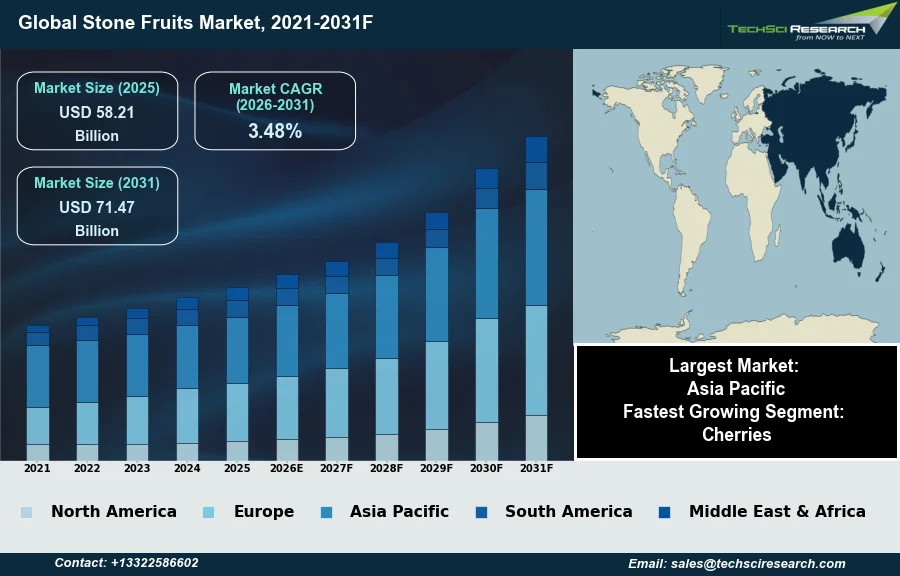
The Global Stone Fruits Market is expected to grow from USD 58.21 Billion in 2025 to USD 71.47 Billion by 2031 at a 3.48% CAGR. Stone fruits, also known as drupes, are characterized by their fleshy outer section surrounding a single, hard seed or "stone" at their core, encompassing varieties such as peaches, plums, cherries, apricots, and nectarines. The global market's expansion is primarily driven by escalating consumer demand for fresh and healthy produce, particularly as health consciousness rises worldwide. Additionally, increasing disposable incomes in emerging economies and continuous population growth contribute significantly to the market's upward trajectory, fostering greater consumption of these fruits.
A significant challenge impeding market expansion is the increasing susceptibility of stone fruit crops to adverse climate change impacts, including unpredictable weather patterns and extreme temperature fluctuations, which can severely affect yield and quality. For instance, according to Europech, in 2025, total stone fruit output in Europe is forecast at 3.2 million tonnes, reflecting a 7% decrease from 2024, primarily due to severe spring frosts in key producing regions.
Key Market Drivers
Health and Wellness-Driven Demand for Stone Fruits
The rising consumer health and wellness focus significantly propels the global stone fruits market. Consumers increasingly seek out fresh and nutritious food options, driven by a greater awareness of the health benefits associated with fruit consumption, such as essential vitamins, antioxidants, and fiber. This trend leads to higher demand for stone fruits like peaches, plums, and cherries, which are perceived as healthy choices. For instance, according to the International Fresh Produce Association, in December 2025, fruit dollar sales in the fresh produce category rose 5.5%, demonstrating robust consumer interest in fresh fruit options. This demand extends to organic and sustainably sourced stone fruits, as consumers connect these attributes with improved health outcomes and environmental responsibility.
Global Trade Expansion and Production Growth for Stone Fruits
Simultaneously, expanding global trade and export opportunities are crucial drivers for the stone fruits market. Improved logistics, reduced trade barriers, and increasing demand from non-traditional markets have facilitated the broader distribution of these seasonal fruits. This enables producers to reach a wider consumer base and extend their sales windows. For example, according to Spain's Ministry of Agriculture, Fisheries, and Food, as reported in November 2024, by July 2024, Spain exported 557,371 tons of stone fruit, showcasing the significant role of exports in national production. Such international trade allows for consistent supply to meet year-round consumer preferences in various regions. Overall, the value of production for all noncitrus fruits in the US is expected to increase by 23 percent, according to the USDA in 2025, indicating a strong positive trajectory for the broader fruit sector, including stone fruits.
Download Free Sample Report
Key Market Challenges
Climate Variability Threatens Stone Fruit Yield and Quality
A significant challenging factor impeding the expansion of the global stone fruits market is the increasing susceptibility of these crops to adverse climate change impacts, including unpredictable weather patterns and extreme temperature fluctuations. Such climatic shifts directly compromise both yield and quality of stone fruit varieties. For instance, severe spring frosts can devastate blossoming orchards, leading to substantial production losses.
Supply Disruptions and Price Volatility from Climate Damage
These climatic events directly hamper market growth by reducing the overall supply of stone fruits. When key producing regions experience significant crop damage, the available volume for both fresh consumption and processing declines, leading to potential supply shortages and price volatility. According to the United States Department of Agriculture's National Agricultural Statistics Service, in 2026, Georgia's peach production experienced a 52 percent reduction, totaling 17,000 tons, primarily due to freeze damage impacting early-blooming varieties in March. Such substantial reductions in output not only affect grower profitability but also limit consumer access to fresh produce, thereby constraining the overall market's growth trajectory and stability.
Key Market Trends
Post-harvest technology and cold-chain advances extend shelf life and reduce waste
Advancements in post-harvest technology and cold chain management are significantly shaping the global stone fruits market by extending shelf life and reducing waste. Innovations such as intelligent packaging, IoT-based storage monitoring, and enhanced refrigeration systems are crucial for preserving fruit quality from farm to consumer, especially for perishable items like stone fruits. These technological improvements enable longer transit times and broader distribution, ensuring that fruits maintain their freshness and nutritional value. For example, according to the Food and Agriculture Organization of the United United Nations, in March 2026, an estimated 526 million tonnes of food, representing about 12% of the global total, are lost or wasted due to inadequate refrigeration. Addressing this through advanced cold chain solutions is vital for market efficiency and sustainability.
Online retail expansion reshapes distribution and consumer access
The rapid expansion of online retail and e-commerce platforms represents another transformative trend, fundamentally altering how stone fruits reach consumers. This digital shift provides new avenues for market access, particularly in regions with improving logistical infrastructure and increased internet penetration. Consumers increasingly value the convenience of online grocery shopping, including the ability to order fresh produce for home delivery. This is evidenced by U.S. online grocery sales, which grew 21.5% year over year in July 2026, according to Brick Meets Click, as reported by Blue Book Services. The increasing confidence in purchasing fresh produce online drives retailers to enhance their digital offerings and invest in efficient last-mile delivery solutions, further boosting the stone fruits market.
Segmental Insights
Cherries Drive Growth: Health Benefits, Versatility, and Supply-Chain Advances
The global stone fruits market is experiencing dynamic shifts, with cherries emerging as the fastest-growing segment. This accelerated growth is primarily driven by increasing consumer awareness regarding the health benefits of cherries, which are rich in antioxidants and vitamins, aligning with a global trend towards healthier eating and plant-based diets. Furthermore, the versatility of cherries in both fresh consumption and various processed applications, such as juices and desserts, significantly contributes to their expanding market presence. Enhanced global supply chains, including advancements in cold chain logistics and packaging technologies like Modified Atmosphere Packaging (MAP), enable year-round availability and extended shelf life, thereby facilitating wider distribution and meeting consistent consumer demand across different regions, particularly in Asia-Pacific where demand for premium fruit is high. Producers are also investing in new, high-quality varieties and improved cultivation techniques to meet market preferences.
Regional Insights
Asia Pacific Dominates the Global Stone Fruits Market
Asia Pacific dominates the Global Stone Fruits Market due to its substantial production and high consumption rates, particularly within countries like China and India. The region benefits from favorable climatic conditions and established agricultural practices that support diverse stone fruit cultivation. A burgeoning middle class and rapid urbanization are significantly driving demand, as consumers increasingly seek fresh, high-quality, and healthier dietary options. Furthermore, ongoing investments in cold-chain infrastructure and expanding retail networks across the region further solidify its leading position, facilitating efficient distribution and meeting evolving consumer preferences.
Recent Developments
-
In June 2025, Homegrown Organic Farms announced the expansion of its stone fruit program, celebrating a successful season characterized by flavorful fruit and robust supply. The company extended its organic offerings and launched a limited conventional program to cater to diverse retail partner demands. This growth was significantly bolstered by the addition of volume from Kliewer Family Farms, positioning Homegrown Organic Farms to provide consistent, high-flavor stone fruit throughout the summer. The core of their offering continued to be their Regenerative Organic Certified stone fruit program, now in its third season, which focuses on soil health and biodiversity.
-
In May 2025, Seville-based Royal introduced an innovative stone fruit packaging concept, marking a significant new product launch for the company. This packaging differentiates the fruit's flesh color, featuring yellow for yellow-fleshed peaches and nectarines, beige for white-fleshed varieties, and deep red for their Royal Sanguine nectarine. The company stated this approach not only improves brand recognition but also helps consumers easily identify their preferred stone fruits. Emphasizing sustainability, the new packaging is 100 percent recyclable and utilizes biodegradable paper and cardboard materials.
-
In May 2025, Cibus Fund II, a sustainable food and agriculture investment fund, completed a strategic acquisition of a majority stake in PSB Producción Vegetal. PSB Producción Vegetal is a prominent company specializing in proprietary fruit genetics and stone fruit breeding. This investment aimed to accelerate PSB's research and development capabilities and global expansion efforts. PSB is recognized for developing climate-resilient stone fruit varieties with enhanced flavor, disease resistance, and improved shelf life, addressing challenges such as sharka virus and powdery mildew. The acquisition reinforces a commitment to sustainable agriculture and innovation in the global fresh fruit market.
-
In March 2025, Frutas de Chile announced plans to significantly enhance its collaborations with major e-commerce platforms, including JD.com, Xiaohongshu, and Douyin, for the 2024/25 stone fruit season. These partnerships aimed to boost online sales by highlighting the health and nutritional benefits of Chilean stone fruits. Additionally, the organization intended to utilize Douyin influencers and wholesale market streamers for livestreaming sales events. Further efforts included extensive nationwide offline promotions with leading retail chains such as Costco, Olé, Freshippo, Walmart, and Metro, alongside popular fruit chains like Xianfeng Fruit and Pagoda, to broaden consumer reach and awareness.
Key Market Players
- Dole plc
- Fresh Del Monte Produce Inc.
- Stemilt Growers
- Zhonglu Fruit
- Mission Produce
- Sun World International
- Pacific Coast Producers
- Agricultural Robotics
- China National Chemical Corporation
- Driscoll's
|
By Fruit Type
|
By Region
|
- Peaches and Nectarines
- Cherries
|
- North America
- Europe
- Asia Pacific
- South America
- Middle East & Africa
|
Report Scope:
In this report, the Global Stone Fruits Market has been segmented into the following categories, in addition to the industry trends which have also been detailed below:
-
Stone Fruits Market, By Fruit Type:
-
Peaches and Nectarines
-
Cherries
-
Stone Fruits Market, By Region:
-
North America
-
United States
-
Canada
-
Mexico
-
Europe
-
France
-
United Kingdom
-
Italy
-
Germany
-
Spain
-
Asia Pacific
-
China
-
India
-
Japan
-
Australia
-
South Korea
-
South America
-
Brazil
-
Argentina
-
Colombia
-
Middle East & Africa
-
South Africa
-
Saudi Arabia
-
UAE
Competitive Landscape
Company Profiles: Detailed analysis of the major companies present in the Global Stone Fruits Market.
Available Customizations:
Global Stone Fruits Market report with the given market data, TechSci Research offers customizations according to a company's specific needs. The following customization options are available for the report:
Company Information
- Detailed analysis and profiling of additional market players (up to five).
Global Stone Fruits Market is an upcoming report to be released soon. If you wish an early delivery of this report or want to confirm the date of release, please contact us at sales@techsciresearch.com