|
Key Insights
|
Details
|
|
Forecast Period
|
2026 - 2031
|
|
Market Size (2025)
|
USD 18.61 Billion
|
|
CAGR (2026-2031)
|
6.05%
|
|
Fastest Growing Segment
|
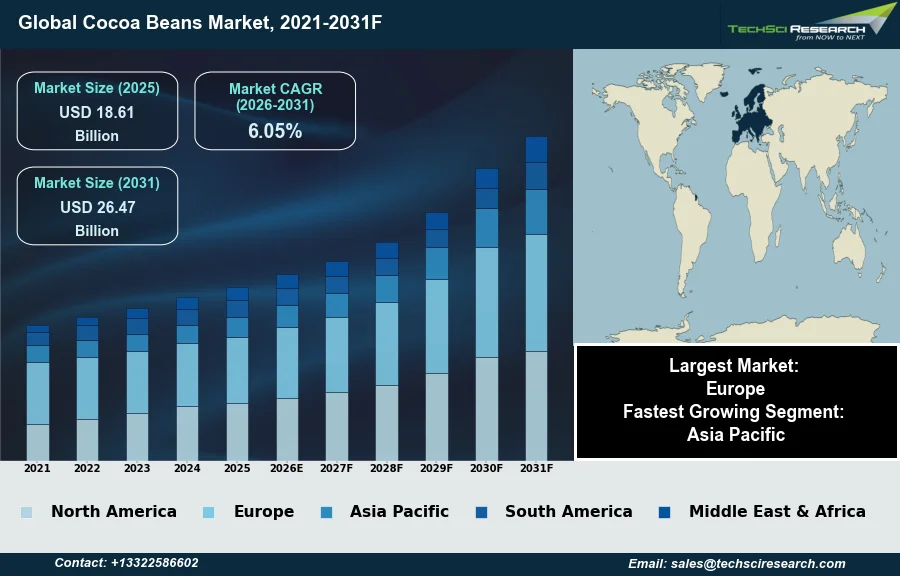
Asia Pacific
|
|
Largest Market
|
Europe
|
|
Market Size (2031)
|
USD 26.47 Billion
|
Market Overview
The Global Cocoa Beans Market is expected to grow from USD 18.61 Billion in 2025 to USD 26.47 Billion by 2031 at a 6.05% CAGR. Cocoa beans are the dried and fermented seeds of the cacao tree (Theobroma cacao), serving as the fundamental raw material for chocolate, cocoa powder, and cocoa butter production. The global cocoa beans market is primarily driven by sustained global demand for chocolate and confectionery products. Growth is further supported by expanding middle-class populations and rising disposable incomes in emerging economies, alongside increasing consumer awareness regarding the potential health benefits associated with cocoa consumption.
According to the International Cocoa Organization (ICCO), in its May 2026 Quarterly Bulletin of Cocoa Statistics, global cocoa production for the 2024/25 cocoa year was estimated at 4.723 million tonnes, while world grindings stood at 4.628 million tonnes. A significant challenge impeding market expansion is the persistent vulnerability of supply to adverse climate conditions, aging plantations, and crop diseases, particularly prevalent in the major West African producing regions.
Key Market Drivers
Global Growth in Chocolate Consumption Drives Cocoa Bean Demand
Growing global chocolate and confectionery consumption represents a fundamental driver for the cocoa beans market, directly influencing demand for its primary raw material. The sustained appeal of chocolate products across diverse demographics, coupled with innovation in flavor profiles and product formats, underpins this continuous growth. Major confectionery companies are continually expanding their market reach and product offerings to cater to evolving consumer preferences and seasonal demands, solidifying the need for a stable and sufficient supply of cocoa beans. According to Confectionery Production, in February 2026, Ferrero confirmed a 4.6% annual turnover increase to €19.3 billion for the financial year ended August 31, 2025, highlighting the significant economic scale of the global chocolate and confectionery industry. This strong performance by leading players indicates robust end-product demand, which translates directly into consistent procurement of cocoa beans.
Premium and Artisanal Chocolates Drive Demand for Specialized Cocoa
Complementing this broad demand is the rising consumer preference for premium and artisanal chocolates, a trend that drives demand for higher quality and often specialized cocoa varieties. Consumers are increasingly willing to pay a premium for chocolates with unique origins, ethical sourcing credentials, and sophisticated flavor complexities, pushing manufacturers to seek out specific cocoa bean profiles. This segment's expansion encourages investment in sustainable farming practices and quality improvement initiatives at the cocoa farm level. According to Confectionery Production, in November 2026, Barry Callebaut's specialist high-end chocolate division saw 13% growth in the fourth quarter, reflecting the significant momentum in the premium segment. Overall, the market continues to see substantial activity, with Barry Callebaut Group delivering sales volume of 2,109,866 tonnes in fiscal year 2025/26, according to Swiss-Press.com in November 2026.
Download Free Sample Report
Key Market Challenges
Supply Vulnerability Driving Cocoa Market Uncertainty
The global cocoa beans market faces a significant impediment to growth stemming from the persistent vulnerability of supply. This vulnerability is primarily driven by adverse climate conditions, aging plantations, and widespread crop diseases, particularly within key West African producing regions. Such factors directly lead to reduced crop yields, increasing the volatility of raw material prices and creating considerable supply chain uncertainty for manufacturers of chocolate and confectionery products. This instability hampers effective planning and investment across the industry.
Forecasted Output Decline Linked to Disease and Aging Farms
The direct impact of these challenges is evident in production forecasts. According to Ghana's cocoa regulator, COCOBOD, in July 2026, the country's 2025/26 cocoa production was projected at 750,000 metric tonnes. However, COCOBOD further indicated that the 2026/27 production could significantly decline to between 450,000 and 550,000 metric tonnes. This projected reduction is attributed to the combined effects of swollen shoot disease, aging cocoa farms, and the likelihood of adverse weather patterns, directly illustrating how these pervasive issues translate into tangible volume losses and restrict overall market expansion.
Key Market Trends
Digitalization, Traceability, and Compliance in Cocoa Supply Chains
Advancements in cocoa supply chain digitalization are profoundly reshaping how cocoa is tracked, verified, and traded. This trend is driven by an increasing need for transparency, efficiency, and compliance with stringent international regulations, such as the upcoming EU Deforestation Regulation. Digital platforms, including blockchain technology, enable stakeholders to monitor cocoa beans from farm to market, ensuring ethical sourcing and environmental sustainability. This technological integration provides verifiable and tamper-proof records, fostering greater trust among buyers and consumers. For instance, the blockchain-based platform Trusty has traced over 100,000 tons of materials and mapped 50,000 farmers, with more than 150 clients globally utilizing its services to ensure regulatory compliance and full traceability of cocoa supply chains. This digitalization enhances operational insights and mitigates risks associated with opaque supply networks.
Diversification of Cocoa Sourcing and Processing Hubs
The diversification of cocoa sourcing geographies represents another significant market trend, aiming to bolster supply chain resilience and reduce over-reliance on a few dominant producing regions. Facing persistent climate vulnerabilities and disease outbreaks in West Africa, manufacturers are increasingly exploring alternative or expanding existing sourcing locations in Latin America and Asia. This geographical shift helps stabilize global supply and introduces distinct cocoa profiles, catering to varied market demands. This trend is also evidenced by changes in value addition locations. For example, according to the 2026 Cocoa Report, Indonesia is transforming from a primary bean exporter into a significant processing hub, with its processed cocoa exports reaching 386,600 metric tonnes in 2024. This strategic realignment supports more stable and varied cocoa procurement, contributing to a more balanced global market.
Segmental Insights
Asia Pacific Growth Driver in Cocoa Beans Market Fueled by Rising Incomes, Urbanization, Investments, and Quality Standards.
The Asia Pacific segment is experiencing rapid growth in the Global Cocoa Beans Market, emerging as a key growth driver due to a confluence of specific economic and consumer trends. This accelerated expansion is primarily fueled by rising disposable incomes and increasing urbanization across countries like China, India, and Southeast Asia, which are shifting consumer preferences towards high-quality, premium, and health-oriented chocolate and cocoa-based products. The region also benefits from substantial investments in local cocoa farming and processing infrastructure by both governmental bodies and private enterprises, reducing reliance on imports and enhancing supply chain efficiency. Furthermore, the growing influence of the Cocoa Association of Asia (CAA) in promoting quality standards and sustainable practices contributes to the robust development of the regional cocoa industry.
Regional Insights
Europe's Central Role in the Cocoa Value Chain: Processing Capacity, Demand, and Regulation
Europe leads the global cocoa beans market primarily due to its sophisticated processing capabilities and deeply embedded chocolate consumption culture. The region acts as the world's largest cocoa grinder and importer, supported by a well-established confectionery industry and high consumer demand for chocolate products. Key ports like Amsterdam facilitate extensive trade and logistics infrastructure. Furthermore, the European Union's stringent regulations concerning product quality, sustainability, and traceability significantly influence global cocoa sourcing practices, reinforcing Europe's central role in the value chain and fostering continuous innovation within its chocolate manufacturing sector.
Recent Developments
-
In December 2025, Olam Food Ingredients (ofi) announced it had surpassed its 2024 cocoa greenhouse gas (GHG) reduction milestone and reached its 2030 living income target for cocoa farmers ahead of schedule. The company achieved a 12% reduction in cocoa GHG natural capital costs per tonne of output against its 2018 baseline. Additionally, 155,000 cocoa farmers participating in its sustainability programs were earning a living income, representing 45% of those farmers. These achievements were driven by agroforestry activities, which included planting millions of trees, and favorable cocoa market prices, reinforcing the resilience and long-term sustainability of cocoa supply chains globally.
-
In October 2024, Cargill inaugurated a new cocoa production line at its processing plant in Gresik, Indonesia, to address the increasing demand for indulgent foods in Asia. This expansion enabled the production of specialized cocoa solutions, including cocoa powders and cocoa liquors with distinct flavor and sensory profiles. Concurrently, Cargill introduced two dark Gerkens® cocoa powder ranges and a new line of Cargill® Craft cocoa liquors. This strategic investment in manufacturing technology and advanced research and development enhanced the company's capability to offer customized cocoa ingredients, supporting regional customers and diversifying the global cocoa beans market with innovative product offerings.
-
In April 2024, Barry Callebaut launched its Future Farming Initiative (FFI), aiming to establish a scalable, high-tech, and sustainable cocoa farming business. The chocolate and cocoa products manufacturer intended for the FFI to catalyze further investment and partnerships with farmers to modernize sustainable cocoa cultivation. The company began developing technology and research and development capabilities, initially signing an agreement with a high-tech farming business in Bahia, Brazil, to develop 5,000 hectares. This initiative sought to create a profitable model for sustainable cocoa farming, integrating learnings from its existing "Farm of the Future" property in Ecuador, thereby contributing to the future of the global cocoa beans market.
-
In 2025, Mondelēz International successfully achieved its target of sourcing approximately 100% of the cocoa volume for its chocolate brands through its Cocoa Life sustainability program. This milestone represented significant progress in transforming the company's cocoa supply chain by working with over 257,000 registered farmers. The program focused on fostering more profitable farming businesses, building resilient communities, and protecting and restoring forests. This accomplishment underscored the company's commitment to sustainable ingredient sourcing and addressed environmental and social challenges within the global cocoa beans market, aligning with evolving industry expectations and regulatory landscapes.
Key Market Players
- Cargill, Incorporated
- Guan Chong Berhad
- Hartree Partners
- Touton SA
- Olam Group
- Barry Callebaut AG
- Ecom Agroindustrial Corp. Limited
- The Hershey Company
- Nestlé S.A.
- Mondelez International
|
By Region
|
- North America
- Europe
- Asia Pacific
- South America
- Middle East & Africa
|
Report Scope:
In this report, the Global Cocoa Beans Market has been segmented into the following categories, in addition to the industry trends which have also been detailed below:
-
Cocoa Beans Market, By Region:
-
North America
-
United States
-
Canada
-
Mexico
-
Europe
-
France
-
United Kingdom
-
Italy
-
Germany
-
Spain
-
Asia Pacific
-
China
-
India
-
Japan
-
Australia
-
South Korea
-
South America
-
Brazil
-
Argentina
-
Colombia
-
Middle East & Africa
-
South Africa
-
Saudi Arabia
-
UAE
Competitive Landscape
Company Profiles: Detailed analysis of the major companies present in the Global Cocoa Beans Market.
Available Customizations:
Global Cocoa Beans Market report with the given market data, TechSci Research offers customizations according to a company's specific needs. The following customization options are available for the report:
Company Information
- Detailed analysis and profiling of additional market players (up to five).
Global Cocoa Beans Market is an upcoming report to be released soon. If you wish an early delivery of this report or want to confirm the date of release, please contact us at sales@techsciresearch.com