|
Key Insights
|
Details
|
|
Forecast Period
|
2027-2031
|
|
Market Size (2025)
|
USD 1.44 Billion
|
|
CAGR (2026-2031)
|
7.24%
|
|
Fastest Growing Segment
|
Women
|
|
Largest Market
|
Northern & Central
|
|
Market Size (2031)
|
USD 2.19 Billion
|
Market Overview
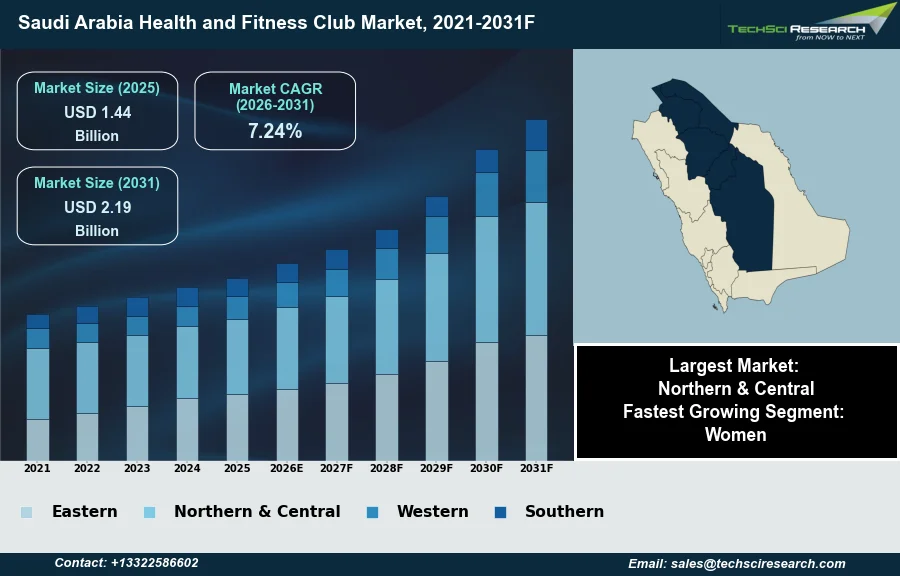
The Health and Fitness Club Market in Saudi Arabia will grow from USD 1.44 Billion in 2025 to USD 2.19 Billion by 2031 at a 7.24% CAGR. Health and fitness clubs are commercial establishments providing facilities, equipment, and structured programs for physical exercise and wellness to members. The Saudi Arabia Health and Fitness Club Market is primarily driven by robust government initiatives, notably Vision 2030's Quality of Life Program, which actively promotes increased physical activity and improved community health outcomes. Furthermore, a growing national health consciousness, heightened by the rising prevalence of lifestyle diseases such as obesity, along with an expanding youth demographic and increasing female participation, substantially propel market expansion.
The market also faces noteworthy impediments, such as high operational costs. According to FIBO's 'Fitness Sector Development Report - Kingdom of Saudi Arabia', in 2024, the industry's value reached approximately SAR 7.7 billion. Despite this growth, significant investments required for prime real estate, state-of-the-art equipment, and qualified personnel pose a considerable challenge to sustainable market development, particularly for new entrants.
Key Market Drivers
Vision 2030 Initiatives Expand Physical Activity and Club Demand
The Saudi Arabia Health and Fitness Club Market experiences significant propulsion from government-led health initiatives, primarily driven by Vision 2030's ambitious Quality of Life Program. This strategic national transformation emphasizes increasing physical activity across the population, fostering an environment conducive to wellness. The government's proactive approach includes developing public sports facilities and launching widespread fitness campaigns. This commitment has yielded tangible results, as evidenced by data from the Saudi Vision 2030 website, which states that in 2025, the percentage of adults engaging in physical activity for at least 150 minutes per week reached 59.1%, surpassing the target set for 2027. This substantial increase in active citizens directly translates to a higher demand for structured fitness solutions offered by health clubs.
Rising Health Awareness and Obesity Fuel Fitness Market Growth
Furthermore, a burgeoning health consciousness among the Saudi populace, spurred by a heightened awareness of lifestyle diseases, significantly contributes to market expansion. The growing prevalence of conditions such as obesity and diabetes has underscored the importance of preventive healthcare through regular exercise. According to the General Authority for Statistics, as of 2024, approximately 23.1% of Saudi adults were classified as obese, driving individuals to seek professional fitness guidance and club memberships. This increased demand for health and fitness services is reflected in strong market activity, with GymNation, for instance, selling 12,000 memberships within 72 hours across its first six locations in Saudi Arabia in June 2024. These combined factors signal a robust and expanding market for health and fitness clubs within the Kingdom.
Download Free Sample Report
Key Market Challenges
Operational costs impede sustainable market expansion
High operational costs present a substantial impediment to the sustainable expansion of the Saudi Arabia Health and Fitness Club Market. These expenses stem from several key areas, including securing prime real estate in urban centers, which demands significant investment, and the acquisition of state-of-the-art fitness equipment necessary to attract and retain members. Additionally, the market faces considerable challenges in attracting and compensating qualified personnel, such as certified trainers and experienced management, with competitive salaries and benefits further elevating operational expenditure.
Costs limit growth with evidence from imports and trainer shortages
This financial burden directly restricts market growth by increasing barriers to entry for new operators and limiting the capacity of existing clubs to reinvest and scale their operations. For instance, according to the Saudi Customs Authority, the total import value for commercial fitness equipment reached USD 320 Million in 2023, which reportedly drove up operational costs by an average of 35% for new facilities. Furthermore, the Saudi Ministry of Human Resources reported a 40% shortage of certified fitness trainers in 2023, with training certification costs averaging USD 3997.66-5330.21 per trainer, consequently increasing staffing costs. Such elevated initial and ongoing expenses impede the rapid proliferation of diverse fitness facilities required to meet the burgeoning consumer demand, thereby hampering the overall market's potential for sustainable development.
Key Market Trends
Expansion of Women-Exclusive Fitness Facilities in Saudi Arabia
The proliferation of women-exclusive fitness facilities marks a significant trend in the Saudi Arabia Health and Fitness Club Market. This expansion is driven by a strong demand for culturally sensitive and specialized fitness environments, allowing female members to pursue wellness in comfortable and private settings. These dedicated clubs often feature comprehensive programs tailored to women's health goals, alongside community-focused initiatives. This strategic market response supports increased female participation in physical activity. For example, Leejam Sports Company opened four new ladies' fitness centers in Riyadh on January 1, 2026, demonstrating continued investment in this segment.
Tech-Driven Innovation in Saudi Fitness and Wellness
Another pivotal trend is the advanced integration of technology within workout experiences. This encompasses the adoption of smart equipment, digital platforms, and personalized virtual tools designed to enhance user engagement and optimize fitness outcomes. Technology offers unparalleled convenience, real-time performance tracking, and customized training programs, catering to a tech-savvy consumer base. Fitness operators are increasingly leveraging these innovations to deliver dynamic and data-driven health and wellness solutions. In a reflection of this trend, total funding in the Fitness and Wellness Tech sector in Saudi Arabia reached over $2.5 million in 2025.
Segmental Insights
Women's Segment Drives Fastest Growth in Saudi Health and Fitness Club Market
The women's segment stands out as the fastest-growing demographic within the Saudi Arabia Health and Fitness Club Market. This rapid expansion is primarily driven by the transformative initiatives of Saudi Vision 2030, particularly its Quality of Life Program, which prioritizes increasing physical activity and empowering women's social participation. Government policy reforms have been instrumental, facilitating the establishment and licensing of women-only fitness facilities, and introducing physical education in girls' schools. These dedicated spaces cater to cultural sensitivities, offering secure and comfortable environments for women to engage in fitness activities. Coupled with rising health awareness and evolving societal attitudes, these factors collectively encourage greater female engagement in sports and wellness across the Kingdom.
Regional Insights
Riyadh-driven drivers propel Northern & Central health and fitness market leadership
The Northern & Central region leads the Saudi Arabia Health and Fitness Club Market primarily due to its high urbanization rates and significant disposable incomes, particularly in Riyadh. As the nation's capital and a major commercial hub, Riyadh benefits from substantial government investments and infrastructure projects under Vision 2030, which actively promotes health and wellness. The concentration of government ministries and multinational corporations further drives demand through corporate wellness initiatives. Additionally, the Saudi Sports for All Federation, coordinating from Riyadh, underscores the region's pivotal role in fitness innovation and widespread participation.
Recent Developments
-
In November 2025, Purpose Brands LLC announced a master franchise agreement with ABFit, based in Riyadh, to introduce the Anytime Fitness brand into the Kingdom of Saudi Arabia. This collaboration signifies a strategic market entry for the global fitness club. Under the terms of the agreement, the first Anytime Fitness club is projected to open in spring 2026, with plans for at least 60 clubs to follow over the subsequent six years. These upcoming facilities will include both women's and men's branches across various Saudi Arabian cities, supporting the national Vision 2030 goals for public health and quality of life.
-
In July 2025, GymNation opened its largest fitness club to date in Riyadh's Qurtubah district, marking a significant new product launch within the Saudi Arabia health and fitness club market. This expansive 77,000 square foot facility incorporated distinct male and female areas. Notably, it featured Saudi Arabia’s largest ladies-only reformer Pilates studio, a private reformer Pilates room, and a substantial recovery zone equipped with saunas and ice baths. Additionally, the club offered the region's largest free weights area and dedicated glute training zones, showcasing GymNation's investment in diverse and comprehensive fitness solutions.
-
In February 2025, In2Fitness, owned by Kun Sports, outlined plans for significant expansion within Saudi Arabia, aiming to launch an additional 25 fitness locations throughout the year. This initiative built upon their activities in 2024, which included the introduction of new gyms for both men and women in Madina and Khamis Mushait. Furthermore, In2Fitness enhanced its service offerings by extending operating hours to 24 hours a day at ten of its existing branches and launching dedicated "Recovery Zone" facilities in select clubs. These developments underscored the company's commitment to strengthening its market presence and enriching the member experience across the Kingdom.
-
In October 2024, RX, an international events organizer, announced the launch of FIBO Arabia, a significant event for the health and fitness industry in Saudi Arabia. This premier exhibition and conference is scheduled to take place in Riyadh in October 2025. The initiative aims to provide a vital platform for regional and international industry professionals to connect, showcase innovations, and drive advancements within the Kingdom's burgeoning health and wellness sector. The launch of FIBO Arabia directly supports the growth and professionalization of the Saudi Arabia health and fitness club market by fostering collaborations and promoting new developments.
Key Market Players
- Fitness First KSA
- Gold's Gym KSA
- Anytime Fitness KSA
- Curves KSA
- Orange Theory KSA
- Al Jazeera Club
- Al Rajhi Fitness Centers
- Body Time KSA
- Fit & Flex KSA
- Wellness Centers KSA
|
By Revenue System
|
By End User
|
By Region
|
- Membership Fees
- Personal Training and Instruction Services
- Others
|
|
- Eastern
- Northern & Central
- Western
- Southern
|
Report Scope:
In this report, the Saudi Arabia Health and Fitness Club Market has been segmented into the following categories, in addition to the industry trends which have also been detailed below:
-
Saudi Arabia Health and Fitness Club Market, By Revenue System:
-
Membership Fees
-
Personal Training and Instruction Services
-
Others
-
Saudi Arabia Health and Fitness Club Market, By End User:
-
Saudi Arabia Health and Fitness Club Market, By Region:
-
Eastern
-
Northern & Central
-
Western
-
Southern
Competitive Landscape
Company Profiles: Detailed analysis of the major companies present in the Saudi Arabia Health and Fitness Club Market.
Available Customizations:
Saudi Arabia Health and Fitness Club Market report with the given market data, TechSci Research offers customizations according to a company's specific needs. The following customization options are available for the report:
Company Information
- Detailed analysis and profiling of additional market players (up to five).
Saudi Arabia Health and Fitness Club Market is an upcoming report to be released soon. If you wish an early delivery of this report or want to confirm the date of release, please contact us at sales@techsciresearch.com