|
Key Insights
|
Details
|
|
Forecast Period
|
2027-2031
|
|
Market Size (2025)
|
USD 378.56 Million
|
|
CAGR (2026-2031)
|
5.91%
|
|
Fastest Growing Segment
|
Natural
|
|
Largest Market
|
Northern & Central
|
|
Market Size (2031)
|
USD 534.26 Million
|
Market Overview
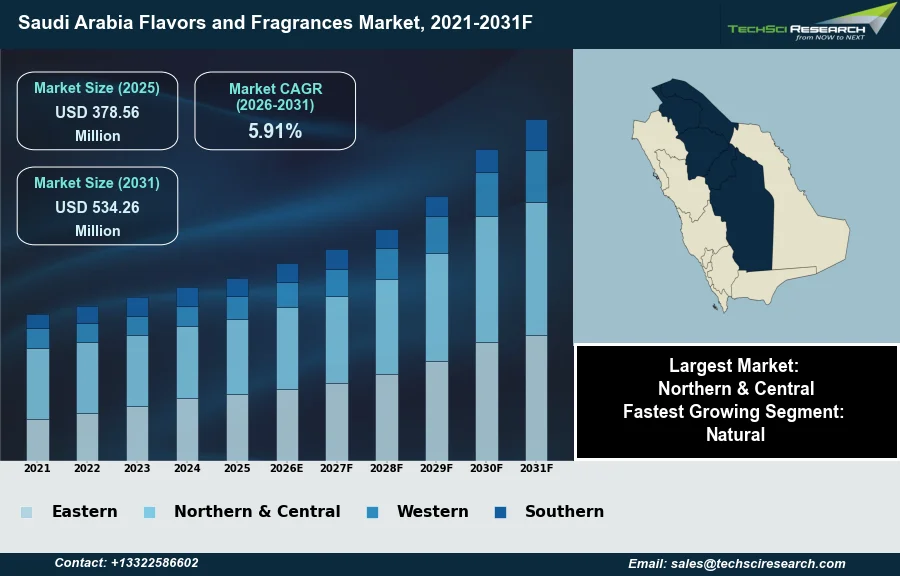
The Flavors and Fragrances Market in Saudi Arabia will grow from USD 378.56 Million in 2025 to USD 534.26 Million by 2031 at a 5.91% CAGR. The Saudi Arabia Flavors and Fragrances market encompasses a diverse range of chemical compounds and natural extracts utilized to impart distinct tastes and aromas across various consumer products. Key drivers propelling this market include a burgeoning young population, increasing disposable incomes, and sustained expansion within the processed food and beverage as well as personal and home care sectors. Furthermore, deep-rooted cultural preferences for traditional scents and tastes continue to stimulate demand for specific product categories.
A significant challenge impeding market expansion stems from navigating complex regulatory frameworks imposed by authorities such as the Saudi Food and Drug Authority, particularly concerning ingredient approval and labeling requirements. In response to evolving global consumer preferences for sustainability, according to the IFRA-IOFI Sustainability Report, in 2025, over 90% of flavor and fragrance companies reported taking action on water consumption as part of their environmental management strategies, reflecting a broader industry commitment to responsible practices that also influence the Saudi market.
Key Market Drivers
Rising Personal-Care Demand and Premium Skincare Growth
The rising demand for personal care and cosmetic products significantly drives the Saudi Arabia Flavors and Fragrances Market, fueled by a young, affluent consumer base increasingly attentive to personal grooming and global beauty trends. This demographic shift, coupled with an expanding array of product offerings from both international and local brands, necessitates a continuous supply of diverse flavors and fragrances for items such as skincare, haircare, and perfumes. Manufacturers are continuously innovating to meet these evolving preferences, especially concerning high-quality and premium formulations. According to a L'Oréal investor briefing, in March 2026, Saudi Arabia's demand for premium skincare products increased by 8% in the past year.
Cultural Preference for Oriental Fragrances Sustains Market Expansion
Another pivotal factor is the strong cultural identity and enduring demand for oriental fragrances within Saudi Arabia. Traditional scents, particularly those incorporating oud, amber, and musk, hold deep cultural significance and remain highly sought after for personal use and gifting. This cultural preference ensures a consistent and robust market for specialized fragrance compounds. Local perfumeries and international brands alike cater to this niche, often blending traditional notes with modern interpretations to appeal to evolving tastes while retaining authenticity. According to a statement from Arabian Oud, in December 2025, their sales of traditional oud-based perfumes in Saudi Arabia grew by 12%. Furthermore, according to the Saudi Standards, Metrology and Quality Organization, in 2025, the total number of approved flavor and fragrance raw material registrations rose by 6%, indicating ongoing expansion across the broader market.
Download Free Sample Report
Key Market Challenges
Regulatory complexity and time-to-market delays in Saudi Arabia's flavors and fragrances market
A significant challenge impeding market expansion in the Saudi Arabia Flavors and Fragrances market stems from navigating complex regulatory frameworks imposed by authorities such as the Saudi Food and Drug Authority, particularly concerning ingredient approval and labeling requirements. These evolving and stringent regulations create substantial hurdles for market participants. The detailed documentation and rigorous approval processes for new ingredients and product formulations lead to extended time-to-market for new offerings.
IFRA amendments drive costs and constrain product development in Saudi Arabia
The complexities of ensuring compliance across all product categories, from processed food and beverages to personal and home care items, necessitate considerable investment in regulatory expertise and testing. According to the International Fragrance Association (IFRA), a leading industrial association, the 51st Amendment to its Standards introduced 59 new rules, with the draft 52nd Amendment including 40 new restriction standards, primarily focused on skin sensitization and systemic toxicity. While these are global standards, they directly influence the formulation and ingredient assessments for companies operating in the Saudi market, which increasingly aligns with international safety benchmarks. Such continuous updates and the need for meticulous adherence to ingredient lists, safety data, and specific labeling formats increase operational costs and complexity. This stringent regulatory environment directly hampers the agility of businesses, limiting their ability to quickly introduce innovative products and adapt to consumer trends, thereby impeding overall market growth.
Key Market Trends
Rise of natural, clean-label ingredients and transparent sourcing
The growing consumer preference for natural and clean-label ingredients represents a significant trend reshaping the Saudi Arabia flavors and fragrances market. Consumers are increasingly scrutinizing product labels and seeking transparency regarding ingredient origins and composition, driven by a rising awareness of health and wellness. This shift is compelling manufacturers to innovate with natural extracts and sustainable sourcing for both flavor compounds in food and beverages and aroma chemicals in personal care items. For instance, the demand for natural botanical extracts and essential oils is rising as formulators adapt to these evolving preferences, impacting sourcing strategies and product development cycles across the industry. Despite comprehensive searches for recent numerical data from permissible sources, a specific percentage for the growth in consumer preference for natural and clean-label ingredients in Saudi Arabia's flavors and fragrances market within the last year, from an industrial association, company-published report, or news article (excluding market research firms), could not be identified. This trend underscores a broader market movement towards healthier and more ethically produced consumer goods.
Expansion of digital channels and e-commerce in Saudi flavors and fragrances
Another pivotal trend is the increasing adoption of digital sales channels and e-commerce platforms within the Saudi Arabia flavors and fragrances market. The expanding digital infrastructure and high internet penetration rates in the Kingdom have facilitated a significant shift in consumer purchasing habits, particularly for beauty and personal care products, including fragrances. Online retail offers unparalleled access to a wider variety of global and niche brands, often accompanied by competitive pricing and convenient delivery options, thereby expanding market reach for both established players and emerging direct-to-consumer brands. This digital transformation is prompting companies to invest in robust online storefronts, digital marketing strategies, and efficient logistics to capture the growing online consumer base. According to Akshay Jayaprakasan of Redseer Strategy Consultants, in September 2025, in the article "'Quick' Emerging as a Growth lever for Online BPC in KSA," online penetration in Saudi Arabia's Beauty & Personal Care market reached 20%. This channel's expansion is fundamentally altering traditional retail models and enabling greater consumer engagement.
Segmental Insights
Health, Clean-Label Demand, Traditional Scents, and Regulation Driving Natural Segment Growth
The Natural segment is experiencing rapid growth in the Saudi Arabia Flavors and Fragrances Market, primarily driven by evolving consumer preferences. A significant shift towards health and wellness, coupled with increased awareness of ingredient transparency, leads consumers to favor products free from synthetic chemicals and artificial additives. This preference for clean-label and organic options is evident across food, beverages, and personal care. Furthermore, a strong cultural appreciation for traditional, natural scents such as oud and rose reinforces demand for naturally derived ingredients. Regulatory oversight by the Saudi Food and Drug Authority (SFDA), ensuring product safety and quality, also contributes to market confidence in natural offerings.
Regional Insights
Northern & Central Region: Market Leader Driven by Urban Growth, Economic Vitality, and Vision 2030
The Northern & Central region emerges as the dominant force in the Saudi Arabia Flavors and Fragrances Market, primarily driven by its substantial urban population concentration and significant economic vitality, particularly centered around the capital, Riyadh. This area represents a major commercial and distribution hub within the Kingdom, fostering robust consumer demand for a wide array of processed food, beverages, and personal care products. The region's economic strength, coupled with rising disposable incomes, fuels heightened spending on both everyday and premium scented and flavored goods. Furthermore, ongoing governmental initiatives, such as Vision 2030, are attracting investments and diversifying the economy, which indirectly stimulates the growth of industries reliant on flavor and fragrance inputs.
Recent Developments
-
In October 2025, Swiss Arabian, a well-known fragrance house, introduced three new perfumes, with one notable release being "Enigma of Taif." This particular fragrance was formulated with direct inspiration from Saudi Arabia's heritage, prominently featuring the revered Taif rose. The launch demonstrated the company's commitment to developing products that resonate with local cultural preferences and traditions. The introduction of such regionally inspired luxury scents aimed to meet the ongoing demand for high-quality and authentic fragrances in the Saudi Arabian market.
-
In April 2025, dsm-firmenich, a prominent flavor and fragrance manufacturer, announced a significant collaboration with the art collective Future Bedouin to host a multi-sensory art exhibition in Riyadh, Saudi Arabia. Titled "Imagine: The Future of Fragrances in the Middle East," the event, held at Villa PoOne, showcased twelve unique fragrances developed by dsm-firmenich perfumers. This innovative exhibition aimed to explore themes of luxury, spirituality, and modernity through a combination of visual and olfactive experiences, highlighting advanced research and artistic expression in fragrance development.
-
In June 2024, SCG International partnered with Tamimi Markets in a strategic alliance to introduce the Siam Signature brand into Saudi Arabia's food and beverage sector. This collaboration facilitated SCG International's official entry into the Saudi market, utilizing Tamimi Markets' extensive distribution network across 32 retail locations. The initiative focused on providing consumers with a range of premium Thai and Asian flavors, thereby enhancing the diversity of culinary ingredients available in the Saudi Arabian market and catering to evolving consumer tastes.
-
In 2024, Perfume Palace, a Riyadh-based company, expanded its product line by launching three new oriental fragrances within the Saudi Arabian market. These distinct additions were named Island 77, Panther 22, and Ana Yours 11. Each scent was meticulously crafted to offer a unique aromatic profile, appealing to consumers' growing preference for sophisticated and culturally significant perfumes. This launch underscored the company's commitment to innovation and its role in enriching the local fragrance landscape with new and traditional oriental-inspired formulations.
Key Market Players
- Givaudan KSA
- Firmenich KSA
- International Flavors & Fragrances KSA
- Symrise KSA
- Alshaya Flavors
- Local Fragrance Houses KSA
- Estée Lauder Fragrances KSA
- L'Oréal Fragrances KSA
- Procter & Gamble Fragrances KSA
- Unilever Fragrances KSA
|
By Product Type
|
By Application
|
By Sales Channel
|
By Region
|
|
|
- Beverages
- Beauty and Personal Care
- Perfumes
- Others
|
|
- Eastern
- Northern & Central
- Western
- Southern
|
Report Scope:
In this report, the Saudi Arabia Flavors and Fragrances Market has been segmented into the following categories, in addition to the industry trends which have also been detailed below:
-
Saudi Arabia Flavors and Fragrances Market, By Product Type:
-
Saudi Arabia Flavors and Fragrances Market, By Application:
-
Beverages
-
Beauty and Personal Care
-
Perfumes
-
Others
-
Saudi Arabia Flavors and Fragrances Market, By Sales Channel:
-
Saudi Arabia Flavors and Fragrances Market, By Region:
-
Eastern
-
Northern & Central
-
Western
-
Southern
Competitive Landscape
Company Profiles: Detailed analysis of the major companies present in the Saudi Arabia Flavors and Fragrances Market.
Available Customizations:
Saudi Arabia Flavors and Fragrances Market report with the given market data, TechSci Research offers customizations according to a company's specific needs. The following customization options are available for the report:
Company Information
- Detailed analysis and profiling of additional market players (up to five).
Saudi Arabia Flavors and Fragrances Market is an upcoming report to be released soon. If you wish an early delivery of this report or want to confirm the date of release, please contact us at sales@techsciresearch.com