|
Key Insights
|
Details
|
|
Forecast Period
|
2027-2031
|
|
Market Size (2025)
|
USD 512.45 Million
|
|
CAGR (2026-2031)
|
6.81%
|
|
Fastest Growing Segment
|
Premium
|
|
Largest Market
|
Northern & Central
|
|
Market Size (2031)
|
USD 760.89 Million
|
Market Overview
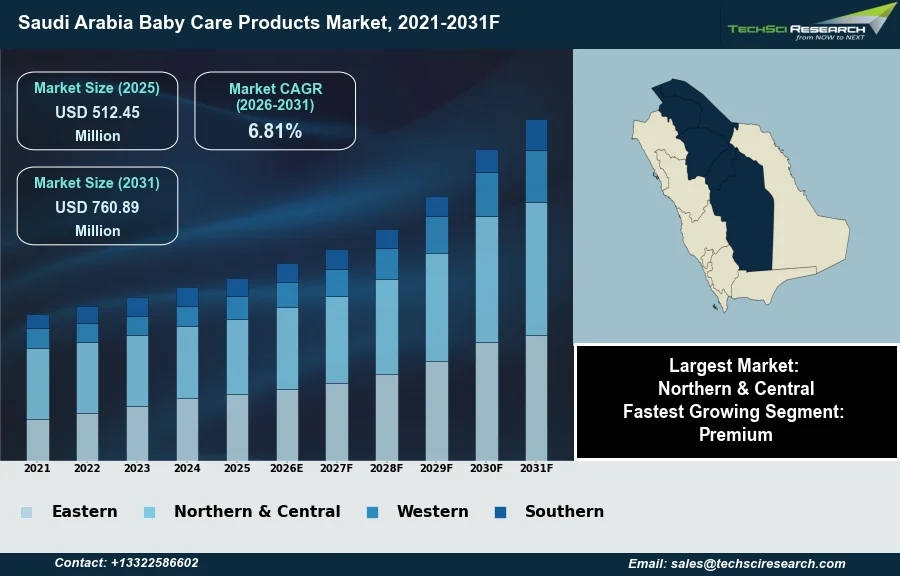
The Baby Care Products Market in Saudi Arabia will grow from USD 512.45 Million in 2025 to USD 760.89 Million by 2031 at a 6.81% CAGR. The Saudi Arabia Baby Care Products Market encompasses a diverse range of items specifically designed for the hygiene, well-being, health, and developmental needs of infants and toddlers, including skincare, haircare, bathing products, toiletries, and feeding accessories. Market growth is primarily driven by heightened parental awareness concerning infant hygiene and health, coupled with increasing disposable incomes among Saudi households. According to the United Nations World Population Prospects 2024, approximately 564,878 babies are projected to be born in Saudi Arabia in 2025, sustaining a substantial consumer base for these products. Further impetus stems from government initiatives emphasizing product safety and robust regulatory frameworks ensuring quality standards.
The market also benefits from rapid urbanization, which correlates with evolving consumer preferences for premium and specialized baby care solutions. However, a significant challenge impeding market expansion is the intense competition from a multitude of local and international brands, often leading to price sensitivity among consumers, particularly concerning higher-cost imported products. This competitive landscape necessitates continuous product differentiation and strategic pricing to maintain market penetration.
Key Market Drivers
Sustained birth rates and a growing youth population drive demand.
Sustained high birth rates and a continuously expanding young population are primary drivers fueling the Saudi Arabia Baby Care Products Market. A consistent influx of newborns ensures a perpetually renewing consumer base, directly correlating with the demand for essential baby care items such as diapers, wipes, and skincare products. This demographic characteristic creates a stable and predictable demand curve for manufacturers and retailers. According to the United Nations Department of Economic and Social Affairs, September 2025, in the 'World Population Prospects 2024' report, the estimated birth rate in Saudi Arabia in mid-2025 was 16.34 per 1,000 people. This significant birth rate underscores the ongoing need for products catering to infant health and well-being, from basic hygiene to developmental support.
Expansion of e-commerce and digital channels enhances accessibility and growth.
The significant expansion of e-commerce and digital retail channels profoundly influences the accessibility and growth of the baby care products market. Online platforms offer unparalleled convenience for parents, providing access to a wider selection of products, competitive pricing, and home delivery services, which are particularly valued by busy households. This digital shift supports both local brands and international entrants in reaching a broader consumer base across the Kingdom. According to the Saudi Central Bank (SAMA), December 2025, in its statistical bulletin for October 2025, e-commerce sales via Mada cards in Saudi Arabia reached over SR 30.7 billion in October 2025, marking a 68 percent year-on-year growth. Furthermore, reflecting the market's robust potential and investment appeal, according to Nestlé, in September 2024, the company announced plans to open its first baby food facility in Saudi Arabia by 2025, an investment of $72 million.
Download Free Sample Report
Key Market Challenges
Competitive Landscape and Price Sensitivity
Intense competition from numerous local and international brands presents a significant challenge to the Saudi Arabia Baby Care Products Market. This crowded landscape frequently results in heightened price sensitivity among consumers, particularly impacting higher-cost imported products. With a substantial consumer base, encompassing approximately 3.1 million children under the age of five in Saudi Arabia as of 2024, according to the General Authority for Statistics, brands are compelled to vie for market share within a sizable, yet discerning, segment.
Growth Constraints and Pricing Challenges
This competitive pressure directly hampers market growth by constraining profit margins and making it difficult for premium or innovative products to gain traction without aggressive pricing strategies. The constant need for product differentiation and strategic pricing adjustments to maintain market penetration can divert resources from other growth-oriented activities, thereby slowing overall expansion. Brands struggle to establish strong pricing power when consumers have a broad array of alternatives, often prioritizing affordability over brand loyalty in certain product categories.
Key Market Trends
Rising Demand for Organic and Natural Baby Care
A significant trend observed in the Saudi Arabia Baby Care Products Market is the rising preference for organic and natural formulations. Parents are increasingly prioritizing products that are free from synthetic chemicals, parabens, and sulfates, driven by heightened awareness of infant health and skin sensitivities. This shift reflects a growing inclination towards ingredients perceived as safer and gentler for delicate baby skin. This consumer willingness to invest in premium, healthier options is evident, with parents willing to pay a premium of 15-20% for healthy organic products for their children, according to an article published by Organic & Natural in 2026. This trend encourages manufacturers to innovate and expand their portfolios with certified organic and plant-based alternatives to meet evolving parental expectations for purity and safety.
Eco-friendly and Sustainable Baby Care Demand
Parallel to the demand for natural ingredients, the Saudi market is also experiencing a growing demand for sustainable and eco-friendly options in baby care. Consumers are becoming more environmentally conscious, seeking products that not only benefit their children but also minimize ecological impact. This includes a preference for products with biodegradable components, refillable packaging, and those from brands with transparent, ethical sourcing practices. Reflecting this growing awareness, nearly 45% of Saudi consumers are actively seeking more eco-friendly products, according to PwC's 'Voice of the Consumer 2024 survey: Saudi Arabia findings,' published in February 2025. This trend is compelling brands to adopt green manufacturing processes and supply chain efficiencies, influencing product development from material selection to end-of-life considerations.
Segmental Insights
Premium Baby Care: Fastest-Growing Segment in Saudi Arabia
In the Saudi Arabia Baby Care Products Market, the Premium segment is experiencing rapid growth, emerging as the fastest-growing category. This surge is primarily driven by rising disposable incomes and a heightened awareness among parents regarding infant health and product safety. Consumers are increasingly prioritizing high-quality, chemical-free, and natural formulations, often influenced by global parenting trends and recommendations for hypoallergenic and dermatologically tested options. Furthermore, robust regulatory frameworks and health campaigns by medical professionals encourage the adoption of certified, superior products, leading families to invest in advanced, trusted baby care solutions.
Regional Insights
Northern & Central Region: A Leading Growth Driver in Saudi Baby Care Market
The Northern & Central region emerges as a key leading force within the Saudi Arabia Baby Care Products Market. This prominence is significantly driven by the presence of Riyadh, the nation's capital and largest urban center, which contributes to a substantial population density and a large consumer base. The region benefits from higher disposable incomes among its residents, enabling increased expenditure on baby care products. Furthermore, Northern & Central boasts a well-developed retail infrastructure and efficient distribution networks, ensuring broad product accessibility and contributing to its robust market share.
Recent Developments
-
In December 2025, Momcozy, a prominent brand in wearable breast pumps, entered a strategic partnership with the Mabrook Initiative in Saudi Arabia. This collaboration focused on enhancing postnatal education and breastfeeding awareness across numerous hospitals throughout the Kingdom. Supported by the Ministry of Health, the Mabrook Initiative provided new mothers with crucial, evidence-based information regarding newborn care. Momcozy contributed by delivering professional health education within the participating hospitals and by providing maternity packages, thereby supporting the broader maternal and baby care ecosystem in Saudi Arabia.
-
In September 2024, Nestlé announced its intentions to open its inaugural factory in Saudi Arabia, a $72 million facility dedicated to baby food production. This manufacturing plant was scheduled to commence operations in Jeddah's Third Industrial City by 2025. The factory was designed with an annual capacity of 15,000 tonnes, aligning with the Saudi government's initiatives to diversify its economy and promote local manufacturing. This significant investment aimed to strengthen Nestlé's presence within the burgeoning Saudi Arabia baby care products market.
-
In June 2024, FirstCry, an e-commerce entity specializing in baby products, revealed extensive plans for market expansion within the Saudi Arabia baby care sector. The company's strategy included the establishment of 12 new modern retail stores across various locations in the Kingdom. Furthermore, FirstCry was developing new warehouse facilities in key logistical hubs such as Riyadh, Jeddah, and Dammam. This expansion aimed to enhance the accessibility of its comprehensive range of baby products and solidify its multi-channel presence in the dynamic Saudi Arabian market.
-
In mid-2024, Napco National introduced a new "Baby Pants" product line, with local production commencing within the Kingdom of Saudi Arabia. This launch underscored the company's dedication to providing high-quality baby care products that met and exceeded industry benchmarks for comfort, safety, and performance for the Saudi consumer base. Concurrently, Napco National's advanced wet wipes manufacturing plant in Saudi Arabia became operational during the same period. This facility was equipped to produce custom wet wipes solutions, further expanding the company's offerings in the Saudi Arabia baby care products market.
Key Market Players
- Johnson & Johnson KSA
- Procter & Gamble KSA
- Unilever KSA Baby
- Kimberly-Clark KSA
- Almarai Baby Care
- Nestlé KSA Baby
- Danone KSA Baby
- Hikma Baby Care
- Al Bayan Baby
- Saudi Pharmaceutical Baby
|
By Product Type
|
By Category
|
By Sales Channel
|
By Region
|
- Skin Care
- Hair Care
- Toiletries
- Others
|
|
- Online
- Specialty Stores
- Supermarkets/Hypermarkets
- Others
|
- Eastern
- Northern & Central
- Western
- Southern
|
Report Scope:
In this report, the Saudi Arabia Baby Care Products Market has been segmented into the following categories, in addition to the industry trends which have also been detailed below:
-
Saudi Arabia Baby Care Products Market, By Product Type:
-
Skin Care
-
Hair Care
-
Toiletries
-
Others
-
Saudi Arabia Baby Care Products Market, By Category:
-
Saudi Arabia Baby Care Products Market, By Sales Channel:
-
Online
-
Specialty Stores
-
Supermarkets/Hypermarkets
-
Others
-
Saudi Arabia Baby Care Products Market, By Region:
-
Eastern
-
Northern & Central
-
Western
-
Southern
Competitive Landscape
Company Profiles: Detailed analysis of the major companies present in the Saudi Arabia Baby Care Products Market.
Available Customizations:
Saudi Arabia Baby Care Products Market report with the given market data, TechSci Research offers customizations according to a company's specific needs. The following customization options are available for the report:
Company Information
- Detailed analysis and profiling of additional market players (up to five).
Saudi Arabia Baby Care Products Market is an upcoming report to be released soon. If you wish an early delivery of this report or want to confirm the date of release, please contact us at sales@techsciresearch.com