|
Key Insights
|
Details
|
|
Forecast Period
|
2027-2031
|
|
Market Size (2025)
|
USD 11.41 Billion
|
|
CAGR (2026-2031)
|
6.08%
|
|
Fastest Growing Segment
|
Central Air Conditioning Systems
|
|
Largest Market
|
South West
|
|
Market Size (2031)
|
USD 16.26 Billion
|
Market Overview
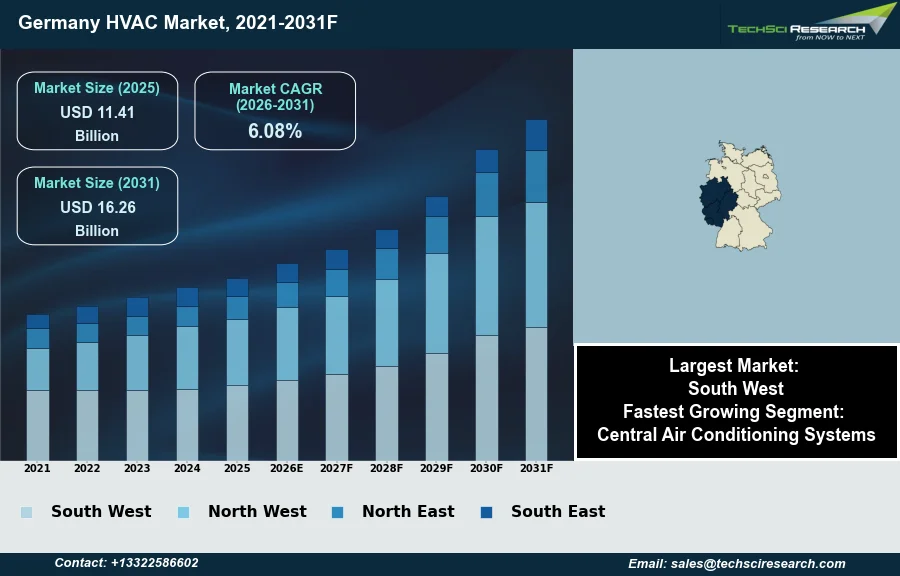
The Germany HVAC Market will grow from USD 11.41 Billion in 2025 to USD 16.26 Billion by 2031 at a 6.08% CAGR. Heating, Ventilation, and Air Conditioning (HVAC) systems are essential for maintaining optimal indoor environmental quality through precise control of thermal comfort and air purity. The German HVAC market is primarily driven by stringent energy efficiency regulations, such as the Gebäudeenergiegesetz (GEG), increasing demand for sustainable building solutions, and the imperative to modernize an aging building infrastructure. Technological advancements, particularly in smart home integration and automation, also contribute significantly to market expansion. According to the Bundesverband der Deutschen Heizungsindustrie (BDH), in 2025, approximately 627,000 heating systems were sold in Germany.
Despite an overall market contraction in heating systems, with sales decreasing by 12% in 2025, the heat pump segment demonstrated robust growth, with approximately 299,000 units sold, representing a 55% increase over the prior year. A significant challenge impeding broader market expansion is the ongoing political uncertainty surrounding legislative frameworks for heating technologies, which generates hesitation among consumers for new investments.
Key Market Drivers
Regulatory Push Drives Germany's HVAC Market
The German HVAC market is significantly propelled by stringent energy efficiency regulations and evolving climate policies, which mandate improved building performance and reduced carbon footprints. These legislative frameworks, such as the national Gebäudeenergiegesetz (GEG) and broader European directives, compel property owners and developers to invest in modern, energy-efficient heating and cooling solutions. For instance, according to the International Energy Agency (IEA), April 2025, in "Germany 2025," the revised EU Energy Performance of Buildings Directive sets binding targets to lower the average primary energy consumption of the residential building stock by 16% by 2030 compared to 2020. This regulatory push directly translates into heightened demand for advanced HVAC systems capable of meeting rigorous energy performance standards in both new constructions and extensive renovations.
Incentives Accelerate Adoption of Sustainable HVAC Solutions
Complementing regulatory pressures, robust government incentives and subsidies for green technologies play a pivotal role in accelerating the adoption of sustainable HVAC solutions. These financial support mechanisms mitigate the initial investment burden for consumers and businesses, making the transition to eco-friendly systems more economically viable. A prime example is the extensive support for heat pump installations; according to Klimango, February 2026, homeowners in Germany can secure a maximum subsidy of 70% of investment costs for eligible heat pump installations, with eligible costs capped at €30,000 per dwelling unit. Such significant financial encouragement directly stimulates market activity, fostering a sustainable building sector. Overall, according to the VdZ and ZVSHK's SHK-Konjunkturbarometer, in the first quarter of 2026, the business climate across all sales stages in Germany's building services sector stood at +3 points.
Download Free Sample Report
Key Market Challenges
Policy uncertainty constrains the German HVAC market
The ongoing political uncertainty surrounding legislative frameworks for heating technologies presents a substantial impediment to the growth of the German HVAC market. Consumers exhibit hesitation towards new investments due to a lack of clear and stable policy direction, leading to delayed purchasing decisions and reduced overall market activity. This environment of unpredictability diminishes confidence in long-term investment viability for heating system upgrades and replacements.
2024 sales contraction driven by legislative instability
This hesitation directly translated into a contraction of the market. According to the Bundesverband der Deutschen Heizungsindustrie (BDH), in 2024, total heating system sales in Germany decreased by 46% compared to the previous year, with 712,500 units sold. Furthermore, heat pump sales, a key segment for market modernization, also experienced a significant decline, falling by 46% to 193,000 units in 2024. Such sharp declines underscore the direct impact of legislative instability on consumer willingness to invest in modern heating solutions, hampering the broader market expansion.
Key Market Trends
Heat pumps drive an economic and strategic energy shift
The Germany HVAC market is significantly shaped by the accelerated adoption of heat pump systems. This trend is driven by a clear governmental push towards decarbonization and reducing reliance on fossil fuels, making heat pumps a cornerstone technology for sustainable heating solutions. The impact of this shift is substantial, as new residential heat pump installations in Germany from 2022 to 2025 collectively slashed the nation's liquefied natural gas import bill by an estimated €1.3 billion, strengthening energy security and financial savings. This highlights not just a technological transition but a profound economic and strategic reorientation within the energy sector, directly influencing investment priorities and consumer choices for heating solutions.
Smart building automation expands with health and safety emphasis
Complementing this, the market is also experiencing a notable expansion of smart HVAC and building automation systems. This trend is less about a specific technology type and more about the intelligent integration and control of various building functions, including heating, ventilation, and air conditioning. The increasing demand for optimized energy management, enhanced occupant comfort, and improved operational efficiency is fueling the growth of these interconnected systems. In a demonstration of evolving priorities, approximately 40% of building automation projects in Germany during 2025 specifically prioritized health and safety features, underscoring a broader shift in market demand towards holistic building performance. This integration enables more responsive and data-driven management of indoor environments, contributing to more sustainable and human-centric building operations.
Segmental Insights
Central Air Conditioning: Fastest-Growing Segment Driven by Demand, Efficiency, and Regulation
In the Germany HVAC Market, Central Air Conditioning Systems represent the fastest-growing segment, driven by several interconnected factors. A primary driver is the escalating demand for effective climate control within large residential, commercial, and industrial structures, where these systems offer superior, consistent temperature regulation. This growth is further propelled by a pronounced shift towards energy-efficient solutions and increased consumer preference for enhanced comfort and automation. Moreover, stringent governmental mandates, such as the Building Energy Act (GEG), promoting energy efficiency and emission reduction in buildings, significantly accelerate the adoption of advanced central air conditioning technologies. This regulatory landscape, combined with technological advancements and a growing need to adapt to warmer climate trends, underpins the segment's rapid expansion.
Regional Insights
South West Region Leads Germany's HVAC Market Through Industrial Strength, Regulation, and Retrofit Activity
The South West region leads the Germany HVAC Market, driven by its robust industrial base and significant commercial and urban residential developments in economically strong states like Baden-Württemberg, fostering consistent demand for advanced HVAC systems. This dominance is further supported by stringent local enforcement of environmental regulations and government incentives for energy-efficient building upgrades, such as those promoted by the Federal Ministry for Economic Affairs and Climate Action (BMWK) under the Building Energy Act (GEG). Additionally, the region benefits from a progressive mindset towards green building practices and substantial retrofit activity for aging infrastructure, accelerating the adoption of sustainable HVAC technologies..
Recent Developments
-
In March 2025, Samsung Electronics and LG unveiled new energy-efficient HVAC systems at the ISH 2025 exhibition held in Frankfurt, Germany. Samsung introduced its high-efficiency residential heat pump, the "Slim Fit Climate Hub," and the "EHS Mono R290" heat pump. Concurrently, LG showcased its advanced heating solutions, including the Therma V™ R290 Monobloc air-to-water heat pump, specifically designed for residential applications utilizing refrigerants with low global warming potential, demonstrating both companies' commitment to sustainable HVAC technology in the German market.
-
In October 2024, Daikin Europe N.V. announced its plans to showcase significant heat pump innovations and HVAC solutions at ISH 2025 in Frankfurt, Germany. A key highlight was the introduction of the fourth generation of the Daikin Altherma heat pump, engineered to operate with natural refrigerant R290. This new series of air-to-water heat pumps, designed and manufactured in Europe, was intended to offer advanced options for sustainable heating, cooling, and hot water supply, addressing the growing demand for low-carbon alternatives in the German HVAC industry to support environmental objectives.
-
In May 2024, CoolAutomation announced a strategic partnership with SG COOL GmbH, a new division of Schmidt Klimatechnik, to enhance the German HVAC market with smart solutions. This collaboration provided SG COOL GmbH with CoolAutomation's advanced integration devices and cloud-based platforms, enabling the delivery of improved HVAC efficiency, comfort, and control for German residential and commercial clients. The initiative aimed to redefine service standards by leveraging innovative technologies to promote energy efficiency and prolong system lifespan, marking a significant development in the optimization of HVAC management within Germany.
-
In April 2024, Panasonic announced strategic partnerships and the development of new green HVAC solutions for the European market, with a bundled solution anticipated for Germany and Italy before winter 2024. Panasonic partnered with tado° GmbH, a Munich-based supplier of intelligent energy management systems, to integrate its Aquarea air-to-water heat pumps with tado° smart thermostats for remote control. Additionally, Panasonic established a collaboration with INNOVA S.r.l., focusing on joint efforts in production, sales, and technology development for a new integrated indoor climate control solution expected in 2025 for the German HVAC sector.
Key Market Players
- Daikin Industries, Ltd.
- Robert Bosch GmbH
- Siemens AG
- Johnson Controls International plc
- Carrier Global Corporation
- Mitsubishi Electric Corporation
- Trane Technologies plc
- Vaillant Group GmbH
- Danfoss A/S
- Lennox International Inc.
|
By Product Type
|
By End Use Sector
|
By Region
|
- Direct Expansion Systems
- Central Air Conditioning Systems
|
- Residential
- Commercial
- Institutional
- Industrial
|
- South-West
- North-West
- North-East
- South-East
|
Report Scope:
In this report, the Germany HVAC Market has been segmented into the following categories, in addition to the industry trends which have also been detailed below:
-
Germany HVAC Market, By Product Type:
-
Direct Expansion Systems
-
Central Air Conditioning Systems
-
Germany HVAC Market, By End Use Sector:
-
Residential
-
Commercial
-
Institutional
-
Industrial
-
Germany HVAC Market, By Region:
-
South-West
-
North-West
-
North-East
-
South-East
Competitive Landscape
Company Profiles: Detailed analysis of the major companies present in the Germany HVAC Market.
Available Customizations:
Germany HVAC Market report with the given market data, TechSci Research offers customizations according to a company's specific needs. The following customization options are available for the report:
Company Information
- Detailed analysis and profiling of additional market players (up to five).
Germany HVAC Market is an upcoming report to be released soon. If you wish an early delivery of this report or want to confirm the date of release, please contact us at sales@techsciresearch.com