|
Key Insights
|
Details
|
|
Forecast Period
|
2027-2031
|
|
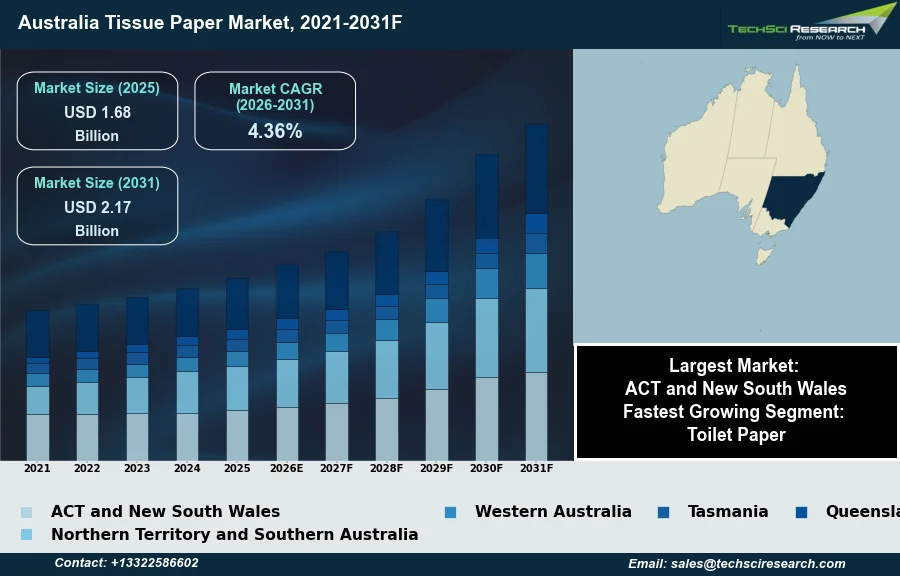
Market Size (2025)
|
USD 1.68 Billion
|
|
CAGR (2026-2031)
|
4.36%
|
|
Fastest Growing Segment
|
Toilet Paper
|
|
Largest Market
|
ACT and New South Wales
|
|
Market Size (2031)
|
USD 2.17 Billion
|
Market Overview
The Australia Tissue Paper Market will grow from USD 1.68 Billion in 2025 to USD 2.17 Billion by 2031 at a 4.36% CAGR. Tissue paper encompasses a category of absorbent, lightweight paper products essential for hygiene and sanitary applications across household, commercial, and institutional sectors, including items such as facial tissues, toilet paper, paper towels, and napkins. The market's growth in Australia is primarily driven by consistent population expansion, an increasing focus on personal hygiene and public health, and rising disposable incomes. Further impetus stems from the expanding commercial and institutional sectors, which require a steady supply of these indispensable products.
A significant challenge impeding the market's robust expansion is the notable volatility of raw material costs, particularly wood pulp, which directly impacts production expenses and pricing strategies. While a comprehensive market overview is available through various sources, specific numerical data for the Australian tissue paper market from industrial associations within the last year (2025-2026) is not publicly accessible in the required format to include in this report.
Key Market Drivers
Hygiene Awareness Driving Tissue Demand
Increasing hygiene and sanitation awareness serves as a fundamental catalyst for the Australian tissue paper market. Public health campaigns and media focus have consistently highlighted the importance of cleanliness, especially in germ prevention, leading to elevated consumption of products such as toilet paper, paper towels, and facial tissues across both household and commercial environments. This sustained consumer and institutional emphasis on improved hygiene practices directly translates into a stable and growing demand base for tissue products. According to MET Magazine, March 17, 2026, reporting on Essity's full-year 2025 results, the company experienced a 1.2 percent organic sales growth in its Consumer Tissue segment, reflecting ongoing demand in hygiene-sensitive categories.
Population Growth Drives Market Expansion
Steady population growth also significantly contributes to the market's expansion. Australia's consistent demographic rise inherently increases the consumer base, subsequently driving higher aggregate demand for essential paper products as more households are formed and per capita usage remains robust. This continuous expansion creates a foundational need for tissue products, underpinning long-term market stability. The Australian Bureau of Statistics reported on June 18, 2026, in 'National, state and territory population,' that Australia's population grew by 1.5 percent in the year ending December 2025, reaching 27,801,023 people. Furthermore, reflecting broader market trends, consumer spending in Australia on personal and household goods collectively increased by 6.6 percent year-on-year in January 2026, according to Mills Shelving, March 20, 2026, in 'Australian Retail Industry Statistics and Trends in 2026'.
Download Free Sample Report
Key Market Challenges
Volatility in Wood Pulp Costs and Market Impact
The notable volatility of raw material costs, particularly wood pulp, presents a significant challenge to the Australia Tissue Paper Market. This fluctuation directly impacts production expenses for manufacturers, leading to unpredictable cost bases and complicating pricing strategies. Such instability can erode profit margins and hinder investment in new capacity or product innovation within the domestic industry.
Rising Pulp Prices and Implications for Pricing and Planning
The unpredictable nature of input costs, especially for wood pulp, creates considerable uncertainty for Australian tissue paper producers. According to Forest & Wood Products Australia (FWPA), in May 2025, Australia's weighted average pulp import price was AUDFob972/t, representing a 3.1% increase from the prior month. These cost increases place upward pressure on the final prices of tissue products, potentially reducing consumer affordability and demand, particularly when competing with imports that may not face similar domestic raw material cost pressures. This environment makes long-term financial planning and market expansion more difficult for local manufacturers.
Key Market Trends
Rising Demand for Sustainable Packaging and Eco-Friendly Materials
The Australia Tissue Paper Market is notably influenced by a growing preference for sustainable and eco-friendly products. Consumers are increasingly valuing tissue items made from recycled materials, sustainably sourced fibers, or those with minimal environmental impact throughout their lifecycle. This shift in consumer demand compels manufacturers to invest in greener production processes and introduce product lines that meet these evolving environmental expectations. According to Premium Packaging, May 2026, in actual surveys, 72% of Australian consumers prefer products with sustainable packaging. This significant preference is driving product innovation and market differentiation, as brands strive to align with ecological concerns and appeal to an environmentally conscious consumer base.
Emphasis on Local Sourcing and Domestic Production Resilience
Concurrently, there is an increased focus on local sourcing and manufacturing resilience within the Australian tissue paper market. Recent global events have highlighted the vulnerabilities of extended supply chains, prompting a strategic pivot towards strengthening domestic production capabilities to ensure supply stability and reduce reliance on imports. This trend also resonates with consumer desires to support local industries and reduce the carbon footprint associated with long-distance transportation. The impact of this is seen in the sustained operations of key domestic players; for instance, a report for TWM by IndustryEdge, April 2026, indicated that by 2024-25, ABC Tissue maintained a production capacity of 100,000 tonnes per year, Kimberly-Clark Australia 90,000 tonnes per year, and The Sorbent Paper Company 32,000 tonnes per year, reflecting a robust commitment to local manufacturing. This emphasis on local production fosters job creation, enhances economic stability, and builds a more resilient supply chain for essential hygiene products.
Segmental Insights
Toilet Paper: Fastest-Growing Segment Fueled by Hygiene Awareness, Population Growth, and Premium, Eco-Friendly Trends
The key segmental insight for the Australia Tissue Paper Market highlights Toilet Paper as the fastest growing segment. This rapid growth is primarily attributed to a heightened consumer awareness of personal hygiene and health, which has significantly influenced purchasing patterns across the nation. Additionally, Australia's consistent population growth inherently escalates the demand for essential household items such as toilet paper. The segment further benefits from evolving consumer preferences that lean towards premium quality products offering superior attributes like softness and strength, alongside a rising demand for sustainable and eco-friendly options. This confluence of improved hygiene standards, demographic expansion, and a shift towards value-added and environmentally conscious choices underpins the robust performance of the Toilet Paper segment.
Regional Insights
Market Leadership in ACT and NSW Driven by Demographics and Infrastructure
The Australian Capital Territory and New South Wales collectively lead the national tissue paper market due to their significant demographic and economic characteristics. These regions boast high population density and advanced urbanization, encompassing major metropolitan centers like Sydney and Canberra, which generate substantial consumer demand. Strong consumer purchasing power further fuels consistent tissue product consumption across residential, commercial, and institutional sectors. The established presence of leading retail chains, extensive hospitality venues, and numerous healthcare facilities in these areas ensures widespread product availability and distribution. This robust combination of concentrated population, economic development, and well-developed infrastructure solidifies their dominant position in the Australian tissue paper market.
Recent Developments
-
In September 2025, Essity continued its expansion of unique coreless technology to new categories and markets for tissue products. This innovative technology eliminates the need for a central cardboard tube, resulting in longer-lasting rolls and contributing to a significant reduction in waste and carbon dioxide emissions. The application of this proprietary and patented technology to additional products like household towels provides a more practical and sustainable solution for consumers. As a global leader in hygiene and health with a presence in Australia, Essity's continued innovation drives product advancements in the Australian tissue paper market.
-
In July 2025, Bunzl Australia & New Zealand announced a new collaboration with Yarn'n, an indigenous-owned company, to distribute its sustainable toilet paper brand across their national network. This partnership significantly expands the availability of Yarn'n's FSC-certified toilet paper, which is made entirely from recycled materials, within the Australian tissue paper market. A portion of the proceeds from Yarn'n's products is dedicated to supporting The Yalari Foundation, providing scholarships for Indigenous students. This initiative aligns with both companies' commitments to reconciliation, supplier diversity, sustainability, and community impact in Australia.
-
In June 2025, Kimberly-Clark Corporation formed a strategic partnership with Suzano, a major step intended to create a prominent international tissue and professional products company. Kimberly-Clark will hold a 49% interest in this new venture, which encompasses substantially all assets of its International Family Care and Professional (IFP) business. This collaboration is set to enhance margins and improve market share momentum for tissue products, leveraging combined capabilities to reduce production costs. This global development directly impacts Kimberly-Clark's operations and product offerings within the Australian tissue paper market.
-
In March 2024, Kimberly-Clark unveiled a new operating model, focusing on its twelve key brands that account for a substantial portion of the company's net sales across categories including family care and professional products. This transformation also included plans to modernize its supply chain through technology and data analytics, aiming for significant gross productivity and working capital savings. Furthermore, Kimberly-Clark reiterated its ambition to achieve a 100% natural forest-free portfolio in all its products, aiming to be over midway to this goal by 2030. This strategic direction influences product innovation and sustainability efforts within the Australian tissue paper market.
Key Market Players
- Kimberly-Clark Corporation
- Procter & Gamble Company
- Essity AB
- Asia Pulp & Paper Group
- Georgia-Pacific LLC
- Sofidel Group
- Metsä Group
- Cascades Inc.
- Kruger Inc.
- WEPA Group
|
By Product Type
|
By End User
|
By Sales Channel
|
By Region
|
- Toilet Paper
- Facial Tissues
- Napkins
- Wrapping Tissue
- Others
|
|
- Hypermarket/Supermarket
- Departmental Stores
- Online
- Others
|
- Australia Capital Territory & New South Wales
- Northern Territory & Southern Australia
- Western Australia
- Queensland
- Victoria & Tasmania
|
Report Scope:
In this report, the Australia Tissue Paper Market has been segmented into the following categories, in addition to the industry trends which have also been detailed below:
-
Australia Tissue Paper Market, By Product Type:
-
Toilet Paper
-
Facial Tissues
-
Napkins
-
Wrapping Tissue
-
Others
-
Australia Tissue Paper Market, By End User:
-
Australia Tissue Paper Market, By Sales Channel:
-
Hypermarket/Supermarket
-
Departmental Stores
-
Online
-
Others
-
Australia Tissue Paper Market, By Region:
-
Australia Capital Territory & New South Wales
-
Northern Territory & Southern Australia
-
Western Australia
-
Queensland
-
Victoria & Tasmania
Competitive Landscape
Company Profiles: Detailed analysis of the major companies present in the Australia Tissue Paper Market.
Available Customizations:
Australia Tissue Paper Market report with the given market data, TechSci Research offers customizations according to a company's specific needs. The following customization options are available for the report:
Company Information
- Detailed analysis and profiling of additional market players (up to five).
Australia Tissue Paper Market is an upcoming report to be released soon. If you wish an early delivery of this report or want to confirm the date of release, please contact us at sales@techsciresearch.com