|
Key Insights
|
Details
|
|
Forecast Period
|
2027-2031
|
|
Market Size (2025)
|
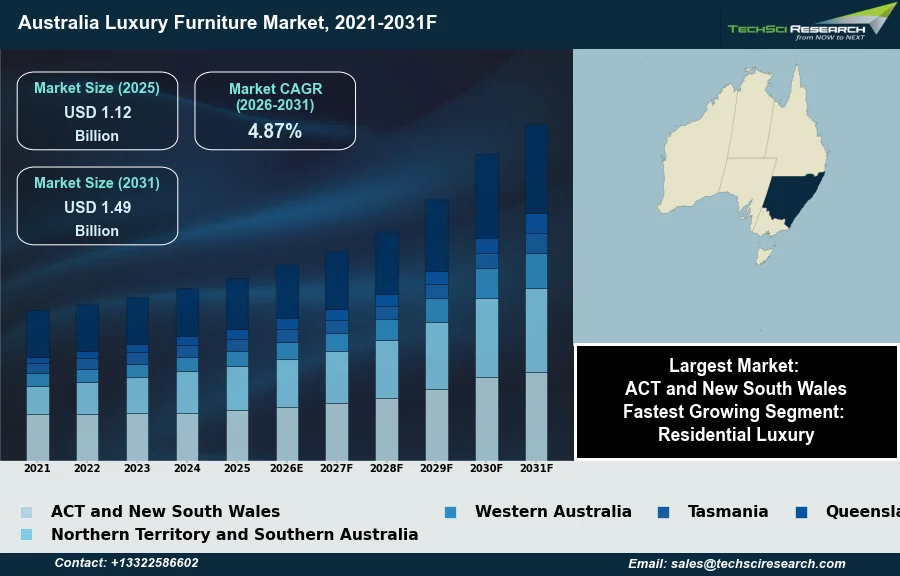
USD 1.12 Billion
|
|
CAGR (2026-2031)
|
4.87%
|
|
Fastest Growing Segment
|
Residential Luxury
|
|
Largest Market
|
ACT and New South Wales
|
|
Market Size (2031)
|
USD 1.49 Billion
|
Market Overview
The Australia Luxury Furniture Market will grow from USD 1.12 Billion in 2025 to USD 1.49 Billion by 2031 at a 4.87% CAGR. Luxury furniture in Australia encompasses high-quality, custom-designed, or artisan-crafted pieces, distinguished by premium materials, superior craftsmanship, and exclusive aesthetics. The market's growth is primarily driven by increasing disposable incomes, which enable a growing segment of affluent consumers to invest in sophisticated home aesthetics and bespoke interior solutions. Furthermore, a robust housing market and significant urban development, particularly in major cities, consistently generate demand for high-end furnishings.
However, a significant challenge impeding market expansion is the ongoing pressure from economic volatility, including elevated interest rates and increased cost-of-living, which can lead to reduced discretionary spending among consumers. While the Australian Furniture Association highlighted 2025 as a year of progress and innovation across the broader furniture industry, precise statistical numerical data pertaining specifically to the Australia Luxury Furniture Market's valuation from industrial associations for the past year is not publicly available under specified constraints.
Key Market Drivers
Affluence and Demographic Shifts Drive Luxury Furniture Demand
Rising affluence and evolving consumer demographics significantly influence the Australia Luxury Furniture Market. A growing segment of the population possesses increased disposable incomes, enabling greater investment in premium home aesthetics and bespoke interior solutions. These affluent consumers often seek furniture reflecting their personal style and status, valuing unique designs, high-quality materials, and superior craftsmanship. The evolving demographics also show a strong preference for customization, driving demand for tailored luxury pieces. According to Capgemini's World Wealth Report 2025, published in April 2026, Australia hosted nearly 334,000 high-net-worth individuals, representing a 0.5% increase year-on-year, indicating a growing consumer base for luxury goods. This demographic shift fuels the desire for distinctive luxury furniture embodying lifestyle expression.
Residential Renovation and New Housing Drive Luxury Furniture Demand
Booming residential renovation and new housing projects are a substantial catalyst for market growth. New housing developments create fresh demand for luxury furnishings, while extensive renovation projects frequently involve upgrading furniture to match newly designed interiors. This demand extends to both detached and multi-unit dwellings as homeowners and investors seek to enhance property value and appeal. According to the Housing Industry Association, in May 2026, the value of renovation approvals increased by 7.0% over the last 12 months, reflecting sustained demand for home improvements. This activity directly translates into opportunities for luxury furniture providers. Overall, according to the Australian Bureau of Statistics, spending on furniture, floor coverings, housewares, and textile goods collectively rose by 2.7% in the year to June 2025.
Download Free Sample Report
Key Market Challenges
Economic volatility constrains discretionary luxury spending
The most significant challenging factor impeding the growth of the Australian luxury furniture market is ongoing economic volatility, encompassing elevated interest rates and increased cost-of-living pressures. This environment directly curtails consumer discretionary spending, a critical component for high-value purchases such as luxury furniture. As households allocate larger portions of their income to essential expenditures and mortgage repayments, their financial capacity and willingness to invest in sophisticated, bespoke interior solutions diminish.
Rates and inflation dampen demand and slow luxury furniture market expansion
This reduction in purchasing power leads to a tangible slowdown in demand for high-end, artisan-crafted pieces. According to a February 2026 report on the Australian economic landscape, the Reserve Bank of Australia had elevated its official cash rate to 4.10 per cent as of March 2026, with the headline Consumer Price Index (CPI) climbing to 3.7 per cent in the year to February 2026. Such persistent economic strain impacts the broader consumer discretionary sector, causing even affluent consumers to adopt a more cautious approach to significant non-essential outlays. Consequently, the luxury furniture segment experiences reduced sales volumes and slower market expansion, despite the Australian Furniture Association highlighting 2025 as a year of progress and innovation for the broader furniture industry.
Key Market Trends
Sustainable and Ethical Luxury Designs
A significant trend influencing the Australia Luxury Furniture Market is the increasing emphasis on sustainable and ethical luxury designs. Consumers are demonstrating a growing awareness of environmental impact and social responsibility, which directly shapes their purchasing decisions for high-end furnishings. This involves a heightened demand for products made from eco-friendly materials, sourced ethically, and produced through sustainable manufacturing processes, fostering a shift towards furniture that is both aesthetically pleasing and responsibly made. This evolving consumer preference encourages brands to incorporate certified timbers, recycled components, and organic textiles into their collections, with durability and timelessness also becoming key considerations. According to AIFF Online, in its December 2025 article "Furniture Market Trends & Statistics 2025-2026", 40% of home improvement projects in 2025 included eco-friendly upgrades, reflecting a broader consumer movement towards sustainable choices.
Smart Technology Integration in Luxury Furniture
Another impactful trend is the integration of smart technology into furniture, transforming traditional pieces into multi-functional, connected elements within the home. This trend extends beyond basic aesthetics, offering enhanced convenience, comfort, and a modern lifestyle experience for luxury consumers. Examples include furniture with built-in wireless charging capabilities, integrated lighting systems, climate control features, or seamlessly incorporated entertainment systems. This adoption of smart solutions allows for greater personalization and control, meeting the desires of affluent consumers for technologically advanced living spaces. The market for smart furniture, while still developing, is experiencing accelerated growth; according to AIFF Online, in the same December 2025 article, the Australian smart furniture market generated a revenue of USD 4.8 million in 2024.
Segmental Insights
Residential Luxury Growth Driven by HNW Wealth, Bespoke Craftsmanship, and Sustainability
The key segmental insight for the Australia Luxury Furniture Market highlights the residential luxury segment as the fastest-growing. This rapid expansion is primarily driven by Australia's expanding base of high-net-worth individuals, who possess increasing disposable incomes and a strong desire for furnishings that reflect personal style and status within their homes. Furthermore, a booming luxury housing market, encompassing architecturally designed properties and extensive residential renovations, is significantly fueling demand for bespoke and high-quality furniture solutions. Consumers are increasingly prioritizing enduring craftsmanship, unique designs, and personalized living spaces, viewing luxury furniture as an investment that enhances their home aesthetics. This trend is further supported by a growing preference for sustainable and locally crafted pieces, aligning with a broader shift towards quality and ethical consumption in the Australian market.
Regional Insights
ACT and NSW as regional leaders in Australia’s luxury furniture market
The Australian Capital Territory and New South Wales demonstrably lead the nation's luxury furniture market, primarily driven by a significant concentration of affluent consumers and high-net-worth individuals within these regions. Urban development, particularly in major centers such as Sydney and Canberra, fuels robust demand for premium, designer furnishings, supported by numerous elite residential projects. The established presence of sophisticated interior design studios and luxury showrooms further cultivates a preference for high-quality, aesthetically curated home décor. Moreover, a prevailing culture of substantial home improvement and renovation initiatives in these areas consistently encourages investment in upscale furniture, solidifying their dominance in Australia's luxury furniture landscape.
Recent Developments
-
In December 2025, Harbour Outdoor, a company focused on luxury outdoor furniture, was recognized with an Australian Good Design Award for its Chloe Lounge Chair. This award acknowledged the chair's sculptural form, comfort, and commitment to thoughtful craftsmanship, highlighting how the company brings interior-level elegance to outdoor spaces. The company also participated in various collaborations, including custom furnishings for hospitality projects, reflecting a broader trend of integrating high-end design into commercial environments within the Australian luxury furniture sector and beyond.
-
In April 2025, Australian furniture brand Satara introduced its Autumn/Winter 2025 collection, significantly expanding its range with over 150 new indoor and outdoor products. The collection was developed under a "relaxed luxury living" philosophy, emphasizing comfort and refined designs inspired by international travels. A notable aspect of this launch included a collaboration with New Zealand-based brand United Strangers for pieces such as the Paddington Occasional Chair, integrating contemporary trends like chrome finishes. This product expansion and collaboration aimed to offer versatile, high-quality furniture options for the Australian luxury market.
-
In November 2024, Crafted Furniture, an Australian maker, unveiled its 2025 collection, which focused on modern Australian living and drew inspiration from the country's natural landscape. The new collection featured a palette of earthy tones and emphasized sophisticated comfort. Key pieces included the Ella modular sofa with its clean lines and the Cigar occasional chair, which incorporated playful design elements. The company highlighted its commitment to customization, allowing for precise adjustments in dimensions and offering numerous upholstery options to provide a bespoke furniture experience for the Australian luxury consumer.
-
In September 2024, luxury designer furniture brand Roche Bobois released its Autumn/Winter collection, presenting a modern vision of French art de vivre. The collection included new designs and reinterpretations of existing ranges. This launch featured collaborations with renowned designers, such as Sacha Lakic, who created the "Love" sofa, and Patrick Norguet, whose "Elanta" collection showcased clean lines and contemporary woodwork. These collaborations brought innovative designs and a strong focus on quality and craftsmanship to the Australian luxury furniture market, enhancing the brand's offerings in adjustable luxury sofas and unique material combinations.
Key Market Players
- Roche Bobois S.A.
- Poltrona Frau S.p.A.
- Minotti S.p.A.
- B&B Italia S.p.A.
- Herman Miller Inc.
- Knoll Inc.
- Restoration Hardware Inc.
- Fendi Casa
- Bentley Home
- Boca do Lobo
|
By End User
|
By Material Type
|
By Sales Channel
|
By Region
|
|
|
- Wood
- Plastic
- Metal
- Others
|
- Supermarkets & Hypermarkets
- Specialty Stores
- Online
- Others
|
- Australia Capital Territory & New South Wales
- Northern Territory & Southern Australia
- Western Australia
- Queensland
- Victoria & Tasmania
|
Report Scope:
In this report, the Australia Luxury Furniture Market has been segmented into the following categories, in addition to the industry trends which have also been detailed below:
-
Australia Luxury Furniture Market, By End User:
-
Australia Luxury Furniture Market, By Material Type:
-
Wood
-
Plastic
-
Metal
-
Others
-
Australia Luxury Furniture Market, By Sales Channel:
-
Supermarkets & Hypermarkets
-
Specialty Stores
-
Online
-
Others
-
Australia Luxury Furniture Market, By Region:
-
Australia Capital Territory & New South Wales
-
Northern Territory & Southern Australia
-
Western Australia
-
Queensland
-
Victoria & Tasmania
Competitive Landscape
Company Profiles: Detailed analysis of the major companies present in the Australia Luxury Furniture Market.
Available Customizations:
Australia Luxury Furniture Market report with the given market data, TechSci Research offers customizations according to a company's specific needs. The following customization options are available for the report:
Company Information
- Detailed analysis and profiling of additional market players (up to five).
Australia Luxury Furniture Market is an upcoming report to be released soon. If you wish an early delivery of this report or want to confirm the date of release, please contact us at sales@techsciresearch.com