|
Key Insights
|
Details
|
|
Forecast Period
|
2027-2031
|
|
Market Size (2025)
|
USD 452.98 Billion
|
|
CAGR (2026-2031)
|
9.14%
|
|
Fastest Growing Segment
|
Drive-through
|
|
Largest Market
|
South
|
|
Market Size (2031)
|
USD 765.57 Billion
|
Market Overview
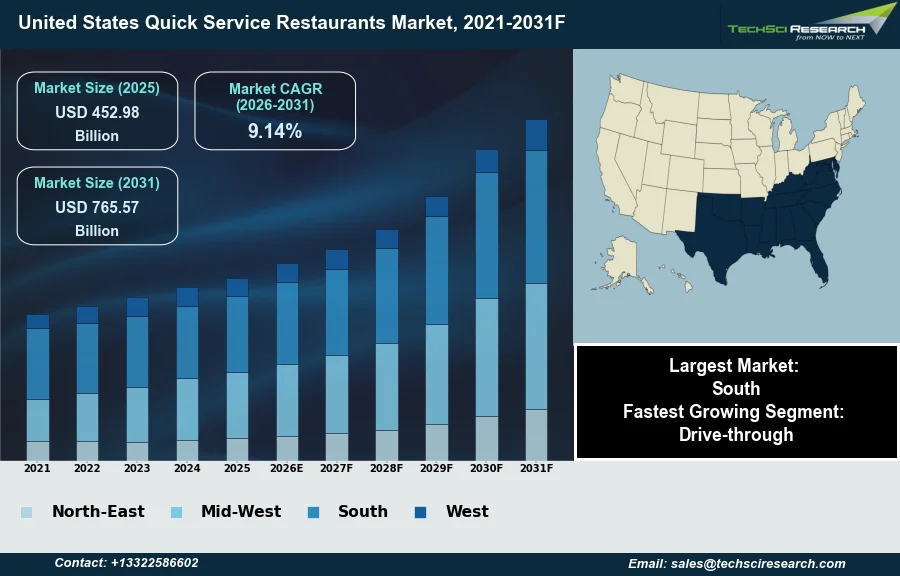
The United States Quick Service Restaurants Market will grow from USD 452.98 Billion in 2025 to USD 765.57 Billion by 2031 at a 9.14% CAGR. Quick Service Restaurants (QSRs) are defined as foodservice establishments characterized by their operational efficiency, rapid order fulfillment, streamlined menus, and focus on providing convenient and affordable meal options through counter service or drive-thru models. The market's growth is primarily driven by persistent consumer demand for convenience, value, and speed, alongside evolving busy lifestyles that prioritize quick meal solutions. Technological integration, such as mobile ordering platforms and enhanced delivery services, further supports market expansion by increasing accessibility and operational efficiency. According to the National Restaurant Association, the limited-service restaurant segment, which encompasses QSRs, is projected to reach $532 billion in sales in 2025.
This robust performance underscores the sector's resilience and its integral role in the broader foodservice landscape. Despite this growth, a significant challenge impeding market expansion is the persistent pressure from rising labor and food costs, which directly impacts operational efficiency and profitability for operators.
Key Market Drivers
Consumer Demand for Convenience and Speed
The United States Quick Service Restaurants market is significantly propelled by persistent consumer demand for convenience and speed. Modern lifestyles, characterized by busy schedules, necessitate rapid meal solutions that QSRs are uniquely positioned to provide. This inherent need for efficiency translates directly into consumer behavior, as, according to Leverege, in its March 2025 article 'Reducing Drive-Thru Wait Times', nearly 15% of potential customers will bypass a restaurant entirely if confronted with a long line. QSR operators consistently strive to optimize service times through various operational enhancements, including streamlined drive-thru designs and efficient kitchen management. The expectation for quick service remains a foundational pillar of the QSR value proposition, influencing both customer choice and operational investment.
Digital Ordering Growth and Labor Cost Pressures
Furthermore, the expansion of digital ordering and delivery platforms continues to be a pivotal growth driver within the market. These platforms cater directly to consumer preferences for ease of access and customized ordering experiences, enabling customers to place orders from any location and receive them through various channels. According to DTiQ, in its May 2025 article 'Mobile Ordering Trends', major restaurant mobile applications, including Uber Eats, Grubhub, and DoorDash, collectively generated over $10 billion in revenue during 2024. This technological integration extends to in-store kiosks and mobile applications, enhancing customer experience and operational throughput. Despite these advancements, the market navigates persistent challenges; for instance, QSR labor costs continued to increase, rising 6.3% in 2024, according to BofA Securities, in September 2025. This highlights the ongoing pressure on profitability amidst rising operational expenses.
Download Free Sample Report
Key Market Challenges
Rising labor and input costs constrain US QSR growth and profitability
Rising labor and food costs present a notable challenge to the growth of the United States Quick Service Restaurants (QSR) market, directly impeding operational efficiency and profitability. The sustained pressure from these elevated expenses forces operators to manage reduced margins or pass costs onto consumers through menu price adjustments. According to the National Restaurant Association, average hourly earnings for private-sector production and nonsupervisory workers increased by 3.4% in June 2026 compared to the prior year, contributing to higher labor overheads.
Escalating food input costs erode margins and restrain QSR expansion
Concurrently, food input costs have experienced substantial increases. For example, producer prices for key commodities such as fresh vegetables, fats and oils, and beef and veal stood significantly above their May 2025 levels in May 2026, with rises of 123.2%, 25.8%, and 15.9% respectively. These escalating input costs directly diminish profit margins for QSR operators, especially within a segment focused on providing value and affordability. This scenario creates a difficult balance between maintaining competitive pricing and ensuring the financial viability of establishments, ultimately restraining overall market expansion.
Key Market Trends
Growth of Plant-Based and Health-Conscious Menus
The United States Quick Service Restaurants market is significantly influenced by the expanding consumer demand for plant-based and health-conscious menu items. This trend extends beyond traditional vegetarian and vegan demographics, driven by a broader base of flexitarian consumers seeking to reduce meat consumption for health or environmental reasons. QSR operators are responding by diversifying their menus with items such as plant-based proteins, healthier sides, and fresh, less-processed ingredients, moving away from solely meat-mimicking alternatives to celebrate vegetable-forward options. For instance, according to The Good Food Institute, in its April 2026 report on the US alt-meat slump, sales of plant-based milk in foodservice surged by 16% in 2025, capturing a 13% pound share of the total milk market in broadline distributor sales. This shift necessitates menu innovation and supply chain adjustments to meet evolving dietary preferences.
Digitalization and Automation in QSR Operations
Another pivotal trend reshaping the QSR landscape is the accelerated integration of digital technologies and automation into operational workflows, extending beyond customer-facing ordering platforms. This includes back-of-house automation, artificial intelligence driven analytics, and robotic solutions aimed at enhancing efficiency and addressing persistent labor challenges. QSRs are increasingly adopting these technologies to streamline food preparation, manage inventory, and optimize staff deployment, leading to improved service speed and order accuracy. For example, according to Field Nation, in its 2026 report 'Why quick-serve restaurants are a top growth category for field service in 2026,' 80% of Quick Service Restaurants have already implemented self-service kiosks. This strategic adoption of automation is vital for maintaining competitive advantage and operational resilience in a dynamic market.
Segmental Insights
Drive-Through Growth Driven by Speed, Convenience, and AI-Enabled Efficiency
The United States Quick Service Restaurants Market is significantly shaped by the drive-through segment, which stands out as the fastest-growing channel, largely due to evolving consumer preferences and technological advancements. This rapid expansion is primarily driven by the consistent demand for speed, unparalleled convenience, and efficient, contactless service. Post-pandemic shifts in dining habits have solidified consumer reliance on quick, on-the-go meal solutions, favoring formats that minimize interaction and wait times. QSR operators have responded by integrating innovations like AI-powered ordering systems and optimized lane configurations, further enhancing throughput and customer experience. This strategic focus on operational efficiency directly addresses the fast-paced lifestyle of American consumers, reinforcing the drive-through's critical role.
Regional Insights
South Leads US QSR Market: Demographics, Fast-Food Culture, and Favorable Business Climate
The South stands as the leading region within the United States Quick Service Restaurants Market. This dominance stems from a combination of factors, including its substantial population density and ongoing growth, which provides a large consumer base. A deeply ingrained culture of fast food consumption and the prevalence of car-centric lifestyles, particularly in expansive suburban areas, further drive demand. Moreover, the region benefits from a favorable business environment, lower operational costs, and the strong presence of numerous major quick service restaurant chains that originated and maintain significant market penetration in the South. These elements collectively contribute to the region's prominent market position.
Recent Developments
-
In March 2025, McDonald's unveiled a collaboration with Minecraft to celebrate the release of 'A Minecraft Movie'. This partnership brought movie-themed menu items to the United States Quick Service Restaurants market, including a Minecraft Movie Meal featuring a choice of popular main items, medium fries, a drink, and a limited-edition collectible. Additionally, Happy Meals included one of twelve film-inspired figurines or Block World toys. This strategic alliance aimed to engage a broader audience, including families and gamers, through unique themed experiences and merchandise.
-
In January 2025, Taco Bell initiated its first limited-time offer of the year by launching Cheesy Dipping Burritos across its United States Quick Service Restaurants. These innovative burritos were designed for dipping and featured grilled, marinated steak or Cantina slow-roasted chicken, accompanied by a selection of creamy chipotle, nacho cheese sauce, or reduced-fat sour cream. Priced at $4.99, the new product followed successful market testing in Detroit, where it garnered positive customer reception. This introduction aimed to expand the chain's diverse menu and cater to evolving consumer preferences for interactive dining.
-
In June 2024, Chick-fil-A introduced its Maple Pepper Bacon Sandwich nationwide as a limited-time offering. This new menu item featured a lemon and herb grilled chicken breast, pepper Jack cheese, sweet bacon, lettuce, and pickles, all served on a maple-flavored brioche bun. The sandwich aimed to provide a distinct flavor profile for summer consumers within the United States Quick Service Restaurants market, following successful testing in the previous year. This launch represented the company's continuous innovation in its core chicken sandwich offerings.
-
In early 2024, McDonald's completed a comprehensive upgrade of its core burger products across all U.S. locations within the Quick Service Restaurants market. This initiative involved over 50 modifications, including serving softer buns, incorporating white onions into beef patties for enhanced flavor, and ensuring perfectly melted cheese. The company also implemented new cooking procedures, such as grilling smaller batches of beef, and increased the amount of special sauce on signature items like the Big Mac. These improvements aimed to elevate the overall quality and taste experience for customers.
Key Market Players
- CFA Properties, Inc.
- Chipotle Mexican Grill, Inc.
- Domino's Pizza Inc.
- Ilitch Holdings, Inc.
- Inspire Brands, Inc.
- McDonald's Corporation
- Papa John's International, Inc.
- Restaurant Brands International Inc.
- The Wendy's Company
- Yum! Brands, Inc.
|
By Service
|
By Outlet
|
By Region
|
- Eat-in
- Takeaway
- Drive-through
- Home Delivery
|
- Chained Outlets
- Independent Outlets
|
- Northeast
- Midwest
- South
- West
|
Report Scope:
In this report, the United States Quick Service Restaurants Market has been segmented into the following categories, in addition to the industry trends which have also been detailed below:
-
United States Quick Service Restaurants Market, By Service:
-
Eat-in
-
Takeaway
-
Drive-through
-
Home Delivery
-
United States Quick Service Restaurants Market, By Outlet:
-
Chained Outlets
-
Independent Outlets
-
United States Quick Service Restaurants Market, By Region:
-
Northeast
-
Midwest
-
South
-
West
Competitive Landscape
Company Profiles: Detailed analysis of the major companies present in the United States Quick Service Restaurants Market.
Available Customizations:
United States Quick Service Restaurants Market report with the given market data, TechSci Research offers customizations according to a company's specific needs. The following customization options are available for the report:
Company Information
- Detailed analysis and profiling of additional market players (up to five).
United States Quick Service Restaurants Market is an upcoming report to be released soon. If you wish an early delivery of this report or want to confirm the date of release, please contact us at sales@techsciresearch.com