|
Key Insights
|
Details
|
|
Forecast Period
|
2027-2031
|
|
Market Size (2025)
|
USD 5.14 Billion
|
|
CAGR (2026-2031)
|
14.26%
|
|
Fastest Growing Segment
|
Cloud-based
|
|
Largest Market
|
West
|
|
Market Size (2031)
|
USD 11.44 Billion
|
Market Overview
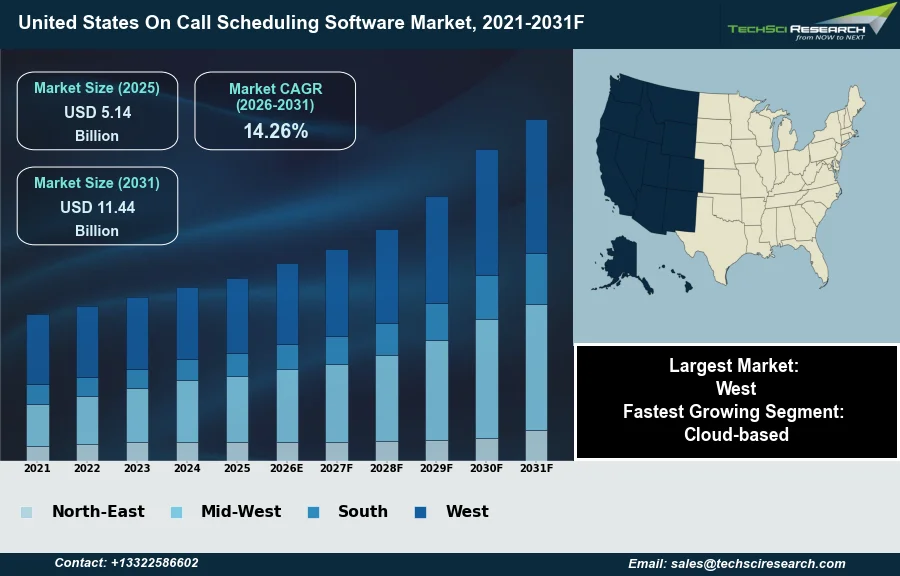
The United States On Call Scheduling Software Market will grow from USD 5.14 Billion in 2025 to USD 11.44 Billion by 2031 at a 14.26% CAGR. On-call scheduling software automates personnel availability and assignment for urgent tasks outside regular hours, facilitating rotating coverage and real-time communication. The United States market's growth is driven by rising demand for workforce optimization, ensuring 24/7 operational continuity across sectors like healthcare and IT services. Solutions enhance efficiency, reduce administrative overhead, and ensure labor compliance. According to the American Medical Association, in 2025, 43.2% of U.S. physicians reported burnout, with ineffective scheduling a contributing factor.
A significant challenge impeding market expansion is the complex integration of modern on-call scheduling platforms with existing legacy systems. Many organizations, particularly in established sectors, utilize outdated workforce management systems incompatible with advanced cloud-based or AI-driven tools. This necessitates substantial investment in IT infrastructure and employee training, potentially deterring widespread adoption.
Key Market Drivers
Optimized Workforce Management as a Growth Driver
The escalating demand for optimized workforce management stands as a primary growth driver for the United States On-Call Scheduling Software Market. Inefficient scheduling practices lead to considerable operational challenges, impacting productivity and employee retention across various sectors. For instance, according to Gallup News, in June 2025, "Work Schedules Fail Millions of U.S. Employees", 62% of U.S. employees reported not having high-quality work schedules, a situation linked to decreased productivity and increased turnover. On-call scheduling software addresses these issues by automating shift assignments, managing availability, and ensuring equitable distribution of urgent tasks, thereby improving overall operational efficiency and reducing administrative burdens for organizations.
Cloud-Based and Mobile Solutions Driving Market Expansion
Complementing this, the increased adoption of cloud-based and mobile solutions significantly propels market expansion. Organizations are increasingly leveraging these flexible platforms to facilitate real-time communication and provide remote access to schedules. According to a report on Amazon.com, in July 2025, "Why 2025 is the Inflection Point for AWS Cloud Migration", small and medium-sized businesses were projected to allocate over half of their technology budgets to cloud services, underscoring the widespread shift towards cloud infrastructure. This trend is particularly vital for distributed and hybrid work models, enabling seamless management of on-call personnel from any location. The broader HR technology landscape also reflects this dynamism; according to HRO Today, in Q1 2026, venture capital activity in HR technology grew to nearly $1.4 billion globally, with 80% of major announcements originating from US-based companies.
Download Free Sample Report
Key Market Challenges
Legacy Systems as a Barrier to Adoption
A significant challenge impeding market expansion is the complex integration of modern on-call scheduling platforms with existing legacy systems. Many organizations, particularly in established sectors, utilize outdated workforce management systems incompatible with advanced cloud-based or AI-driven tools. This necessitates substantial investment in IT infrastructure upgrades and comprehensive employee training, which often deters widespread adoption of new solutions.
Legacy Systems Limiting Growth of the U.S. On-Call Scheduling Market
The continued reliance on these older systems directly hampers the growth of the United States On Call Scheduling Software Market. According to a 2025 survey of over 500 U.S. IT professionals conducted by Researchscape on behalf of Saritasa, 62% of organizations continue to rely on legacy software systems. This significant prevalence of outdated infrastructure creates considerable technical debt and operational silos, preventing seamless data flow and real-time communication that modern on-call software offers. The prohibitive costs and resource allocation required to bridge the gap between incompatible systems delay or entirely prevent organizations from implementing new scheduling technologies, thereby stifling market expansion for these advanced platforms.
Key Market Trends
AI-Driven Predictive Scheduling Transforms U.S. On-Call Management
AI and predictive analytics integration is fundamentally transforming on-call scheduling from reactive management to proactive optimization within the United States market. This trend leverages advanced algorithms to forecast demand, identify potential staffing gaps, and intelligently assign personnel based on historical data, skill sets, and even anticipated individual workload, moving beyond basic automation. Such capabilities enable organizations to enhance operational resilience and make informed decisions that mitigate burnout and ensure optimal coverage. According to the American Medical Association, in May 2026, in the 'Healthcare AI In 2026: What's Working, What Isn't, And What's Next' report, more than 80% of physicians report using AI in their professional work, underscoring its growing prevalence in sectors reliant on on-call personnel.
HR and Workforce Management System Integration Enhances On-Call Scheduling
Another significant trend is the increasing integration of on-call scheduling software with broader HR and workforce management systems. This strategic convergence facilitates a unified platform for all employee data, from scheduling and time-off requests to payroll and performance management. By breaking down operational silos, these integrated solutions provide a holistic view of the workforce, improving data accuracy, streamlining administrative tasks, and ensuring consistent policy enforcement across an organization. This deep integration enhances overall HR efficiency and employee experience. According to SPARK Blog, ADP, in June 2026, in the 'Key HR Technology Trends for 2026 — and How to Plan for Each' article, a survey found that 64% of IT leaders projected a complete HR-IT merger within five years.
Segmental Insights
Cloud-based Scheduling Drives Rapid Market Growth Through Scalability, Accessibility, and Cost Benefits.
The United States On-Call Scheduling Software Market is witnessing rapid expansion, with the Cloud-based segment emerging as the fastest-growing due to its inherent operational advantages. Cloud deployment solutions offer unparalleled scalability and flexibility, allowing organizations to efficiently adapt to fluctuating workforce demands and integrate seamlessly with existing business applications without significant infrastructure overhead. Furthermore, cloud-based software enhances accessibility, enabling managers and employees to manage schedules remotely and in real-time, which is crucial for distributed teams and maintaining continuous operations. This model's cost-effectiveness, stemming from subscription-based pricing and reduced IT maintenance, further drives its adoption across diverse industries seeking streamlined workforce management and improved efficiency.
Regional Insights
North America Leads the On-Call Scheduling Software Market
North America leads the United States On Call Scheduling Software Market due to its high adoption of advanced workforce management solutions and a strong presence of key industry players. The region benefits from a robust IT infrastructure and a significant shift towards digital services across healthcare, IT, and retail sectors, driving widespread implementation of these solutions. While the Western United States is recognized for its contributions to general digital health innovation and technology adoption within the healthcare sector, comprehensive market research indicates North America as the overarching dominant region for on-call scheduling software solutions. This dominance is primarily attributed to the increasing demand for efficient workforce management, real-time staff coordination, and the integration of cloud-based and AI-driven automation tools.
Recent Developments
-
In July 2025, QGenda, a prominent provider of healthcare workforce management solutions, completed the acquisition of New Innovations, a leading residency management software provider. This strategic collaboration aimed to broaden QGenda's healthcare-specific workforce management portfolio in the United States by integrating comprehensive management of the resident and fellow training lifecycle. The acquisition was set to include features for onboarding, evaluations, and scheduling, creating a unified platform for workforce data across the entire care team. This development was intended to enhance operational efficiency for healthcare organizations managing complex on-call schedules for medical learners.
-
In February 2025, TigerConnect announced the early access availability of a new Scheduling AI Agent, expanding its clinical communication platform within the United States market. This AI assistant was developed to facilitate easier on-call scheduling management for users of TigerConnect Physician Scheduling and Clinical Collaboration applications. It aimed to simplify how physicians retrieve on-call schedule information and effortlessly swap shifts directly within the clinical collaboration app. This product launch underscored TigerConnect's commitment to modernizing hospital workflows and enhancing the efficiency of staffing and care delivery through intelligent automation in the on-call scheduling domain.
-
In October 2024, PagerDuty introduced significant AI-powered innovations to its Operations Cloud platform, directly enhancing digital operations management and incident response capabilities. These advancements included the PagerDuty Advance Assistant for Microsoft Teams, offering generative AI to aid in incident lifecycle management and accelerate resolution. Additionally, new features like Global Intelligent Alert Grouping and an enhanced Operations Console became generally available or entered early access, aiming to automate processes, reduce resolution times, and strengthen operational resilience. These product launches by PagerDuty aimed to empower operations teams in the United States to manage unplanned outages more effectively.
-
In June 2024, Datadog, Inc. launched its new platform, Datadog On-Call, specifically designed to streamline on-call operations for various teams including DevOps, SRE, Security, and IT Operations. This new product integrated observability-enriched paging with unified incident management capabilities. The goal of this launch was to provide contextual insights and reduce the complexity associated with managing incident responses within organizations. This introduction expanded Datadog's offerings in the United States On-Call Scheduling Software Market by enabling more efficient and coordinated handling of critical incidents, thereby improving overall operational workflows and team readiness.
Key Market Players
- UKG Inc.
- Shiftboard Inc.
- When I Work Inc.
- Deputy Group Pty Ltd.
- Kronos Incorporated
- PagerDuty Inc.
- Opsgenie (Atlassian Corporation Plc)
- ServiceNow Inc.
- BambooHR LLC
- Zoho Corporation Pvt. Ltd.
|
By Component
|
By Deployment
|
By Application
|
By Region
|
|
|
|
|
- Northeast
- Midwest
- South
- West
|
Report Scope:
In this report, the United States On Call Scheduling Software Market has been segmented into the following categories, in addition to the industry trends which have also been detailed below:
-
United States On Call Scheduling Software Market, By Component:
-
United States On Call Scheduling Software Market, By Deployment:
-
United States On Call Scheduling Software Market, By Application:
-
United States On Call Scheduling Software Market, By Region:
-
Northeast
-
Midwest
-
South
-
West
Competitive Landscape
Company Profiles: Detailed analysis of the major companies present in the United States On Call Scheduling Software Market.
Available Customizations:
United States On Call Scheduling Software Market report with the given market data, TechSci Research offers customizations according to a company's specific needs. The following customization options are available for the report:
Company Information
- Detailed analysis and profiling of additional market players (up to five).
United States On Call Scheduling Software Market is an upcoming report to be released soon. If you wish an early delivery of this report or want to confirm the date of release, please contact us at sales@techsciresearch.com