|
Key Insights
|
Details
|
|
Forecast Period
|
2027-2031
|
|
Market Size (2025)
|
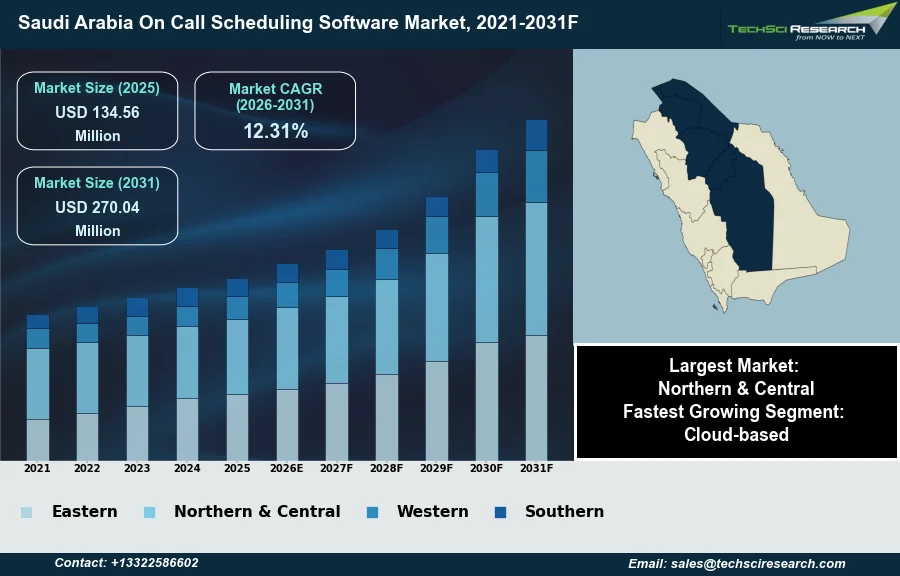
USD 134.56 Million
|
|
CAGR (2026-2031)
|
12.31%
|
|
Fastest Growing Segment
|
Cloud-based
|
|
Largest Market
|
Northern & Central
|
|
Market Size (2031)
|
USD 270.04 Million
|
Market Overview
The Saudi Arabia On Call Scheduling Software Market will grow from USD 134.56 Million in 2025 to USD 270.04 Million by 2031 at a 12.31% CAGR. On-call scheduling software facilitates the coordination of personnel required to respond to critical incidents or patient demands outside standard operating hours, managing rotation schedules, automating notifications, and defining escalation protocols to ensure uninterrupted service provision. The Saudi Arabia market for this software is primarily driven by the nation's Vision 2030 digital transformation initiatives aimed at modernizing healthcare infrastructure, coupled with the increasing prevalence of chronic diseases demanding efficient patient management. Furthermore, the growing imperative for operational efficiency and the accelerating adoption of telemedicine solutions are significant growth catalysts.
A notable challenge impeding market expansion is the persistent concern regarding data security, privacy, and interoperability across fragmented healthcare IT systems. According to the International Trade Administration, in 2026, the Saudi government allocated $1.5 billion for healthcare IT and digital transformation programs, with telehealth adoption reaching approximately 70 percent, underscoring the strong governmental push towards digital health despite integration complexities.
Key Market Drivers
Vision 2030 and Digital Transformation Driving On-Call Scheduling Adoption
Digital Transformation and Vision 2030 Initiatives are a primary force driving the adoption of on-call scheduling software across Saudi Arabia. The nation's ambitious Vision 2030 framework emphasizes widespread digitalization across all sectors to enhance efficiency, competitiveness, and service delivery. This push necessitates robust technological solutions that can streamline complex operational processes and optimize resource allocation. As organizations modernize their infrastructure and operations, the need to effectively manage personnel availability for critical tasks outside regular hours becomes paramount. For instance, Saudi Arabia has witnessed significant growth in its digital infrastructure, with investments exceeding SAR16 billion in over 60 data centers as of April 2026, reflecting a growing capability to support advanced digital services. This substantial investment in core digital infrastructure creates a fertile environment for the deployment of specialized software solutions, including those for on-call scheduling.
Healthcare Expansion Drives Demand for On-Call Scheduling Tools
The significant expansion and digitalization of the healthcare sector further amplify the demand for specialized on-call scheduling tools. With ongoing investments in new medical facilities and the integration of digital health platforms, healthcare providers require sophisticated systems to manage intricate staff rotations for doctors, nurses, and specialized technicians. This ensures continuous patient care, particularly in emergency situations and specialized treatments that often extend beyond standard working hours. This commitment to healthcare expansion is evident, with USD 8.4 billion in new hospital and infrastructure development projects announced at the Global Health Exhibition in October 2025. Such growth directly correlates with a greater need for efficient workforce coordination and communication tools. Overall, the broader Saudi economy continues to demonstrate resilience and digital adoption, with the International Monetary Fund projecting Saudi Arabia's real GDP to grow by 3.1% in 2026.
Download Free Sample Report
Key Market Challenges
Security, privacy, and interoperability barriers
A significant impediment to the expansion of the Saudi Arabia On-Call Scheduling Software Market stems from persistent concerns regarding data security, patient privacy, and interoperability across fragmented healthcare IT systems. This challenge directly hampers growth as healthcare institutions exhibit hesitation in adopting new software solutions that manage sensitive patient information and staff schedules, primarily due to the elevated risk of data breaches. Adherence to stringent data protection regulations is paramount, and any perceived vulnerability can significantly delay or prevent implementation. According to a 2025 study published in MDPI, 59.5% of patients in Saudi Arabia reported feeling limited control over how their health data is utilized, highlighting a significant trust deficit that impacts digital health adoption.
Fragmented IT infrastructure and lack of standards hinder deployment
The fragmented nature of existing healthcare IT infrastructure further complicates the market. New on-call scheduling platforms must seamlessly integrate with disparate legacy systems to be effective, which often necessitates considerable investment in customization and infrastructure upgrades. This leads to increased implementation costs and extended deployment timelines, reducing the attractiveness of these solutions for many healthcare providers. The lack of standardized protocols for data exchange between various departmental systems directly impedes efficient deployment and limits the full potential utilization of new scheduling technologies.
Key Market Trends
AI-Driven Scheduling: Optimizing Deployment, Forecasting Demand, and Compliance
The integration of artificial intelligence and automation into scheduling workflows represents a pivotal shift, moving beyond conventional rule-based systems to intelligent, adaptive platforms. This trend significantly enhances the capability of on-call scheduling software to optimize staff deployment, predict demand fluctuations, and minimize human error. Advanced algorithms can analyze historical data to forecast staffing needs, balance workloads, and ensure compliance with labor regulations, thereby streamlining complex rotations in healthcare settings. According to new research from Nintex, December 2025, in a report highlighting Saudi enterprises, 63 percent of Saudi organizations plan to implement a formal automation strategy within the next 7 to 12 months, indicating a clear trajectory towards more autonomous operational management.
Cloud Adoption with Local Regions Enables Scalable, Data-Sovereign Scheduling
Concurrently, the increased adoption of cloud-based solutions is transforming how on-call scheduling software is delivered and consumed in Saudi Arabia. This trend allows organizations to forgo substantial upfront infrastructure investments, opting instead for scalable, accessible, and flexible software-as-a-service models. Cloud deployment facilitates remote access for staff, supports seamless updates, and improves overall system resilience, which is crucial for critical service provision. The establishment of local cloud regions further supports this shift by addressing data sovereignty requirements, enabling organizations to leverage global cloud benefits while maintaining data within national borders. According to Mak it Solutions, June 2026, AWS has announced plans for a Saudi Arabia cloud region in 2026 with more than $5.3 billion in investment, signalling a significant expansion of cloud infrastructure within the Kingdom.
Segmental Insights
Cloud-Based Segment: Fastest Growth Driven by Flexibility, Real-Time Collaboration, and Vision 2030 Cloud Initiatives
In the Saudi Arabia On Call Scheduling Software Market, the Cloud-based segment is experiencing rapid expansion, emerging as the fastest-growing category. This accelerated adoption is primarily driven by organizations seeking enhanced flexibility, scalability, and accessibility for their workforce management solutions. Cloud-based platforms enable real-time updates and foster seamless collaboration, which are crucial for efficient on-call management, especially within critical sectors like healthcare. Furthermore, significant government-led digitalization initiatives under Saudi Vision 2030 are actively promoting cloud-first policies and advanced infrastructure, encouraging businesses and public institutions to modernize operations and reduce upfront IT investment, thereby bolstering the shift towards cloud solutions across the Kingdom.
Regional Insights
Northern & Central Saudi Arabia as the Market Leader in On Call Scheduling Software
Northern & Central Saudi Arabia spearheads the On Call Scheduling Software Market due to a significant convergence of strategic factors. The region, home to the capital Riyadh, is the epicenter for government policies and substantial investments in digital health infrastructure driven by the Saudi Vision 2030 initiative. This strategic national transformation, actively promoted by entities like the Ministry of Health, emphasizes the adoption of advanced healthcare technologies. Furthermore, the Northern & Central region boasts the highest concentration of healthcare facilities, including major hospitals and clinics, which are actively integrating digital solutions to optimize operations and enhance patient care. This robust ecosystem of government support, advanced infrastructure, and numerous healthcare institutions creates a compelling environment for market dominance.
Recent Developments
-
In January 2025, SIGNL4, a prominent on-call scheduling software provider, updated its offerings for the year, emphasizing a mobile-first approach to managing shifts and alerts. The company highlighted enhanced digital planning capabilities for on-call duties, featuring intuitive templates and drag-and-drop functionality. This included automated shift reminders, handover assistance, and calendar synchronization, aimed at improving team efficiency and reducing burnout across critical services. The platform’s ability to combine scheduling with immediate incident communication and after-hours call routing was particularly noted for its relevance to IT, manufacturing, and critical infrastructure operations in the Saudi Arabian market.
-
In January 2025, ZenHR, a cloud-based HR platform specifically developed for the Saudi Arabian market and the wider MENA region, showcased advancements in its time and attendance system. The company introduced an intelligent staff rostering feature designed to manage various shift types, including regular, split, overnight, and flexible schedules, with automatic notifications. ZenHR also integrated an AI-powered Smart Recommendations Engine, which autonomously detects missing overtime, late arrivals, and early departures, then suggests corrections. This innovation aimed to significantly reduce manual HR workload and enhance payroll accuracy for businesses operating under Saudi labor laws.
-
In December 2024, Snowflake, an AI Data Cloud company, significantly expanded its presence in the Middle East by establishing a new regional headquarters in Riyadh, Saudi Arabia. Concurrently, the company announced the general availability of its AI Data Cloud on Google Cloud within the Kingdom. This expansion was driven by the increasing need for secure and compliant data solutions that meet local data residency and sovereignty requirements. The initiative by Snowflake is crucial for supporting organizations in Saudi Arabia to leverage data for insights, which indirectly aids in optimizing various operational aspects, including potentially advanced workforce planning and scheduling solutions built on robust data platforms.
-
In September 2024, Lumofy announced a strategic partnership with Jisr, an HR management platform based in Saudi Arabia. This collaboration focused on integrating AI-powered training solutions to enhance workforce development. While primarily centered on training, the partnership aimed to provide Saudi organizations with comprehensive learning materials to upskill their employees and ensure alignment with national standards through Lumofy’s platform, which is part of a broader HR ecosystem that often includes scheduling and workforce optimization to support efficient deployment of a skilled workforce.
Key Market Players
- Oracle
- SAP Middle East
- Microsoft
- IBM
- Workday
- UKG
- ADP
- Ceridian
- Alshaya Software
|
By Component
|
By Deployment
|
By Application
|
By Region
|
|
|
|
|
- Eastern
- Northern & Central
- Western
- Southern
|
Report Scope:
In this report, the Saudi Arabia On Call Scheduling Software Market has been segmented into the following categories, in addition to the industry trends which have also been detailed below:
-
Saudi Arabia On Call Scheduling Software Market, By Component:
-
Saudi Arabia On Call Scheduling Software Market, By Deployment:
-
Saudi Arabia On Call Scheduling Software Market, By Application:
-
Saudi Arabia On Call Scheduling Software Market, By Region:
-
Eastern
-
Northern & Central
-
Western
-
Southern
Competitive Landscape
Company Profiles: Detailed analysis of the major companies present in the Saudi Arabia On Call Scheduling Software Market.
Available Customizations:
Saudi Arabia On Call Scheduling Software Market report with the given market data, TechSci Research offers customizations according to a company's specific needs. The following customization options are available for the report:
Company Information
- Detailed analysis and profiling of additional market players (up to five).
Saudi Arabia On Call Scheduling Software Market is an upcoming report to be released soon. If you wish an early delivery of this report or want to confirm the date of release, please contact us at sales@techsciresearch.com