Main Content start here
Main Layout
Report Description

Report Description

Forecast Period

2026-2030

Market Size (2024)

USD 82.41 Billion

Market Size (2030)

USD 132.39 Billion

CAGR (2025-2030)

8.06%

Fastest Growing Segment

Residential

Largest Market

Abu Dhabi

Market Overview

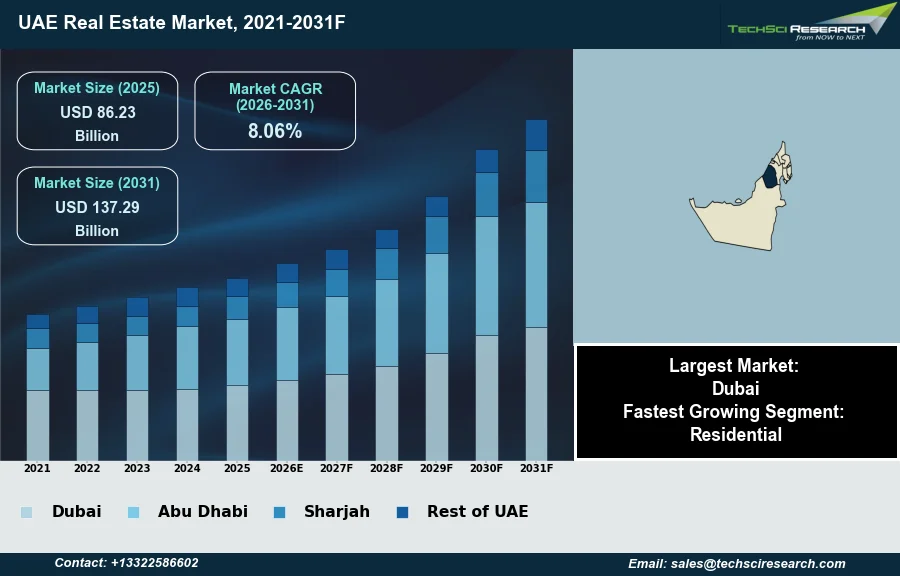
UAE Real Estate Market was valued at USD 82.41 Billion in 2024 and is expected to reach USD 132.39 Billion by 2030 with a CAGR of 8.06% during the forecast period.

The UAE real estate market stands as one of the most dynamic and resilient sectors in the region, underpinned by government-led diversification, liberal foreign ownership laws, and world-class infrastructure. Over the past decade, this market has evolved from oil-dependence to becoming a hub for global tourism, business, and residential investment. Dubai and Abu Dhabi continue to lead the market, offering luxury properties, commercial office spaces, hospitality assets, and affordable housing to cater to a wide demographic base. Dubai’s successful hosting of Expo 2020 provided a major boost to demand across sectors, while Abu Dhabi’s Vision 2030 plan continues to drive large-scale infrastructure development and integrated urban living.

The real estate sector is characterized by diverse offerings ranging from ultra-luxury apartments and villas in waterfront communities to budget-friendly developments targeted at expatriates. The introduction of long-term residency visas for investors, professionals, and retirees has further encouraged real estate ownership among foreign nationals. Moreover, the rise of proptech platforms, digital real estate transactions, and virtual property tours has modernized the industry. In terms of regional variation, Dubai dominates in transaction volume and foreign investment, while Sharjah and Ras Al Khaimah are rapidly growing as affordable alternatives with a strong focus on mid-income housing.

The rental market remains robust, with rental yields in areas like Jumeirah Village Circle (JVC) and Business Bay ranging between 6% and 9%. Meanwhile, Abu Dhabi is witnessing growth in the office leasing sector, driven by multinational firms establishing regional headquarters. On the commercial side, the rapid expansion of e-commerce is fueling demand for warehousing and logistics spaces, especially near Jebel Ali and Dubai South. Increasing public-private partnerships and REIT investments are improving the institutionalization of the sector. Overall, with strong fundamentals, visionary leadership, and continued foreign investor appetite, the UAE real estate market remains a central pillar of the nation’s long-term economic strategy.

Key Market Drivers

Rising Population and Urbanization

The UAE's rapidly growing population is a fundamental driver of real estate demand, especially in urban centers like Dubai, Abu Dhabi, and Sharjah. According to the Federal Competitiveness and Statistics Centre (FCSC), the UAE’s population surpassed 10 million in 2022, driven largely by an influx of expatriates and labor force migration. With Dubai’s population alone projected to reach 5.8 million by 2040, housing, transportation, and commercial infrastructure expansion has become a national priority.

Urbanization has led to higher demand for residential units, retail outlets, and office space in key areas. In 2023, Dubai recorded over 80,000 residential unit completions, reflecting the growing need for diversified housing options. Additionally, more than 12,000 units were launched in Abu Dhabi, supported by mega projects such as Saadiyat Grove and Reem Island expansions. With over 86% of the UAE population living in urban areas, the real estate sector is naturally aligned with national development goals such as Dubai 2040 Urban Master Plan.

Moreover, the need for affordable housing is increasing, particularly among middle-income expatriates. Approximately 60% of Dubai's population earns less than AED 15,000/month, creating strong demand for affordable and mid-segment developments. The influx of blue-collar and service-sector workers has also led to significant expansion in labor housing projects in areas like Jebel Ali and Muhaisnah.

In response to urban growth, authorities have initiated smart infrastructure programs, including AED 66 billion in transportation investments under Dubai Metro and Etihad Rail, which further stimulate land development opportunities. The interplay between population growth and real estate is also evident in Sharjah, which saw a 14% increase in residential permits issued in 2023. Overall, urbanization is acting as both a demand catalyst and a roadmap for strategic real estate development across the UAE.

Government Reforms and Visa Policies

Liberal government reforms and progressive visa policies are powerful enablers of real estate activity in the UAE. One of the most impactful changes has been the introduction of the 10-year Golden Visa, which grants long-term residency to investors, entrepreneurs, and highly skilled professionals. This policy has not only boosted property ownership among foreign nationals but has also encouraged long-term investment in freehold developments.

Data from the Dubai Land Department (DLD) revealed that more than 150,000 Golden Visas were issued between 2021 and 2023, many linked directly to property investments exceeding AED 2 million (USD 0.54 million). Additionally, the new retirement visa program launched in Dubai allows foreign residents aged 55+ to secure 5-year visas with property ownership of at least AED 1 million (USD 0.27 million), further stimulating senior-focused housing developments.

Another pivotal move has been the complete foreign ownership rule, now extended to more than 1,000 business sectors, removing prior limitations on real estate acquisitions in designated zones. As a result, Dubai recorded real estate transactions worth over AED 400 billion in 2023, a 20% YoY increase, attributed largely to international investor participation.

In Abu Dhabi, non-GCC citizens can now buy freehold properties in investment zones like Saadiyat and Al Reem Islands—an initiative that saw a 42% increase in foreign buyer registrations in 2023. These policies have also encouraged institutional investment, with several international REITs and funds entering the UAE market.

To support these policies, government portals like Dubai REST and Abu Dhabi TAMM have digitized property transactions, improving transparency and investor confidence. Together, these reforms are not only expanding the buyer base but are also solidifying the UAE’s image as a globally competitive, investor-friendly real estate market.

Tourism and Hospitality Sector Growth

The UAE's tourism boom continues to energize the real estate market, especially in the hospitality, short-term rental, and branded residence segments. As one of the top global tourist destinations, the UAE recorded over 17 million international visitors to Dubai alone in 2023, according to Dubai Tourism. This has directly fueled demand for hotel apartments, vacation homes, and luxury mixed-use developments.

In Dubai, occupancy rates in hospitality assets averaged 76.4% in 2023, among the highest globally, encouraging developers to expand hotel pipeline projects. Approximately 30,000 new hotel rooms are planned across the UAE by 2026, many integrated into mixed-use communities. Prominent developments such as Atlantis The Royal and the Dubai Creek Harbour projects are examples of tourism-driven real estate activity.

The short-term rental market is also booming. Platforms like Airbnb and local equivalents have led to a surge in demand for furnished apartments in areas like Downtown Dubai, JBR, and Dubai Marina. There were over 20,000 active short-term rental listings in Dubai as of early 2024, showing how tourism overlaps with residential real estate supply.

Abu Dhabi’s cultural tourism—boosted by attractions like Louvre Abu Dhabi, Yas Island, and the upcoming Guggenheim Museum—has seen its hotel guest numbers surpass 4.5 million in 2023, prompting more hospitality-oriented real estate investments. The expected rise in eco-tourism and medical tourism is also leading to diversification in asset classes such as wellness resorts and rehabilitation centers.

Sharjah and Ras Al Khaimah are also positioning themselves as budget and heritage destinations, with both emirates witnessing double-digit growth in annual hotel occupancy. With the UAE targeting 40 million hotel guests annually by 2030 under the National Tourism Strategy, the linkage between hospitality demand and real estate supply is poised to strengthen further.

Download Free Sample Report

Key Market Challenges

Oversupply in Residential and Commercial Segments

One of the most persistent challenges in the UAE real estate market is the oversupply of both residential and commercial properties, particularly in Dubai and Abu Dhabi. Rapid construction and development over the past decade, fueled by speculative investment and ambitious urban planning, have resulted in a surplus of units that outpaces demand. In Dubai, over 80,000 residential units were completed in 2023 alone, adding to an already saturated market. This oversupply has led to downward pressure on property prices and rental yields. As a result, landlords are offering extended rent-free periods, waived maintenance charges, and other incentives to attract tenants. Commercial office spaces, particularly in Business Bay and Downtown Dubai, are also experiencing high vacancy rates. Reports suggest that Grade A office spaces had an average vacancy rate of over 25% in 2023. Abu Dhabi faces a similar issue with large-scale developments like Reem Island and Al Raha Beach still seeing significant unoccupied inventories. This supply-demand mismatch creates instability and discourages new entrants and investors, particularly in the mid-market and commercial segments. Developers are now being urged to align their projects with actual demand data and adopt phased development strategies. The oversupply issue also hampers price appreciation and can lead to long-term stagnation in property values, affecting both individual investors and institutional stakeholders.

Regulatory Fragmentation Across Emirates

While the UAE is a unified federation, the real estate regulatory landscape remains fragmented across its seven emirates. Each emirate has its own regulatory authority, laws, and registration procedures, which complicates investment decisions, especially for foreign and institutional investors. For instance, Dubai operates under the Dubai Land Department (DLD) and Real Estate Regulatory Authority (RERA), while Abu Dhabi has the Department of Municipalities and Transport (DMT). Sharjah and Ajman also have independent authorities with differing rules on freehold and leasehold ownership. This lack of standardization leads to confusion regarding legal protections, dispute resolution, and investment eligibility. Moreover, certain emirates restrict foreign ownership to specific investment zones, limiting the mobility and appeal of cross-emirate investments. For example, in Sharjah, non-GCC nationals can only buy in selected areas like Aljada and Tilal City. The variation in escrow regulations, licensing requirements for brokers, and property valuation standards further adds to operational complexity. Investors who seek to build a diversified portfolio across the UAE often face logistical, legal, and procedural hurdles due to this decentralized approach. Efforts are underway to introduce greater regulatory cohesion and digital integration, but until a nationwide framework is established, the disparity will continue to serve as a barrier to seamless growth and investor confidence in the UAE's broader real estate ecosystem.

Volatility in Rental Yields and Capital Gains

Rental yields and capital gains in the UAE real estate market have shown considerable volatility over the years, particularly in investment-heavy zones like Dubai Marina, Downtown Dubai, and Jumeirah Village Circle. While certain areas offer yields of 6% to 9%, these returns are not consistent year-on-year due to fluctuating demand, economic cycles, and regulatory changes. The COVID-19 pandemic in 2020 saw rental prices plummet by over 15% in many communities. Although the market rebounded in 2022 and 2023, inconsistencies persist, making it difficult for investors to forecast long-term returns. Properties in outer zones such as Dubailand and Remraam often offer high gross yields but come with lower tenant retention and high vacancy risks. Capital appreciation is also unpredictable, with some areas experiencing significant price corrections. For example, apartment prices in Dubai Sports City and Discovery Gardens declined by over 10% between 2019 and 2021, only to see marginal recovery afterward. These fluctuations are driven by macroeconomic factors like oil prices, global interest rates, and geopolitical tensions, all of which impact buyer sentiment and investment flows. Moreover, rental disputes and delays in rental payments add another layer of risk for landlords. This volatility limits the appeal of the UAE as a stable, income-generating real estate destination and prompts cautious behavior among investors, especially first-time buyers and foreign institutions.

High Transaction Costs and Financing Barriers

Despite its investor-friendly image, the UAE real estate market is associated with relatively high transaction costs and financing limitations. Buyers typically face multiple layers of fees, including agent commissions (2%), transfer fees (4% in Dubai), mortgage registration fees (0.25% of loan value), and developer admin charges. These costs can amount to 6-8% of the property value, significantly raising the investment threshold. Additionally, mortgage financing remains conservative. Most banks require a 20% to 25% down payment for expatriates, with tighter conditions for off-plan properties. Interest rates have also seen an upward trend, with average mortgage rates ranging between 4% and 5.5% annually as of 2024, reflecting broader global monetary tightening. Financing challenges are more pronounced for self-employed individuals and non-residents, who often face higher scrutiny and additional documentation. Furthermore, the lack of credit scoring for expatriates and inconsistent lending standards across banks makes the borrowing process cumbersome. These barriers discourage many potential buyers, particularly in the affordable and mid-market segments, where liquidity is limited. Developers have introduced post-handover payment plans and rent-to-own schemes to ease access, but these are still not widespread or standardized. Unless structural changes in financing and transaction processes are implemented, the high entry and exit costs will remain a deterrent to real estate investment in the UAE.

Sustainability Pressures and Environmental Risks

With growing global awareness around climate change, the UAE real estate sector faces mounting pressure to adopt sustainable and environmentally responsible practices. The country’s harsh climate, high energy consumption, and dependency on air conditioning and desalinated water make green building practices both a necessity and a challenge. Despite initiatives like Estidama in Abu Dhabi and Dubai's Green Building Regulations, the adoption of sustainable construction techniques remains uneven. Many existing buildings are not retrofitted for energy efficiency, leading to high operational costs. According to the UAE Ministry of Climate Change and Environment, buildings account for nearly 45% of the country's total energy use. Rising temperatures and extreme weather events are also putting stress on building materials and infrastructure. Moreover, projects near coastlines, such as those on Palm Jumeirah or Dubai Creek, face increased vulnerability to sea-level rise and saltwater intrusion. Regulatory bodies are tightening sustainability compliance, but developers often cite increased construction costs and limited technical expertise as hurdles. Green-certified properties still make up a small portion of total stock, and the market for eco-conscious buyers and tenants is nascent. Until sustainability is fully integrated into design, construction, and valuation norms, the sector will struggle to align with the UAE's long-term environmental targets and its vision for a green economy.

Key Market Trends

Digital Transformation and Proptech Adoption

The UAE real estate market is rapidly embracing digital transformation through the rise of proptech solutions that streamline transactions, enhance customer experience, and improve operational efficiency. Digital listing portals, virtual reality (VR) property tours, blockchain-enabled smart contracts, and AI-powered valuation tools are becoming mainstream. Dubai Land Department's blockchain-based Real Estate Self Transaction (REST) platform is a prime example, allowing investors to conduct property purchases remotely. As of 2023, over 80% of property listings in Dubai and Abu Dhabi were digitized, and more than 60% of buyers initiated transactions via online portals. Property developers like Emaar, Aldar, and Sobha have adopted virtual walkthroughs and online booking tools, significantly reducing the sales cycle. AI is increasingly used to analyze market trends, automate pricing models, and personalize recommendations for buyers. In facilities management, IoT integration allows for predictive maintenance, energy optimization, and smart security systems. Additionally, digital payments and e-signatures are enabling seamless leasing and ownership processes. The rise of NFTs and tokenized real estate is also beginning to reshape ownership models, although adoption is still nascent. Proptech is further supported by government initiatives like the UAE Digital Government Strategy 2025 and Smart Dubai. With rising consumer expectations and investor preference for transparency and speed, digital transformation is becoming a competitive necessity. This tech-led evolution is not only improving market efficiency but also widening investor access, making UAE real estate more globally attractive.

Growing Demand for Branded Residences

The UAE is experiencing a surge in branded residential developments, where global luxury hospitality and fashion brands partner with real estate developers to deliver high-end living experiences. Properties affiliated with names like Armani, Versace, Bugatti, and Ritz-Carlton are seeing increased interest, particularly among HNWIs and international investors. According to Knight Frank, Dubai now ranks among the top five cities globally for branded residences, with over 50 such projects either completed or in the pipeline as of 2023. These developments often command a price premium of 25% to 35% compared to non-branded equivalents, justified by superior design, exclusive amenities, and service quality. Areas such as Downtown Dubai, Palm Jumeirah, and Business Bay are hotspots for these projects. The success of branded residences is partly due to the lifestyle appeal and assurance of quality associated with global brands. Projects like The Lana, Dorchester Collection, and The Residences by St. Regis have reported high pre-launch booking rates. Investors are drawn by the strong rental yields and resale value these properties offer. Moreover, developers benefit from brand affiliation through faster sales cycles and international market access. Branded residences are also gaining ground in Abu Dhabi and Ras Al Khaimah, supported by luxury tourism initiatives. With increasing ultra-luxury demand from markets like Russia, China, and India, this segment is expected to grow further. As experiential living becomes a market norm, branded residences will likely reshape the definition of luxury real estate in the UAE.

Shift Toward Affordable and Mid-Income Housing

While the UAE real estate market has long been associated with luxury and premium developments, there is a growing emphasis on affordable and mid-income housing, particularly in Dubai, Sharjah, and Ajman. This shift is driven by the changing demographics of the expatriate population and the government's push to ensure housing inclusivity. According to the Dubai Land Department, nearly 60% of real estate transactions in 2023 were in the AED 500,000 to AED 1.5 million bracket. Developers such as Danube, MAG, and Azizi are increasingly launching projects catering to this price-sensitive segment. Locations like Dubai South, International City, and Jumeirah Village Circle have emerged as popular hubs for mid-income buyers due to their competitive pricing, payment plans, and improved connectivity. Government initiatives, including long-term visas and rent-to-own schemes, are also facilitating homeownership among salaried residents. In Sharjah, Aljada and Tilal City are leading affordable projects that offer high-quality units at accessible price points. The affordable segment is witnessing strong rental demand as well, with yields averaging 6% to 8%, especially in communities with schools, public transit, and healthcare facilities. This trend is further supported by the introduction of sustainable, prefabricated housing technologies that lower construction costs. The market is also seeing innovative financing models tailored for low-income groups. As urban growth continues, the demand for economically viable housing options will remain robust, making this segment a cornerstone of long-term real estate planning in the UAE.

Emergence of Real Estate Investment Trusts (REITs)

REITs are gaining traction in the UAE as a transparent and regulated vehicle for institutional and retail investment in real estate. The growing popularity of REITs is helping to institutionalize the sector, improve liquidity, and open up access to a broader base of investors. As of 2023, several major REITs such as Emirates REIT, ENBD REIT, and Manrre REIT were actively managing diversified portfolios across commercial, industrial, and educational assets. The total assets under management (AUM) for UAE-based REITs surpassed AED 6 billion, reflecting growing investor confidence. REITs offer regular dividend income, professional asset management, and lower investment thresholds, making them attractive to both individual and institutional investors. Regulatory reforms, including listing on local exchanges like Nasdaq Dubai and ADX, have improved market visibility and investor protections. The government’s focus on financial market development, combined with the real estate sector’s need for stable funding sources, is accelerating REIT adoption. Additionally, Sharia-compliant REITs are gaining momentum among regional investors. The success of REITs is encouraging more developers to consider asset monetization through portfolio transfers. With growing interest in income-generating assets and portfolio diversification, REITs are poised to become a central feature of the UAE real estate investment landscape.

Segmental Insights

Property Type Insights

Commercial segment dominated in the UAE Real Estate market in 2024 due to a robust increase in demand for office, retail, and industrial spaces. This surge is driven by economic diversification, growth in e-commerce, and expansion in professional services and international corporations. Office space demand surged significantly, especially in business hubs such as Dubai International Financial Centre (DIFC), Abu Dhabi Global Market (ADGM), and Sharjah’s Al Majaz district. In Dubai, Grade A office occupancy surpassed 90% in early 2024, indicating limited supply and strong absorption rates. The UAE’s successful hosting of global events and conferences has elevated its status as a commercial hub, increasing demand for short-term and long-term commercial leases. Retail space also witnessed a resurgence with malls in Abu Dhabi and Dubai reporting footfall growth of over 12% compared to the previous year. Demand for flexible co-working and hybrid office spaces rose by 17% year-on-year, spurred by SMEs, startups, and tech firms seeking agile workplace solutions. Industrial real estate—particularly warehousing and logistics assets—grew due to the accelerated expansion of supply chain networks, especially near Jebel Ali Port and KIZAD. Government-backed initiatives like free zone expansions and 100% foreign ownership have further attracted global tenants. Additionally, tourism growth has catalyzed development in hospitality real estate, especially in commercial zones. These factors combined make the commercial segment a cornerstone of real estate demand in 2024.

Business Insights

Sales segment dominated the UAE Real Estate market in 2024 primarily due to high demand for ready-to-move and off-plan properties, attractive mortgage rates, and growing investor interest. Developers offered flexible post-handover payment plans, spurring buyer activity. Dubai Land Department recorded a 22% increase in property transactions by volume, while Abu Dhabi saw an 18% growth. Investor incentives, such as long-term residency visas, also encouraged property purchases over rentals.


Download Free Sample Report

Region Insights

Largest Region

Abu Dhabi dominated the UAE Real Estate market in 2024 owing to its strategic development plans, infrastructure investments, and strong governance. Major masterplans like the Saadiyat Cultural District, Yas Bay Waterfront, and Al Reem Island developments have played a central role in attracting both investors and residents. The capital city’s real estate market benefitted from a well-balanced mix of commercial, residential, and hospitality projects with a focus on sustainability and long-term value creation. Government-backed entities like Aldar Properties launched expansive housing and mixed-use developments, contributing to rising transaction volumes. Abu Dhabi’s real estate transparency and regulatory clarity have attracted foreign direct investment, further reinforced by initiatives such as the introduction of freehold zones for foreigners. The city’s focus on affordable and mid-income housing underpins sustained demand, while luxury villas and waterfront properties on Saadiyat and Yas Islands continue to attract high-net-worth buyers. As of early 2024, average occupancy in prime residential properties exceeded 88%, while new commercial leases increased 15% year-on-year. Infrastructure projects like the Midfield Terminal at Abu Dhabi International Airport and Etihad Rail have boosted connectivity and long-term real estate attractiveness. The integration of smart city technology, sustainability benchmarks, and green building regulations has further enhanced Abu Dhabi’s market leadership in 2024.

Emerging Region

Dubai was the emerging region in the UAE Real Estate market in the coming period due to increasing foreign investment, new visa rules, and sustained infrastructure development. Areas like Dubai South, Business Bay, and MBR City are seeing a surge in off-plan sales, while Dubai’s rental yields remain among the highest globally. The city’s focus on digital innovation, luxury developments, and tourism-linked assets is expected to drive continued growth and investor interest.

Recent Developments

  • In May 2025, the Dubai Land Department (DLD) launched the region’s first tokenized real estate investment project via the Prypco Mint platform. Developed in partnership with Prypco and supported by VARA, the UAE Central Bank, DFF, and Zand Digital Bank, the initiative enables UAE ID holders to invest digitally in premium real estate. The platform marks a pioneering regulatory-backed step in MENA, reinforcing Dubai’s global leadership in property technology and digital asset innovation.
  • In April 2025, MANSORY, known for luxury automotive customization, has entered the global real estate sector through a partnership with Dubai-based developer Amaal. This debut marks MANSORY’s transition into ultra-luxury residential development. The collaboration aims to blend high-end architectural design with the brand’s signature craftsmanship, setting a new standard for opulent living experiences in Dubai’s property landscape, where design boldness and individuality take center stage.
  • In July 2025, India-based Mantra Properties partnered with luxury brand Jacob & Co to launch the AED 400 million Jacob & Co Residences on Al Marjan Island, Ras Al Khaimah. This marks Mantra’s entry into the Middle East and Jacob & Co’s first residential project on the island. The collaboration, unveiled at Salvaje Dubai alongside a showcase of Jacob & Co timepieces, represents the brand’s third UAE branded residence and reinforces Al Marjan Island’s position in the ultra-luxury real estate segment.
  • Abu Dhabi’s Lunate and NYSE-listed Brookfield Asset Management announced a USD1 billion joint venture in May 2025 to invest in real estate across the Middle East. The initiative will target build-to-sell and opportunistic residential assets in the UAE, Saudi Arabia, and beyond. With Lunate managing over USD110 billion in assets and committing a major cornerstone investment, the partnership signals strong institutional confidence in the region’s real estate growth trajectory.

Key Market Players

  • Emaar Properties          
  • Aldar Properties
  • Nakheel
  • DAMAC Properties
  • Sobha Realty
  • Meraas
  • MAG Property Development
  • Azizi Developments
  • Binghatti Developers
  • Ellington Properties     

By Property Type

By Business

By End User

By Region

  • Residential
  • Commercial
  • Industrial
  • Hospitality
  • Others
  • Sales
  • Rental
  • Lease
  • Owner-occupied
  • Rented
  • Institutional buyers
  • Government buyers
  • Abu Dhabi
  • Dubai
  • Sharjah
  • Ajman
  • Umm Al Quwain
  • Ras Al Khaimah
  • Fujairah

Report Scope:

In this report, the UAE Real Estate Market has been segmented into the following categories, in addition to the End User trends which have also been detailed below:

  • UAE Real Estate Market, By Property Type:

o   Residential

o   Commercial

o   Industrial

o   Hospitality

o   Others

  • UAE Real Estate Market, By Business:

o   Sales

o   Rental

o   Lease

  • UAE Real Estate Market, By End User:

o   Owner-occupied

o   Rented

o   Institutional buyers

o   Government buyers

  • UAE Real Estate Market, By Region:

o   Abu Dhabi

o   Dubai

o   Sharjah

o   Ajman

o   Umm Al Quwain

o   Ras Al Khaimah

o   Fujairah

Competitive Landscape

Company Profiles: Detailed analysis of the major companies present in the UAE Real Estate Market.

Available Customizations:

UAE Real Estate Market report with the given market data, TechSci Research offers customizations according to a company's specific needs. The following customization options are available for the report:

Company Information

  • Detailed analysis and profiling of additional market players (up to five).

UAE Real Estate Market is an upcoming report to be released soon. If you wish an early delivery of this report or want to confirm the date of release, please contact us at [email protected]  

Table of content

Table of content

1.    Product Overview

1.1.  Market Definition

1.2.  Scope of the Market

1.2.1.    Markets Covered

1.2.2.    Years Considered for Study

1.2.3.    Key Market Segmentations

2.    Research Methodology

2.1.  Objective of the Study

2.2.  Baseline Methodology

2.3.  Key End User Partners

2.4.  Major Association and Secondary Sources

2.5.  Forecasting Methodology

2.6.  Data Triangulation & Validation

2.7.  Assumptions and Limitations

3.    Executive Summary

3.1.  Overview of the Market

3.2.  Overview of Key Market Segmentations

3.3.  Overview of Key Market Players

3.4.  Overview of Key Regions/Countries

3.5.  Overview of Market Drivers, Challenges, and Trends

4.    Voice of Customer

5.    UAE Real Estate Market Outlook

5.1.  Market Size & Forecast

5.1.1.    By Value

5.2.   Market Share & Forecast

5.2.1.    By Property Type (Residential, Commercial, Industrial, Hospitality, Others)

5.2.2.    By Business (Sales, Rental, Lease)

5.2.3.    By End User (Owner-occupied, Rented, Institutional buyers, Government buyers)

5.2.4.    By Region (Abu Dhabi, Dubai, Sharjah, Ajman, Umm Al Quwain, Ras Al Khaimah and Fujairah)

5.3.  By Company (2024)

5.4.   Market Map

6.    Abu Dhabi Real Estate Market Outlook

6.1.  Market Size & Forecast

6.1.1.    By Value

6.2.  Market Share & Forecast

6.2.1.    By Property Type

6.2.2.    By Business

6.2.3.    By End User

7.    Dubai Real Estate Market Outlook

7.1.  Market Size & Forecast

7.1.1.    By Value

7.2.  Market Share & Forecast

7.2.1.    By Property Type

7.2.2.    By Business

7.2.3.    By End User

8.    Sharjah Real Estate Market Outlook

8.1.  Market Size & Forecast

8.1.1.    By Value

8.2.  Market Share & Forecast

8.2.1.    By Property Type

8.2.2.    By Business

8.2.3.    By End User

9.    Ajman Real Estate Market Outlook

9.1.  Market Size & Forecast

9.1.1.    By Value

9.2.  Market Share & Forecast

9.2.1.    By Property Type

9.2.2.    By Business

9.2.3.    By End User

10. Umm Al Quwain Real Estate Market Outlook

10.1.     Market Size & Forecast

10.1.1. By Value

10.2.     Market Share & Forecast

10.2.1. By Property Type

10.2.2. By Business

10.2.3. By End User

11. Ras Al Khaimah Real Estate Market Outlook

11.1.     Market Size & Forecast

11.1.1. By Value

11.2.     Market Share & Forecast

11.2.1. By Property Type

11.2.2. By Business

11.2.3. By End User

12. Fujairah Real Estate Market Outlook

12.1.     Market Size & Forecast

12.1.1. By Value

12.2.     Market Share & Forecast

12.2.1. By Property Type

12.2.2. By Business

12.2.3. By End User

13.  Market Dynamics

13.1.     Drivers

13.2.     Challenges

14. Market Trends and Developments

14.1.     Merger & Acquisition (If Any)

14.2.     Product Launches (If Any)

14.3.     Recent Developments

15. Company Profiles

15.1.      Emaar Properties           

15.1.1. Business Overview

15.1.2. Key Revenue and Financials 

15.1.3. Recent Developments

15.1.4. Key Personnel

15.1.5. Key Product/Property Types Offered

15.2.     Aldar Properties

15.3.     Nakheel

15.4.     DAMAC Properties

15.5.     Sobha Realty

15.6.     Meraas

15.7.     MAG Property Development

15.8.     Azizi Developments

15.9.     Binghatti Developers

15.10.   Ellington Properties      

16. Strategic Recommendations

17. About Us & Disclaimer

Figures and Tables

Frequently asked questions

Frequently asked questions

The market size of the UAE Real Estate market was USD 82.41 Billion in 2024.

Rental is the fastest growing segment in the UAE Real Estate market, By Business in the forecast period due to rising expatriate populations, short-term workforce contracts, and demand for flexible housing. High property prices deter ownership, pushing tenants toward rentals. Government initiatives like golden visas also encourage long-term stays, further stimulating demand for rental accommodations across residential and commercial spaces.

The UAE real estate market faces challenges such as oversupply in certain segments, fluctuating rental yields, and dependence on foreign investment. Regulatory compliance, rising construction costs, and economic sensitivity to global events also pose hurdles, impacting market stability and investor confidence in the short-to-medium term.

Key drivers include rising population, tourism growth, infrastructure investments like the Dubai 2040 Urban Plan, and favorable policies such as long-term residency visas. Increased foreign ownership rights and smart city initiatives also boost demand across residential, commercial, and industrial segments, reinforcing real estate’s role in the UAE’s diversified economy.

Related Reports

We use cookies to deliver the best possible experience on our website. To learn more, visit our Privacy Policy. By continuing to use this site or by closing this box, you consent to our use of cookies. More info.