|
Forecast Period
|
2026-2030
|
|
Market Size (2024)
|
USD
73.4 Million
|
|
Market Size (2030)
|
USD 97.56 Million
|
|
CAGR (2025-2030)
|
4.7%
|
|
Fastest Growing
Segment
|
Architecture
|
|
Largest Market
|
Dubai
|
Market Overview
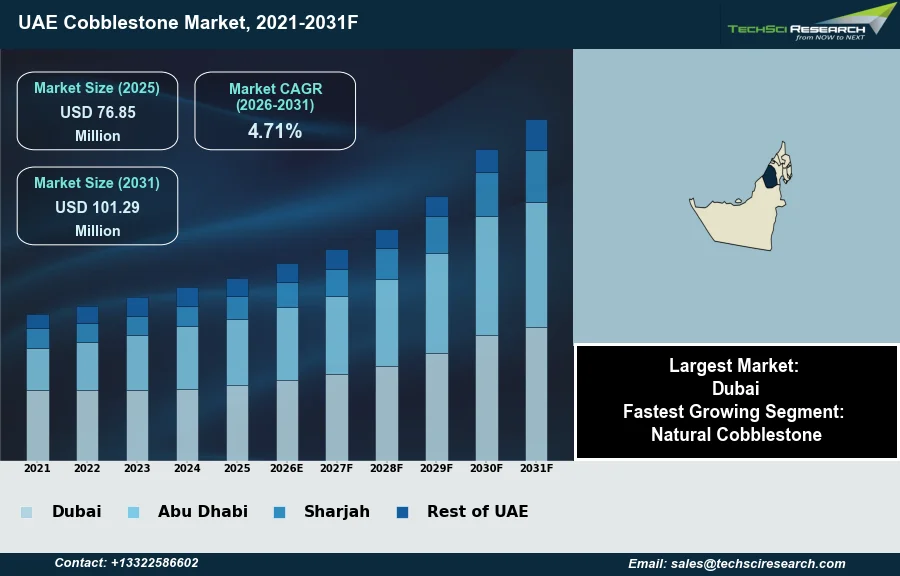
UAE Cobblestone Market was
valued at USD 73.4 Million in 2024 and is expected to reach at USD 97.56
Million in 2030 and project robust growth in the forecast period with a CAGR of
4.7% through 2030.
The UAE cobblestone market is growing steadily, driven by rapid urbanization, infrastructure expansion, and rising demand for durable and visually appealing materials. Cities like Dubai, Abu Dhabi, and Sharjah are witnessing increased use of cobblestones in residential, commercial, and public spaces. Government initiatives under Vision 2030, along with growth in tourism and hospitality, further boost demand. Their durability, sustainability, and suitability for extreme weather conditions make cobblestones ideal for urban landscaping, supporting the UAE’s focus on creating modern, eco-friendly, and pedestrian-friendly environments.
Key Market Drivers
Luxury Real Estate and Commercial Developments
The expansion of the UAE’s luxury real estate sector is playing a visible role in lifting demand for premium construction materials such as cobblestones, especially as developers across Dubai and Abu Dhabi continue to prioritize destination-style residential communities, landmark mixed-use assets, and hospitality-led commercial spaces that rely heavily on refined outdoor finishes and strong visual identity.
In premium settings, cobblestones are valued not only for their durability but also for the texture, depth, and prestige they add to entrance courts, promenades, landscaped pathways, drop-off zones, and public gathering areas, which is why they fit naturally into upscale projects where first impressions matter as much as long-term performance. Palm Jumeirah remains a strong symbol of this design approach, as luxury communities and resort environments across the UAE increasingly use hardscape materials to create a distinct sense of exclusivity and place.
For instance, Emaar reported AED 46 billion in property sales in the first half of 2025, while Knight Frank said Dubai recorded 435 home sales above US$10 million in 2024, with Palm Jumeirah remaining the top performer in this ultra-prime segment, showing how strongly premium development activity continues to shape material demand in the UAE.
Sustainability Trends in Construction
Sustainability is becoming a defining influence on the UAE cobblestone market as developers, asset owners, and public authorities place greater emphasis on materials that can support long service life, lower replacement cycles, and more climate-conscious urban design. Cobblestones align well with these priorities because they are durable, low maintenance, and compatible with landscaping strategies that aim to improve water movement, reduce surface wear, and deliver a more natural visual finish in both residential and commercial projects.
This is especially important in the UAE, where sustainability is no longer treated as a niche preference but as a mainstream development requirement tied to building standards, investor expectations, and long-term operating efficiency. Green buildings, wellness-focused districts, and environmentally responsible hospitality assets are all encouraging more careful material selection, and that benefits products that can combine aesthetics with resilience.
For instance, Emirates NBD announced that it secured 25 LEED Platinum certifications in March 2025, while Dubai’s Department of Economy and Tourism said 153 hotels received the Dubai Sustainable Tourism Stamp in 2024 after meeting 19 sustainability requirements, highlighting how strongly sustainability benchmarks are now influencing construction and fit-out choices across the UAE.
Government Initiatives and Urban Planning Policies
Government-led urban development initiatives and planning policies are also strengthening demand for cobblestones in the UAE by encouraging more attractive, pedestrian-oriented, and experience-driven public spaces across fast-growing urban corridors. As cities such as Dubai and Abu Dhabi continue to expand transport links, community districts, parks, waterfronts, and cultural destinations, the need rises for surface materials that can handle heavy footfall while still contributing to a high-quality urban environment.
Cobblestones fit this requirement well because they help create streetscapes and walkways that feel more permanent, human-scaled, and visually cohesive than purely utilitarian paving solutions. Their growing relevance is closely linked to the UAE’s wider push to build connected neighborhoods where mobility, public realm quality, and urban identity develop together rather than separately. This makes cobblestones especially suitable for plazas, shaded walkways, transit-adjacent zones, and landscaped civic areas that are being upgraded under long-term planning frameworks.
For instance, Dubai’s Metro Blue Line will span 30 kilometres with 14 stations and is designed to serve areas expected to accommodate around 1 million residents by 2040, underlining the scale of government-backed urban expansion that can directly support demand for durable and design-led paving materials.
Tourism and Hospitality Industry Growth
The rapid growth of the UAE’s tourism and hospitality sector is another strong driver of the cobblestone market because hotels, resorts, lifestyle destinations, and recreation-led developments all depend on outdoor materials that can balance aesthetics, comfort, and long-term wear resistance. Cobblestones are widely used in arrival zones, courtyards, beachfront promenades, poolside pathways, garden walkways, and outdoor dining environments, where they help create a polished guest experience while standing up to frequent use.
In a market such as the UAE, where hospitality projects compete heavily on design quality and sense of place, the choice of external finishing materials becomes an important part of the brand experience rather than a purely functional decision. This is particularly true in Dubai, where luxury hotel openings and destination development continue to raise the visual standards expected across the sector.
For instance, Dubai welcomed 18.72 million international overnight visitors in 2024, and the emirate’s hotel inventory reached 154,016 rooms across 832 establishments with average occupancy at 78.2, showing the scale of hospitality infrastructure that continues to create sustained demand for durable and visually appealing hardscape materials such as cobblestones.

Download Free Sample Report
Key Market Challenges
High Material and Installation Costs
One of the main challenges in the UAE cobblestone market is the high cost burden attached to both sourcing and installation, especially when compared with more widely used paving options such as concrete blocks and asphalt. Natural cobblestones typically involve higher procurement expenses, and the gap becomes more noticeable in projects where developers are under pressure to control budgets without sacrificing delivery speed or visual quality.
The issue is not limited to the material itself, because cobblestone laying is also more labor intensive, requires better surface preparation, and depends on experienced installers to achieve proper alignment, drainage, and finish. In a construction environment where developers are constantly balancing aesthetics with cost efficiency, this makes cobblestones harder to justify in mid-range or value-led projects, even when they offer long-term durability. For luxury developments the appeal remains strong, but the upfront investment can still affect design choices, procurement timing, and overall project feasibility.
For instance, Turner and Townsend says materials now account for around 60 percent of construction baseline costs in the UAE and forecasts tender price inflation of 3.3 percent for 2025, while AECOM expects annual construction cost increases of 4 to 6 percent, showing why premium paving packages such as cobblestones can quickly become difficult to scale across cost-sensitive projects.
Limited Availability of Raw Materials
Another important challenge in the UAE cobblestone market is the limited local availability of raw materials required for premium stone-based paving, which increases dependence on imports and leaves supply conditions exposed to shipping schedules, freight costs, and overseas production cycles. Unlike markets with abundant domestic quarry resources, the UAE relies heavily on imported natural stone for many upscale residential, hospitality, and commercial applications, and this can lengthen lead times when projects need specific textures, colors, or durability standards.
That dependence becomes even more problematic when developers are working on tightly sequenced construction schedules, because delays in imported materials can affect hardscape installation, landscaping completion, and final handover timelines. Although manufactured alternatives and engineered substitutes are available, they do not always deliver the same visual character or premium finish expected in high-end UAE developments, especially in projects designed to emphasize luxury, heritage, or resort-style appeal. This creates a persistent tension between design ambition and sourcing practicality.
For instance, the Italian Trade Agency reported that Italian exports of stones and stone technologies to the UAE reached nearly 40 million euros in the first half of 2024 and that almost 100 Italian companies participated in Big 5 Global 2024 and Marble and Stone World 2024 in Dubai, underlining how strongly the UAE still depends on imported stone supply for premium construction and landscape applications.
Competition from Alternative Paving
Solutions
The UAE cobblestone market also faces strong competition from alternative paving solutions that are often easier to procure, faster to install, and better aligned with large-scale infrastructure and community development timelines. Interlocking concrete pavers, asphalt, and other modern surface materials are widely preferred in projects where speed, uniformity, and maintenance practicality carry more weight than the premium visual character associated with cobblestones.
This is particularly relevant in roadworks, industrial districts, large residential communities, utility corridors, and public infrastructure upgrades, where contractors and authorities usually prioritize standardized execution and efficient lifecycle management. Even though cobblestones offer durability and a distinctive aesthetic, they are more time consuming to install and can become less attractive in areas that must accommodate high traffic volumes or repeated access for repairs and utility work. As a result, cobblestones tend to remain concentrated in luxury, tourism-led, and design-sensitive spaces rather than becoming the default paving choice across the broader built environment.
For instance, Dubai approved a five-year internal roads plan for 2025 to 2029 covering 634 kilometres of new roads at a cost of AED 3.7 billion, while Phoenix Concrete says its UAE facilities can produce 4 to 5 million blocks per month, illustrating the scale, speed, and supply readiness of alternative paving systems that continue to challenge wider cobblestone adoption.
Key Market Trends
Shift Towards
Sustainable Construction Practices
One of the
dominant trends in the UAE Cobblestone Market is the increasing shift toward
sustainable construction practices. As the UAE government intensifies its focus
on sustainability, particularly under the Vision 2030 plan, there has been a
notable demand for eco-friendly building materials. Cobblestones, often made
from natural stone or recycled materials, align with this trend due to their
durability, low maintenance requirements, and ability to withstand harsh
weather conditions. The growing preference for sustainable materials across
urban developments, public spaces, and luxury residential projects has
positioned cobblestones as a preferred choice for developers seeking to meet
sustainability goals.
Additionally, with a focus on reducing the carbon
footprint, cobblestones offer an environmentally responsible alternative to
conventional paving materials, as they are durable and can be reused,
contributing to a circular economy. The growing awareness among developers and
architects about the environmental impact of construction materials is a key
factor driving this trend, making cobblestones a favored solution in green
construction projects.
Increase in
High-End Residential and Commercial Projects
The UAE is
witnessing a surge in high-end residential and commercial projects,
particularly in cities like Dubai and Abu Dhabi. This trend is fueling the
demand for aesthetically pleasing and durable construction materials, with
cobblestones being increasingly used in luxury developments, landscaped areas,
and public spaces. Cobblestones are considered a premium material due to their
visual appeal, versatility, and ability to add character to urban environments.
The UAE’s booming real estate sector, driven by significant investments in
commercial, residential, and hospitality sectors, has created a growing demand
for decorative and high-quality materials. Developers and architects are opting
for cobblestones to enhance the overall aesthetic of projects, such as luxury
resorts, upscale residential communities, and sophisticated urban spaces. This
trend is expected to continue as developers seek to differentiate their
projects with materials that offer both functionality and elegance, positioning
cobblestones as a key element in the design of premium developments.
Rise of Smart
Cities and Infrastructure Projects
The rise of
smart cities and large-scale infrastructure projects in the UAE is another
trend driving the growth of the cobblestone market. The UAE government is
heavily investing in smart city initiatives, such as the development of the
Mohammed bin Rashid City in Dubai and the NEOM project, which aims to create a
futuristic, technologically advanced city. These smart cities emphasize
sustainability, advanced infrastructure, and pedestrian-friendly environments.
Cobblestones, being a durable and visually attractive material, are being
increasingly incorporated into urban planning to create aesthetic walkways,
streetscapes, and outdoor spaces that blend with the innovative designs of
smart cities.
Additionally, cobblestones are used in landscaping, parks, and
public squares, where their longevity and low maintenance align with the
operational efficiency goals of these smart city projects. As the UAE continues
to invest in such large-scale urban developments, the demand for cobblestones
will rise as part of the move towards more sustainable, people-centric, and
eco-friendly urban environments.
Technological
Advancements in Cobblestone Production
A notable
trend in the UAE Cobblestone Market is the adoption of technological
advancements in the production of cobblestones. Manufacturers are increasingly
utilizing modern machinery and techniques to improve the quality, variety, and
cost-efficiency of cobblestone production. Innovations in stone cutting,
shaping, and surface finishing allow for more customized designs and
higher-quality products that meet the evolving needs of developers and
architects. For instance, advanced machinery is enabling the production of
cobblestones in different shapes, sizes, and colors, offering greater design
flexibility for urban projects.
Furthermore, the use of computer-aided design
(CAD) and other digital technologies is enhancing the precision of production,
allowing for better consistency and reduced waste. These technological
advancements not only improve the aesthetic and functional qualities of
cobblestones but also lower the production costs, making them more accessible
for large-scale projects. As these technologies continue to evolve, the
efficiency and affordability of cobblestone production are expected to drive
further market growth, helping cobblestones maintain their appeal as a
versatile and cost-effective building material.
Segmental Insights
Type Insights
In 2024, the Natural Cobblestone segment dominated the UAE Cobblestone
Market and is expected to maintain its dominance throughout the forecast
period. Natural cobblestones, known for their durability, aesthetic appeal, and
sustainability, have become the preferred choice for various urban development
projects in the UAE. With rapid urbanization and large-scale infrastructure
projects such as luxury residential complexes, commercial developments, and
public spaces, the demand for high-quality, natural materials like cobblestones
has surged. These materials are particularly favored for their ability to blend
with both traditional and modern architectural styles, making them suitable for
diverse applications in urban planning, including walkways, streetscapes, and
public squares.
Furthermore, natural cobblestones align with the growing
emphasis on sustainability in construction, as they are eco-friendly,
long-lasting, and require minimal maintenance. The UAE's commitment to creating
green and sustainable urban environments, alongside the development of
pedestrian-friendly spaces in cities like Dubai and Abu Dhabi, has contributed
to the growing demand for these materials. Natural cobblestones are also ideal
for high-traffic areas due to their strength and ability to withstand harsh
weather conditions, including extreme heat and sandstorms.
Additionally, the
luxury real estate market in the UAE, particularly in Dubai, further fuels the
demand for natural cobblestones, as developers seek premium materials to enhance
the visual appeal of their projects. As the trend toward sustainable, durable,
and aesthetically pleasing building materials continues, natural cobblestones
are expected to maintain their market leadership in the UAE. This dominance is
reinforced by the material’s alignment with the UAE's long-term urban
development strategies, which focus on sustainable construction practices and
high-quality infrastructure.

Download Free Sample Report
Regional Insights
Largest Region
In
2024, the Dubai region was expected to dominate the UAE Cobblestone Market and
maintain its leadership during the forecast period. Dubai’s robust construction
sector, fueled by its status as a global tourism, business, and trade hub, is a
key driver behind the demand for cobblestones. The city’s large-scale
infrastructure projects, including residential complexes, commercial
developments, public spaces, and luxury resorts, heavily rely on high-quality,
durable materials like cobblestones. Dubai's continuous urbanization and iconic
real estate projects, such as Palm Jumeirah and Downtown Dubai, emphasize the
use of aesthetically appealing materials that blend well with both traditional
and modern designs.
Furthermore, the UAE government's push for sustainability
and green urban development aligns with the growing demand for cobblestones, as
they offer long-lasting, low-maintenance solutions for outdoor spaces. The
increase in public-private partnerships and significant urban redevelopment
initiatives in Dubai further boosts the demand for cobblestones, particularly
in pedestrian walkways, roads, and recreational areas. As Dubai remains a
hotspot for luxury real estate, hotels, and tourist attractions, the demand for
cobblestones in the architecture and landscaping of these high-end developments
continues to rise.
Additionally, the city’s Vision 2040 urban master plan,
which focuses on enhancing green spaces, pedestrian-friendly areas, and
sustainability, is expected to maintain the demand for cobblestones in both
public and private projects. As a result, Dubai's dominance in the UAE
Cobblestone Market is projected to continue, given its ongoing growth, urban
development projects, and focus on sustainable, high-quality infrastructure.
Other regions like Abu Dhabi and Sharjah may follow but will likely remain
behind Dubai in terms of market share during the forecast period.
Emerging Region
In
2024, Ras Al Khaimah was emerging as a key region in the UAE Cobblestone Market
and is expected to maintain its growth momentum during the forecast period. As
part of the UAE’s broader strategic development initiatives, Ras Al Khaimah is
experiencing significant growth in both residential and commercial
infrastructure projects, which is driving demand for high-quality materials
like cobblestones. The government’s focus on diversifying its economy and
promoting sustainable urban development has led to an increase in construction
activities, particularly in the hospitality, residential, and industrial
sectors. Additionally, Ras Al Khaimah has emerged as an attractive destination
for investors, with multiple new residential developments, resorts, and tourist
attractions in the pipeline.
This growth is accompanied by a rising demand for
materials that offer aesthetic appeal, durability, and environmental benefits,
which is where cobblestones come into play. As the region develops its
infrastructure to cater to both the growing population and the influx of
tourists, cobblestones are increasingly used in landscaping projects,
pedestrian pathways, and public spaces. Furthermore, Ras Al Khaimah’s
government has committed to sustainable development, which aligns well with the
growing demand for eco-friendly construction materials, such as cobblestones,
that are long-lasting and low-maintenance.
The region’s emphasis on creating
visually appealing, pedestrian-friendly urban spaces is also contributing to
the increasing use of cobblestones in landscaping and architectural designs.
With continued investment in infrastructure, urban planning, and tourism, Ras
Al Khaimah is poised to be an emerging leader in the UAE Cobblestone Market,
with significant growth expected throughout the forecast period. This
development, supported by both private and public sector projects, ensures that
the region will play an increasingly important role in the UAE’s construction
and infrastructure landscape.
Recent Developments
- In July 2025, Dubai Municipality announced it had completed AED190 million worth of landscaping and beautification works across major intersections and roadways during the first half of the year, covering more than three million square metres. The projects included more than 300,000 trees and seedlings, 222,500 square metres of ground covers and flowers, and smart irrigation systems connected to IoT-enabled remote-control networks, which marked a clear innovation step in how Dubai is designing and managing public outdoor environments. For the UAE cobblestone and paving segment, this matters because large urban beautification projects typically drive demand for coordinated hardscape materials, including decorative paving and stone-surface solutions used around landscaped corridors and public-realm upgrades.
- In May 2025, Construction Machinery Middle East reported on the renewed collaboration between Dynapac and Al Shirawi Trading in the UAE, describing it as a major partnership aimed at strengthening the local road-construction and paving-equipment market. The article said Dynapac planned to introduce a new generation of highway pavers along with advances in digitalisation and electric equipment at BAUMA 2025, positioning the partnership around both product rollout and technology-led innovation. This is relevant to the UAE cobblestone and paving ecosystem because improved laying equipment, smarter controls, and cleaner machinery can influence how efficiently premium stone, block, and surface-finish projects are executed across urban and infrastructure developments.
- In Feb 2025, Sika has
acquired a leading green roof provider in Singapore, enhancing its position in
the sustainable construction market. This strategic acquisition allows Sika to
expand its product offerings with innovative green roofing solutions,
addressing the growing demand for environmentally friendly building materials.
The move aligns with Sika’s commitment to sustainability and strengthens its
presence in Asia’s fast-growing markets. By integrating this acquisition, Sika
aims to drive growth and contribute to the development of eco-friendly
infrastructure in the region.
- In Oct 2024, CEMEX has been
selected as the primary concrete supplier for Line 1 of the Bogotá Metro, a
major infrastructure project in Colombia. This partnership underscores CEMEX’s
commitment to providing high-quality, sustainable construction materials for
large-scale projects. The Bogotá Metro, a key initiative to improve urban
mobility, will benefit from CEMEX’s advanced concrete solutions, ensuring the
durability and efficiency of the metro's construction. This collaboration
highlights CEMEX’s role in supporting significant transportation infrastructure
development in Latin America.
Key Market Players
- LafargeHolcim
Ltd.
- CRH
plc
- Vulcan
Materials Company
- Martin
Marietta Materials, Inc.
- Hanson
UK
- Oldcastle
APG
- Sika
AG
- CEMEX
S.A.B. de C.V.
|
By Type
|
By Application
|
By Region
|
- Mechanical Pebble
- Natural
Cobblestone
- Riverstone
- Others
|
- Roading
- Architecture
- Others
|
- Abu Dhabi
- Dubai
- Sharjah
- Ajman
- Umm Al Quwain
- Ras Al Khaimah
- Fujairah
|
Report Scope:
In this report, the UAE Cobblestone
Market has been segmented into the following categories, in addition to the
industry trends which have also been detailed below:
- UAE Cobblestone
Market, By Type:
o Mechanical Pebble
o Natural Cobblestone
o Riverstone
o Others
- UAE Cobblestone
Market, By Application:
o Roading
o Architecture
o Others
- UAE Cobblestone
Market, By Region:
o Abu Dhabi
o
Dubai
o
Sharjah
o
Ajman
o
Umm Al
Quwain
o
Ras Al
Khaimah
o Fujairah
Competitive Landscape
Company Profiles: Detailed analysis of the major companies
present in the UAE Cobblestone Market.
Available Customizations:
UAE Cobblestone Market report with the given
market data, TechSci Research offers customizations according to a company's
specific needs. The following customization options are available for the
report:
Company Information
- Detailed analysis and
profiling of additional market players (up to five).
UAE Cobblestone Market is an upcoming report to be
released soon. If you wish an early delivery of this report or want to confirm
the date of release, please contact us at [email protected]