Main Content start here
Main Layout
Report Description

Report Description

Forecast Period

2026-2030

Market Size (2024)

USD 5.40 Billion

Market Size (2030)

USD 11.94 Billion

CAGR (2025-2030)

13.97%

Fastest Growing Segment

Carbon Steel Rebar

Largest Market

Riyadh

Market Overview

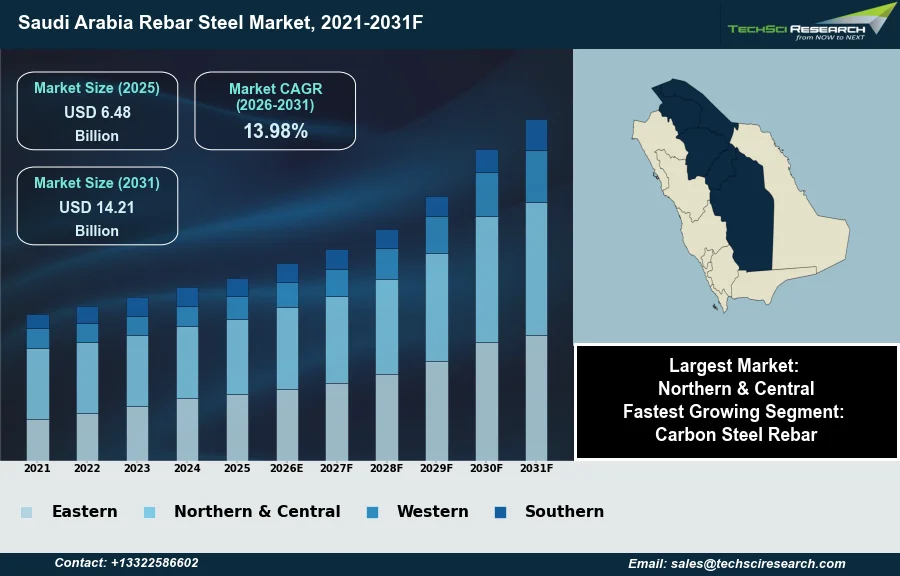
Saudi Arabia's Rebar Steel Market was valued at USD 5.40 billion in 2024 and is projected to reach USD 11.94 billion by 2030, with a CAGR of 13.97% over the forecast period. 

The rebar steel market comprises the industry engaged in the production, distribution, and sale of steel reinforcing bars (rebar) used primarily in the construction sector. Rebar is a critical component in reinforced concrete and masonry structures, providing tensile strength and durability to concrete, which is inherently weak in tension. The market encompasses various types of rebar, including deformed and plain bars, and varies in sizes and grades to meet diverse construction needs.

Rebar steel is essential in constructing buildings, bridges, roads, and other infrastructure projects. The market is driven by factors such as urbanization, population growth, and increasing investment in infrastructure development globally. Additionally, advancements in manufacturing technologies and the adoption of sustainable practices are shaping the market dynamics.

Key Market Drivers

Population Growth and Urbanization

Population growth and urbanization are supporting Saudi Arabia’s rebar steel market because rising household formation, expanding cities, and stronger demand for social infrastructure are translating into a larger pipeline of residential buildings, schools, healthcare facilities, utilities, and mixed-use urban projects that all rely heavily on reinforced concrete structures. The demographic base for this demand is already substantial, with Saudi census results showing the Kingdom’s population rose from 24 million in 2010 to 32.2 million in 2022, reflecting a 34.2 percent increase and an average annual growth rate of 2.5 percent, which indicates a sustained need for new housing and city infrastructure rather than a temporary construction cycle.

Urban development is being reinforced by Vision 2030’s housing agenda, where the official Housing Program states that homeownership increased from 47 percent before Vision 2030 to more than 60 percent by the end of 2022 and remains on a path toward 70 percent by 2030, creating clear momentum for new communities and large-scale residential expansion. This matters directly for rebar demand because Saudi housing delivery is still largely concrete intensive, meaning every new apartment block, villa cluster, public amenity, or urban road connection pushes additional demand for steel reinforcement across foundations, columns, beams, and slabs.

For instance, the Ministry of Municipalities and Housing announced in March 2026 that nearly 26,000 housing units were launched under off-plan sales projects through the Sakani platform during the first half of 2025 to support the goal of raising Saudi family homeownership to 70 percent, a clear sign that urban population growth is being converted into active construction volumes that support continued rebar consumption 

Economic Diversification and Industrial Growth

Economic diversification is also strengthening Saudi Arabia’s rebar steel market because the Kingdom’s push to expand manufacturing, logistics, mining, and downstream industry requires the construction of factories, warehouses, industrial parks, worker facilities, transport links, and utility systems that depend heavily on reinforced steel structures. This shift is central to Vision 2030, whose Privatization Program is designed to increase private-sector participation and improve asset efficiency, while industrial development authorities continue to expand the physical backbone needed for non-oil growth across multiple sectors.

The scale of industrial expansion is already visible in official investment data, with MODON reporting that it attracted SAR 24 billion in new local and foreign investments in 2024, lifting cumulative investments to SAR 440 billion across 39 industrial cities and raising the number of industrial, logistical, and investment establishments to 8,616. That kind of ecosystem creates durable rebar demand because industrial growth is not limited to plant buildings alone, but also includes roads, utility corridors, storage zones, worker services, and future expansion infrastructure that extend steel consumption across the full construction chain. Strategic industrial geographies such as King Abdullah Economic City and Jubail continue to reinforce this pattern by anchoring logistics and industrial capacity that requires ongoing structural development and supporting civil works.

For instance, MODON said jobs in its industrial cities reached 593,000 in 2024 after about 55,000 new jobs were added during the year, which shows that industrial diversification is creating a larger operating footprint on the ground and, in turn, a stronger long-term requirement for rebar in industrial buildings and related infrastructure across Saudi Arabia.


Download Free Sample Report

Key Market Challenges

Fluctuations in Raw Material Prices

Fluctuations in raw material prices remain a serious challenge for Saudi Arabia’s rebar steel market because producers are exposed to changing costs for scrap, iron ore, freight, and energy-linked inputs, all of which can alter mill margins quickly and make project pricing more difficult for both manufacturers and construction contractors.

This issue is especially important in the Kingdom because the sector still depends on a mix of locally available scrap and internationally influenced input markets, meaning domestic producers are affected not only by local demand conditions but also by global trade movements, shipping costs, and shifts in benchmark pricing outside Saudi Arabia. Market evidence from 2025 shows how unstable this environment can be, as Fastmarkets reported that Saudi domestic scrap prices moved differently from Turkey import benchmarks, prompting the launch of a dedicated Saudi domestic steel scrap index in August 2025 because local negotiations and contracts needed a more accurate reference point for a market facing sharp price swings and weak mill margins. The pressure is amplified by supply constraints, with Argaam reporting in October 2025 that Al Ittefaq Steel saw local scrap availability as limited while demand remained high, keeping prices elevated and volatile and increasing cost pressure as new steel plants entered the market.

For instance, Saudi Iron and Steel Company Hadeed reduced rebar prices by SAR 70 per ton for May 2025 deliveries to SAR 2,280 per ton, a move that illustrates how quickly producers may have to reset selling prices in response to changing raw material conditions and market realities, often leaving little room to protect profitability without unsettling downstream construction budgets.

Environmental Regulations and Sustainability Concerns

Environmental regulations and sustainability expectations are also becoming a meaningful challenge for Saudi Arabia’s rebar steel market because steelmaking is energy intensive and increasingly subject to pressure from national decarbonization goals, cleaner production standards, and the construction sector’s growing preference for materials that can demonstrate stronger environmental performance.

The policy direction in Saudi Arabia is now very clear, with the Saudi Green Initiative supporting the Kingdom’s ambition to reach net zero emissions by 2060 and advancing 77 activated initiatives representing more than 186 billion dollars of investment, while also targeting carbon emissions reductions of 278 million tonnes annually by 2030.

For steel producers, this creates a more demanding operating environment because compliance increasingly requires investment in energy efficiency, emissions control, process optimization, waste management, and certification systems that can show alignment with evolving sustainability expectations rather than simple output expansion alone. Large industrial groups are already responding, and SABIC’s sustainability reporting states that it has targeted a 25 percent reduction in energy intensity by 2025 from its 2010 baseline while also aiming to facilitate 12 GW of renewable energy capacity in Saudi Arabia by 2030, highlighting the scale of transition expected from heavy industry.

For instance, National Steel Company Ltd operating under Al Ittefaq Steel Products received ISO 50001 certification in 2024, and SGS said the certification strengthened compliance with regulatory requirements while helping reduce energy costs and greenhouse gas emissions, which shows that even established steel producers in Saudi Arabia are being pushed to invest in structured sustainability upgrades that can raise costs in the near term even as they improve long-run competitiveness.

Key Market Trends

Adoption of Advanced Manufacturing Technologies

The Saudi Arabia rebar steel market is experiencing a significant trend towards the adoption of advanced manufacturing technologies. This shift is driven by the need to enhance production efficiency, improve product quality, and meet the growing demand for high-performance rebar. Technologies such as automation, robotics, and digitalization are being increasingly integrated into steel manufacturing processes.

Automation and robotics streamline operations, reduce human error, and increase productivity. Automated systems can handle repetitive tasks, such as cutting, bending, and welding rebar, with precision and speed, leading to consistent product quality and reduced labor costs. Robotics also enhance safety by taking over dangerous tasks, minimizing the risk of workplace accidents.

Digitalization, including the use of Industry 4.0 technologies like the Internet of Things (IoT) and artificial intelligence (AI), is revolutionizing the steel manufacturing process. IoT devices enable real-time monitoring of equipment and processes, allowing for predictive maintenance and reducing downtime. AI algorithms analyze data to optimize production parameters, improve energy efficiency, and minimize waste.

The adoption of advanced manufacturing technologies not only boosts efficiency and quality but also supports sustainability goals. By optimizing resource use and reducing emissions, these technologies align with environmental regulations and market demand for eco-friendly products. As a result, the integration of advanced manufacturing technologies is a key trend shaping the future of the rebar steel market in Saudi Arabia.

Increasing Demand for High-Strength Rebar

Another notable trend in the Saudi Arabia rebar steel market is the increasing demand for high-strength rebar. As construction projects become more complex and ambitious, the need for materials that can withstand higher loads and provide greater structural integrity is growing. High-strength rebar offers several advantages, including improved durability, reduced material usage, and enhanced safety.

Infrastructure projects, such as high-rise buildings, bridges, and industrial facilities, require rebar with superior tensile strength to support large-scale constructions. High-strength rebar reduces the amount of steel needed, which lowers construction costs and minimizes the environmental impact. Additionally, it enhances the safety and longevity of structures, making it a preferred choice for critical infrastructure projects. Saudi Arabia's mega projects, including NEOM and The Line, are set to revolutionize urban living. NEOM alone spans 26,500 square kilometers and is projected to cost USD 500 billion. These large-scale developments require substantial amounts of construction materials, including rebar, to build the envisioned infrastructure. 

The development of new grades of high-strength rebar, including micro alloyed and thermos mechanically treated (TMT) rebar, is driving this trend. These advanced rebar types offer better performance characteristics, such as increased resistance to corrosion, fatigue, and seismic activity. The construction industry's emphasis on quality and safety standards further fuels the demand for high-strength rebar, positioning it as a key growth area in the market.

Sustainability and Green Building Initiatives

Sustainability and green building initiatives are increasingly influencing the Saudi Arabia rebar steel market. As part of its Vision 2030 plan, Saudi Arabia is committed to promoting sustainable development and reducing its carbon footprint. This commitment is reflected in the construction sector, where green building practices are gaining prominence.

Green building initiatives focus on minimizing the environmental impact of construction activities by using sustainable materials and practices. In the rebar steel market, this translates to a growing demand for eco-friendly rebar products. Manufacturers are adopting cleaner production technologies, such as electric arc furnaces (EAF) that use scrap metal, reducing reliance on virgin raw materials and lowering greenhouse gas emissions.

Recycling and reusing steel is also becoming a critical aspect of sustainability in the market. The rebar steel industry is increasingly incorporating recycled steel into its production processes, aligning with circular economy principles. This not only reduces waste but also conserves natural resources and energy.

Green certification programs, such as LEED (Leadership in Energy and Environmental Design), encourage the use of sustainable construction materials, including rebar with low embodied carbon. These certifications drive the demand for environmentally friendly rebar, prompting manufacturers to innovate and develop products that meet green building standards..

Segmental Insights

Type Insights

The Deformed held the largest market share in 2024. Deformed rebar is designed with ridges and grooves on its surface, which significantly improve the bonding between the steel and concrete. This enhanced bonding is crucial for the structural integrity of reinforced concrete, ensuring that the rebar and concrete act together to withstand stresses. In high-stress applications such as high-rise buildings, bridges, and industrial structures, this superior bonding strength is essential for safety and durability.

Deformed rebar generally possesses higher tensile strength compared to mild rebar. This characteristic makes it more suitable for structural applications that require robust and reliable materials. The high tensile strength of deformed rebar ensures that it can handle greater loads and resist deformation under stress, which is vital for the long-term performance of infrastructure projects.

Saudi Arabia's construction industry is governed by stringent building codes and standards that prioritize safety and durability. These regulations often specify the use of deformed rebar due to its superior mechanical properties and performance. Compliance with these standards is mandatory for developers and contractors, further driving the demand for deformed rebar.


Download Free Sample Report

Regional Insights

Riyadh held the largest market share in 2024. The Riyadh region dominatesthe Saudi Arabia rebar steel market for several compelling reasons that highlight its pivotal role in the country's economic and infrastructural landscape.

As the capital city of Saudi Arabia, Riyadh serves as the economic, administrative, and cultural hub of the country. This central role positions Riyadh as a focal point for extensive construction activities and infrastructure development. The city's continuous expansion and modernization efforts require substantial quantities of rebar steel for various construction projects.

Riyadh is experiencing rapid urbanization and population growth, driven by factors such as internal migration, employment opportunities, and government initiatives to decentralize economic activities. This demographic shift fuels the demand for residential buildings, commercial complexes, educational institutions, healthcare facilities, and other infrastructure developments all of which require significant quantities of rebar steel for construction.

Saudi Arabia's Vision 2030 initiative, aimed at diversifying the economy and reducing dependency on oil revenues, includes several mega-projects and infrastructure investments in Riyadh. These projects, such as the Riyadh Metro, King Abdullah Financial District, and various residential and commercial developments, rely heavily on rebar steel for their structural integrity and longevity. The government's commitment to these initiatives ensures a steady demand for rebar steel in the region.

Riyadh's strategic location in the heart of Saudi Arabia enhances its importance as a logistical and transportation hub. The city's well-developed road networks, proximity to major ports, and ongoing investments in transportation infrastructure facilitate the efficient distribution of construction materials, including rebar steel, across the region and beyond. This logistical advantage further supports Riyadh's dominance in the rebar steel market by ensuring timely supply and delivery of materials to construction sites.

The regulatory environment in Riyadh, characterized by stringent building codes and standards enforced by local authorities, mandates the use of high-quality construction materials, including rebar steel. Compliance with these regulations ensures the safety, durability, and resilience of structures built in the region, driving the preference for reliable and certified rebar steel suppliers.

Recent Developments

  • In January 2026, Fushun New Steel announced that it had obtained SASO certification in Saudi Arabia for its rebar products, a significant product-market development because SASO approval is a key compliance gateway for selling construction steel in the Kingdom and effectively opens the door for certified rebar supply into Saudi projects.
  • In December 2025, Kallanish reported that Hadeed raised domestic prices for 12-32 mm ASTM A615 Grade 60 rebar by SAR 70 per tonne for January sales, while National Committee Steel Industry vice chairman and Al-Ittefaq sales and marketing general manager Jassim Abbas said Saudi rebar demand in the fourth quarter of 2025 had increased by 2-3% year on year, making the move a notable commercial development around the Kingdom’s flagship rebar product line as market conditions firmed.
  • In April 2025, Saudi Arabia’s Al-Ittefaq Steel Products Company officially joined the World Steel Association as a regular member, with CEO Sharjeel Azhar named as its representative, making Al-Ittefaq only the second Saudi steel producer after Hadeed to secure that status and marking an important collaboration-oriented step in connecting a major Saudi rebar producer more closely with global steel governance and industry networks..

Key Market Players

  • Saudi Iron & Steel Company (HADEED)
  • Al Ittefaq Steel Products Co.
  • Rajhi Steel Industries Company Ltd.
  • Watania Steel Factory Corporation
  • Al Yamamah Company for Reinforcing Steel Bars
  • Saudi National Steel Factory
  • Baghlaf Steel
  • Mass Steel
  • Madar Building Materials, LLC
  • Bahra Steel Co.

By Type

By End Use

By Process

By Finishing Type

By Region

  • Deformed
  • Mild
  • Residential Sector
  • Commercial Sector
  • Industrial Sector
  • Public Sector
  • Basic Oxygen Steelmaking
  • Electric Arc Furnace
  • Epoxy-Coated Rebar
  • Carbon Steel Rebar
  • Others
  • Riyadh
  • Makkah
  • Madinah
  • Eastern Province
  • Dammam
  • Rest of Saudi Arabia

Report Scope:

In this report, the Saudi Arabia Rebar Steel Market has been segmented into the following categories, in addition to the industry trends which have also been detailed below:

  • Saudi Arabia Rebar Steel Market, By Type:

o   Deformed

o   Mild

  • Saudi Arabia Rebar Steel Market, By End Use:

o   Residential Sector

o   Commercial Sector

o   Industrial Sector

o   Public Sector   

  • Saudi Arabia Rebar Steel Market, By Process:

o   Basic Oxygen Steelmaking

o   Electric Arc Furnace

  • Saudi Arabia Rebar Steel Market, By Finishing Type:

o   Epoxy-Coated Rebar

o   Carbon Steel Rebar

o   Others

  • Saudi Arabia Rebar Steel Market, By Region:

o   Riyadh

o   Makkah

o   Madinah

o   Eastern Province

o   Dammam

o   Rest of Saudi Arabia

Competitive Landscape

Company Profiles: Detailed analysis of the major companies present in the Saudi Arabia Rebar Steel Market.

Available Customizations:

Saudi Arabia Rebar Steel Market report with the given market data, TechSci Research offers customizations according to a company's specific needs. The following customization options are available for the report:

Company Information

  • Detailed analysis and profiling of additional market players (up to five).

Saudi Arabia Rebar Steel Market is an upcoming report to be released soon. If you wish an early delivery of this report or want to confirm the date of release, please contact us at [email protected]

Table of content

Table of content

1.         Product Overview

1.1.    Market Definition

1.2.    Scope of the Market

1.2.1.Markets Covered

1.2.2.Years Considered for Study

1.2.3.Key Market Segmentations

2.         Research Methodology

2.1.    Objective of the Study

2.2.    Baseline Methodology

2.3.    Formulation of the Scope

2.4.    Assumptions and Limitations

2.5.    Sources of Research

2.5.1.Secondary Research

2.5.2.Primary Research

2.6.    Approach for the Market Study

2.6.1.The Bottom-Up Approach

2.6.2.The Top-Down Approach

2.7.    Methodology Followed for Calculation of Market Size & Market Shares

2.8.    Forecasting Methodology

2.8.1.Data Triangulation & Validation

3.         Executive Summary

4.         Voice of Customer

5.         Saudi Arabia Rebar Steel Market Overview

6.         Saudi Arabia Rebar Steel Market Outlook

6.1.    Market Size & Forecast

6.1.1.By Value

6.2.    Market Share & Forecast

6.2.1.By Type (Deformed, Mild)

6.2.2.By End Use (Residential Sector, Commercial Sector, Industrial Sector, Public Sector)

6.2.3.By Process (Basic Oxygen Steelmaking, Electric Arc Furnace)

6.2.4.By Finishing Type (Epoxy-Coated Rebar, Carbon Steel Rebar, Others)

6.2.5.By Region (Riyadh, Makkah, Madinah, Eastern Province, Dammam, Rest of Saudi Arabia)

6.3.    By Company (2024)

6.4.    Market Map

7.         Riyadh Rebar Steel Market Outlook

7.1.    Market Size & Forecast

7.1.1.By Value

7.2.    Market Share & Forecast

7.2.1.By Type

7.2.2.By End Use

7.2.3.By Process

7.2.4.By Finishing Type

8.         Makkah Rebar Steel Market Outlook

8.1.    Market Size & Forecast

8.1.1.By Value

8.2.    Market Share & Forecast

8.2.1.By Type

8.2.2.By End Use

8.2.3.By Process

8.2.4.By Finishing Type

9.         Madinah Rebar Steel Market Outlook

9.1.    Market Size & Forecast

9.1.1.By Value

9.2.    Market Share & Forecast

9.2.1.By Type

9.2.2.By End Use

9.2.3.By Process

9.2.4.By Finishing Type

10.      Eastern Province Rebar Steel Market Outlook

10.1. Market Size & Forecast

10.1.1.     By Value

10.2. Market Share & Forecast

10.2.1.     By Type

10.2.2.     By End Use

10.2.3.     By Process

10.2.4.     By Finishing Type

11.      Dammam Rebar Steel Market Outlook

11.1. Market Size & Forecast

11.1.1.     By Value

11.2. Market Share & Forecast

11.2.1.     By Type

11.2.2.     By End Use

11.2.3.     By Process

11.2.4.     By Finishing Type

12.      Market Dynamics

12.1. Drivers

12.2. Challenges

13.      Market Trends and Developments

14.      Saudi Arabia Economic Profile

15.      Company Profiles

15.1.  Saudi Iron & Steel Company (HADEED)

15.1.1.    Business Overview

15.1.2.     Key Revenue and Financials  

15.1.3.     Recent Developments

15.1.4.     Key Personnel/Key Contact Person

15.1.5.     Key Product/Services Offered

15.2.  Al Ittefaq Steel Products Co.

15.2.1.    Business Overview

15.2.2.     Key Revenue and Financials  

15.2.3.     Recent Developments

15.2.4.     Key Personnel/Key Contact Person

15.2.5.     Key Product/Services Offered

15.3.  Rajhi Steel Industries Company Ltd.

15.3.1.    Business Overview

15.3.2.     Key Revenue and Financials  

15.3.3.     Recent Developments

15.3.4.     Key Personnel/Key Contact Person

15.3.5.     Key Product/Services Offered

15.4.  Watania Steel Factory Corporation

15.4.1.    Business Overview

15.4.2.     Key Revenue and Financials  

15.4.3.     Recent Developments

15.4.4.     Key Personnel/Key Contact Person

15.4.5.     Key Product/Services Offered

15.5.  Al Yamamah Company for Reinforcing Steel Bars

15.5.1.    Business Overview

15.5.2.     Key Revenue and Financials  

15.5.3.     Recent Developments

15.5.4.     Key Personnel/Key Contact Person

15.5.5.     Key Product/Services Offered

15.6.  Saudi National Steel Factory

15.6.1.    Business Overview

15.6.2.     Key Revenue and Financials  

15.6.3.     Recent Developments

15.6.4.     Key Personnel/Key Contact Person

15.6.5.     Key Product/Services Offered

15.7.  Baghlaf Steel

15.7.1.    Business Overview

15.7.2.     Key Revenue and Financials  

15.7.3.     Recent Developments

15.7.4.     Key Personnel/Key Contact Person

15.7.5.     Key Product/Services Offered

15.8.  Mass Steel

15.8.1.    Business Overview

15.8.2.     Key Revenue and Financials  

15.8.3.     Recent Developments

15.8.4.     Key Personnel/Key Contact Person

15.8.5.     Key Product/Services Offered

15.9.  Madar Building Materials, LLC

15.9.1.    Business Overview

15.9.2.     Key Revenue and Financials  

15.9.3.     Recent Developments

15.9.4.     Key Personnel/Key Contact Person

15.9.5.     Key Product/Services Offered

15.10.                     Bahra Steel Co.

15.10.1. Business Overview

15.10.2.   Key Revenue and Financials  

15.10.3.   Recent Developments

15.10.4.   Key Personnel/Key Contact Person

15.10.5.   Key Product/Services Offered

16.      Strategic Recommendations

17.      About Us & Disclaimer

Figures and Tables

Frequently asked questions

Frequently asked questions

The market size of the Saudi Arabia Rebar Steel Market was USD 5.40 Billion in 2024.

In 2024, public sector dominated Saudi Arabia's rebar steel market due to extensive government-led infrastructure projects under Vision 2030, including housing, transportation, and industrial developments. Public sector investments in megaprojects like NEOM, Red Sea Project, and urban expansion drive high demand for rebar steel, a key material for reinforced concrete structures.

The major challenges for the Saudi Arabia rebar steel market include fluctuations in raw material prices, stringent environmental regulations, competition from alternative materials, and the need for technological advancements to improve production efficiency and sustainability. These factors impact cost structures, market dynamics, and overall industry growth.

The drivers for the Saudi Arabia rebar steel market include infrastructure development under Vision 2030, rapid urbanization, population growth, and government policies supporting economic diversification. These factors fuel demand for rebar steel in construction of residential, commercial, industrial, and public infrastructure projects across the kingdom.

Related Reports

We use cookies to deliver the best possible experience on our website. To learn more, visit our Privacy Policy. By continuing to use this site or by closing this box, you consent to our use of cookies. More info.