|
Key Insights
|
Details
|
|
Forecast Period
|
2027-2031
|
|
Market Size (2025)
|
USD 178.56 Million
|
|
CAGR (2026-2031)
|
12.51%
|
|
Fastest Growing Segment
|
Home Energy Management System (HEMS)
|
|
Largest Market
|
Northern & Central
|
|
Market Size (2031)
|
USD 362.19 Million
|
Market Overview
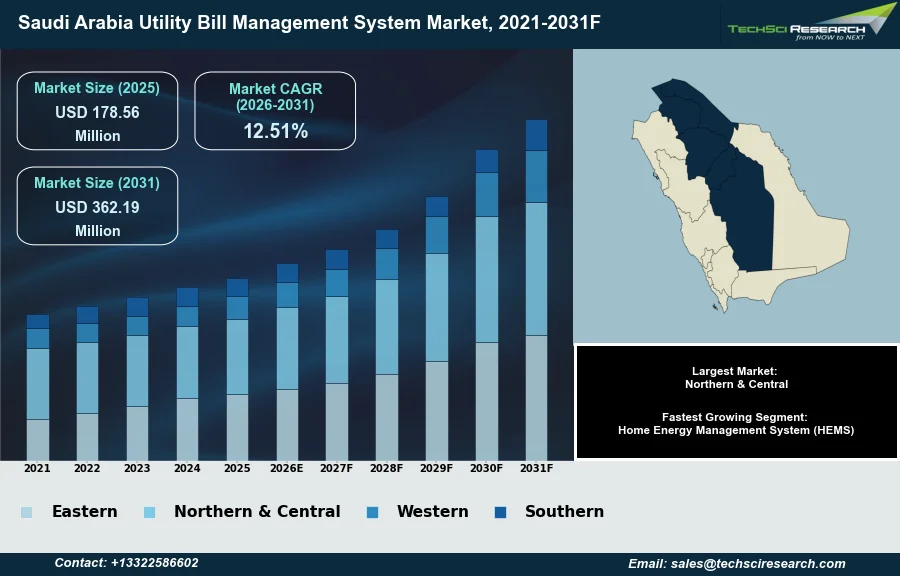
The Saudi Arabia Utility Bill Management System Market will grow from USD 178.56 Million in 2025 to USD 362.19 Million by 2031 at a 12.51% CAGR. A Utility Bill Management System (UBMS) represents a software solution designed to automate the collection, processing, and analytical review of utility consumption data and associated invoices for both organizational and individual entities, thereby enabling precise billing and optimized resource utilization. The Saudi Arabia Utility Bill Management System market experiences growth primarily due to distinct drivers such as the extensive national digital transformation agenda under Saudi Vision 2030, which prioritizes efficiency and technological integration across essential services. Furthermore, governmental directives advocating for smart grid implementation and energy conservation initiatives, along with an increasing need for cost optimization and transparent consumption monitoring among commercial and residential consumers, significantly propel market demand.
According to Saudi Energy, in 2025, the automation rate of distribution stations across the Kingdom reached 40.8%, underscoring substantial investment in digital infrastructure enhancement. This progressive digitalization, encompassing the widespread deployment of advanced metering infrastructure, forms a fundamental basis for the increasing demand for sophisticated utility bill management solutions. Nevertheless, a notable challenge potentially impeding market expansion is the inherent complexity involved in integrating modern UBMS platforms with the disparate legacy utility infrastructure and existing enterprise resource planning systems prevalent throughout the Saudi Arabian utility sector.
Key Market Drivers
Vision 2030-Driven Digital Transformation Accelerates UBMS Deployment
The Saudi Arabia Utility Bill Management System market is substantially driven by the nation's robust commitment to National Digital Transformation Initiatives, aiming to modernize various sectors through advanced technology adoption. This broad governmental agenda, deeply embedded within Saudi Vision 2030, fosters an environment conducive to the deployment of sophisticated digital solutions like UBMS. Such initiatives involve significant investments in digital infrastructure, cloud computing, and artificial intelligence across public and private entities. For instance, Saudi Arabia's Information and Communications Technology (ICT) sector was valued at nearly $48 billion as of May 2025, underscoring the foundational digital investment propelling market expansion. This extensive digitalization across the Kingdom creates an inherent demand for integrated systems that can efficiently manage complex utility data, optimize processes, and support smart city development.
Operational Efficiency and Data Analytics Drive UBMS for Large Utilities
A second critical factor propelling the market is the increased emphasis on operational efficiency within the utility sector. Companies are actively seeking ways to streamline operations, reduce waste, and enhance resource management, with UBMS providing the tools to achieve these goals. The integration of advanced data analytics for consumption management enables utilities to identify inefficiencies, predict demand, and manage assets more effectively. According to Saudi Energy, in March 2026, its gross profit for 2025 grew by 18.9% to SAR 20.8 billion, reflecting improved operational efficiency gained through strategic initiatives. This focus on efficiency is crucial for large-scale utility providers. Furthermore, the sheer scale of the Saudi utility landscape, with Saudi Electricity Company serving more than 11.5 million customers in April 2026, highlights the profound need for automated and efficient billing and management systems to handle such an extensive customer base and complex operations.
Download Free Sample Report
Key Market Challenges
Legacy IT and ERP Integration Challenges
The inherent complexity of integrating modern Utility Bill Management System (UBMS) platforms with disparate legacy utility infrastructure and existing enterprise resource planning (ERP) systems significantly impedes market growth. Many utility providers in Saudi Arabia operate on outdated core IT systems not originally designed for the interconnected digital environment of contemporary solutions. This creates substantial technical hurdles, requiring extensive customization and prolonged implementation cycles for new UBMS deployments. The high resource allocation needed for such integrations directly impacts the return on investment for adopting advanced UBMS, making it a less appealing proposition for entities already grappling with operational costs.
IT Disruptions and Maintenance Costs Limiting UBMS Adoption
For instance, research conducted in 2025 indicated that 66 percent of Saudi organizations reported weekly disruptions to business operations due to flaws in their core enterprise IT systems. This pervasive issue highlights the fundamental incompatibility and instability of current infrastructure, posing a considerable barrier to the seamless integration and widespread adoption of innovative utility management solutions. Furthermore, maintaining these older systems diverts significant financial resources, as maintenance alone can consume up to 40% of an organization's IT budget. This expenditure reduces available capital for new technology investments, directly hindering market expansion for advanced UBMS.
Key Market Trends
Real-time IoT Monitoring for Energy Savings and Improved Utility Operations
Real-time Consumption Monitoring via IoT is a significant trend transforming the Saudi Arabia Utility Bill Management System market by providing immediate insights into energy usage. This capability, driven by the widespread deployment of smart meters and IoT devices, moves beyond traditional periodic meter readings to offer continuous data streams. This granular information empowers both residential and commercial consumers to actively manage their consumption, fostering energy conservation and promoting efficiency. Utility providers leverage this real-time data for improved network management, predictive maintenance, and enhanced customer service, leading to more responsive utility operations. According to ENTEK.AI, in June 2026, Saudi enterprises typically achieve 15-30% energy savings within the first year of implementing IoT monitoring. This direct financial benefit underscores the strong market appeal for UBMS solutions that integrate real-time IoT consumption data.
Flexible Tariffs and Dynamic Billing Reflecting Consumption and Peak Demand
The evolution of flexible tariff and billing models represents another impactful trend, driven by the need for more dynamic and responsive pricing structures that reflect actual consumption patterns and peak demand. As the energy landscape integrates more renewable sources and demand-side management becomes crucial, traditional flat-rate billing is being replaced by models that incentivize off-peak consumption or reward energy efficiency. This shift necessitates sophisticated UBMS platforms capable of handling complex calculations, real-time adjustments, and transparent communication of these varied pricing structures to consumers. Such systems are vital for enabling new services and revenue streams for utilities while offering consumers greater control over their costs. According to Clenergize, in August 2025, the KSA electricity tariffs shifted for commercial users, setting SAR 0.22 per kWh for consumption up to 6,000 kWh/month and SAR 0.32 per kWh for usage exceeding 6,000 kWh/month. This change illustrates the ongoing adaptation of billing models to encourage more efficient energy utilization.
Segmental Insights
HEMS: Fastest-Growing Segment Driven by Vision 2030, Consumer Awareness, and Smart Meter Deployment
The Saudi Arabia Utility Bill Management System Market is witnessing Home Energy Management Systems (HEMS) emerge as the fastest-growing segment. This rapid expansion is primarily driven by the Kingdom's strategic initiatives under Saudi Vision 2030, which prioritizes energy efficiency, digitalization, and sustainability. Increasing consumer awareness regarding energy conservation, coupled with rising electricity costs, motivates homeowners to adopt HEMS for optimized consumption and reduced utility expenditure. Furthermore, the large-scale deployment of smart meters by entities like the Saudi Electricity Company (SEC) provides real-time data, empowering residential users to actively manage their energy usage. This supportive regulatory environment and technological advancements collectively accelerate HEMS adoption.
Regional Insights
Riyadh-Driven Growth and Regulatory Support Drive Regional Market Leadership
The Northern & Central region leads the Saudi Arabia Utility Bill Management System Market, primarily driven by the significant economic activities and substantial population concentrated in Riyadh, the nation's capital. This region exhibits high demand for utility services due to extensive infrastructure development and numerous commercial and residential establishments. Furthermore, Riyadh's role as a center for digital transformation initiatives actively promotes the adoption of advanced utility management technologies. Regulatory frameworks overseen by bodies such as the Ministry of Energy and the Saudi Electricity Regulatory Authority, which supervise the electricity and water desalination sectors, further reinforce the necessity for efficient and modernized billing systems across this prominent region.
Recent Developments
-
In September 2025, the Saudi Electricity Company (SEC) entered into a strategic Memorandum of Understanding with NTPC Limited of India. This collaboration, conducted under the guidance of the Ministry of Energy, sought to expand cooperation and facilitate the sharing of technical expertise within the broader power sector. The agreement encompassed various areas, including power plant operations, maintenance, upgrades, modernization, and engineering services. This international partnership aimed to bolster the Kingdom's electricity infrastructure by leveraging global best practices, which could indirectly benefit future utility service delivery and management.
-
In July 2025, Wipro Limited secured a multi-year strategic contract from Saudi Electric Company – National Grid SA. The agreement stipulated that Wipro would implement a Smart Meter Data Management (MDM) system for the transmission network. This initiative aimed to modernize the client's meter data platform, thereby enhancing operational efficiencies and improving risk management. The new MDM system was designed to provide continuous monitoring, which would contribute to improved grid stability through real-time data on power flow, voltage, and equipment performance, directly impacting the foundational data for utility billing.
-
In 2024, Schneider Electric introduced an AI-powered home energy system tailored for its Wiser Home energy management application in Saudi Arabia. This new product launch focused on enhancing smart energy optimization for residential consumers in the Kingdom. The system was developed to offer advanced capabilities for monitoring and controlling household energy consumption, facilitating more efficient energy use. This development expanded the market's offerings for residential utility bill management by providing consumers with innovative tools to manage their energy expenditure.
-
In 2024, SADAD, the Kingdom's established centralized platform for bill payments, significantly expanded its operational reach and transaction volume. The platform connected more than 300 major billers across Saudi Arabia and processed a total of 364 million payments, encompassing various services, including utilities. This substantial increase in processed transactions underscored SADAD's critical and growing role in the nation's public and utility payments infrastructure. The continuous scaling of this digital payment system enhanced the efficiency and accessibility of utility bill management for a broad user base.
Key Market Players
- Siemens
- Schneider Electric
- Landis+Gyr
- Elster
- Al Futtaim Utility
- Al Naboodah Utility
- STC Utility
- Mobily Utility
- Zain Utility
|
By Component
|
By End-User
|
By Application
|
By Region
|
|
|
|
- Home Energy Management System (HEMS)
- Building Energy Management System (BEMS)
- Industrial Energy Management System (IEMS)
|
- Eastern
- Northern & Central
- Western
- Southern
|
Report Scope:
In this report, the Saudi Arabia Utility Bill Management System Market has been segmented into the following categories, in addition to the industry trends which have also been detailed below:
-
Saudi Arabia Utility Bill Management System Market, By Component:
-
Saudi Arabia Utility Bill Management System Market, By End-User:
-
Saudi Arabia Utility Bill Management System Market, By Application:
-
Home Energy Management System (HEMS)
-
Building Energy Management System (BEMS)
-
Industrial Energy Management System (IEMS)
-
Saudi Arabia Utility Bill Management System Market, By Region:
-
Eastern
-
Northern & Central
-
Western
-
Southern
Competitive Landscape
Company Profiles: Detailed analysis of the major companies present in the Saudi Arabia Utility Bill Management System Market.
Available Customizations:
Saudi Arabia Utility Bill Management System Market report with the given market data, TechSci Research offers customizations according to a company's specific needs. The following customization options are available for the report:
Company Information
- Detailed analysis and profiling of additional market players (up to five).
Saudi Arabia Utility Bill Management System Market is an upcoming report to be released soon. If you wish an early delivery of this report or want to confirm the date of release, please contact us at sales@techsciresearch.com