Main Content start here
Main Layout
Report Description

Report Description

Forecast Period

2026-2030

Market Size (2024)

USD 56.3 Million

CAGR (2025-2030)

8.2%

Fastest Growing Segment

Motorcycles

Largest Market

Northern & Central

Market Size (2030)

USD 90.4 Million


Market Overview:

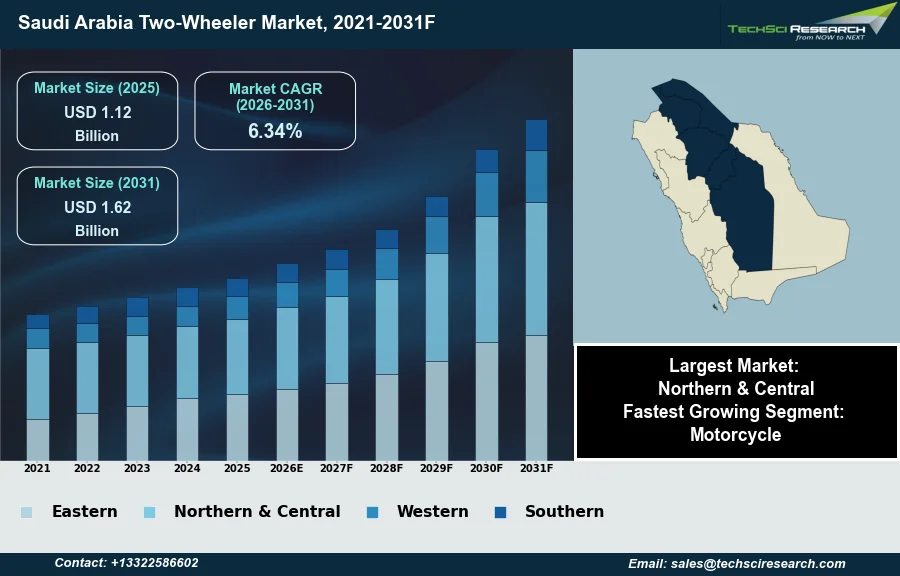
The Saudi Arabia Two-Wheeler Market was valued at USD 56.3 Million in 2024 and is expected to reach USD 90.4 Million by 2030 with a CAGR of 8.2% during the forecast period. The Saudi Arabia two-wheeler market is witnessing steady growth due to a shift in mobility preferences across urban centers. Young professionals and students increasingly seek affordable and efficient commuting options, prompting a rise in demand for motorcycles and scooters. Changing consumer behavior toward personal transport, coupled with increasing fuel efficiency of two-wheelers, is reshaping the local transport landscape. The limited availability of public transportation in certain areas further amplifies the appeal of two-wheelers as a practical solution for short- to mid-range travel.

Technological integration into two-wheelers is becoming a major market enabler. Smart connectivity, digital dashboards, and integrated GPS systems are gaining traction, especially among the tech-savvy youth. Government initiatives encouraging diversified mobility options, coupled with improvements in road infrastructure and dedicated lanes for two-wheelers in select cities, are contributing to market expansion. Sustainability is also becoming a point of interest, with electric variants gradually being introduced in the market despite infrastructural challenges. Environmental consciousness among young buyers is supporting this slow but steady adoption trend.

Challenges persist in the form of regulatory norms and road safety concerns. High temperatures and desert terrain can also impact the performance and comfort associated with two-wheelers, limiting their usage during peak summer months. Limited service centers and spare part availability outside major cities are barriers to wider penetration. However, growing e-commerce and food delivery sectors continue to expand the utility of two-wheelers beyond personal transport, hinting at future growth opportunities in both personal and commercial segments.

Market Drivers

Rising Urban Mobility Demand

Rapid population growth in Saudi cities is creating congestion and over-reliance on limited public transport options. The increasing need for compact, cost-effective, and easily maneuverable transportation is pushing urban dwellers toward two-wheelers. With younger consumers entering the workforce and seeking flexible travel options, motorcycles and mopeds are becoming a preferred choice. The affordability and fuel efficiency of two-wheelers cater well to budget-conscious consumers in metropolitan and semi-urban areas. This shift in commuting behavior aligns with the urban mobility goals of minimizing traffic congestion while enhancing personal convenience.

Growing Youth Demographics

Saudi Arabia’s young population is increasingly driving demand for two-wheelers as a lifestyle and practical choice. The 2022 Saudi census, described by Minister of Economy and Planning Faisal Al-Ibrahim as the most comprehensive and accurate in the Kingdom’s history, reveals a population of just over 32 million. Of this, 18.8 million are Saudi nationals, representing 58.4%, while non-Saudis account for 13.4 million or 41.6%. A striking insight from the census is that 63% of the population is under the age of 30, reflecting a predominantly young and vibrant demographic. This demographic shows high receptiveness to new technology and is more likely to prefer independent transport solutions. Many are drawn to the thrill, freedom, and economic advantages offered by motorcycles and scooters. The influence of youth-centric trends, including biking as a recreational activity, is reshaping consumer preferences. As disposable income among this segment rises, the market is poised to witness continued interest in entry-level and mid-range two-wheeler options across urban and suburban locations.

Emergence of Delivery and E-commerce Platforms

The surge in demand for instant delivery of food, groceries, and parcels has led to significant uptake in two-wheeler purchases for commercial use. The two-wheeler market is experiencing rapid growth in demand from gig economy workers and last-mile delivery agents. Scooters and motorcycles offer a low-cost and agile mode of transport suited for navigating narrow streets and ensuring fast deliveries. With growing penetration of digital commerce and home delivery services across Saudi Arabia, this sector continues to provide steady demand that supplements the personal use segment of the two-wheeler market.

Low Operating and Maintenance Costs

Two-wheelers are cost-effective in terms of fuel consumption, routine maintenance, and repair expenses. The affordability of spare parts and simplicity of mechanical systems make them an attractive option for consumers seeking budget-friendly transport solutions. Fuel-efficient models offer extended mileage at minimal running costs, encouraging adoption among middle-income households and daily commuters. These factors not only influence first-time buyers but also repeat customers who prioritize durability and operational economy. The appeal of low ownership cost plays a critical role in the expanding footprint of two-wheelers in the country.

Technological Advancements in Two-Wheelers

Modern two-wheelers equipped with digital displays, Bluetooth connectivity, anti-theft systems, and integrated navigation tools are gaining appeal. Manufacturers are increasingly incorporating technology to enhance safety, comfort, and convenience for riders. The integration of smart features is attracting tech-savvy consumers who value connected experiences. Innovations in lightweight materials and improved engine performance are also contributing to improved ride quality and fuel efficiency. These advancements are transforming two-wheelers into intelligent machines tailored for the evolving mobility expectations of the modern Saudi consumer.


Download Free Sample Report

Key Market Challenges

Harsh Climatic Conditions

Saudi Arabia’s high temperatures and arid climate pose discomfort and performance issues for two-wheeler users. Extreme heat during summer months deters regular usage, limiting the seasonal practicality of motorcycles and scooters. Engine overheating, reduced tire performance, and rider fatigue become prominent challenges. Unlike enclosed vehicles, two-wheelers offer no protection from environmental exposure, which can discourage potential users. Climate-related limitations thus hinder the growth potential of the market, especially for daily commuters and long-distance travelers across desert zones.

Limited Safety Infrastructure

Insufficient dedicated lanes, inadequate traffic enforcement, and minimal road safety education for two-wheeler users contribute to higher accident risks. The absence of designated parking zones and dedicated lanes in many urban areas creates operational hazards for riders. Road-sharing with larger vehicles often leads to safety concerns. These issues lower public confidence in adopting two-wheelers as a regular mode of transport. Safety perceptions significantly influence market adoption, especially among families and older demographics who prioritize secure commuting experiences.

Inconsistent Availability of Spare Parts

The inconsistent supply of spare parts and maintenance services across regions disrupts ownership experience. Outside major cities, access to reliable service stations remains limited, resulting in longer downtimes and increased maintenance costs. This gap in aftermarket services affects the longevity and performance of two-wheelers. Prospective buyers in remote or smaller towns may hesitate to invest due to lack of support infrastructure. The uneven distribution of technical support poses a hurdle to the broader geographic penetration of two-wheelers in the country.

Regulatory, Licensing and Import Constraints

Stringent licensing processes and evolving traffic regulations can be deterrents for potential buyers. The requirement of training, testing, and compliance documentation can slow down adoption rates, particularly among first-time users. Complex insurance requirements and varying registration procedures across regions further complicate ownership. As traffic laws tighten in response to safety and environmental concerns, prospective users may face additional barriers to entry, especially in high-density urban zones. These regulatory bottlenecks create friction in the otherwise accessible two-wheeler market.

Additionally, the ban imposed on imports of two-wheelers that fail to meet Saudi Standards is further hampering the market growth. For instance, in November 2024, The Saudi Standards, Metrology and Quality Organization (SASO), in coordination with the Ministry of Commerce and the Zakat, Tax and Customs Authority, has imposed a ban on the import, distribution, sale, and display of five specific categories of motorcycles in the Kingdom. The affected categories include motorcycles designed for children under 8 years old, as well as those with a maximum design speed below 24 km/h, engines under 50cc, or power outputs below 1.5 kW. The ban also applies to any motorcycles that fail to meet technical regulations and safety standards established by SASO. This move aims to enhance road safety, protect consumers, particularly children—and ensure that vehicles on the market adhere to national quality and safety requirements. The ban reflects the authorities' broader commitment to regulating vehicle imports and maintaining a safe transportation environment in the Kingdom.

Public Transport Expansion Programs

Government investment in metro systems and bus networks could reduce the appeal of personal two-wheeler transport. As urban public transport infrastructure develops, particularly in major cities, two-wheelers may face competition as a preferred mode of commuting. Free or subsidized fares for public transport create affordability challenges for two-wheelers. This shift in policy focus can limit two-wheeler market growth unless manufacturers reposition offerings for niche or multi-modal transport applications. Public sector transport advancements thus represent an indirect but notable challenge to market expansion.

Key Market Trends

Adoption of Electric Two-Wheelers

Interest in electric two-wheelers is gaining momentum due to rising environmental awareness and support for decarbonization goals. While infrastructure challenges remain, early adopters are exploring electric models for their low operating costs and sustainability benefits. Manufacturers are introducing entry-level electric scooters with compact batteries suited for short-distance urban travel. For instance, Saudi Arabia’s Vego Group announced plans to establish the Kingdom’s first electric motorcycle manufacturing plant, set to begin operations by 2026. The facility will be developed in partnership with a Chinese company and located in Sudair City for Industry and Business, about 150 km from Riyadh. With an expected annual production capacity of 50,000 units, the initiative aims to localize manufacturing, reduce reliance on imports, and expand into global export markets. This move supports Saudi Arabia’s broader sustainability and industrial diversification goals. The project also emphasizes innovation, national workforce development, and eco-friendly urban mobility solutions. The gradual shift toward electric mobility aligns with national sustainability targets and growing consumer consciousness. This trend is set to influence the future landscape of the two-wheeler market in terms of both design and infrastructure investment.

Rise of Smart and Connected Two-Wheelers

Smart technologies such as app-based diagnostics, geo-fencing, and rider assistance systems are entering the two-wheeler market. Consumers increasingly value digital connectivity, real-time tracking, and personalized performance data. These features appeal to the tech-savvy demographic and enhance both user experience and vehicle security. Connected two-wheelers are shaping consumer expectations, pushing manufacturers to innovate beyond mechanical reliability and into digital convenience. The integration of smart features will continue to reshape the market offering in terms of value proposition and user interaction.

Customization and Personalization Demand

There is a growing inclination among Saudi consumers toward customized two-wheelers that reflect personal style and identity. From aesthetic enhancements to performance upgrades, demand for personalized modifications is on the rise. This trend spans youth and hobbyist segments who view their vehicle as an expression of individuality. The emergence of aftermarket customization services and DIY kits is fueling this demand further. Customization culture is driving a parallel market that supports core vehicle sales and enriches the consumer engagement ecosystem.

Shared Mobility Integration

Two-wheelers are becoming an integral component of shared mobility services aimed at solving last-mile transport challenges. Companies are exploring scooter-sharing and bike-rental models to provide affordable and flexible urban transport. This trend is supported by urban infrastructure improvements and evolving attitudes toward ownership. Shared two-wheelers reduce traffic congestion and offer convenience for short-distance commuters, particularly in dense city centers. The rise of app-based mobility platforms is boosting the relevance of two-wheelers in multimodal transport ecosystems.

Adventure and Leisure Motorcycling

A growing number of consumers are engaging in leisure and adventure motorcycling, transforming two-wheelers into lifestyle products. Off-road and touring motorcycles are gaining popularity for weekend travel and recreation. Social media communities and organized riding groups are encouraging participation in motorcycling events and road trips. This shift supports a non-commuter segment of the market and drives interest in higher-performance and specialty models. Leisure biking culture is emerging as a significant trend, expanding the definition of utility and desirability for two-wheelers.

Segmental Insights

Vehicle Type Insights

The two-wheeler market in Saudi Arabia includes motorcycles and scooters/mopeds, each catering to different user preferences and application needs. Motorcycles are often favored by consumers who seek higher engine power and performance. They are suitable for both urban and semi-urban travel and attract a wide user base that includes young riders, long-distance commuters, and hobbyists. Their durability and ability to handle a variety of road conditions contribute to their popularity in areas with varied terrain and open roads. Motorcycles are also seen as aspirational products among youth, often associated with freedom and speed, which influences purchasing decisions.

Scooters and mopeds, on the other hand, appeal to users seeking lightweight, fuel-efficient, and easy-to-operate vehicles. These are especially popular in dense urban settings where maneuverability and compact size matter. Their automatic transmission and comfortable seating make them accessible to a broader demographic, including students, women, and older individuals. Scooters and mopeds are frequently used for short-distance travel, errands, and last-mile deliveries, making them practical for daily urban commuting. The rise of e-commerce and delivery-based services further increases their utility in commercial applications.

Each segment serves distinct use cases and user expectations. While motorcycles offer versatility and performance, scooters/mopeds prioritize ease of use and practicality. The coexistence of both vehicle types allows the market to serve a diverse range of needs across urban and suburban Saudi Arabia.


Download Free Sample Report

Region Insights

In 2024, the Northern & Central region of Saudi Arabia leads the two-wheeler market due to its high population density, urban concentration, and better-developed road infrastructure. This region includes key cities like Riyadh, the capital and largest city, which serves as a major economic and administrative hub. The strong presence of the working population, daily commuters, and a growing number of young riders has created a robust demand for two-wheelers, both for personal mobility and commercial purposes such as deliveries and ride-hailing services.

The increase in traffic congestion and limited availability of parking in urban centers like Riyadh and Buraydah has made two-wheelers a more practical and time-efficient mode of transportation. Consumers in this region are increasingly shifting towards scooters and motorcycles that offer fuel efficiency, low maintenance costs, and ease of navigation through congested streets. Moreover, the expansion of digital platforms supporting last-mile delivery services has significantly boosted the use of two-wheelers for logistics and e-commerce operations. The gig economy’s expansion has further contributed to the rising number of individuals purchasing two-wheelers for employment opportunities.

Government-led initiatives under Vision 2030 to diversify the economy and improve public transportation infrastructure have also impacted mobility trends. However, until large-scale public transport systems are fully implemented, two-wheelers continue to fill the mobility gap, especially in medium-income neighborhoods. Public acceptance of two-wheelers has gradually increased due to affordability, fuel savings, and ease of use. Retail outlets, service centers, and financing options are more readily available in this region, which simplifies access to two-wheelers for a wider audience.

The presence of universities, industrial zones, and commercial centers in the Northern & Central region has attracted a large influx of students and workers who prefer budget-friendly, reliable transportation solutions. Cultural shifts and changing attitudes toward personal mobility have also played a role in boosting market penetration. Rising fuel prices and increasing awareness of carbon emissions have encouraged consumers to seek alternatives to conventional cars, with motorcycles and scooters presenting a viable solution.

As the region continues to grow in population and economic activity, the demand for efficient, affordable mobility solutions is expected to remain strong. This dynamic environment makes the Northern & Central region the leading contributor to the two-wheeler market in Saudi Arabia in 2024.

Recent Developments

  • In July 2025, Navee announced the launch of its latest electric scooters in Saudi Arabia, expanding its footprint in the Middle Eastern mobility market. The new models promise enhanced range and innovative safety features aimed at urban commuters. Navee’s entry aligns with Saudi Arabia’s push for sustainable transport solutions and growing demand for eco-friendly vehicles. The launch underscores the brand’s ambition to cater to evolving consumer preferences and support the country’s green mobility goals.
  • In December 2024, Saudi Arabia’s Vego Group announced plans to establish the Kingdom’s first electric motorcycle manufacturing plant, set to begin operations by 2026. The facility will be developed in partnership with a Chinese company and located in Sudair City for Industry and Business, about 150 km from Riyadh. With an expected annual production capacity of 50,000 units, the initiative aims to localize manufacturing, reduce reliance on imports, and expand into global export markets. This move supports Saudi Arabia’s broader sustainability and industrial diversification goals. The project also emphasizes innovation, national workforce development, and eco-friendly urban mobility solutions.
  • In May 2025, Lumi, a leading mobility provider in Saudi Arabia, launched its first motorcycle rental outlets in Riyadh and Jeddah, offering high-end Harley-Davidson and BMW bikes along with gear rentals and lounges for biking enthusiasts. This makes Lumi the only provider of physical motorcycle rental services in the Kingdom.
  • In August 2024, BMW Motorrad has launched the next-generation R 1300 GS in Saudi Arabia, marking its 100-year anniversary. The launch events in Jeddah and Riyadh highlighted the bike's powerful 1300cc boxer engine, delivering 145 hp and 149 Nm of torque. The R 1300 GS features a new Dynamic Suspension Adjustment system, adaptive vehicle height, and four riding modes. Three variants—Trophy, Triple Black, and Option 719 Tramuntana—are now available. BMW also showcased its 100-Year Editions of the R 18 and R nineT models.

Key Market Players

  • Bajaj Auto Ltd.
  • BMW Motorrad
  • Harley-Davidson, Inc.
  • Hero MotoCorp Ltd.
  • Honda Motor Co., Ltd.
  • KTM AG
  • Piaggio & C. SpA
  • Suzuki Motor Corporation
  • TVS Motor Company
  • Yamaha Motor Co., Ltd.

By Vehicle Type

By Engine

By End Use

By Region

  • Motorcycle   
  • Scooter/Moped
  • Above 500cc
  • 126-250cc
  • 251-500cc
  • Till 125cc
  • Personal
  • Commercial
  • Northern & Central
  • Western
  • Southern
  • Eastern


Report Scope:

In this report, the Saudi Arabia Two-Wheeler Market has been segmented into the following categories, in addition to the industry trends which have also been detailed below:

·         Saudi Arabia Two-Wheeler Market, By Vehicle Type:

o    Motorcycle  

o    Scooter/Moped

·         Saudi Arabia Two-Wheeler Market, By Engine:

o    Above 500cc

o    126-250cc

o    251-500cc

o    Till 125cc

·         Saudi Arabia Two-Wheeler Market, By End Use:

o    Personal

o    Commercial

·         Saudi Arabia Two-Wheeler Market, By Region:

o    Northern & Central

o    Western

o    Southern

o    Eastern

Competitive Landscape

Company Profiles: Detailed analysis of the major companies presents in the Saudi Arabia Two-Wheeler Market.

Available Customizations:

Saudi Arabia Two-Wheeler Market report with the given market data, Tech Sci Research offers customizations according to the company’s specific needs. The following customization options are available for the report:

Company Information

  • Detailed analysis and profiling of additional market players (up to five).

Saudi Arabia Two-Wheeler Market is an upcoming report to be released soon. If you wish an early delivery of this report or want to confirm the date of release, please contact us at [email protected]

Table of content

Table of content

1. Introduction

1.1. Research Tenure Considered

1.2. Market Definition

1.3. Scope of the Market

1.4. Markets Covered

1.5. Years Considered for Study

1.6. Key Market Segmentations

2.  Research Methodology

2.1. Objective of the Study

2.2. Baseline Methodology

2.3. Key Industry Partners

2.4. Major Association and Secondary Sources

2.5. Forecasting Methodology

2.6. Data Triangulation & Validation

2.7. Assumptions and Limitations

3.  Executive Summary     

3.1. Overview of the Market

3.2. Overview of Key Market Segmentations

3.3. Overview of Key Regions/Countries

4. Saudi Arabia Two-Wheeler Market Outlook

4.1. Market Size & Forecast

4.1.1. By Value

4.2. Market Share & Forecast

4.2.1.  By Vehicle Type Market Share Analysis (Motorcycle, Scooter/Moped)

4.2.2. By Engine Market Share Analysis (Till 125cc, 126-250cc, 251-500cc, Above 500cc)

4.2.3. By End Use Market Share Analysis (Personal, Commercial)

4.2.4. By Region Market Share Analysis

4.2.5. By Top 5 Companies Market Share Analysis, Others (2024)

5. Northern & Central Two-Wheeler Market Outlook

5.1. Market Size & Forecast

5.1.1. By Value

5.2. Market Share & Forecast

5.2.1. By Vehicle Type Share Analysis

5.2.2. By Engine Market Share Analysis

5.2.3. By End Use Market Share Analysis

6. Western Two-Wheeler Market Outlook

6.1. Market Size & Forecast

6.1.1. By Value

6.2. Market Share & Forecast

6.2.1. By Vehicle Type Share Analysis

6.2.2. By Engine Market Share Analysis

6.2.3. By End Use Market Share Analysis

7. Southern Two-Wheeler Market Outlook

7.1. Market Size & Forecast

7.1.1. By Value

7.2. Market Share & Forecast

7.2.1. By Vehicle Type Share Analysis

7.2.2. By Engine Market Share Analysis

7.2.3. By End Use Market Share Analysis

8. Eastern Two-Wheeler Market Outlook

8.1. Market Size & Forecast

8.1.1. By Value

8.2. Market Share & Forecast

8.2.1. By Vehicle Type Share Analysis

8.2.2. By Engine Market Share Analysis

8.2.3. By End Use Market Share Analysis

9. Market Dynamics

9.1. Drivers

9.2. Challenges

10. Market Trends & Developments

11. Porters Five Forces Analysis

12. Saudi Arabia Economic Profile

13. Policy & Regulatory Landscape

14. Competitive Landscape

14.1. Company Profiles

14.1.1. Bajaj Auto Ltd.

14.1.1.1. Company Details

14.1.1.2. Products

14.1.1.3. Financials (As Per Availability)

14.1.1.4. Key Market Focus & Geographical Presence

14.1.1.5. Recent Developments

14.1.1.6. Key Management Personnel

14.1.2. BMW Motorrad

14.1.3. Harley-Davidson, Inc.

14.1.4. Hero MotoCorp Ltd.

14.1.5. Honda Motor Co., Ltd.

14.1.6. KTM AG

14.1.7. Piaggio & C. SpA

14.1.8. Suzuki Motor Corporation

14.1.9. TVS Motor Company

14.1.10. Yamaha Motor Co., Ltd.

15. Strategic Recommendations

16. About Us & Disclaimer

Figures and Tables

Frequently asked questions

Frequently asked questions

The market size of the Saudi Arabia Two-Wheeler Market was estimated to USD 56.3 Million in 2024.

The major drivers for the Saudi Arabia two-wheeler market include rising urban traffic congestion and growing demand for affordable personal mobility. Additionally, increasing popularity of motorcycles among youth and delivery services boosts market growth.

Key trends in the Saudi Arabia two-wheeler market include a rising shift toward electric bikes and smart, connected vehicles. There's also growing interest in leisure and adventure biking among younger consumers.

The major challenges include extreme weather conditions limiting year-round usage and a lack of dedicated two-wheeler infrastructure. Additionally, cultural preferences and safety concerns impact adoption rates.

Related Reports

We use cookies to deliver the best possible experience on our website. To learn more, visit our Privacy Policy. By continuing to use this site or by closing this box, you consent to our use of cookies. More info.