|
Key Insights
|
Details
|
|
Forecast Period
|
2027-2031
|
|
Market Size (2025)
|
USD 432.56 Million
|
|
CAGR (2026-2031)
|
4.75%
|
|
Fastest Growing Segment
|
Electronic Health Record
|
|
Largest Market
|
Northern & Central
|
|
Market Size (2031)
|
USD 571.44 Million
|
Market Overview
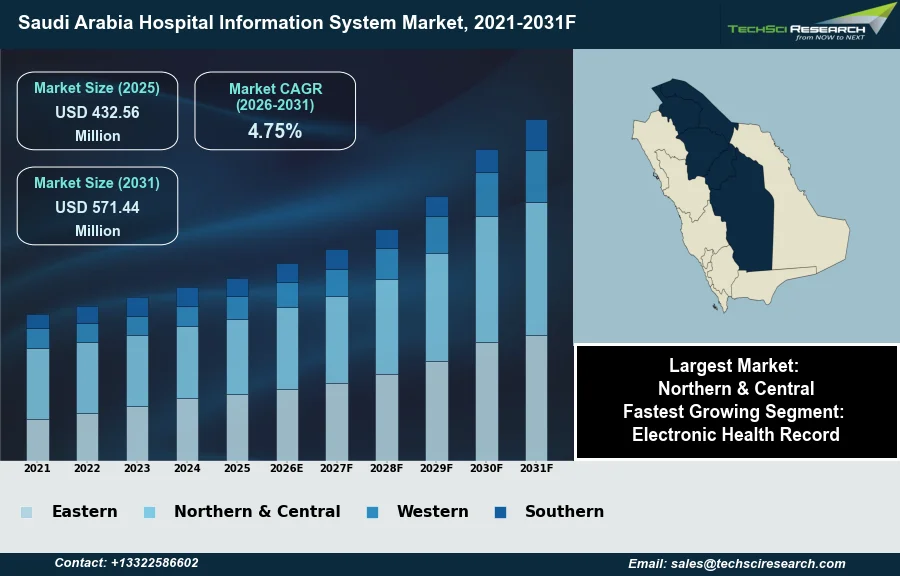
The Saudi Arabia Hospital Information System Market will grow from USD 432.56 Million in 2025 to USD 571.44 Million by 2031 at a 4.75% CAGR. A Hospital Information System (HIS) represents an integrated suite of software applications designed to streamline the administrative, clinical, and financial operations within healthcare institutions. The market for these systems in Saudi Arabia is primarily driven by extensive government-led digital transformation initiatives under Vision 2030, increasing national healthcare expenditure, and a persistent demand for improved operational efficiency and patient care quality. According to the 2024 Health Sector Transformation Program report via the Saudi Press Agency, in 2024, over 51 million virtual consultations and appointments were conducted through the Sehhaty app, demonstrating substantial digital health engagement. This robust adoption of digital services underscores the foundational role of HIS in the evolving healthcare ecosystem.
However, a significant challenge impeding market expansion is the substantial need for a highly skilled workforce capable of managing, implementing, and maintaining these complex information systems. This encompasses not only technical expertise but also a deep understanding of ongoing data privacy and cybersecurity protocols, critical for safeguarding sensitive patient information in an increasingly digitized environment.
Key Market Drivers
Vision 2030-driven digital health modernization and AI investment
Government-led healthcare digital transformation initiatives are a primary catalyst for the Saudi Arabia Hospital Information System market. The Kingdom, under Vision 2030, is deeply committed to modernizing its healthcare landscape through extensive digitalization efforts, which inherently require robust HIS solutions. These initiatives aim to improve operational efficiency, enhance patient care delivery, and create an integrated national health ecosystem. Such efforts encompass the adoption of electronic health records, telemedicine platforms, and smart hospital technologies. According to SAMENA Daily News, in June 2026, in its report 'Saudi Arabia invests SAR 13.3 billion in AI and digital health to transform healthcare delivery,' Saudi Arabia is accelerating its healthcare transformation through investments exceeding SAR 13.3 billion, leveraging artificial intelligence, digital technologies, and advanced medical innovation. This substantial financial commitment directly drives the demand for comprehensive HIS implementations and upgrades across public and private healthcare facilities.
Healthcare infrastructure expansion drives demand for scalable HIS solutions
Simultaneously, the expansion and modernization of healthcare infrastructure significantly fuel the demand for Hospital Information Systems. The Saudi government's strategic investments in building new medical facilities and upgrading existing ones necessitate advanced integrated systems to manage complex administrative, clinical, and financial operations from their inception. As these new hospitals and health centers become operational, they require sophisticated HIS to support everything from patient registration and scheduling to laboratory results and billing. According to MOH News, in December 2025, in its report 'Health Minister Highlights Healthcare Achievements at Budget Forum 2026,' public hospitals in Saudi Arabia expanded their bed capacity by more than 1,700 beds in 2025 alone, with an additional 2,900 beds added in the private sector. This physical growth directly translates into an increased need for scalable and interconnected HIS solutions. Overall, the Saudi Arabia Hospital Information System market is experiencing dynamic growth driven by these foundational shifts. According to the Saudi Press Agency, in February 2026, the Global Health Exhibition generated initiatives and investments totaling more than SAR124 billion.
Download Free Sample Report
Key Market Challenges
Skilled-workforce Shortage Impedes HIS Deployment
The substantial need for a highly skilled workforce represents a critical impediment to the expansion of the Hospital Information System market in Saudi Arabia. This deficiency extends beyond general technical skills to include specialized expertise required for managing, implementing, and maintaining complex information systems, as well as a thorough understanding of data privacy and cybersecurity protocols. The absence of such a proficient talent pool directly hampers the efficient deployment and optimization of advanced HIS solutions across healthcare institutions.
Talent Shortage Drives Costs, Delays, and Security Risks
This shortage forces healthcare providers to either delay crucial system upgrades and implementations or rely heavily on costly external consultants, thereby increasing operational expenses and slowing market adoption. Furthermore, insufficient in-house expertise in cybersecurity poses significant risks to sensitive patient data, potentially undermining trust and compliance with national digital health initiatives. According to a 2025 report by Nucamp and the Ministry, there was a 20 percent shortfall between tech job vacancies and qualified local talent, indicating a significant gap in the specialized skills essential for advanced digital healthcare infrastructure. This gap directly limits the market's growth potential by impeding the seamless integration and secure operation of sophisticated HIS.
Key Market Trends
Shift to Cloud-based Hospital Information Systems
A growing preference for cloud-based Hospital Information Systems signifies a notable shift from traditional on-premise infrastructure to scalable, accessible cloud environments. Saudi Arabian healthcare providers are increasingly adopting cloud-based HIS to enhance data accessibility, reduce operational costs, and ensure business continuity. This transition facilitates seamless integration across diverse healthcare touchpoints, improving resource allocation and system resilience. The flexibility of cloud platforms also supports rapid deployment of new applications and critical updates. As Saudi Arabia embraces digital health, cloud-based solutions have taken center stage, accounting for 76.89% of the market, according to Saudi's Digital Health Future: IT Market Growth at 10.1%, published June 04, 2025. This trend highlights the market's strong movement towards agile and cost-effective IT solutions.
AI-Driven Analytics and Predictive Insights in HIS
Advanced artificial intelligence and data analytics capabilities integrated into HIS frameworks form another significant trend, moving beyond basic data collection to sophisticated predictive insights. This empowers Saudi Arabian hospitals to leverage patient data for proactive disease management, personalized treatment plans, and optimized operational workflows. AI-powered analytics identify complex patterns, enhancing diagnostic accuracy and clinical decision-making. Such integration within HIS transforms care delivery by enabling intelligent systems that continuously learn. For instance, Seha Virtual Hospital rolled out advanced AI diagnostic tools, achieving 97 percent accuracy for early heart disease detection across over 220 healthcare facilities, according to Saudi Arabia Healthcare IT Market Size to Hit USD 7.7 Billion, published March 12, 2026. This demonstrates AI's substantial impact on patient outcomes and efficiency.
Segmental Insights
Rapid EHR Growth Under Vision 2030 and MOH Policy Support
In the Saudi Arabia Hospital Information System Market, Electronic Health Records (EHR) represent the fastest-growing segment. This rapid expansion is primarily driven by the Kingdom's strategic digital transformation initiatives, notably Saudi Vision 2030, which prioritizes modernizing the healthcare sector and improving service delivery through technology. The Ministry of Health (MOH) actively promotes EHR integration to enhance healthcare service delivery, supported by policy frameworks like the National E-Health Strategy and the Saudi Health Information Exchange. These efforts aim to improve data accuracy, reduce medical errors, and facilitate better coordination among healthcare providers, ultimately leading to enhanced patient care and operational efficiency across facilities. The increasing emphasis on data analytics in healthcare further fuels demand for EHR systems to leverage insights for operational and clinical performance improvements.
Regional Insights
Northern & Central Region: Market Leadership Driven by Infrastructure and Vision 2030
The Northern & Central region dominates the Saudi Arabia Hospital Information System Market, primarily driven by its position as the nation's political and economic hub, with Riyadh as a prominent example. This leadership stems from a high concentration of advanced public and private healthcare facilities that have been early adopters of comprehensive Hospital Information Systems. Significant government investments, aligning with Saudi Vision 2030 and Ministry of Health initiatives, have propelled the development of sophisticated healthcare infrastructure across these areas. Additionally, substantial urban growth and a large population density in this region create considerable demand for advanced healthcare services, consequently accelerating the adoption of digital solutions and enhancing regulatory compliance within its robust healthcare ecosystem.
Recent Developments
-
In October 2025, IQVIA announced a strategic collaboration with Six Phases, the technology arm of Healthcare Alliance (HCA), to digitally transform healthcare delivery across HCA’s medical facilities in Saudi Arabia. This initiative involved IQVIA deploying its next-generation, cloud-based Hospital Information System (HIS), along with a Patient-Level Costing Solution (PLCS) and IQVIA Care Management System (Home Care). The objective of this collaboration was to unify clinical and financial data across HCA entities, which aimed to ensure connected care, enhance cost insights, and improve decision-making at all levels within the Saudi healthcare network.
-
In October 2025, Seha Virtual Hospital, a key initiative under the Saudi Ministry of Health, conducted a significant clinical study to validate the accuracy of the iSelfie.ai platform. This advanced AI-powered solution, developed by the Canadian company AiZtech, is designed for the early detection of heart disease and associated chronic conditions by analyzing short facial "selfie" videos. The study, conducted in collaboration with leading national institutions across Saudi Arabia, confirmed the platform's accuracy compared to traditional medical devices. This breakthrough research demonstrates the application of artificial intelligence in non-invasive diagnostics within the Saudi healthcare landscape.
-
In October 2024, Philips introduced a suite of advanced health technology solutions at the Global Health Exhibition in Riyadh. These innovations, directly relevant to the Saudi Arabia Hospital Information System Market, included AI-enabled, patient-centric platforms. Among the key offerings was an advanced clinical command eICU Centre, developed in collaboration with the Health Holding Company, alongside data-driven cardiology and imaging solutions. This unveiling highlighted Philips' commitment to supporting the expansion of electronic health records and modernizing healthcare infrastructure within the Kingdom, aiming to enhance clinical operations and patient outcomes.
-
In April 2024, Augnito, an India-based medical voice AI innovator, established a partnership with Cloud Solutions, a prominent digital transformation company in the Middle East. This collaboration aimed to significantly enhance healthcare efficiency in Saudi Arabia through the integration of AI-powered clinical voice technologies. The initiative was designed to improve accuracy, streamline clinical workflows, and optimize resource utilization within healthcare facilities. This strategic alliance supports Saudi Arabia's Vision 2030 objectives for an interoperable regional electronic health record (EHR) system, facilitating advanced digital health solutions in the market.
Key Market Players
- Epic Systems
- Cerner Corporation
- InterSystems
- Philips
- Siemens Healthineers
- GE HealthCare
- McKesson
- Allscripts
- NextGen
|
By Type
|
By Component
|
By Region
|
- Electronic Health Record
- Electronic Medical Record
- Real-time Healthcare
- Patient Engagement Solution
- Population Health Management
|
- Software
- Hardware
- Services
|
- Eastern
- Northern & Central
- Western
- Southern
|
Report Scope:
In this report, the Saudi Arabia Hospital Information System Market has been segmented into the following categories, in addition to the industry trends which have also been detailed below:
-
Saudi Arabia Hospital Information System Market, By Type:
-
Electronic Health Record
-
Electronic Medical Record
-
Real-time Healthcare
-
Patient Engagement Solution
-
Population Health Management
-
Saudi Arabia Hospital Information System Market, By Component:
-
Software
-
Hardware
-
Services
-
Saudi Arabia Hospital Information System Market, By Region:
-
Eastern
-
Northern & Central
-
Western
-
Southern
Competitive Landscape
Company Profiles: Detailed analysis of the major companies present in the Saudi Arabia Hospital Information System Market.
Available Customizations:
Saudi Arabia Hospital Information System Market report with the given market data, TechSci Research offers customizations according to a company's specific needs. The following customization options are available for the report:
Company Information
- Detailed analysis and profiling of additional market players (up to five).
Saudi Arabia Hospital Information System Market is an upcoming report to be released soon. If you wish an early delivery of this report or want to confirm the date of release, please contact us at sales@techsciresearch.com