|
Key Insights
|
Details
|
|
Forecast Period
|
2027-2031
|
|
Market Size (2025)
|
USD 1340.66 Million
|
|
CAGR (2026-2031)
|
7.85%
|
|
Fastest Growing Segment
|
Skin Care
|
|
Largest Market
|
Western
|
|
Market Size (2031)
|
USD 2109.79 Million
|
Market Overview
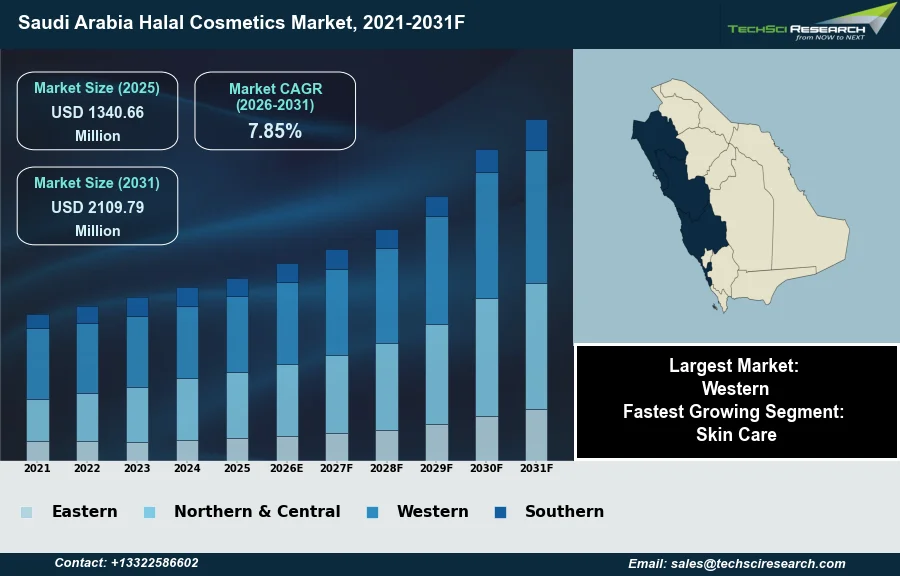
The Halal Cosmetics Market in Saudi Arabia will grow from USD 1340.66 Million in 2025 to USD 2109.79 Million by 2031 at a 7.85% CAGR. Halal cosmetics are beauty and personal care products manufactured, processed, and stored in accordance with Islamic Sharia law, ensuring they are free from forbidden (haram) ingredients such as pork derivatives, certain alcohols, and animal products not slaughtered according to halal practices, alongside upholding ethical sourcing and production standards. The Saudi Arabia Halal Cosmetics market experiences growth driven by increasing consumer awareness regarding the religious compliance and purity of products, coupled with rising disposable incomes that enable greater expenditure on premium, ethically produced goods. Government initiatives, notably under Saudi Vision 2030, also foster a supportive regulatory environment for the halal industry.
However, the market faces a significant challenge from stringent and often complex certification processes, which can increase production costs due to rigorous ingredient sourcing standards and extensive verification requirements. These operational complexities can impede market entry and elevate product pricing, potentially limiting broader consumer accessibility. The Saudi Arabian Halal Cosmetics market is further supported by robust consumer demographics, with its total population estimated at 35.3 million people in mid-2024, according to the General Authority of Statistics.
Key Market Drivers
Young, Digitally Savvy Consumers Propel Halal Cosmetics Demand
Favorable youth demographics are a significant driver for the Saudi Arabia Halal Cosmetics market. The Kingdom possesses a young and dynamic population; according to the Saudi Press Agency, in August 2025, Saudis under the age of 35 comprised 69.4% of the total Saudi population in 2024. This substantial youth segment, highly digitally literate and exposed to global beauty trends via social media, is actively shaping evolving beauty standards. These young consumers increasingly seek products aligning with both aesthetic aspirations and religious and ethical values, driving demand for innovative halal cosmetic formulations. Brands catering to these preferences, emphasizing efficacy and Sharia compliance, are well-positioned for growth.
Rising Female Workforce Expands Halal Cosmetics Spending
Another pivotal factor is increasing female workforce participation, significantly enhancing purchasing power and expanding consumer exposure to professional environments. Female participation in the workforce dramatically increased to over 35 percent in 2025, as reported by the "Population of Saudi Arabia 2026: 36 Million Demographics Gui" encyclopedia in April 2026, surpassing original Vision 2030 targets. This demographic shift leads to greater financial independence among women, translating into increased expenditure on personal grooming and halal cosmetics. As women assume more prominent roles in public life, demand for high-quality, ethically sourced beauty solutions meeting performance and religious requirements is heightened. Overall, according to Snapchat and The Business of Fashion, Saudi Arabia's beauty market is projected to reach $9.3 billion in 2026, indicating robust sector growth.
Download Free Sample Report
Key Market Challenges
Rigorous Halal Certification: Cost Increases and Market Barriers
The stringent and complex certification processes present a significant challenge for the Saudi Arabia Halal Cosmetics market. These rigorous requirements necessitate meticulous ingredient sourcing standards and extensive verification protocols, directly contributing to increased production costs for manufacturers. Such operational complexities not only heighten financial outlays but also impede market entry for new businesses, consequently limiting market competition and product innovation.
Consumer Pricing Impact and Extended Certification Lead Times
Furthermore, the elevated production costs are frequently passed on to consumers, resulting in higher product pricing which can curtail broader market accessibility. For instance, a course offered by the Gulf Standardization Organization (GSO) in November 2025, designed to explain Halal Certification requirements under Gulf Standard 2055-2, was priced at 3,450 Saudi Riyals. This illustrates the direct investment manufacturers must make to merely navigate the intricate regulatory framework. Additionally, the halal certification process for cosmetic products can extend from three to six weeks, depending on factors such as document completeness and inspection demands, thereby lengthening lead times and increasing operational overhead.
Key Market Trends
Premiumization of halal cosmetics and expanding luxury retail presence
The Saudi Arabia Halal Cosmetics market is significantly influenced by the premiumization of halal beauty offerings, as consumers increasingly seek high-quality products that combine religious compliance with luxury formulations and sophisticated aesthetics. This trend moves beyond basic ethical sourcing to demand superior product efficacy, innovative ingredients, and elegant packaging, aligning with a broader consumer shift towards discerning and high-value purchases. According to perfumenews.com, February 18, 2025, in the 'V Perfumes Celebrates Grand Opening at Mall of Arabia, Jeddah' article, V Perfumes opened its 51st store in the GCC at the Mall of Arabia in Jeddah on February 13, 2025, demonstrating the expanding retail infrastructure for luxury beauty products.
Domestic halal manufacturing growth and investment momentum
Another impactful trend is the growth of domestic halal cosmetics manufacturing, driven by strategic national initiatives aimed at economic diversification and enhanced self-sufficiency. This localized production fosters supply chain resilience, ensures closer adherence to specific Sharia requirements, and caters to national pride in locally made goods. According to DinarStandard's 'Saudi Arabia's Halal Market Opportunity Report 2024/2025', launched in partnership with the Halal Products Development Company in October 2025, Saudi Arabia secured SAR 5.5 billion (US$1.5 billion) in halal-related investments in 2023, positioning the Kingdom as a leading destination for such economic activity.
Segmental Insights
Fastest-growing Skin Care segment driven by religious observance and evolving preferences
The Skin Care segment is currently the fastest-growing category within the Saudi Arabia Halal Cosmetics Market, driven by a confluence of religious observance and evolving consumer preferences. This rapid expansion stems from heightened consumer awareness regarding ingredient transparency and the increasing demand for products aligning with Islamic principles. Saudi consumers, particularly younger demographics, prioritize halal-certified formulations, free from prohibited substances like alcohol or certain animal derivatives, as a reflection of ethical consumption and personal well-being. Furthermore, the robust regulatory oversight from bodies such as the Saudi Food and Drug Authority (SFDA) and the Saudi Standards, Metrology and Quality Organization (SASO) reinforces trust by ensuring adherence to stringent halal and safety standards.
Regional Insights
Western Region: Market Leadership Driven by Demographics, Religious Tourism, and Halal Certification Oversight.
The Western region stands as a principal driver within the Saudi Arabia Halal Cosmetics Market, largely due to its unique demographic and cultural landscape. This dominance is significantly attributed to the presence of holy cities like Mecca and Medina, which attract a substantial volume of religious tourists and residents with a strong adherence to Shariah-compliant products. Furthermore, Jeddah, a cosmopolitan hub within the Western region, contributes to this leadership through its diverse consumer base and exposure to international influences, fostering a robust demand for Halal-certified premium cosmetics. The collective religious observance across these areas, coupled with the oversight from regulatory bodies such as the Saudi Food and Drug Authority (SFDA) and the Saudi Halal Center in ensuring Halal certification, underpins consumer trust and market expansion.
Recent Developments
-
In January 2025, L'Oréal launched a new line of halal-certified skincare products. These products were specifically formulated for the broader Middle Eastern market, intending to meet the increasing consumer demand for beauty solutions that adhere to cultural and religious guidelines. This product introduction by a prominent international company diversified the offerings within the Saudi Arabia Halal Cosmetics Market, addressing consumers' preferences for ethically produced and Shariah-compliant skincare options.
-
In October 2024, the Saudi International Halal Expo & Summit was held in Riyadh, Saudi Arabia. Organized by 1st Arabia Tradeshows & Conferences, this event served as a platform to explore global Halal market trends, developments, and opportunities, including those within the cosmetics sector. The summit was designed to provide attendees with valuable insights, networking opportunities, and avenues for strategic collaborations, thereby fostering growth and innovation among companies operating in Saudi Arabia's halal cosmetics market.
-
In June 2024, Lady K Malaysia introduced a portfolio of halal and vegan skincare products. Although the launch and a pop-up store primarily occurred in Malaysia, this development highlights the expanding availability and innovation within halal and vegan skincare product ranges by companies, signaling a growing trend that influences consumer choices and market offerings in regions like Saudi Arabia, where demand for such certified products is increasing.
-
In May 2024, Halal Products Development Company (HPDC) invested in Believe, a company specializing in halal cosmetics and personal care products. This strategic agreement facilitated the relocation of Believe's headquarters from Singapore to Saudi Arabia. The move aimed to establish Saudi Arabia as a central hub for exporting Believe's halal products globally and included plans to localize cosmetics and personal care production through a new manufacturing facility in the Kingdom. This facility would also offer contract manufacturing services for local and future international brands.
Key Market Players
- IBA Halal Care (Iba Cosmetics)
- Amara Cosmetics (Amara Halal Cosmetics)
- INIKA Organic
- Wardah Cosmetics (PT Paragon Technology and Innovation)
- Martha Tilaar Group
- Himalaya Wellness
- Dabur
- Unilever
- L'Oréal S.A.
- Procter & Gamble (P&G)
|
By Type
|
By Demography
|
By Sales Channel
|
By Region
|
- Skin Care
- Bath & Shower Products
- Makeup & Color Cosmetics
- Hair Care
- Fragrances & Deodorants
- Others
|
|
- Supermarket/Hypermarket
- Multi-Branded Stores
- Online
- Others
|
- Eastern
- Northern & Central
- Western
- Southern
|
Report Scope:
In this report, the Saudi Arabia Halal Cosmetics Market has been segmented into the following categories, in addition to the industry trends which have also been detailed below:
-
Saudi Arabia Halal Cosmetics Market, By Type:
-
Skin Care
-
Bath & Shower Products
-
Makeup & Color Cosmetics
-
Hair Care
-
Fragrances & Deodorants
-
Others
-
Saudi Arabia Halal Cosmetics Market, By Demography:
-
Saudi Arabia Halal Cosmetics Market, By Sales Channel:
-
Supermarket/Hypermarket
-
Multi-Branded Stores
-
Online
-
Others
-
Saudi Arabia Halal Cosmetics Market, By Region:
-
Eastern
-
Northern & Central
-
Western
-
Southern
Competitive Landscape
Company Profiles: Detailed analysis of the major companies present in the Saudi Arabia Halal Cosmetics Market.
Available Customizations:
Saudi Arabia Halal Cosmetics Market report with the given market data, TechSci Research offers customizations according to a company's specific needs. The following customization options are available for the report:
Company Information
- Detailed analysis and profiling of additional market players (up to five).
Saudi Arabia Halal Cosmetics Market is an upcoming report to be released soon. If you wish an early delivery of this report or want to confirm the date of release, please contact us at sales@techsciresearch.com