|
Key Insights
|
Details
|
|
Forecast Period
|
2027-2031
|
|
Market Size (2025)
|
USD 6.69 Million
|
|
CAGR (2026-2031)
|
6.41%
|
|
Fastest Growing Segment
|
Fats
|
|
Largest Market
|
Northern & Central
|
|
Market Size (2031)
|
USD 9.71 Million
|
Market Overview
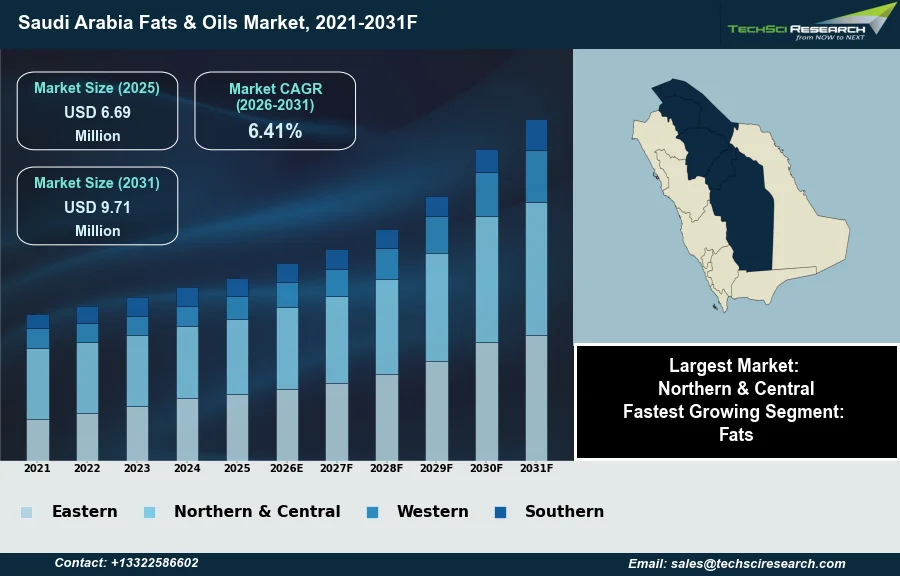
The Fats & Oils Market in Saudi Arabia will grow from USD 6.69 Million in 2025 to USD 9.71 Million by 2031 at a 6.41% CAGR. The Saudi Arabia Fats & Oils Market encompasses a diverse range of products, including edible oils such as vegetable and olive oils, alongside specialty fats used extensively in food processing and manufacturing. Market expansion is primarily driven by significant demographic shifts, notably rapid population growth and increasing urbanization, which fuel demand for convenience and processed foods. The flourishing food service sector, propelled by growing tourism and hospitality, further underpins this growth. Additionally, rising disposable incomes among consumers contribute to increased expenditure on higher-quality oils and fats.
According to the Saudi Agricultural and Livestock Investment Company, palm oil consumption per capita in Saudi Arabia was 19.21 kg in 2023. Despite these growth catalysts, a notable impediment to market expansion is the inherent vulnerability of supply chains due to Saudi Arabia’s heavy reliance on imported raw materials for edible oils, exposing the market to global price fluctuations and geopolitical disruptions.
Key Market Drivers
Population Growth and Urbanization Driving Fats & Oils Demand
Population growth and urbanization significantly propel the Saudi Arabia Fats & Oils Market. A steadily increasing population directly translates to higher overall food consumption, encompassing diverse dietary preferences and processed food items. This demographic expansion, particularly within urban centers, intensifies the demand for readily available and convenient food options, which are often prepared with various fats and oils. According to StatisticsTimes.com, in March 2026, Saudi Arabia's population is projected at 35.17 million on July 1, 2026, an increase from 34.57 million on July 1, 2025. This trend necessitates a corresponding rise in the supply of essential food ingredients.
Growth of the Food Service Sector and Tourism Boosts Fats & Oils Demand
The robust expansion of the food service sector further bolsters the demand for fats and oils within the Kingdom. This growth is driven by the burgeoning tourism industry, a rising number of restaurants, cafes, and catering services. Increased visitor influx leads to heightened consumption of prepared meals, increasing the utilization of cooking oils and specialty fats. According to the Saudi Press Agency (SPA), in April 2026, domestic tourists reached approximately 28.9 million during the first quarter of 2026, marking a 16% increase compared to the same period in 2025. This activity highlights the critical role of the food service industry. Furthermore, according to GTAIC, in March 2026, Saudi Arabia's import values for refined soya bean oil reached US$48.61 million for the period of January to July 2025, marking a 316.9% increase compared to the same period last year. This import rise indicates a strong and growing overall demand for specific edible oils.
Download Free Sample Report
Key Market Challenges
Import Dependence Drives Price Volatility in Edible Oils
Saudi Arabia's heavy reliance on imported raw materials for edible oils presents a significant challenging factor, directly hampering the growth and stability of its fats and oils market. This dependency renders the market inherently vulnerable to international commodity price volatility. Global price fluctuations for raw materials, driven by factors such as weather patterns in key producing regions, crop yields, and shifts in global demand, directly translate into fluctuating costs for Saudi Arabian importers and, subsequently, for local processors and consumers.
Geopolitical Disruptions and Trade-Route Risks
Furthermore, this import dependence exposes the market to geopolitical disruptions affecting major trade routes or supplier nations. Any instability can lead to supply chain interruptions, delayed shipments, and scarcity of essential raw materials, impacting production schedules and market availability. Such vulnerabilities hinder long-term planning and investment within the domestic fats and oils sector. According to GTAIC, Saudi Arabia's refined soya bean oil import values reached US$71.52 million during the August 2024 to July 2025 period, surging by 331.81% compared to the previous year. This substantial fluctuation in import value underscores the market’s exposure to external dynamics, complicating inventory management and pricing strategies for businesses operating within the Kingdom.
Key Market Trends
Health-driven product innovation and rising olive oil output
Product innovation for health-conscious consumers significantly influences the Saudi Arabia Fats & Oils Market. Driven by increasing awareness regarding diet and wellness, consumers actively seek healthier alternatives, including oils with reduced fat content, enriched vitamins, or beneficial fatty acids. This trend pushes manufacturers to develop and market products such as virgin olive oil, avocado oil, and fortified blends, catering to evolving preferences for nutritional value. The growing availability of such healthy options is a key aspect of this innovation. The International Olive Council, in January 2025, estimated that Saudi Arabia would produce a record-high 33,500 tons of olive oil in the 2024/25 crop year, reflecting the market's response to consumer demand for healthier choices. This sustained interest compels market players to invest in research and development for health-oriented fats and oils.
Local sourcing and domestic production to bolster food security
Strengthening local sourcing and production is a pivotal trend, driven by Saudi Arabia's strategic imperative to enhance food security and reduce reliance on volatile global supply chains. This involves significant governmental and private sector investments in domestic agricultural capabilities and processing infrastructure to cultivate oilseed crops and establish crushing and refining facilities. Such initiatives mitigate import risks, foster economic diversification, and help stabilize supply and pricing. As part of these efforts, the Saudi Press Agency (SPA) reported in April 2026 on the Ministry of Environment, Water and Agriculture's initiatives aimed at bolstering domestic agricultural output. Specifically, domestic olive oil yield for the 2025 harvest season increased by 9%. This push towards self-sufficiency is gradually transforming the market's supply landscape.
Segmental Insights
Fats Segment: Fastest Growth Driven by Food Service Demand and Vision 2030 Initiatives
The Saudi Arabia Fats & Oils Market identifies the Fats segment as its most rapidly expanding category. This accelerated growth is primarily attributed to a surging demand from the expanding food service industry, including bakeries, confectioneries, and quick-service restaurants, which heavily utilize various fat types for product development and enhancement. Furthermore, evolving consumer dietary preferences, influenced by increasing urbanization and an appetite for convenient, processed, and Western-style foods, are significantly boosting the consumption of fats. The Saudi government's Vision 2030 initiatives, which promote health and wellness while encouraging local food processing and production, also contribute to the segment's expansion by driving demand for healthier and functional fat ingredients.
Regional Insights
Northern & Central Region: Market Leader in Saudi Fats & Oils
The Northern & Central region emerges as the dominant force in the Saudi Arabia Fats & Oils Market, primarily due to its significant population density and advanced urbanization. Major cities, particularly Riyadh, located within this central area, function as pivotal centers for commerce, diverse industrial activities, and a robust food service sector. This concentration of economic and human activity directly contributes to a high demand for fats and oils across both household consumption and commercial applications. The region also benefits from a well-developed distribution network and extensive access to retail and foodservice outlets, ensuring widespread product availability and strong market presence.
Recent Developments
-
In April 2025, Food Specialities Limited (FSL), a key provider of ingredient solutions, announced a strategic partnership with Kerry Group. This collaboration is intended to bolster FSL's product offerings through advanced solutions and technologies, specifically incorporating Kerry's CalPro NIACET brand. The partnership is set to cater to various sectors, including the oils and fats industries across Saudi Arabia. The objective is to deliver integrated supply chain solutions and reduce lead times for advanced ingredient technologies.
-
In April 2025, the NEOM Investment Fund and Liberation Labs unveiled a strategic collaboration focused on advancing food innovation within Saudi Arabia. This partnership signifies a notable progression in breakthrough research, aiming to apply novel biomanufacturing techniques for various food ingredients. The initiative holds potential for future applications in the production of specialty fats and oils within the Saudi Arabian market, supporting the region's efforts in food technology and sustainable ingredient development.
-
In 2024, Cargill established a joint venture with a prominent Saudi food manufacturer to develop an advanced oil processing facility in Jeddah. This new facility is designed to have an annual capacity of 250,000 metric tons. The collaboration aims to strengthen Cargill's presence in the Saudi Arabian fats and oils market by expanding local production capabilities. It also focuses on introducing innovative edible oil products, such as specialty fats and high-oleic sunflower oils, to address the increasing consumer demand for healthier food options in the region.
-
In 2025, Savola Group's food processing segment demonstrated improved profitability and revenue growth, partly driven by the consolidation of United Sugar Company of Egypt. This strategic move contributed to higher sales volumes within the edible oils sector, which forms a significant part of the food processing segment. The consolidation, along with increased edible oil prices, positively impacted the segment's financial performance throughout the year, reinforcing its market position in Saudi Arabia's food industry.
Key Market Players
- IFFCO Group
- Cargill Incorporated
- Areej Vegetable Oils & Derivatives S.A.O.C.
- Wilmar International Limited
- Pacific Oils & Fats Industries
- Mewah Group
- Parisons Group of Companies
- Aak India
- Fuji Oil Asia Pte. Ltd
- Bunge Global SA
|
By Type
|
By Form
|
By Application
|
By Region
|
|
|
|
- Chocolate & Confectioneries
- Processed Foods
- Bakery Products
- Dairy Products
- Others
|
- Eastern
- Northern & Central
- Western
- Southern
|
Report Scope:
In this report, the Saudi Arabia Fats & Oils Market has been segmented into the following categories, in addition to the industry trends which have also been detailed below:
-
Saudi Arabia Fats & Oils Market, By Type:
-
Saudi Arabia Fats & Oils Market, By Form:
-
Saudi Arabia Fats & Oils Market, By Application:
-
Chocolate & Confectioneries
-
Processed Foods
-
Bakery Products
-
Dairy Products
-
Others
-
Saudi Arabia Fats & Oils Market, By Region:
-
Eastern
-
Northern & Central
-
Western
-
Southern
Competitive Landscape
Company Profiles: Detailed analysis of the major companies present in the Saudi Arabia Fats & Oils Market.
Available Customizations:
Saudi Arabia Fats & Oils Market report with the given market data, TechSci Research offers customizations according to a company's specific needs. The following customization options are available for the report:
Company Information
- Detailed analysis and profiling of additional market players (up to five).
Saudi Arabia Fats & Oils Market is an upcoming report to be released soon. If you wish an early delivery of this report or want to confirm the date of release, please contact us at sales@techsciresearch.com