|
Key Insights
|
Details
|
|
Forecast Period
|
2027-2031
|
|
Market Size (2025)
|
USD 289.34 Million
|
|
CAGR (2026-2031)
|
13.51%
|
|
Fastest Growing Segment
|
Cloud-based
|
|
Largest Market
|
Northern & Central
|
|
Market Size (2031)
|
USD 618.89 Million
|
Market Overview
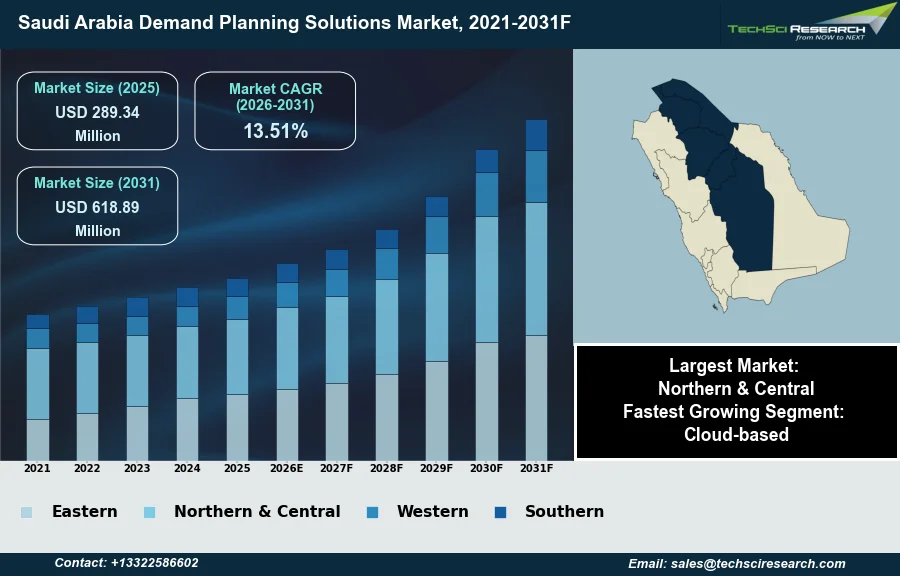
The Saudi Arabia Demand Planning Solutions Market will grow from USD 289.34 Million in 2025 to USD 618.89 Million by 2031 at a 13.51% CAGR. Demand planning solutions encompass a suite of software and analytical tools designed to forecast future customer demand, optimizing a company's production, inventory, and budgeting processes to meet market needs efficiently and mitigate stockouts or excess inventory. The market for these solutions in Saudi Arabia is significantly supported by the Kingdom's Vision 2030 initiative, which prioritizes digital transformation and economic diversification across various sectors. Furthermore, the increasing focus on enhancing supply chain efficiency, improving business agility, and boosting overall operational performance drives the adoption of advanced forecasting and inventory optimization tools.
The market expansion is further contextualized by significant investments in foundational technologies. According to the Saudi Industrial Development Fund (SIDF), the market value for Artificial Intelligence and Machine Learning technologies within Saudi Arabia's manufacturing sector, critical components of modern demand planning, reached USD 21.17 million in 2023. This growth trajectory, however, faces a notable impediment in the form of limited data infrastructure and challenges related to data quality and integration, which can hinder the effectiveness of these advanced planning systems.
Key Market Drivers
Vision 2030 as a Catalyst for Demand Planning and Digital Transformation
Saudi Vision 2030 initiatives are a primary catalyst for the increasing demand for planning solutions, as the national transformation agenda emphasizes digital advancement and economic diversification beyond oil. This strategic framework encourages industries across the Kingdom to adopt modern technologies and practices to enhance efficiency and competitiveness. The extensive government-led projects and programs necessitate sophisticated demand planning to manage complex supply chains and optimize resource allocation effectively. According to the Ministry of Communications and Information Technology, in April 2025, the size of Saudi Arabia's digital economy had reached approximately SAR495 billion, contributing 15% to the national GDP, reflecting substantial investment and focus on digital transformation. This overarching drive for modernization across all sectors under Vision 2030 directly creates a need for robust demand forecasting and inventory optimization tools.
Retail, E-commerce Growth Driving Demand Planning Adoption
The rapid growth witnessed in key sectors, particularly retail, e-commerce, and manufacturing, further fuels the expansion of the Saudi Arabia demand planning solutions market. As consumer buying patterns evolve and online sales channels proliferate, businesses require advanced tools to accurately predict demand fluctuations and manage inventory across various distribution networks. This is particularly evident in the burgeoning e-commerce segment, which demands highly responsive and precise planning capabilities. According to the Saudi Central Bank's statistical bulletin, in July 2025, e-commerce sales via "Mada" cards in Saudi Arabia totaled over SAR69.3 billion during the first quarter of 2025, reflecting an annual growth of 56%. Such rapid expansion underscores the critical need for solutions that process vast amounts of data for agile decision-making. Overall, the Kingdom's ICT market surpassed SAR180 billion by 2024, according to the Ministry of Communications and Information Technology in April 2025, demonstrating a fertile ground for enterprise software adoption.
Download Free Sample Report
Key Market Challenges
Data infrastructure and quality gaps constrain demand planning effectiveness
The growth of the Saudi Arabia Demand Planning Solutions Market is notably impeded by deficiencies in data infrastructure and persistent challenges concerning data quality and integration. Effective demand planning systems are fundamentally dependent on access to comprehensive, accurate, and timely data across an organization's operations. Where underlying data infrastructure is insufficient, it constrains the capacity for collecting, processing, and storing the extensive datasets necessary for sophisticated forecasting algorithms to operate optimally. This directly limits the effectiveness of advanced analytics tools designed to predict future customer demand.
Data quality issues, data silos, and integration challenges dampen forecast reliability and market adoption
Furthermore, issues such as data inconsistencies, inaccuracies, or incomplete information directly compromise the reliability of forecasts generated by demand planning solutions. Businesses implementing these systems may find their predictions are not reflective of actual market dynamics, leading to suboptimal decisions regarding production schedules, inventory levels, and resource allocation. The difficulty in seamlessly integrating disparate data sources, often siloed across various departments or legacy systems, further exacerbates this problem. This fragmentation prevents a unified and holistic view of the supply chain, which is critical for generating precise demand signals. According to the Saudi Industrial Development Fund (SIDF), in 2026, the organization is actively engaged in providing a lending data quality improvement service and establishing a unified integration platform to streamline internal systems and enable external connectivity. This extensive effort by a key industrial enabler highlights the foundational nature and widespread relevance of data quality and integration challenges within the Kingdom's industrial landscape. Consequently, the perceived value and tangible return on investment for adopting demand planning solutions are diminished, directly hindering broader market penetration and expansion within Saudi Arabia.
Key Market Trends
Cloud-based demand planning drives flexibility, collaboration, and SMB access
The shift towards cloud-based demand planning platforms is significantly influencing the Saudi Arabian market by offering businesses enhanced flexibility, scalability, and accessibility to advanced planning tools without substantial upfront infrastructure investments. This operational model facilitates seamless collaboration across supply chain stakeholders and supports remote work capabilities, which are increasingly vital for maintaining business continuity and agility. Such platforms democratize access to sophisticated demand forecasting capabilities, enabling a wider range of companies, including small and medium-sized enterprises, to optimize their inventory and production processes. According to the International Trade Administration, May 2026, annual spending on public cloud services in Saudi Arabia is forecasted to surpass $2.7 billion in 2025.
AI/ML forecasting enhances accuracy and responsiveness in Saudi demand planning
Complementing the move to cloud solutions, the increased adoption of AI and Machine Learning in forecasting represents a pivotal trend reshaping demand planning in Saudi Arabia. These technologies empower organizations to analyze vast datasets, identify complex patterns, and generate highly accurate demand predictions that traditional statistical methods often miss. By automating and refining forecasting processes, AI and ML solutions help minimize forecast errors, leading to optimized inventory levels, reduced waste, and improved customer service. This focus on advanced analytical capabilities allows businesses to respond more dynamically to rapidly changing market conditions and consumer behaviors. According to Fast Company Middle East, March 2026, AI companies in Saudi Arabia secured $9.1 billion in funding through 70 investment deals in 2025.
Segmental Insights
Cloud-based Demand Planning Growth Driven by Vision 2030 and Cloud-First Policy
The Cloud-based segment is experiencing rapid growth within the Saudi Arabia Demand Planning Solutions Market, positioning it as the fastest-growing category. This acceleration is primarily attributed to the Kingdom's robust digital transformation agenda, notably driven by Saudi Vision 2030, which emphasizes technological modernization across all sectors. Government initiatives, such as the Cloud First Policy implemented by entities like the Ministry of Communications and Information Technology, mandate prioritizing cloud solutions for public sector entities and encourage private sector adoption. This fosters an environment where businesses increasingly leverage cloud platforms for their demand planning requirements due to the inherent scalability, enhanced accessibility, and reduced infrastructure investments, enabling greater operational efficiency and agility in dynamic market conditions.
Regional Insights
Northern & Central Region: Market Leader Driven by Riyadh's Economic Influence
The Northern & Central region leads the Saudi Arabia Demand Planning Solutions Market, primarily due to the significant economic and commercial influence of Riyadh, the nation's capital and largest city. This region serves as a central hub for diverse industries and businesses, driving a substantial need for advanced solutions to optimize supply chain processes and enhance operational efficiency. The strong presence of large enterprises focused on digital transformation and embracing technologies like artificial intelligence within this economic powerhouse further propels the adoption of demand planning solutions, aligning with national strategic imperatives such as Saudi Vision 2030.
Recent Developments
-
In February 2025, SAP expanded its efforts to collaborate with partners and customers on developing industry-specific artificial intelligence solutions and use cases at its Khobar Experience & Innovation Center. A survey commissioned by SAP indicated that Saudi enterprises were making significant progress in preparing for effective business AI utilization, with a strong focus on data quality. These AI solutions were specifically designed to enable accurate demand forecasting and streamline supply chains, directly enhancing the capabilities of demand planning within the Kingdom by leveraging advanced algorithmic insights.
-
In February 2025, Salesforce announced plans to invest USD 500 million in Saudi Arabia, primarily focused on artificial intelligence initiatives. As part of this strategic investment, Salesforce introduced Hyperforce, its platform architecture delivered in collaboration with Amazon Web Services (AWS), within the Kingdom. This move was intended to provide a robust cloud-based infrastructure that supports advanced AI capabilities. Such an investment and technology launch are instrumental for the Saudi Arabia demand planning solutions market, enabling businesses to leverage scalable cloud resources and advanced AI for enhanced forecasting accuracy and operational agility.
-
In January 2025, JAGGAER announced an alliance with Saudi Arabia's Technology Force of Communication and Information Technology (TForce). The collaboration aimed to deliver enhanced digital procurement and supply chain solutions to businesses throughout the nation. By combining JAGGAER's expertise with TForce, the alliance intended to provide sophisticated tools and insights capable of transforming how organizations manage their supply chains. This development is significant for the Saudi Arabia demand planning solutions market, as it seeks to offer improved capabilities for forecasting, inventory management, and overall supply chain optimization.
-
In February 2024, Aramco, a leading energy and chemicals company, collaborated with DHL Supply Chain to establish a new joint venture named ASMO (Advanced Supply Management Operations). This initiative focused on developing sustainable supply chain solutions within Saudi Arabia. ASMO aimed to enhance efficiency and achieve economies of scale by integrating advanced digital technologies such as artificial intelligence, data analytics, and automation. This strategic partnership was designed to meet the increasing demand for more efficient supply chain services across the region, directly impacting the precision and responsiveness of demand planning within various industrial sectors by providing robust logistical support.
Key Market Players
- SAP
- Oracle
- IBM
- Microsoft
- Kinaxis
- DemandCaster
- RELEX Solutions
- Blue Yonder
- Alshaya Demand Tech
|
By Component
|
By Deployment
|
By Enterprise Size
|
By Industry
|
By Region
|
|
|
|
- Small and Medium Sized Enterprises (SMEs)
- Large Enterprises
|
- BFSI
- IT & Telecom
- Healthcare
- Retail & e-Commerce
- Automotive
- Food & Beverages
- Manufacturing
- Others
|
- Eastern
- Northern & Central
- Western
- Southern
|
Report Scope:
In this report, the Saudi Arabia Demand Planning Solutions Market has been segmented into the following categories, in addition to the industry trends which have also been detailed below:
-
Saudi Arabia Demand Planning Solutions Market, By Component:
-
Saudi Arabia Demand Planning Solutions Market, By Deployment:
-
Saudi Arabia Demand Planning Solutions Market, By Enterprise Size:
-
Small and Medium Sized Enterprises (SMEs)
-
Large Enterprises
-
Saudi Arabia Demand Planning Solutions Market, By Industry:
-
BFSI
-
IT & Telecom
-
Healthcare
-
Retail & e-Commerce
-
Automotive
-
Food & Beverages
-
Manufacturing
-
Others
-
Saudi Arabia Demand Planning Solutions Market, By Region:
-
Eastern
-
Northern & Central
-
Western
-
Southern
Competitive Landscape
Company Profiles: Detailed analysis of the major companies present in the Saudi Arabia Demand Planning Solutions Market.
Available Customizations:
Saudi Arabia Demand Planning Solutions Market report with the given market data, TechSci Research offers customizations according to a company's specific needs. The following customization options are available for the report:
Company Information
- Detailed analysis and profiling of additional market players (up to five).
Saudi Arabia Demand Planning Solutions Market is an upcoming report to be released soon. If you wish an early delivery of this report or want to confirm the date of release, please contact us at sales@techsciresearch.com