|
Key Insights
|
Details
|
|
Forecast Period
|
2027-2031
|
|
Market Size (2025)
|
USD 134.56 Million
|
|
CAGR (2026-2031)
|
9.51%
|
|
Fastest Growing Segment
|
Instruments
|
|
Largest Market
|
Northern & Central
|
|
Market Size (2031)
|
USD 232.08 Million
|
Market Overview
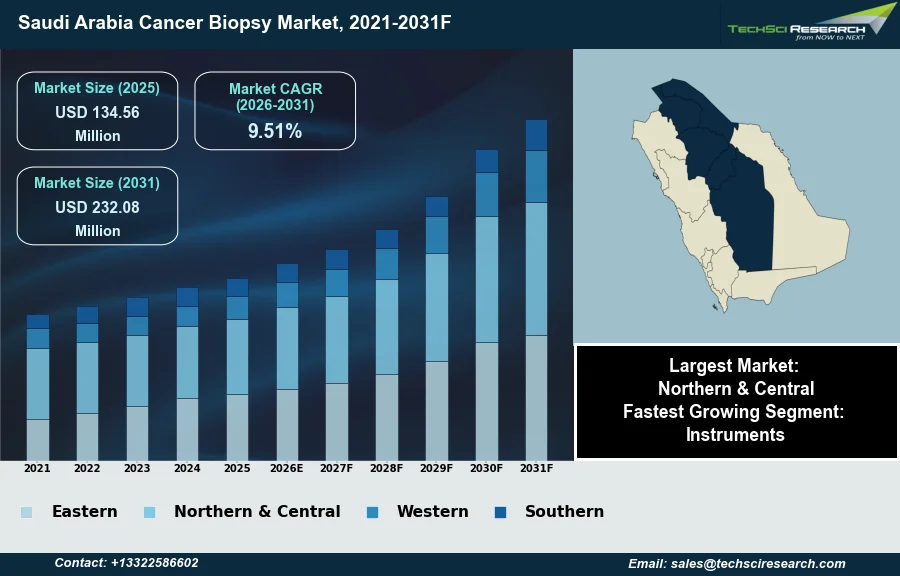
The Saudi Arabia Cancer Biopsy Market will grow from USD 134.56 Million in 2025 to USD 232.08 Million by 2031 at a 9.51% CAGR. A cancer biopsy involves the removal of tissue or cells from the body for microscopic examination to diagnose the presence and characteristics of cancerous cells. The Saudi Arabia Cancer Biopsy Market is supported by several fundamental drivers, including the increasing incidence of various cancer types across the population, robust government initiatives aimed at enhancing cancer control and early detection as part of Vision 2030, and substantial investments in the national healthcare infrastructure. Furthermore, growing public awareness regarding the importance of early diagnosis significantly contributes to market expansion. According to the Saudi Health Council, in February 2026, the survival rate for breast cancer reached 76%, prostate cancer 82%, and colorectal cancer 61%, indicating the critical role of timely diagnostics.
Despite these growth factors, a notable challenge impeding market expansion is the high cost associated with advanced biopsy procedures and biomarker analysis, which can limit accessibility and adoption. Addressing this economic barrier is crucial for sustaining comprehensive market development and ensuring equitable access to advanced diagnostic capabilities throughout the Kingdom.
Key Market Drivers
Rising cancer burden drives biopsy demand
The increasing cancer incidence and prevalence within Saudi Arabia directly fuels the demand for cancer biopsy procedures, which are essential for definitive diagnosis and staging. As the population grows and ages, a greater number of individuals are requiring precise diagnostic services, consequently driving market expansion for biopsy solutions. This trend is underscored by recent findings, with the Saudi Medical Journal reporting in December 2025, in "Rising cancer burden among older adults in Saudi Arabia," that Joinpoint regression analysis revealed significant post-2020 cancer rate increases among Saudis, with an annual percentage change of 21% for men and 16.5% for women. This escalating cancer burden necessitates a corresponding rise in diagnostic capabilities, including advanced biopsy techniques, to enable early and accurate disease identification.
Infrastructure expansion and investment expand biopsy access
Complementing this, the ongoing expansion of healthcare infrastructure and substantial government investment are pivotal in enabling greater access to biopsy services across the Kingdom. Modernized and enlarged medical facilities are equipped to handle a higher volume and complexity of diagnostic procedures. For example, according to MOH News, in December 2025, public hospitals expanded their bed capacity by over 1,700 beds in 2025 alone, with an additional 2,900 beds added in the private sector, demonstrating significant growth in diagnostic and treatment capabilities. This infrastructure development, coupled with a broader commitment to healthcare enhancement, is further exemplified by the Global Health Exhibition in Riyadh in July 2025, which, according to Amplifier Financial, in 2026, resulted in approximately $35.5 billion in signed partnerships and investment commitments for the healthcare sector. Such investments reinforce the market's capacity to adopt advanced biopsy technologies and meet rising patient needs.
Download Free Sample Report
Key Market Challenges
Economic Barriers to Advanced Biopsy Adoption
The primary challenging factor impeding the growth of the Saudi Arabia Cancer Biopsy Market is the high cost associated with advanced biopsy procedures and biomarker analysis. This economic barrier directly constrains market expansion by limiting both the accessibility of these crucial diagnostic tools for patients and their widespread adoption by healthcare providers across the Kingdom. The substantial investment required for sophisticated biopsy equipment and the ongoing expenses for reagents and specialized personnel can strain hospital budgets, particularly for smaller private clinics or facilities in less urbanized areas.
Cost-Driven Disparities in Diagnostic Access
Consequently, the high costs can lead to an uneven distribution of advanced diagnostic capabilities, creating disparities in patient access to timely and accurate cancer detection. For example, according to the Saudi Ministry of Health's 2025 Annual Health Report, diagnostic services with equipment costs exceeding SAR 500,000 experienced an average adoption rate that was 18% lower in general hospitals compared to specialized cancer centers. This indicates that financial considerations significantly influence procurement and operational decisions, which can subsequently delay critical diagnoses or necessitate referrals to larger, better-equipped facilities. The inability to widely deploy and sustain these advanced procedures due to cost directly hampers the market’s potential for comprehensive development across all segments of the Saudi healthcare system.
Key Market Trends
Liquid Biopsy Advances and Biobank Capacity
Advancements in liquid biopsy technology represent a significant trend reshaping the Saudi Arabia Cancer Biopsy Market by offering less invasive alternatives for cancer detection and monitoring. This technology enables the analysis of circulating tumor DNA and other biomarkers from a simple blood sample, reducing the need for traditional tissue biopsies, which can be painful and carry risks. The increasing adoption reflects a preference for patient-friendly diagnostic methods that can also facilitate earlier detection and ongoing disease management. According to EINPresswire.com, in October 2025, in "Inside the New KFSHRC Biobank: Building the Foundation for Healthier, Data Driven Future," King Faisal Specialist Hospital and Research Centre in Riyadh developed a modernized Biobank Center with capacity for ten million high-quality biospecimens, including liquid biopsies, indicating substantial investment in this advanced diagnostic capability.
AI-Driven Diagnostics and Genomic Testing Growth
The integration of artificial intelligence (AI) in cancer diagnostics is another pivotal trend, enhancing the precision and efficiency of biopsy analysis within the Kingdom. AI algorithms can analyze complex pathology images and genomic data with speed and accuracy, aiding pathologists in identifying subtle cancerous changes and predicting treatment responses more effectively. This integration supports the broader move towards personalized medicine by providing deeper insights into cancer characteristics. As reported by GLOBE NEWSWIRE, in April 2026, King Faisal Specialist Hospital and Research Centre scaled its genomic medicine model, resulting in genomic testing increasing from approximately 22,000 tests to over 44,000 within two years, with AI-driven computational sciences being a core component of this advancement.
Segmental Insights
Vision 2030–driven growth and SFDA regulation of biopsy instruments in Saudi Arabia
The Instruments segment is experiencing rapid growth in the Saudi Arabia Cancer Biopsy Market, positioning it as the fastest expanding product category. This accelerated demand is primarily driven by substantial government investments in healthcare infrastructure as part of Vision 2030, leading to the establishment and modernization of diagnostic centers and specialized hospitals across the Kingdom. Furthermore, the rising prevalence of cancer necessitates advanced and precise diagnostic tools for early detection and accurate staging, directly increasing the adoption of sophisticated biopsy instruments. The continuous advancements in minimally invasive and image-guided biopsy technologies, which offer enhanced precision and reduced patient discomfort, also significantly contribute to this growth. The Saudi Food and Drug Authority (SFDA) plays a crucial role in regulating these medical devices, ensuring that only high-quality and safe instruments are available in the market, thereby fostering confidence and wider adoption.
Regional Insights
Northern & Central Region: Dominance Driven by Advanced Healthcare Infrastructure and Vision 2030 Initiatives
The Northern & Central region dominates the Saudi Arabia Cancer Biopsy Market due to its robust healthcare infrastructure and high concentration of specialized medical expertise. Riyadh, as the central hub, houses the country's most advanced hospitals equipped with sophisticated diagnostic technologies and staffed by highly qualified medical professionals. This concentration of premier healthcare facilities, including leading oncology centers like King Faisal Specialist Hospital and Research Center, ensures a greater capacity for advanced cancer diagnostics and treatment. Furthermore, ongoing government initiatives under Vision 2030, spearheaded by the Ministry of Health, prioritize significant investments in healthcare modernization and the expansion of diagnostic capabilities across these major urban centers, reinforcing the region's leading position in the market.
Recent Developments
-
In August 2025, Rakovina Therapeutics Inc. and Saudi-based NanoPalm Ltd. announced a non-binding Letter of Intent to establish a joint venture focused on developing AI-discovered cancer treatments. The initial focus of this collaboration was on kt-3283, a dual PARP-HDAC inhibitor. Rakovina Therapeutics contributed its expertise in AI-driven drug discovery, while NanoPalm provided its patterned lipid nanoparticle delivery platform and clinical support infrastructure within Saudi Arabia. This breakthrough research and development aims to address hard-to-treat tumors, signifying advancements in oncology that will necessitate sophisticated diagnostic approaches, including precise biopsy analyses for patient stratification and treatment efficacy assessment.
-
In June 2025, Saudi biotech startup Novo Genomics formed an agreement with Tracer Biotechnologies to localize circulating tumor DNA (ctDNA) monitoring technologies in Saudi Arabia. This strategic partnership directly contributes to the Saudi Arabia cancer biopsy market by advancing liquid biopsy methods. These technologies enable the detection and monitoring of cancer through blood samples, offering a less invasive alternative to traditional tissue biopsies. The localization efforts, utilizing local genomic data, were intended to enhance diagnostic precision for various cancers and support Saudi Arabia's broader objectives in personalized medicine.
-
In May 2025, ImmunityBio, Inc., a leading immunotherapy company, signed a strategic Memorandum of Understanding with the Ministry of Investment of Saudi Arabia, King Faisal Specialist Hospital & Research Centre, and King Abdullah International Medical Research Center. This collaboration aimed to introduce the FDA-approved Cancer BioShield platform to Saudi Arabia and the broader Middle East. The platform, powered by Anktiva, offers immune-restorative therapies for cancer patients. This initiative is expected to support the localization of advanced biotechnology and biomanufacturing capabilities within the Kingdom, influencing the demand for comprehensive cancer diagnostics and potentially impacting the scope of biopsy procedures for diagnosis and ongoing disease monitoring.
-
In November 2024, Axbio Inc. showcased its molecular testing and multi-omics platforms at the Riyadh Global Medical Biotechnology Summit. The company highlighted its fourth-generation nanopore sequencing technology, emphasizing its utility in genetic analysis and infectious disease diagnostics. While not exclusively centered on biopsy instruments, these advanced molecular diagnostic platforms are crucial for analyzing tissue and fluid samples obtained through cancer biopsies. This breakthrough in diagnostic technology offers enhanced capabilities for obtaining detailed genetic and molecular profiles of tumors, thereby supporting personalized treatment strategies and influencing the analytical segment of the Saudi Arabia cancer biopsy market.
Key Market Players
- Medtronic
- Johnson & Johnson
- B. Braun
- Stryker
- Boston Scientific
- Zimmer Biomet
- Smith & Nephew
- Conmed
- Integra LifeSciences
- Karl Storz
|
By Product
|
By Application
|
By Region
|
- Instruments
- Kits & Consumables
- Services
|
- Breast Cancer
- Colorectal Cancer
- Cervical Cancer
- Lung Cancer
- Prostate Cancer
- Skin Cancer
- Blood Cancer
- Kidney Cancer
- Liver Cancer
- Others
|
- Eastern
- Northern & Central
- Western
- Southern
|
Report Scope:
In this report, the Saudi Arabia Cancer Biopsy Market has been segmented into the following categories, in addition to the industry trends which have also been detailed below:
-
Saudi Arabia Cancer Biopsy Market, By Product:
-
Instruments
-
Kits & Consumables
-
Services
-
Saudi Arabia Cancer Biopsy Market, By Application:
-
Breast Cancer
-
Colorectal Cancer
-
Cervical Cancer
-
Lung Cancer
-
Prostate Cancer
-
Skin Cancer
-
Blood Cancer
-
Kidney Cancer
-
Liver Cancer
-
Others
-
Saudi Arabia Cancer Biopsy Market, By Region:
-
Eastern
-
Northern & Central
-
Western
-
Southern
Competitive Landscape
Company Profiles: Detailed analysis of the major companies present in the Saudi Arabia Cancer Biopsy Market.
Available Customizations:
Saudi Arabia Cancer Biopsy Market report with the given market data, TechSci Research offers customizations according to a company's specific needs. The following customization options are available for the report:
Company Information
- Detailed analysis and profiling of additional market players (up to five).
Saudi Arabia Cancer Biopsy Market is an upcoming report to be released soon. If you wish an early delivery of this report or want to confirm the date of release, please contact us at sales@techsciresearch.com