|
Key Insights
|
Details
|
|
Forecast Period
|
2027-2031
|
|
Market Size (2025)
|
USD 5.67 Billion
|
|
CAGR (2026-2031)
|
6.19%
|
|
Fastest Growing Segment
|
Replacement
|
|
Largest Market
|
Northern & Central
|
|
Market Size (2031)
|
USD 8.13 Billion
|
Market Overview
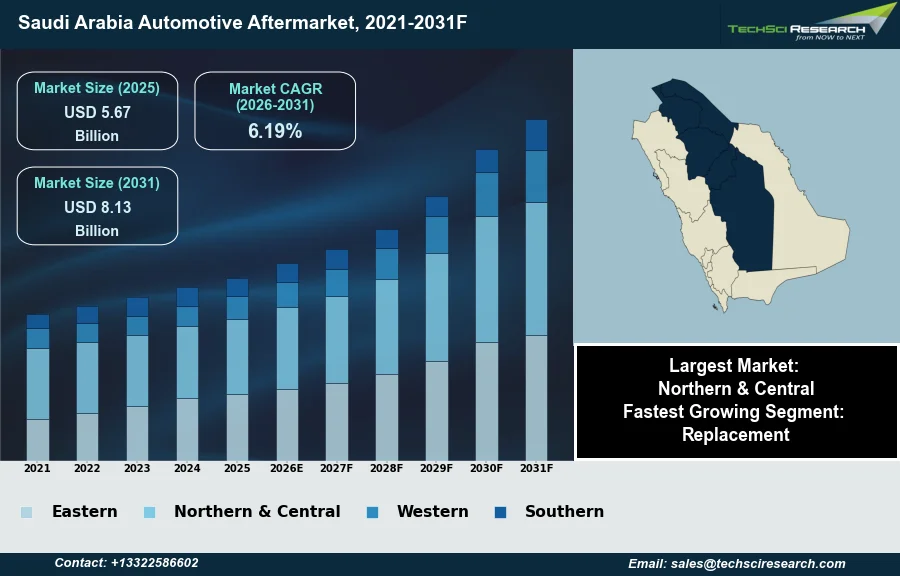
The Saudi Arabia Automotive Aftermarket will grow from USD 5.67 Billion in 2025 to USD 8.13 Billion by 2031 at a 6.19% CAGR. The Saudi Arabia Automotive Aftermarket encompasses the provision of vehicle parts, accessories, lubricants, tires, and maintenance services for vehicles post-sale, outside of the original equipment manufacturer's production and assembly lines. Key drivers supporting market expansion include the sustained growth in the national vehicle parc, increasing average vehicle age necessitating more frequent repairs, and a robust consumer preference for vehicle maintenance over premature replacement. The harsh climatic conditions in the Kingdom also accelerate component wear and tear, consistently generating demand for replacement parts.
This market continues to grow, with new vehicle sales in Saudi Arabia reaching 827,544 units in 2025, according to International Organization of Motor Vehicle Manufacturers statistics. These additions contribute to a burgeoning car fleet requiring ongoing servicing and parts. A significant challenge impeding further market expansion is the persistent shortage of skilled labor capable of servicing increasingly complex and technologically advanced vehicles, including those with advanced driver-assistance systems and electric drivetrains.
Key Market Drivers
Vision 2030 Support and Local Automotive Localization
Governmental support and Vision 2030 initiatives represent a foundational driver for the Saudi Arabia Automotive Aftermarket. These strategic programs aim to diversify the economy and localize industrial capabilities, fostering a robust domestic automotive ecosystem. A key objective outlined by the Ministry of Investment, as of January 26, 2026, is the establishment of five factories with an annual production capacity reaching up to 600,000 vehicles by 2035, indicating significant long-term growth and a reduced reliance on imports. This proactive governmental involvement creates a stable environment for investment in related value chains, including maintenance, spare parts manufacturing, and distribution, thereby directly stimulating demand within the aftermarket. The emphasis on local content targets within these manufacturing initiatives further encourages the development of a resilient domestic supply for automotive components.
Rising Vehicle Fleet and Import Growth Driving Aftermarket Demand
Concurrently, the expanding vehicle fleet significantly contributes to the sustained demand within the aftermarket. As more vehicles enter service in the Kingdom, the need for routine maintenance, accident repair, and eventual component replacement naturally escalates. Supporting this expansion, data from the Saudi Zakat, Tax and Customs Authority (ZATCA) reveals that Saudi Arabia imported approximately 959,403 vehicles by 2025. This consistent influx of vehicles, combined with the increasing average age of the existing car parc, ensures a perpetual requirement for aftermarket products and services. Overall, the Saudi Arabia Automotive Aftermarket is a dynamic sector, with TradeInt reporting that the nation imported $15.60 billion in vehicles and auto parts in 2025, underscoring the substantial scale of component flow into the market.
Download Free Sample Report
Key Market Challenges
Skilled-Labor Shortage Impedes Growth of the Saudi Arabia Automotive Aftermarket
A persistent shortage of skilled labor directly impedes the growth of the Saudi Arabia Automotive Aftermarket. As the national vehicle fleet expands and incorporates increasingly sophisticated models, including those equipped with advanced driver-assistance systems and electric drivetrains, the demand for specialized diagnostic and repair expertise intensifies. The scarcity of technicians trained in these evolving technologies limits the market's capacity to deliver efficient and high-quality maintenance services. This deficiency can result in extended service wait times, compromised repair quality, and a reduced ability to properly service modern vehicles, which may lead vehicle owners to defer critical maintenance or seek less qualified options. According to the Hays Saudi Arabia Salary Guide 2026, 93 percent of employers experienced skills gaps in 2025, highlighting the widespread nature of this workforce challenge across various sectors including automotive. Consequently, the aftermarket struggles to meet the growing and complex servicing needs of the burgeoning vehicle parc, directly restraining its potential for further expansion and development.
Key Market Trends
Digital Transformation and Online Expansion in the Saudi Arabia Automotive Aftermarket
The Saudi Arabia Automotive Aftermarket is undergoing a significant transformation driven by the digitalization of sales and distribution channels. This trend reflects a broader shift in consumer behavior towards online platforms for purchasing vehicle parts and accessories, prioritizing convenience, competitive pricing, and a wider selection beyond traditional brick-and-mortar stores. Businesses are increasingly investing in robust e-commerce capabilities, including user-friendly websites and mobile applications, to meet evolving customer expectations and expand their market reach. The Saudi Arabian Vehicle Parts E-Commerce Market generated an e-commerce revenue of US$264 million in 2025, according to ECDB. This digital evolution necessitates adaptations in supply chain management and logistics, impacting traditional distribution models and fostering the growth of specialized online auto parts retailers and platforms.
Rising EV-Specific Aftermarket Needs and Technician Training
Concurrently, the market is experiencing a notable growth in demand for electric vehicle (EV)-specific aftermarket products and services. As Saudi Arabia actively pursues its Vision 2030 goals, including initiatives to boost EV adoption, the composition of the national vehicle fleet is gradually shifting. This growth introduces entirely new categories of aftermarket needs, such as specialized components for electric powertrains, battery diagnostics, and dedicated charging infrastructure maintenance. Servicing these vehicles requires distinct expertise and tooling, prompting automotive service providers to invest in retraining technicians and upgrading their diagnostic equipment. EV sales in Saudi Arabia reached 23,464 units in 2025, as reported by Focus2Move in May 2026, underscoring the emerging requirement for a specialized EV aftermarket ecosystem.
Segmental Insights
Growth Drivers: Expanding Fleet, Harsh Climate, and Regulatory Requirements
The Saudi Arabia Automotive Aftermarket is experiencing significant growth, with the Replacement segment identified as the fastest-growing. This acceleration is primarily driven by a continuously expanding and aging national vehicle fleet, necessitating more frequent maintenance and component replacements as vehicles exceed their initial warranty periods. Furthermore, the Kingdom's challenging climatic conditions, marked by extreme temperatures and pervasive dust, considerably hasten the wear and tear on critical automotive parts such as cooling systems, batteries, and tires. This demand is further reinforced by regulatory frameworks, including mandatory periodic vehicle inspections (Fahas) enforced by the General Directorate of Traffic, and product safety standards stipulated by the Saudi Standards, Metrology and Quality Organization (SASO), which compel motorists to ensure vehicle roadworthiness and compliance.
Regional Insights
Northern & Central Region: Primary Driver of the Automotive Aftermarket
The Northern & Central region spearheads the Saudi Arabia Automotive Aftermarket due to its pivotal role as the Kingdom's primary commercial and administrative hub, anchored by Riyadh. This region features a significant concentration of economic activities, a dense urban population, and a substantial vehicle fleet, including passenger and commercial vehicles, collectively driving considerable demand for vehicle maintenance and replacement components. An extensive infrastructure of authorized service centers and spare parts distributors further supports aftermarket services in this area. Additionally, the mandatory vehicle inspection regime and stringent quality standards for aftermarket parts, enforced by the Saudi Standards, Metrology and Quality Organization, contribute to consistent demand within this dominant region.
Recent Developments
-
In May 2025, SOUEAST Motor Co. Ltd. officially launched its Saudi subsidiary and inaugurated its largest automotive spare parts center in the Kingdom, in partnership with Starlinks. This strategic collaboration aimed to strengthen SOUEAST's localization strategy in the Middle East. The 10,000-square-meter facility was designed to ensure a 100 percent parts supply guarantee, significantly reducing waiting times for customers. Its intelligent warehouse system was intended to facilitate parts delivery within 24 hours, with emergency resolutions guaranteed within 48 hours across Saudi Arabia, thereby enhancing aftersales services.
-
In January 2025, Al Ghurair announced an exclusive distributor partnership with EXEED Automobile Company for the Saudi Arabian market. This strategic alliance aimed to expand Al Ghurair's footprint in the GCC automotive sector. The collaboration sought to introduce advanced vehicles and provide comprehensive service experiences to customers in Saudi Arabia, establishing a new benchmark for premium automotive offerings. Furthermore, the partnership planned to launch electric and hybrid vehicle models in 2025, aligning with Saudi Arabia's Vision 2030 sustainability goals.
-
In April 2024, during Automechanika Riyadh, Hyundai, in collaboration with Saudi Arabia’s Public Investment Fund, highlighted breakthrough research in nanotechnology with applications for the automotive aftermarket. The company showcased six innovative nanotechnologies, including self-healing polymer coatings and radiative cooling films for car windows. These advancements were presented as crucial drivers for future mobility, aiming to enhance engine efficiency, reduce emissions, improve vehicle communication, and refine overall vehicle design, directly impacting vehicle longevity and performance within the aftermarket sector.
-
In January 2024, Robert Bosch GmbH inaugurated its new headquarters in Saudi Arabia to expand its automotive aftermarket operations. This strategic move aimed to leverage the increasing demand for smart mobility solutions within the region. The new facility underscores Bosch's commitment to strengthening its presence and service capabilities in the Saudi Arabian automotive aftermarket. This expansion allowed the company to enhance its operational efficiency and better serve its growing customer base with advanced automotive technologies and services.
Key Market Players
- Al Futtaim Aftermarket
- Al Habtoor Aftermarket
- Al Tayer Aftermarket
- Emirates Motors Aftermarket
- Premier Motors Aftermarket
- Auto Spare Parts KSA
- Midas KSA
- Bosch Auto Service KSA
- Euromaster KSA
- Sasoo Auto Parts KSA
|
By Vehicle Type
|
By Component
|
By Sales Channel
|
By Region
|
- Two-Wheelers
- Commercial Vehicle
- Passenger Cars
|
- Tires
- Body & Mechanical parts
- Batteries
- Accessories & Vehicle Care Products
- Lubricants
|
|
- Eastern
- Northern & Central
- Western
- Southern
|
Report Scope:
In this report, the Saudi Arabia Automotive Aftermarket has been segmented into the following categories, in addition to the industry trends which have also been detailed below:
-
Saudi Arabia Automotive Aftermarket, By Vehicle Type:
-
Two-Wheelers
-
Commercial Vehicle
-
Passenger Cars
-
Saudi Arabia Automotive Aftermarket, By Component:
-
Tires
-
Body & Mechanical parts
-
Batteries
-
Accessories & Vehicle Care Products
-
Lubricants
-
Saudi Arabia Automotive Aftermarket, By Sales Channel:
-
Saudi Arabia Automotive Aftermarket, By Region:
-
Eastern
-
Northern & Central
-
Western
-
Southern
Competitive Landscape
Company Profiles: Detailed analysis of the major companies present in the Saudi Arabia Automotive Aftermarket.
Available Customizations:
Saudi Arabia Automotive Aftermarket report with the given market data, TechSci Research offers customizations according to a company's specific needs. The following customization options are available for the report:
Company Information
- Detailed analysis and profiling of additional market players (up to five).
Saudi Arabia Automotive Aftermarket is an upcoming report to be released soon. If you wish an early delivery of this report or want to confirm the date of release, please contact us at sales@techsciresearch.com