|
Key Insights
|
Details
|
|
Forecast Period
|
2027-2031
|
|
Market Size (2025)
|
USD 5.75 Billion
|
|
CAGR (2026-2031)
|
6.12%
|
|
Fastest Growing Segment
|
Premium Cosmetics
|
|
Largest Market
|
ACT and New South Wales
|
|
Market Size (2031)
|
USD 8.21 Billion
|
Market Overview
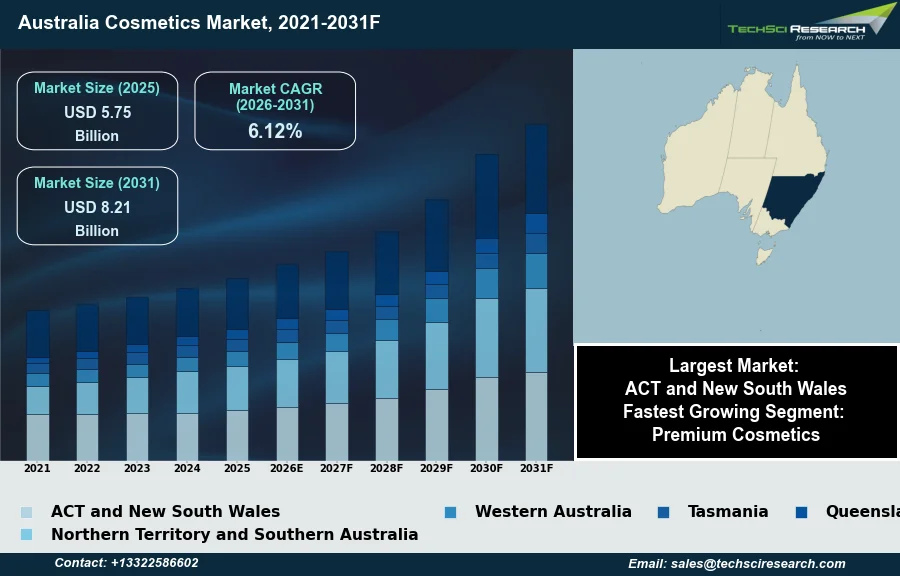
The Australia Cosmetics Market will grow from USD 5.75 Billion in 2025 to USD 8.21 Billion by 2031 at a 6.12% CAGR. Cosmetics encompass substances or preparations intended for external application to the human body, including the mouth and teeth, to cleanse, perfume, protect, alter appearance, or maintain condition. The Australian cosmetics market is primarily driven by consistent growth in disposable income, enabling increased consumer spending on discretionary items. Further market expansion is supported by ongoing urbanization, a heightened societal focus on personal grooming, and a generally high standard of living across the population. These fundamental economic and social factors underpin demand, distinct from fleeting product trends.
Regarding market performance, according to the Australian Retailers Association referencing data from the Australian Bureau of Statistics, in June 2024, the "other retailing" category, which encompasses cosmetics, recreational goods, and sports, experienced a notable 6.3% year-on-year growth. This indicates a resilient segment within the broader retail landscape. However, a significant challenge impeding market expansion is the complex regulatory environment governing product introduction and labeling, which necessitates adherence to strict standards set by bodies such as the Australian Industrial Chemicals Introduction Scheme and the Australian Competition and Consumer Commission.
Key Market Drivers
Rise of natural, transparent, and ethical beauty
The increasing focus on self-care and wellness, alongside heightened awareness of skin health, significantly shapes Australian consumer preferences, particularly driving demand for natural, organic, and clean beauty products. Consumers actively seek formulations free from synthetic ingredients, prioritizing transparency in sourcing and production. This shift underscores a broader trend towards ethical consumption; according to KPMG's Australian Retail Outlook 2026, a full 76 percent of Australians consider sustainability in their spending decisions. This inclination compels beauty brands to innovate, offering conscious and skin-friendly options to meet evolving market expectations.
Digital channels accelerating beauty discovery and sales
The profound influence of social media and expanding e-commerce platforms are pivotal in transforming how cosmetics are discovered, marketed, and purchased in Australia. Digital channels provide brands direct avenues to engage consumers, showcase innovations, and leverage influencer marketing. This digital acceleration has led to substantial growth in online beauty transactions; according to WifiTalents, in February 2026, online beauty sales grew by 15.4% during the last fiscal year. Such robust online performance highlights the critical role of a strong digital presence. This resilience in consumer spending, partly fueled by online retail, is reflected in broader economic indicators. According to the Australian Bureau of Statistics, in January 2026, household retail spending increased by 5% year-on-year, demonstrating sustained consumer activity across retail categories.
Download Free Sample Report
Key Market Challenges
Regulatory Burden and Costs Limiting Australian Cosmetics Growth
A significant challenge impeding the expansion of the Australian cosmetics market is the intricate regulatory environment governing product introduction and labeling. This complexity necessitates rigorous adherence to strict standards established by various bodies, including the Australian Industrial Chemicals Introduction Scheme and the Australian Competition and Consumer Commission. Such demanding compliance requirements impose substantial financial burdens and extend the timeframe for new product launches or even the re-introduction of existing ones. These hurdles can deter both local innovators and international brands from entering or expanding within the market. For example, according to Accord Australasia, in June 2026, companies seeking to re-start the importation of retinal-containing cosmetic products faced a minimum cost of $24,100 for a health-focused assessment application, in addition to expenses for necessary data generation. Such direct regulatory costs, coupled with potential delays, divert resources that could otherwise be allocated to innovation, marketing, or price competitiveness. This regulatory burden ultimately hampers the market's overall growth by limiting product diversity and increasing operational overheads for businesses.
Key Market Trends
Rise of personalized, clinical skincare and HYDRINITY’s Australian expansion
The Australian cosmetics market is currently experiencing a significant trend towards personalized and clinical skincare solutions, driven by consumers seeking highly efficacious and tailored treatments. This shift reflects a growing demand for professional-grade formulations and expert-backed advice that goes beyond general cosmetic benefits. A notable development in this area is the March 2025 expansion of HYDRINITY Accelerated Skin Science, a U.S.-based professional clinical skincare brand, into the Australian market, targeting over 1,000 plastic surgeons and dermatologists, as well as 39,000 general practitioners for distribution of its products. This expansion underscores the increasing integration of medical and aesthetic expertise into mainstream beauty offerings, responding to consumer desires for visible and measurable results.
Skinimalism and multifunctional products; omnichannel retail enhancement
Complementing this, the market is also shaped by the "skinimalism" movement and a preference for multifunctional products, where consumers prioritize streamlined routines and efficiency. This trend sees individuals opting for fewer, high-performing items that offer multiple benefits, simplifying their beauty regimens without compromising effectiveness. Supporting this consumer behavior, in February 2025, major Australian beauty retailer Adore Beauty enhanced its omnichannel approach by deploying endless aisle technology in over 25 physical store locations, allowing full online catalog access and a more efficient shopping experience for consumers seeking to curate their product selections. This retail innovation caters to the demand for considered purchasing, where consumers can research and select multi-purpose products with ease.
Segmental Insights
Premium Cosmetics: Fastest-Growing Segment Driven by Income, Quality, and Ethical Transparency
The Australian Cosmetics Market demonstrates a notable key segmental insight with the Premium Cosmetics segment emerging as the fastest-growing. This acceleration is predominantly fueled by rising disposable incomes and a strong consumer inclination towards higher quality products and advanced formulations. Australian consumers are increasingly prioritizing brands that offer scientific credibility, ingredient transparency, and align with ethical considerations such as sustainability and cruelty-free practices. Moreover, the expanding reach of e-commerce platforms and boutique retail channels has enhanced the accessibility of premium offerings, further stimulating demand. This trend underscores a discerning market valuing efficacy and sophisticated beauty solutions.
Regional Insights
ACT and NSW: Market Leaders Driven by Demographics, Affluence, and Retail Infrastructure
The Australian Capital Territory and New South Wales lead the Australia Cosmetics Market due to significant demographic and economic factors. These regions benefit from a large, diverse, and relatively affluent population, particularly within major urban centers, which drives substantial consumer expenditure on cosmetic products. The concentration of commercial activity and established retail infrastructure in these areas facilitates extensive product distribution across various channels, including a robust online presence. Consumers in these key regions also exhibit strong demand for premium, innovative, and ethically sourced beauty solutions, aligning with prevailing market trends for sustainable and natural products, thus amplifying growth in these economically active locations.
Recent Developments
-
In October 2025, BIG W, an Australian retailer, significantly expanded its cosmetics offerings by introducing a new own-brand bath and body range called 'Beauty Bar' and adding over 420 new products from 22 additional brands to its shelves. This initiative aimed to meet the growing consumer demand for affordable and accessible beauty products within the Australian market. The expansion included supporting Australian-founded businesses such as Skin Control and BOOST LAB, integrating viral cosmetic brands influenced by social media trends. A significant portion of the new range was made available for under $25, with many items priced below $15, making high-quality beauty more attainable.
-
In April 2025, Australian brand Natio launched its new Glow Beauty Boost Cleansing Balm, exclusively available through Chemist Warehouse Australia. This product was designed to thoroughly dissolve makeup, sunscreen, and surface oils while actively maintaining the skin's essential moisture balance. The cleansing balm incorporated cellular extracts from Australian Kakadu plum, goji berry, and pomegranate, ingredients chosen for their antioxidant properties to boost and brighten skin for a healthy and radiant complexion. This new product launch reinforced Natio's presence in the Australian cosmetics market with a focus on naturally derived, efficacious skincare solutions.
-
In May 2024, prominent brands significantly participated in Australian Fashion Week, showcasing collaborations and innovative beauty applications. Ultraceuticals partnered with eco-conscious brand Liandra Swim as the official skin preparation sponsor, ensuring models featured dewy, flawless skin using newly reformulated products. Concurrently, MAKE UP FOR EVER enhanced the natural beauty of models for various designers, including Liandra Swim, Alix Higgins, and Albus Lumen, by applying dewy, sun-kissed skin tones and earthy makeup to complement the fashion collections. These collaborations underscored a focus on natural radiance and strategic product integration within the Australian beauty industry.
-
In April 2024, Australian beauty brand MCoBeauty entered the United States market through an exclusive collaboration with Kroger Family of Stores. This expansion introduced over 250 of MCoBeauty's cruelty-free makeup and skincare products, reflecting the brand's mission to provide accessible and innovative beauty solutions to a broader audience. Kroger's Vice President of Home, Health & Beauty Care Merchandising emphasized that this partnership offered customers a wider selection of sought-after beauty items, maximizing convenience. The move aimed to replicate MCoBeauty's success in Australia and New Zealand, solidifying its presence in the international beauty landscape.
Key Market Players
- L'Oréal S.A.
- Estée Lauder Companies Inc.
- Unilever PLC
- Procter & Gamble Company
- Shiseido Company Limited
- Coty Inc.
- Revlon Inc.
- Amorepacific Corporation
- Beiersdorf AG
- Kao Corporation
|
By Type
|
By Pricing
|
By Sales Channel
|
By Region
|
- Body Care
- Hair Care
- Color Cosmetics
- Fragrances
- Others
|
|
- Supermarkets/Hypermarkets
- Specialty Stores
- Online
- Others
|
- Australia Capital Territory & New South Wales
- Northern Territory & Southern Australia
- Western Australia
- Queensland
- Victoria & Tasmania
|
Report Scope:
In this report, the Australia Cosmetics Market has been segmented into the following categories, in addition to the industry trends which have also been detailed below:
-
Australia Cosmetics Market, By Type:
-
Body Care
-
Hair Care
-
Color Cosmetics
-
Fragrances
-
Others
-
Australia Cosmetics Market, By Pricing:
-
Australia Cosmetics Market, By Sales Channel:
-
Supermarkets/Hypermarkets
-
Specialty Stores
-
Online
-
Others
-
Australia Cosmetics Market, By Region:
-
Australia Capital Territory & New South Wales
-
Northern Territory & Southern Australia
-
Western Australia
-
Queensland
-
Victoria & Tasmania
Competitive Landscape
Company Profiles: Detailed analysis of the major companies present in the Australia Cosmetics Market.
Available Customizations:
Australia Cosmetics Market report with the given market data, TechSci Research offers customizations according to a company's specific needs. The following customization options are available for the report:
Company Information
- Detailed analysis and profiling of additional market players (up to five).
Australia Cosmetics Market is an upcoming report to be released soon. If you wish an early delivery of this report or want to confirm the date of release, please contact us at sales@techsciresearch.com