Main Content start here
Main Layout
Report Description

Report Description

Forecast Period

2026-2030

Market Size (2024)

USD 68.9 Million

CAGR (2025-2030)

5.00%

Fastest Growing Segment

Pharmaceuticals

Largest Market

Central Vietnam

Market Size (2030)

USD 91.29 Million

Market Overview

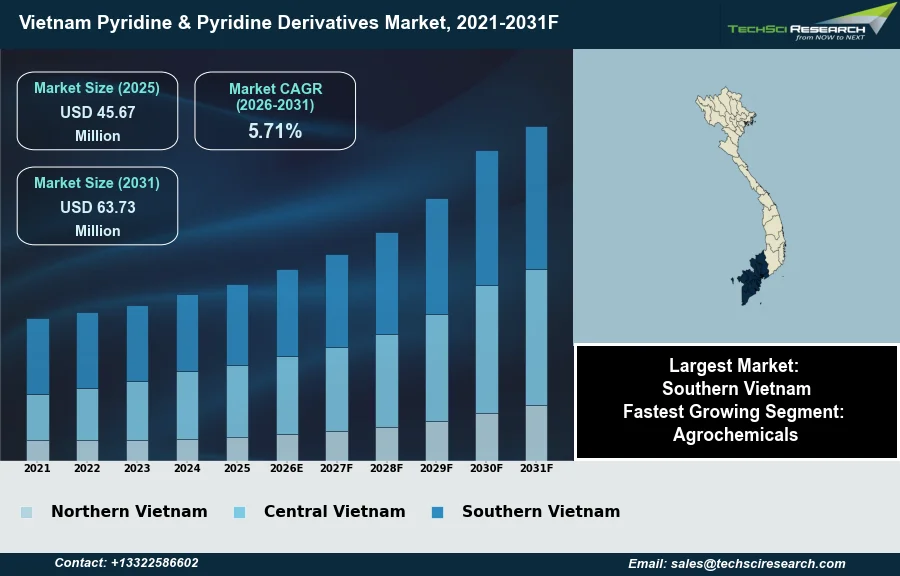
Vietnam Pyridine & Pyridine Derivatives Market was valued at USD 68.9 Million in 2024 and is expected to reach USD 91.29 Million by 2030 with a CAGR of 5.00% during the forecast period. This growth is ascribed to increasing adoption of food flavoring in the food and beverage industry, rising demand for agrochemicals like herbicides & insecticides, and increasing use of pyridine as a solvent for paints and coatings. Apart from these, favorable government policies and a growing reputation for the quality and reliability of Vietnamese product is expected to drive Vietnam's pyridine and pyridine derivatives market in the forecasted period. The industrial sector of Vietnam is also growing by 9% in 2022 and is expected to reach a level where the industrial sector will contribute 40% of the country’s GDP in 2030. As an outcome, there is significant growth in trade of pyridine & pyridine derivatives such as 215 import consignments of pyridine shipments in Vietnam from 213 Suppliers where the top three importers are India with 34,614 shipments, followed by the United States with 20,923 and Germany at the 3rd spot with 10,421 shipments. Pyridine is a heterocyclic organic compound that plays a critical role in the production of a range of important chemical intermediates and solvents Pyridine is a versatile chemical and serves as a building block in the synthesis of many products that is further used in the synthesis of pharmaceuticals, agrochemicals, and other specialty chemicals by end-user industries.

Key Market Drivers

Increasing Demand from the Food and Beverage Industry Driving the Vietnam Pyridine & Pyridine Derivatives Market Growth

The food and beverage industry plays a crucial role in driving the demand for pyridine and its derivatives in Vietnam. Pyridine derivatives are used as flavor and fragrance additives in the food and beverage industry to enhance the taste and aroma of various food products, including processed foods, beverages, and snacks. As consumers' preferences evolve, the usage of pyridine derivatives in the food industry may rise to fulfill the demand for diverse and exotic flavors. Pyridine derivatives possess antimicrobial properties, making them useful as preservatives in food and beverage products. By the end of 2024, Vietnam’s food and beverage (F&B) sector recorded approximately 323,010 establishments, reflecting a 1.8% year-over-year increase. Notably, 52.3% of Vietnamese consumers now prefer to spend less than VND35,000 (USD 1.37) per beverage, underscoring a growing focus on value-for-money consumption. Additionally, the frequency of social drinking has risen significantly, with the proportion of individuals going out for drinks three to four times per week increasing from 17.4% in 2023 to 32.8% in 2024. These shifts in consumer behavior,  increased F&B activity, cost-conscious preferences, and higher frequency of consumption are driving demand for efficient, high-quality ingredients and additives. As a result, the market for Pyridine and Pyridine Derivatives in Vietnam is experiencing strong growth, supported by their essential role in the formulation of flavoring agents, preservatives, and nutritional supplements widely used in the F&B industry. Preservatives help extend the shelf life of perishable items, reducing food wastage and ensuring product safety. With the growing focus on food safety and longer shelf life, the demand for pyridine derivatives as preservatives may increase. Pyridine derivatives can also be used as additives in beverages, providing them with specific functional properties. For instance, they can be used in energy drinks, carbonated beverages, or functional drinks to enhance their effects or stability.

Increasing Demand of Pyridine & Pyridine Derivatives in Paint and Coating Industry

Pyridine and its derivatives find various applications in the paint and coating sector due to their unique chemical properties that enhance the performance and characteristics of paints and coatings. Pyridine is a widely used solvent in the paint and coating industry. It is an effective solvent for resins, pigments, and other additives used in paint formulations. The solvent properties of pyridine help in dissolving and dispersing solid components, resulting in stable and uniform paint solutions. As the paint and coating industry in Vietnam expands, the demand for pyridine as a solvent is likely to increase in the forecasted period. Some kinds of pyridine derivatives possess corrosion-inhibiting properties. Corrosion inhibitors are essential additives in coatings, especially for metal substrates, as they help protect against rust and degradation. Hence, the demand for pyridine derivatives as corrosion inhibitors increases as there is an increasing focus on infrastructure development and protective coatings. Pyridine derivatives also act as catalysts and additives in the production of certain types of coatings. They can facilitate specific chemical reactions, improve coating adhesion, and enhance other performance characteristics. These lead to an increase in the use of pyridine derivatives as catalysts and additives as the paint and coating industry in Vietnam seeks innovative and high-performance products. Pyridine derivatives can function as polymerization initiators in certain coating formulations. Polymerization is a crucial process that imparts various desirable properties to coatings, such as durability, flexibility, and chemical resistance. The demand for pyridine derivatives is expected to grow as a polymerization initiator to fulfill the demand for high-quality coatings in Vietnam. Environmental concerns and regulations drive the shift towards more sustainable and eco-friendly coating formulations. Pyridine derivatives play a role in waterborne coatings, which have lower levels of volatile organic compounds (VOCs) and are considered more environmentally friendly. The growing emphasis on sustainability in the paint and coating industry may boost the demand for pyridine derivatives suitable for waterborne coatings. Pyridine derivatives are used in the synthesis of certain dyes and pigments used in coatings. These dyes and pigments add color and aesthetic appeal to the coatings, meeting the demand for various shades and finishes. Therefore, the growing demand for paint and coating is expected to propel the demand for pyridine & pyridine derivatives in Vietnam.

Growing Demand of Pyridine & Pyridine Derivatives in Pharmaceutical Industry

In Vietnam, the rising demand for pyridine and pyridine derivatives has been a significant factor driving the growth of the local market. This increase can be attributed to their indispensable contributions to drug development, manufacturing processes, and the country's expanding focus on pharmaceutical research and production. Pyridine derivatives are integral components in the construction of various drug molecules. From anti-inflammatory agents to anti-cancer drugs, pyridine-based compounds serve as structural components that enable the synthesis of specific pharmacologically active compounds. Pyridine derivatives act as catalysts in numerous chemical reactions, facilitating the synthesis of complex pharmaceutical compounds more efficiently. These catalysts contribute to cost-effective and environmentally friendly manufacturing processes. As reported by the International Monetary Fund (IMF), Vietnam’s GDP reached USD 406.45 billion in 2022, positioning it as the fifth-largest economy in Southeast Asia and the 37th globally. Complementing this economic growth, healthcare spending stood at approximately USD 18.5 billion in the same year, accounting for 4.6% of national GDP, according to the Economist Intelligence Unit (EIU). Vietnam’s pharmaceutical sector is undergoing rapid expansion, supported by a robust infrastructure comprising around 250 manufacturing facilities, 200 import-export enterprises, 43,000 wholesale agents, and over 62,000 retail outlets nationwide. This growing ecosystem is fueling demand for essential chemical intermediates like Pyridine and Pyridine Derivatives, which are vital in the synthesis of a wide range of pharmaceutical products including vitamins, anti-infectives, and anti-inflammatory drugs. As Vietnam continues to prioritize healthcare investment and local drug production, the need for high-quality chemical inputs such as Pyridine compounds is expected to rise significantly, reinforcing their strategic importance in the country’s pharmaceutical value chain. Moreover, pyridine's exceptional solvent properties render it an optimal medium for specific reactions and separations in drug synthesis. It facilitates the creation of ideal conditions for chemical transformations, resulting in enhanced yields and superior purity. The influx of foreign investment in Vietnam's pharmaceutical industry has further accelerated the demand for pyridine derivatives. International pharmaceutical companies and manufacturers are establishing partnerships and production facilities in the country, boosting the need for high-quality raw materials.

Download Free Sample Report

Key Market Challenges

Disruptions in Supply Chain

Pyridine and its derivatives serve as essential building blocks in the synthesis of various chemicals and compounds. The production of pyridine relies heavily on feedstocks such as coal tar, which is a byproduct of the steel industry. Fluctuations in the steel market and supply chain disruptions can result in shortages of these key raw materials, affecting pyridine production and causing price volatility. Shifts in global supply and demand, geopolitical tensions, and trade disputes can impact the availability and cost of pyridine and its derivatives, leading to uncertainty for manufacturers and buyers. Pyridine and its derivatives are subject to strict regulatory requirements, particularly in industries like pharmaceuticals. Alterations in regulations, compliance concerns, or delays in obtaining necessary approvals can disrupt production and sales. Furthermore, heightened environmental consciousness has resulted in increased scrutiny of chemical manufacturing processes. Regulatory changes aimed at minimizing environmental impact may necessitate companies to adapt their production methods, potentially causing disruptions in the supply chain.

Shortage of Skilled Workforce

Developing new pyridine derivatives with enhanced properties and applications necessitates a skilled research and development (R&D) workforce. The scarcity of researchers proficient in molecular design, synthesis, and characterization slows down the discovery of novel compounds. Ensuring the quality and safety of pyridine-based products demands a rigorous quality control process. The lack of skilled personnel proficient in analytical techniques and regulatory compliance may lead to subpar product quality and potential legal and safety issues. Furthermore, pyridine production and synthesis involve intricate chemical processes that require optimization to achieve cost-effectiveness and sustainability. A shortage of skilled chemical engineers and process optimization experts can impede the development of efficient production methods.     

Key Market Trends

Increasing Demand for Specialty Chemicals

The chemical manufacturing sector in Vietnam is experiencing steady growth, driven by industrialization and foreign investment. This expansion creates a favorable environment for the production and distribution of specialty chemicals. With the growth of the chemical manufacturing industry, the demand for pyridine and its derivatives is expected to increase. Environmental regulations and a growing focus on sustainability have prompted the adoption of greener and more environmentally friendly chemical solutions. Specialty pyridine derivatives that offer reduced environmental impact and improved biodegradability are gaining momentum. Companies are increasingly investing in sustainable manufacturing processes and eco-friendly products to meet the evolving demands of environmentally conscious consumers. Furthermore, the expansion of the pharmaceuticals, agrochemicals, and food additives sectors, along with advancements in research and development, are driving the growth of specialty chemicals.

Growing Emphasis on Environmental Sustainability

The pyridine and pyridine derivatives market in Vietnam is experiencing a significant shift driven by an increasing emphasis on environmental sustainability. Vietnam, like many other countries, is grappling with the adverse impacts of pollution and environmental degradation. Industrial activities, including chemical production, have been identified as significant contributors to air, water, and soil pollution. The escalating environmental concerns have spurred regulatory authorities, businesses, and consumers to demand more sustainable practices and products. One of the primary aspects of environmental sustainability in the pyridine market is the sustainable sourcing of raw materials. Companies are now exploring eco-friendly alternatives for sourcing key raw materials to reduce the environmental footprint of their operations. Utilizing renewable resources or adopting green extraction methods can help mitigate the environmental impact associated with traditional sourcing practices. Additionally, formulators are investing in research and development to create greener alternatives with reduced toxicity and minimal environmental impact

Segmental Insights

Type Insights

Based on type, Beta Picoline emerged as the dominating segment in the Vietnam market for Pyridine & Pyridine Derivatives in 2024. This is due to its critical role as an intermediate in pharmaceutical manufacturing. As Vietnam’s pharmaceutical industry experiences rapid growth supported by rising healthcare expenditure, government investment, and a broadening network of manufacturing and distribution facilities, the demand for high-purity chemical compounds like Beta Picoline continues to escalate. This compound is widely used in the synthesis of active pharmaceutical ingredients (APIs), including vitamin B3 (niacin), anti-infectives, and other therapeutic drugs, making it indispensable for local production. Beta Picoline is used extensively in the agrochemical sector, particularly in the production of herbicides and pesticides. As Vietnam modernizes its agricultural practices to meet food security and export goals, the need for efficient agrochemical inputs has increased, further fueling Beta Picoline demand. Additionally, it plays a role in the synthesis of dyes, resins, rubber chemicals, and corrosion inhibitors, making it valuable across multiple industrial applications. Additionally, advancements in research and development have enhanced the efficiency and cost-effectiveness of Beta Picoline synthesis, further solidifying its position in the market. With Vietnam prioritizing domestic drug production and reducing reliance on imports, the strategic importance of Beta Picoline is expected to grow, maintaining its lead in the Pyridine derivatives segment.

Application Insights

Based on application, pharmaceuticals emerged as the fastest growing segment in the Vietnam market for Pyridine & Pyridine Derivatives during the forecast period. The country’s healthcare sector is expanding rapidly, fueled by rising public health awareness, increased government spending, and a growing middle class with greater access to medical services. Vietnam's healthcare spending has shown a rapid increase, with a 2.5% growth from 2017 to 2023. The forecast suggests a continued rise, expected to be 2.3% between 2023 and 2032. the country’s healthcare sector is expanding rapidly, fueled by rising public health awareness, increased government spending, and a growing middle class with greater access to medical services. This surge in healthcare demand is directly boosting domestic pharmaceutical production and imports of active pharmaceutical ingredients (APIs). Pyridine and its derivatives, especially Beta Picoline and Alpha Picoline, are essential intermediates in the synthesis of a wide range of pharmaceutical compounds, including vitamins (like B3), anti-infectives, anti-inflammatory drugs, and cardiovascular medications. As Vietnam strengthens its local manufacturing capabilities, the need for high-quality chemical building blocks is growing proportionally. Furthermore, Vietnam’s push to reduce reliance on imported finished drugs by encouraging local API production increases the relevance of Pyridine derivatives. With continued regulatory support, foreign investment, and the rising burden of chronic diseases, the pharmaceutical segment is expected to remain the primary growth driver within the Pyridine & Pyridine Derivatives market.


Download Free Sample Report

Regional Insights

Based on Region, Central Vietnam emerged as the dominant region in the Vietnam market for Pyridine & Pyridine Derivatives in 2024. This is driven by its robust industrial infrastructure and strategic geographic advantages. The region benefits from a well-developed network of manufacturing facilities, efficient transportation systems, and access to major trade corridors and deep-sea ports, which significantly enhance both domestic distribution and international exports. This logistical strength is especially important for the timely supply of pyridine-based compounds to key industries such as pharmaceuticals, agrochemicals, and specialty chemicals. In addition, Central Vietnam has attracted substantial investment through government-backed industrial parks and favorable business policies that encourage chemical processing and high-value manufacturing. The presence of skilled labor, lower operational costs compared to major urban centers, and growing partnerships between local producers and multinational firms have further reinforced the region’s competitiveness. These factors have positioned Central Vietnam not only as a production hub but also as a strategic growth engine for Vietnam’s Pyridine & Pyridine Derivatives market.

Key Market Players

  • Shandong Huimeng Bio-tech Co. Ltd.
  • BASF Vietnam Co. Ltd.
  • Vietnam Climate Innovation Center
  • Hubei Sanonda Co. Ltd.
  • Resonance Specialties Ltd.

By Type

By Application

 By Region

  • Pyridine
  • Beta Picoline
  • Alpha Picoline
  • Gamma Picoline
  • Others
  • Agrochemicals
  • Pharmaceuticals
  • Latexes
  • Food
  • Others
  • North Vietnam
  • South Vietnam
  • Central Vietnam

Report Scope:

In this report, the Vietnam Pyridine & Pyridine Derivatives Market has been segmented into the following categories, in addition to the industry trends which have also been detailed below:

  • Vietnam Pyridine & Pyridine Derivatives Market, By Type:
    • Pyridine
    • Beta Picoline
    • Alpha Picoline
    • Gamma Picoline
    • Others
  • Vietnam Pyridine & Pyridine Derivatives Market, By Application:
    • Agrochemicals
    • Pharmaceuticals
    • Latexes
    • Food
    • Others
  • Vietnam Pyridine & Pyridine Derivatives Market, By Region:
    • North Vietnam
    • Central Vietnam
    • South Vietnam

Competitive Landscape

Company Profiles: Detailed analysis of the major companies present in the Vietnam Pyridine & Pyridine Derivatives Market.

Available Customizations:

Vietnam Pyridine & Pyridine Derivatives Market report with the given market data, TechSci Research offers customizations according to a company's specific needs. The following customization options are available for the report:

Company Information

  • Detailed analysis and profiling of additional market players (up to five).

Vietnam Pyridine & Pyridine Derivatives Market is an upcoming report to be released soon. If you wish an early delivery of this report or want to confirm the date of release, please contact us at [email protected]

Table of content

Table of content

1.    Product Overview

1.1.  Market Definition

1.2.  Scope of the Market

1.2.1.    Markets Covered

1.2.2.    Years Considered for Study

1.2.3.    Key Market Segmentations

2.    Research Methodology

2.1.  Objective of the Study

2.2.  Baseline Methodology

2.3.  Key Industry Partners

2.4.  Major Association and Secondary Sources

2.5.  Forecasting Methodology

2.6.  Data Triangulation & Validation

2.7.  Assumptions and Limitations

3.    Executive Summary

3.1.  Overview of the Market

3.2.  Overview of Key Market Segmentations

3.3.  Overview of Key Market Players

3.4.  Overview of Key Regions/Countries

3.5.  Overview of Market Drivers, Challenges, and Trends

4.    Impact of COVID-19 on Vietnam Pyridine & Pyridine Derivatives Market

5.    Vietnam Pyridine & Pyridine Derivatives Market Outlook

5.1.  Market Size & Forecast

5.1.1.    By Value

5.2.  Market Share & Forecast

5.2.1.    By Type (Pyridine, Beta Picoline, Alpha Picoline, Gamma Picoline, and Others),

5.2.2.    By Application (Agrochemicals, Pharmaceuticals, Latexes, Food and Others)

5.2.3.    By Region (North Vietnam, South Vietnam, and Central Vietnam)

5.2.4.    By Company (2024)

5.3.  Product Market Map

6.    North Vietnam Pyridine & Pyridine Derivatives Market Outlook

6.1.  Market Size & Forecast       

6.1.1.    By Value

6.2.  Market Share & Forecast

6.2.1.    By Application

6.2.2.    By Type

7.    Central Vietnam Pyridine & Pyridine Derivatives Market Outlook

7.1.  Market Size & Forecast       

7.1.1.    By Value

7.2.  Market Share & Forecast

7.2.1.    By Application

7.2.2.    By Type

8.    South Vietnam Pyridine & Pyridine Derivatives Market Outlook

8.1.  Market Size & Forecast       

8.1.1.    By Value

8.2.  Market Share & Forecast

8.2.1.    By Application

8.2.2.    By Type

9.    Market Dynamics

9.1.  Drivers

9.2.  Challenges

10. Market Trends & Developments

10.1.              Merger & Acquisition

10.2.              Product Development

10.3.              Recent Developments

11. Porters Five Forces Analysis

11.1.              Competition in the Industry

11.2.              Potential of New Entrants

11.3.              Power of Suppliers

11.4.              Power of Customers

11.5.              Threat of Substitute Products

12. Vietnam Pyridine & Pyridine Derivatives Market: SWOT Analysis

13. Competitive Landscape

13.1.              Shandong Huimeng Bio-tech Co. Ltd.

13.1.1. Business Overview

13.1.2. Company Snapshot

13.1.3. Products & Services

13.1.4. Financials (As Reported)

13.1.5. Recent Developments

13.1.6. SWOT Analysis

13.2.              BASF Vietnam Co. Ltd

13.3.              Vietnam Climate Innovation Center

13.4.              Hubei Sanonda Co. Ltd.

13.5.              Resonance Specialties Ltd.

14. Strategic Recommendations

15. About us and Disclaimer

Figures and Tables

Frequently asked questions

Frequently asked questions

The market size of the Vietnam Pyridine & Pyridine Derivatives Market was estimated to be USD 68.9 Million in 2024.

The beta picoline segment demonstrated significant dominance in 2024. This is due to its critical role in pharmaceutical manufacturing, especially vitamin B3 production, along with rising demand from agrochemicals, dyes, and specialty chemicals, supported by expanding industrial and healthcare sectors.

Central Vietnam dominated the market with a revenue share in 2024. This is due to its strong industrial base, efficient logistics, strategic port access, supportive government policies, and growing investments in chemical manufacturing and pharmaceutical supply chains.

Increasing Demand from the Food and Beverage Industry and Increasing Demand from Paint and Coating Industry are the major drivers for the Vietnam Pyridine & Pyridine Derivatives Market.

Related Reports

We use cookies to deliver the best possible experience on our website. To learn more, visit our Privacy Policy. By continuing to use this site or by closing this box, you consent to our use of cookies. More info.